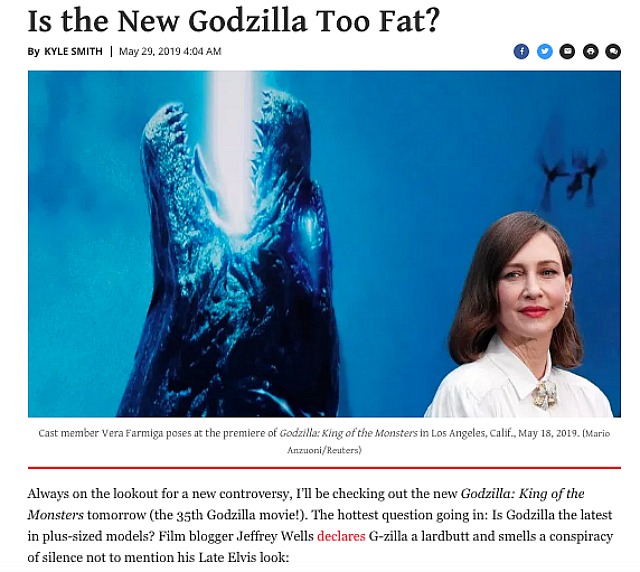
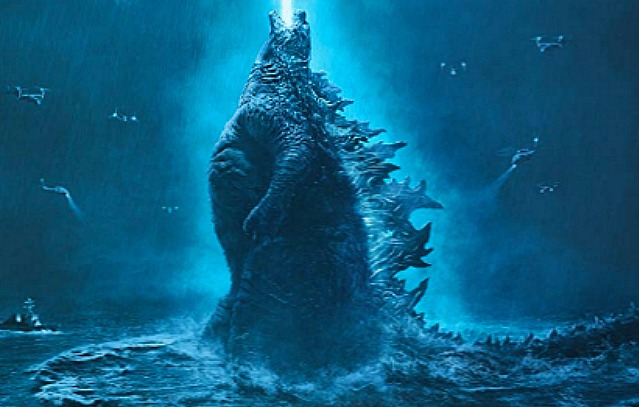
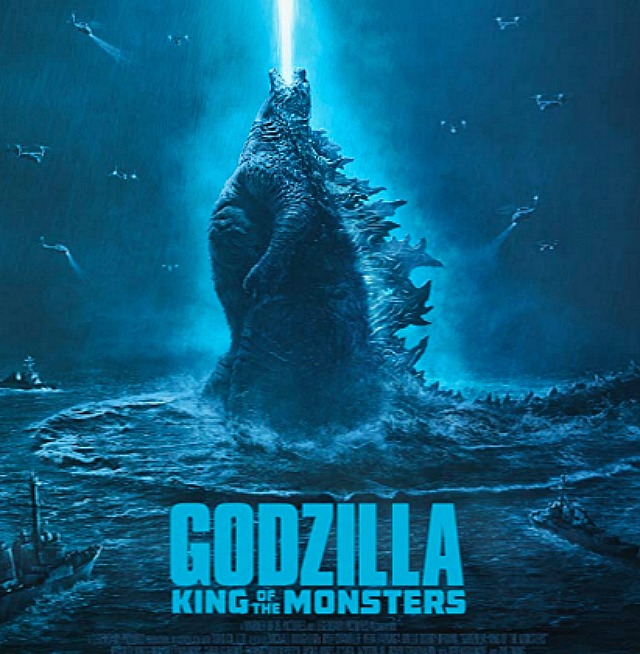
A couple of days ago I half-lamented and half-predicted that very few critics would have the balls to even mention the fact that the reptilian star of Godzilla: King of the Monsters is a big-bellied, roly-poly fella.
The reason, I explained, is that in today’s French terror culture noting that this or that character is corpulent would be immediately suspected as a form of fat-shaming, which these days is regarded in the same light as racism or homophobia. So the safe thing, Godzilla-wise, is to keep quiet lest you be carted off to the Place d’Concorde.
I’ve just spent a couple of arduous hours sifting through 20 or 25 reviews of Godzilla: King of the Monsters, and can report that almost everyone has indeed sidestepped the Fatzilla factor.
Only two critics have exhibited cast-iron cojones in this regard — Variety‘s Owen Gleiberman and N.Y. Times critic Glenn Kenny.
Gleiberman: “Is it my imagination, or does it look like Godzilla has been hitting the dessert cart? I’m not merely speaking about his distended belly. The creature has been designed so that his head and neck, which used to resemble the top of the letter f, now sort of melt right into his torso. As a result, his face no longer pops in the same vivid anthropomorphic way. And that’s a miscalculation. If Godzilla looks a little chunkier than before, so be it, but you don’t want to watch a Godzilla movie thinking that his personality is slightly out of focus — that he’s not quite the same dude.”
Kenny: “As in the 2014 film, this Godzilla is a stouter fellow than we have seen in previous incarnations. While underwater, he resembles a giant electric eel with bourbon bloat.”
National Review critic Kyle Smith seemed to indicate agreement or at least amusement when he riffed early this morning about my Fatzilla thing.
Toronto Globe and Mail critic Barry Hertz seemingly went in the opposite direction, proclaiming that “the creature design is superb.”
The following critics have bypassed the obvious (i.e., chickened out): Time Out‘s Josh Rothkopf, TheWrap‘s Alonso Duralde, CNN’s Brian Lowry, the Empire guy, the Uproxx guy, the South China Morning Post‘s James Mottram.
Even N.Y. Post critic Johnny Oleksinki, who normally just blurts out whatever he’s thinking, played it carefully this time.