Nobody Else Turns Me On

I’ve posted five or six riffs about how Beto O’Rourke has to run against Donald Trump in 2020 — no ifs, ands or buts. An 11.11 Hill piece by Amie Parnes (“Beto 2020 Calls Multiply Among Dems“) stirred the pot a bit. Last Tuesday a similar piece by Politico‘s David Siders had a snap-crackle-pop effect.

“The prospect of a presidential bid by O’Rourke, whose charismatic Senate candidacy captured the party’s imagination, has suddenly rewired the race,” he wrote. “O’Rourke — who raised a stunning $38 million in the third quarter of his race — is widely considered capable of raising millions of dollars quickly, according to interviews with multiple Democratic money bundlers and strategists, catapulting him into the upper echelons of the 2020 campaign.”

The implication of the Siders piece is that O’Rourke will need to pull the trigger by early ’19, certainly by March or April if not before.

Excerpt: “Mikal Watts, a San Antonio-based lawyer and major Democratic money bundler, said several donors and political operatives in Iowa, after hearing from other potential candidates in recent days, have called to ask whether O’Rourke is running, a sign of his impact in the first-in-the-nation caucus state.

“They’re not wanting to sign on to other presidential campaigns until they know whether Beto is going,” Watts said. “And if Beto is running, what good progressive Democrat wouldn’t want to work for Beto O’Rourke?”

Once again, O’Rourke will beat Trump because (a) he’s a blend of Barack Obama, Bobby Kennedy and Bill McKay, and will enlist the enthusiasm of younger voters, (b) he’s 16 or 17 times smarter and more knowledgable than Trump, not to mention more eloquent and principled, (c) is 26 years younger than Trump, (d) at 6′ 4″, he’s roughly two inches taller (and the taller candidate almost always wins), not to mention a lot thinner, (e) he skateboards and (f) played in a band in the ’90s. A changing of the generational guard — sold.

How Degraded Thou Art

Late November is a good time to catch films in cinemas, of course, but otherwise the megaplex experience is generally a must-to-avoid, or at the very least a touch-and-go thing. Mainstream movies have been declining for many decades, and always because of stupid audiences.

In the early ’50s Manny Faber wrote an influential essay called “Blame the Audience,” although if you consider what was playing in Manhattan in the late summer of 1953 it’s hard to understand what he was on about.

In 1964, Pauline Kael asked “Are the Movies Going to Pieces?” in The Atlantic Monthly, claiming that “the younger generation’s embrace of crudely made films and the intelligentsia’s fondness for intentionally confusing ones was responsible for Hollywood’s decline.”

On 1.21.72, right in the middle of the grandest, funkiest and most fabled era of auteurist glory, Dick Cavett asked four directorsRobert Altman, Mel Brooks, Peter Bogdanovich and Frank Capraif Hollywood was dead. He didn’t mean L.A.-centric filmmaking but the big-studio system that reigned from the ’20s through the ’50s. He was also observing that corporations and corporate-think had taken over from old-school moguls like Harry Cohn, Daryl F. Zanuck and Louis B. Mayer.

On 6.23.80 Kael published her famous New Yorker broadside — “Why Are Movies So Bad or, The Numbers” — about the increasing corporate influence upon Hollywood filmmaking culture.

I first began to sense the onset of megaplex theme-park cinema and the general loss of the spiritual in the early ’90s…a general feeling of alienation from the concept of theatres-as-churches and a gradual slide into the swamp.

12 and a half years ago I wrote that “movies are a religion and, whether some of you get this or not, going to see the best movies is the same thing as going to church and, in a manner of speaking, taking Holy Communion. They’re about values (philosophical or otherwise) and emotion and contemplation and quality of life. Even the shallowest people out there understand that the best movies contain and in fact propel notions of spirit and emotion and transcendental recognition.”

Movies are doing well enough in some respects (via this and that format), but that communal, church-like atmosphere in theatres…when was the last time you felt it?

I honestly wonder if deep-soul qualities in films (i.e., the kind of thing you can sense in abundance from Alfonso Cuaron‘s Roma) are of any importance to the New Academy Kidz, the p.c. militants, the representation and identity-politics crowd.

On 7.17.06 I wrote that “some may see going to a just-opened movie as a kind of cathartic Southern Baptist service (talking back to the screen, letting it all out, etc.), but most people probably see movies as a kind of sporting event or mass video game or amusement ride.

Read more

Kael vs. Eastwood

Clint Eastwood made his bones in the ’60s and ’70s with brutal, emotion-less dispensations of violence — by projecting a capability and willingness to drill the bad guys between the eyes without blinking an eye and certainly without giving it much thought. He wasn’t as much two-fisted as big-gunned, and he sure as hell blam-blammed a whole lot of guys during his “Man With No Name” meets Dirty Harry heyday, and with rightwing justifications, of course. “You fuck with me, you’ll pay the price.”

He was never anyone’s idea of a great or highly skilled actor, but he always knew how to deliver that silent, steaming-radiator thing and was certainly effective within his range. I think his Unforgiven performance (i.e., the snarly Bill Munny) was actually pretty close to great, partly because of (a) “helluva thing, killin’ a man,” “(b) “we all got it comin’, kid” and (c) how that final shoot-out scene draws upon our collective memory of the snarly guy he was in the Nixon, Ford and Carter eras.

But when we think of Eastwood we mainly sink into a soothing impression that took hold in the early to mid ’90s, which was when he suddenly became this exalted, almost mythical-level actor and director — one on hand with his aging, guilt-ridden secret service agent in Wolfgang Petersen‘s In The Line of Fire (’93) and on the other as the director who delivered the one-two punch of Unforgiven (’93) and The Bridges of Madison County (’95).

And at the same time his reputation as a likable, laid-back, salty-haired guy who always shot films fast and unfussy and who occasionally described himself as an Eisenhower Republican…all of that sunk in too. Even his briefly warming to Sarah Palin + talking to the empty chair thing…even that didn’t dispel the genial vibe.

And here we are on the 2018 home stretch and still no word of any Mule screenings, which reenforces suspicions that it’s probably nothing too special, even with Eastwood giving what may be his last performance…who knows?

Van Helsing and the Stake

The idea of driving a stake through the heart of a filmmaker is a bit extreme. I do, however, understand a brief impulse (i.e., flirted with but not acted upon) to inflict pain upon a director or producer for having made what you may feel is a bad or hateful or hard-to-sit-through film. I definitely felt this way about James Wan after sitting through Furious 7.

From page 28 of “Conversations with Pauline Kael“:

I Want To Be Free

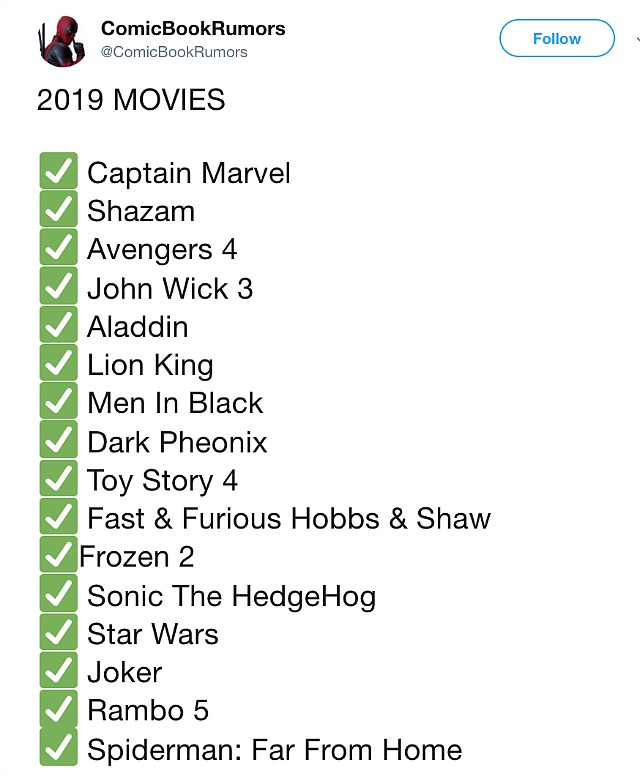
18 years and 2 months after the debut of Nancy MeyersWhat Women Want, in which the rakish Mel Gibson discovered an ability to divine what women are thinking, comes Adam Shankman‘s officially sanctioned. gender-reversed remake. In a rough facsimile of the Gibson role, Taraji P. Henson is a struggling businesswoman, coping with corporate sexism and the usual hindrances to advancement, imbued with an ability to hear what men are thinking. Is this a movie for dudes? Just asking. It feels broad.

“Congenial Is The Word”

Over the last few weeks I somehow managed to miss three Manhattan press screenings of Jon S. Baird‘s Stan & Ollie. I have another one late Monday afternoon, and I’m determined to attend this time. This trailer underlines what all the critics have been saying, which is that the performances by Steve Coogan and John C. Reilly are worth the price.

Sony Pictures Classics will open Stan & Ollie on 12.28 in New York and Los Angeles.

“By the time of the touching conclusion, one has come to like and care about these sweet old guys a good deal. Everything the film has to offer is obvious and on the surface, its pleasures simple and sincere under the attentive guidance of director Jon S. Baird; these good men have their differences but well understand that whatever they might have accomplished individually would never have remotely equaled what they were able to do together. This is clear from the fact that, after Hardy’s death, Laurel never acted again despite many offers, even if he did continue to write.” — from Todd McCarthy’s 10.21 Hollywood Reporter review.

Who Today Is At Least Trying To Write on Chayefsky’s Level?

Diana Rigg: If you love me, I don’t see what other choice you have.
George C. Scott: What do you mean, ‘if I love you’? I raped you in a suicidal rage. Where did you get love and children all of a sudden?
Rigg: I think I should know if a man loves me or not. You must have told me a hundred times last night. You murmured it, shouted it. One time you opened a window and bellowed it out into the street.
Scott: Well, I think those were more expressions of gratitude than love.
Rigg: Gratitude for what?
Scott: Well, my God, for resurrecting feelings of life in me I thought dead!
Rigg: Well, my God, what do you think love is?
Scott: All right, I love you! And you love me. I’m not about to argue with so relentless a romantic.

Read more