Toasting Used To Matter

I smoked cigarettes from the time I was 14 or 15 until 26 or thereabouts. Then I more or less “quit”, which means I would quit and feel great and then return to the fucking things and then quit again, etc. This went on for another decade or so with the relapse periods lasting a couple of weeks to a couple of months. I would always lapse in Europe because it’s different over there. I used to be into Davidoffs or Galouises when I was on French soil. I would love smoking the first two or three, and then hate myself as I finished off the pack.

I used to smoke all kinds of brands when I was in high school — Camels, Chesterfields, Lucky Strike, Parliament, Benson & Hedges.

Some Italian guy whose last name ended in a vowel (and who wore pegged pants, pointed shoes and a Brylcream pompadour) taught me to toast them when I was in junior high, and I totally bought into the idea that this improved their taste. It made sense — I was baking or double-browning the shredded tobacco leaves, and so they would naturally deliver more flavor in the same way that marshmallows taste better when you hold them over a campfire or Pepperidge Farm sandwich bread tastes better when you pop it into a toaster.

He’s Just Not That Into You

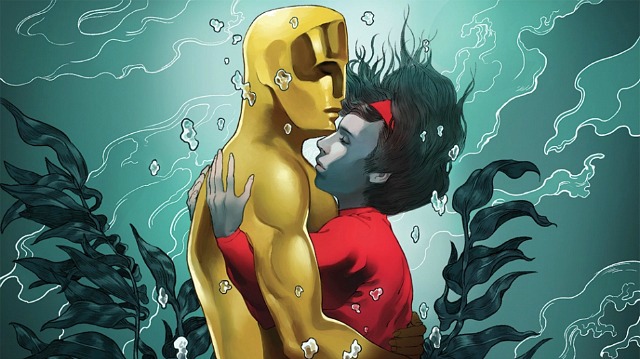
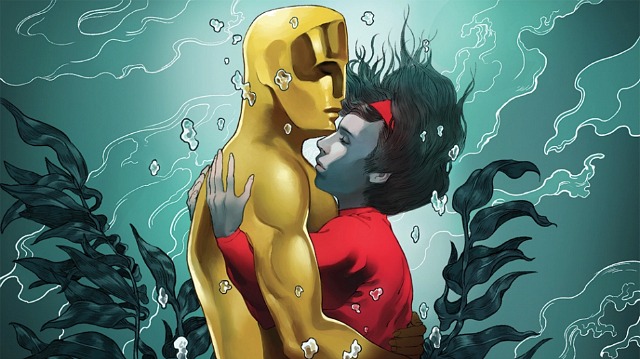
I feel kinda “meh” about the latest (final?) Oscar handicap piece by Variety‘s Kris Tapley, but the illustration art by “Naki” (aka Ha Gyung Lee) is fascinating.

Sally Hawkins is obviously ready for a little aquatic hunka-chunka with the Oscar statuette, but look at his stiff posture. He’s clearly feeling conflicted. His eyes are closed but he’s apparently saying to himself, “What have I gotten myself into?” Why isn’t he embracing Hawkins wholeheartedly? His left hand is weakly touching her back, but otherwise his body posture screams standoffishness. The position of his arms say “maybe she’ll stop if I just stand here and I don’t express anything that could be seen as warm or erotic?”

We all know that Oscar’s arms are traditionally folded as he clasps an upside-down sword, but Naki could have gone anywhere with this. She could have shown Oscar giving Hawkins a sexy bear hug or kissing her on the lips, or caressing her hair with his left hand while his right hand strokes her neck. Instead she portrayed him as respectful but passive — a good friend or a son, but not a lover.

My pet theory is that Naki isn’t that much of a fan of The Shape of Water, and that she held back on the romantic frisson as a result. Good artists always reveal themselves in their work.

No Gloating

Five and a half months ago MCN’s David Poland assessed what appeared to be the Best Picture contenders of the moment. And then I assessed Poland’s assessment (“Poland’s Rightos & Wrongos”).

We both saw Three Billboards as a likely nominee (although I mainly saw it as an acting vehicle) but we were both wrong on the Best Picture chances of Get Out. And neither of us foresaw that The Post would be shut down by the Academy’s newer, younger voting bloc (representation, identity-politics, “let’s give somebody else a chance”) because it seemed too boomerish and traditionally Oscar-baity.

Poland asserted that Aaron Sorkin‘s Molly’s Game had a “legit” Best Picture shot, but I said no way. He also said that Guillermo del Toro‘s The Shape of Water had a “good chance” of being Best Picture-nominated. I said I loved the Sally Hawkins Johnny Belinda factor (i.e., giving a silent performance) but noted that others have called it under-written with too many plot holes. And I was much more enthusiastic about Lady Bird.

Just re-read this (Poland’s spitball picks vs. my reactions) and consider the perception gaps:

Poland claims that “only two movies came out of North American premieres at TIFF with legit Best Picture hopes” — Aaron Sorkin‘s Molly’s Game and Martin McDonagh‘s Three Billboards Outside Ebbing, Missouri. HE response: It would be great if Three Billboards makes the grade but Poland knows it’s primarily an acting nomination platform for Frances McDormand (Best Actress) and Sam Rockwell (Best Supporting Actor). The chilly, hyper-aggressive Molly’s Game has its moments (i.e., Idris Elba‘s climactic rebuttal to prosecutors, Jessica Chastain and Kevin Costner on the park bench) but it hasn’t a prayer of being BP nominated…forget it.

Poland’s biggest wrongo is declaring that Luca Guadagnino‘s Call Me By Your Name has a “punching chance” of being a Best Picture contender. This rapturously received, Eric Rohmer-esque love story has a good to excellent chance — trust me. Everyone I talked to in Toronto called it a triple or a home run. Okay, it might fall short if the guilds and the Academy membership decide to vote against that sun-dappled, lullingly sensual, Rohmer-ish aesthetic or if they don’t want to go gay two years in a row or if it’s regarded as too Italian or some other chickenshit beef.

Two Poland-approved locks: Darkest Hour, Dunkirk. HE response: Dunkirk, absolutely. Darkest Hour is a stirring historical drama and nicely composed as far it goes (HE is a longtime Joe Wright fan), but it could have been released in 1987. It’s a Best Picture contender for 50-and-over squares and sentimentalists. Which doesn’t mean it won’t be nominated — it’s just a mezzo-mezzo contender.

Read more

Bernardin Is Mostly Right

For his debut Hollywood Reporter column (2.27), Marc Bernadin (Fatman on Batman) explains that a key reason for the huge successes of Black Panther, Wonder Woman, Get Out and Girls’ Trip is that their respective directors — Ryan Coogler, Patti Jenkins, Jordan Peele and Malcolm Leeknew the subjects and themes like the backs of their hands, and therefore delivered currents that audiences recognized as real-deal.

In other words, diversity, identification and representation were dominant factors. When will white-ass studio chiefs recognize that these films have connected for this reason? And when will they stop calling these successes “anomalies”? That’s the question, says Bernardin.

The final paragraph delivers a nice summary: “What audiences are responding to, in every movie that’s popped in the past year, is a sense of truth. Just as we can tell, somehow, when CG is spackled on a little too heavily, we can sense when something feels inauthentic. We can tell the difference between 12 Years a Slave and Amistad, between The Joy Luck Club and The Last Samurai, between Selma and Mississippi Burning. One of them feels true — and truth, ultimately, is what makes something universal.”

Whoa, hold on, nope…Bernardin is wrong about Ava DuVernay‘s Selma (’14) vs. Alan Parker‘s Mississippi Burning (’88). Sorry, brah.

Is DuVernay’s film a more accurate history lesson? Is it more organically truthful? Did it deliver an identity current that translated into a better-than-decent domestic haul of $52,076,908? Yes to all, but Mississippi Burning is a better film despite all the bullshit it sold. (And let’s not forget that Selma sold some bullshit of its own.)

The key thing is that Mississippi Burning delivered an emotionally satisfying payoff that audiences bought into, and which resulted in earnings of $86 million if you adjust for inflation.

Here’s how I put it on 11.29.14: “Alan Parker‘s Mississippi Burning gets an awful lot wrong about the way things really were in Mississippi in 1964. African Americans did a lot more than sing hymns and watch their churches burn, and we all know that Parker and screenwriter Chris Gerolmo mangled the history of the FBI’s hunt for the killers of three Civil Rights workers (Michael Schwerner, James Chaney and Andrew Goodman).

“Their coup de grace was having a pair of FBI agents, played by Gene Hackman and Willem Dafoe, turn into Dirty Harry-style vigilantes in Act Three, bringing the guilty yokels to justice by playing rough games and faking them out. Pauline Kael called it ‘a Charles Bronson movie.’

“And I’ve never cared that much. Very few have, I suspect. I’ve always had a soft spot for Mississippi Burning for various reasons — the polish of it, Hackman’s performance (particularly his scenes with Frances McDormand), Peter Biziou‘s cinematography, Gerry Hambling‘s editing, the percussive rumble of Trevor Jones‘ music, da coolness. But especially Parker and Gerolmo’s bullshit plot. Because the lies they came up with are emotionally comfortable, and that’s always the bottom line.

“I agree with Gore Vidal‘s old line that ‘the ends never justify the means because there are no ends, only means’, and yet it feels very fulfilling to see vigilante tactics used against racist murderers. Especially after watching Hackman and Dafoe go through weeks of fruitless investigating while the guilty crackers smirk and drink cream soda and chew tobacco.

“If audiences feel that a film is delivering real emotional justice, they’ll always tolerate mistakes and oversights. Even lies. That’s what happened here.

“The above clip of Hackman and McDormand exchanging silent words or more precisely of McDormand passing along important new information is one of the best scenes Parker ever shot. There’s nothing in Selma that even begins to approach the brilliance of this scene.”

Oh, Sparrows!

I’m told there were “lots of walk outs” during Monday night’s Red Sparrow premiere at Manhattan’s Lincoln Center. Alice Tully Hall was packed when the film started, less so when the lights came up. One patron overheard while exiting: “Disgusting.” The guy who tipped me says “maybe Russia should have hacked the screenplay.”

All this means, of course, is that older, wealthier folks (younger, poorer types don’t attend posh movie premieres as a rule) are finding Red Sparrow a bit harsh, which was pretty much my reaction.


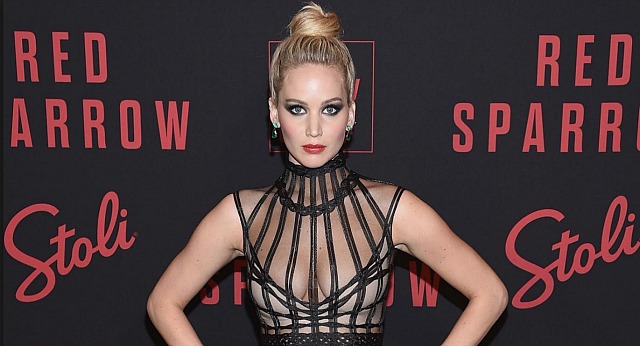
Jennifer Lawrence before Monday night’s Lincoln Center premiere of Red Sparrow.

From 2.16 HE review: “This is not, to put it mildly, a double-agent film with the finesse and subtlety of, say, Martin Ritt‘s The Spy Who Came In From The Cold (’65), which was regarded as a rather cold-hearted piece when it opened a half-century ago.

“The focus on cruelty in Red Sparrow makes that John Le Carre adaptation seem rather mild in this regard. At every turn Sparrow says ‘try a little heartlessness.’

Red Sparrow is more in the realm of Atomic Blonde, the period (late ’80s) spy film with Charlize Theron, minus the gymnastics. It’s an aggressively sexual thing, I mean, but is mainly about all kinds of physical brutality, including a pair of attempted rapes and two especially savage beating-and-torture scenes that would, in the real world, result in God-knows-how-many-weeks in a hospital.”

Yes, No & Maybe

Looming Tower (Hulu, 2.28) costars Jeff Daniels and Peter Sarsgaard were asked by Meet The Press‘s Chuck Todd about whether they’d work with Woody Allen again. Allen defenders can repeat the same facts and talking points over and over but “will you work with him again?” has become a meme, which in itself tells you that the Farrows are totally controlling the narrative. Anyway…

Daniels responded creatively by splitting the difference. “It’s a difficult decision because of Purple Rose of Cairo,” Daniels said. “That movie will always be a great experience, a great movie for me, and he will always be a great American filmmaker. I got to work with him at the age of 30, and it changed my life. [That said] I believe Dylan Farrow. Would I do another one with Woody? The difficult decision would be to turn him down.”

Read more

Introducing HE:(plus)

Get ready for HE:(plus), a parallel paywall site that will augment Hollywood Elsewhere with extra material and new columns and whatnot. Seriously, no foolin’ — HE Plus will double the dramaquirk-factorangst excitement. Not for me, of course, but hopefully HE readers. It’ll launch sometime in April, certainly before May 1st. I think.

I’m jazzed for the usual starting-a-new-enterprise reasons — it’ll be “fun”, a creative challenge, a dog bark, a splash, an attention-grabber. It’ll be $4.99 mønthly or $49 annually. I could charge less, I suppose, but that would be embarassing. The new material will easily be worth a lousy $1.25 per week…c’mon.

Classic Hollywood Elsewhere isn’t changing or downsizing or anything like that. Everything will stay exactly the same, and for free as always. I’ll continue to bang out four or five riffs, reviews and stories per day, like I’ve been doing since August ’04.

But I’ll also post two fresh articles on HE:(plus) each day plus generate material for some new columns on some kind of biweekly, haphazard, flying-fuck-at-a-rolling-donut basis.

I’m contemplating a biographical column called MISERABLE WANDERER Over Half The Globe (i.e., all the stuff I’d write about if I were to sit down and write a proper autobiography, which of course I’ll never do because of HE🙁plus). A Bluray/streaming column called DYING ART FORM. A relationship column called YOU BROKE MY HEART, a kind of bluesy, world-weary, suburban angst-meets-Miss Lonelyhearts type deal. And TALK’S CHEAP, a forum for HE podcasts. Maybe I’ll implement all of these or junk half of them or whatever. I’ll play it by ear as I go along.

HE’s own Jordan Ruimy will generate a new column, which we’ve tentatively agreed will be titled RUIMY WITH A VIEW. Partly reviews, partly trends or commentary, partly undisciplined musings and incomplete notions…whatever pops out.

A Manhattan-based guy is thinking about tapping out an anonymous smartass-potshot column.

HE’s Svetlana Cvetko has suggested a section that would throw a spotlight on the most promising Xfactor female directors currently pitching something or prepping a feature or currently showing a short on the festival circuit or whatever. (I know I’m supposed to avoid “female” but “woman” isn’t an adjective.)

And finally I’m thinking about a new Reddit-like, scattershot column called (a) IL FORO ROMANO or (b) HOLLYWOOD WELTSCHMERZ or maybe something else. It’ll be a kind of HE community bulletin board thing, and will be partly written or “fed” by any trusted friend and/or semi-professional acquaintance of Hollywood Elsewhere who has anything to say. I’ll allow these trustees to post directly without my input. They can post any damn thing as long as it’s not absurd or vulgar or pro-Trumpy or rancid or old-farty, and is reasonably well composed. If they spill ketchup on the tablecloth, they’ll be terminated…simple as that.

Read more

Everybody Wants One

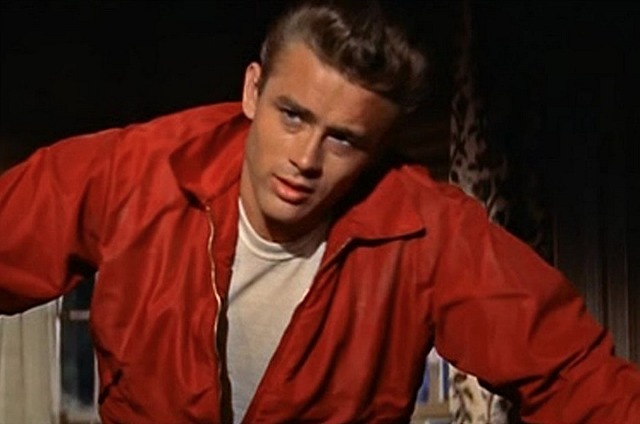
I’ve wanted to own a James Dean Rebel Without A Cause jacket all my life. My problem has been with the big collar. I don’t wear shirts with standard-issue collars — only banded collars (i.e., no collar at all). And I’ve said all along that I won’t wear a Dean jacket unless it has a similar thing going. Like the one below, a Labretta bomber jacket being sold out of England.

Has anyone ever owned one, and if so worn it with jeans and boots and a white T-shirt? Did you feel like you were wearing a Santa Claus outfit? Did anyone make a joke at your expense?

Read more

Steve McQueen Begs To Differ

From HE’s own Jordan Ruimy: “I feel like we have to somehow reinvent the idea of art itself. I’d say more than half of criticism now rates movies, TV and books on whether they properly cheerlead for women, gays, blacks, etc. or whether they’re ‘problematic’ for failing to do so in some way. That is really all cultural criticism is now.”

He’s saying (and I agree with this) that film criticism has become a “pass or fail” decision about whether a film in question says the right thing or the wrong thing according to the comintern and the Twitter commentariat.

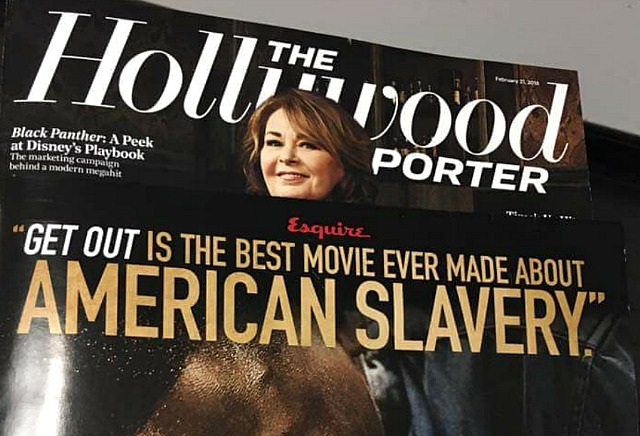
An example of a strong “pass” came nearly a year ago from Esquire critic Steven Thrasher, a reverent worshipper of Jordan Peele’s film if there ever was one.

Sample quote: “Peele doesn’t allow white liberals to view the theft of black bodies in a faraway frame of an Antebellum Southern plantation, nor to blame crude Trump supporters. Instead, Get Out blames the theft on contemporary, Northern white Obamaniacs. American liberalism, not just Trumpism, continues to make race by way of bodily theft.”

Really? This on top of “a film for the ages“? You have to hand it to Universal’s marketing team — they’re shameless, really going for broke.

Read more

All-Time Greatest Oscar Snafu…Loved It!

Obits for famous people are often written in advance, and you know that somewhere in the first two or three paragraphs of Warren Beatty‘s obit-in-waiting there’s a mention of The Great LaLa Land vs. Moonlight Oscar Envelope Screw-Up.

Nominated for 14 Academy Awards and winner of a Best Director Oscar for Reds. The co-auteur of Bonnie and Clyde and Bugsy, and the ruling creative force behind Shampoo, Bulworth, Dick Tracy and Heaven Can Wait. Teen heartthrob star of the early ’60s after his Splendor in the Grass debut. One of the greatest nookie kings in the history of Western Civilization. And — history will never forget — the guy who didn’t know quite what to do when he opened a Best Picture winner envelope that said “Emma Stone, LaLa Land,” and so he handed it to co-presenter Faye Dunaway.

The snafu wasn’t Beatty’s fault, of course, but in the hazy fog of public memory he’ll never be able to fully rid himself of this world-class embarassment. Fairly or unfairly he’s stuck with it. Ditto Dunaway, Oscar host Jimmy Kimmel and the infamous Brian Cullinan, the Price Waterhouse guy who gave Beatty the wrong envelope and will forever be wearing a scarlet tattoo (“T” for tweeter) on his forehead.

I’m recalling all this because of Scott Feinberg‘s “‘They Got the Wrong Envelope!’: The Oral History of Oscar’s Epic Best Picture Fiasco,” which appeared on the HollywoodReporter‘s site on 2.26 and is part of the 2.28 issue of The Hollywood Reporter magazine. Great reading, an epic saga, a “howtheydunnit” page-turner.

The piece represents only about 1/5 of what Feinberg gathered together with all the interviews and whatnot. It took him “months.” The initial draft was 31,000 words, and “a lot of juicy stuff” didn’t make the cut, I’m told. I see a book in this — maybe a 50,000 word coffee-table book with all kinds of great photos and sidebars and whatnot. Hell, it would make a great documentary — think of it!

Read more

All Over In Six Days

Out of 26 Gold Derby “experts”, eight (8) are betting on The Shape of Water winning the Best Picture Oscar — Deadline‘s Pete Hammond, Indiewire‘s Anne Thompson, EW‘s Sara Wilkommerson, Susan Wloszczyna, Jack Matthews, Andrea Mandell, Gold Derby‘s Joyce Eng, Variety‘s Tim Gray and Rotten TomatoesGrae Drake.

There are currently eleven (11) Three Billboards believers, which reflects the fact that Martin McDonagh‘s small-town drama has been gathering momentum over the past couple of weeks and especially since the BAFTAs — myself, Vulture‘s Kyle Buchanan, Awards Daily‘s Sasha Stone, Michael Musto, GD honcho Tom O’Neill, Bonnie Fuller, Fox’s Tariq Kahn, ESPN’s Adnan Virk, Rolling Stone‘s Peter Travers, USA Today‘s Brian Truitt and GD’s Thelma Adams.

And there are five (5) Get Out die-hards — The Tracking Board‘s Ed Douglas, Vanity Fair‘s Michael Hogan, Yahoo‘s Kevin Polowy, Fandango‘s Erik Davis and HuffPo‘s Matthew Jacobs.

All hail the character, backbone and general indifference-to-consensus of EW‘s Christopher Rosen, who is standing by Lady Bird. Of the four leading GD contenders, Greta Gerwig‘s period drama is far and away my favorite as well as the best.

Up In Smoke

In Ramin Bahrani‘s 99 Homes, Michael Shannon played a foreclosure shark who was showing financially struggling Andrew Garfield the ropes of the Florida real-estate game. You knew Garfield would rebel against Shannon’s cynicism at the end because that’s what guys do in films like this — they stand up and cleanse their souls at the end of Act Three. Bahrani’s Fahrenheit 451, an adaptation of Ray Bradbury’s 1953 novel about a dystopian society that burns books, feels like the same basic dynamic — Shannon the hardened cynic explaining the logistics and necessity of book-burning to the naive Michael B. Jordan. Costarring Sofia Boutella, Martin Donovan, Laura Harrier, Keir Dullea. The HBO pic pops sometime in the spring.