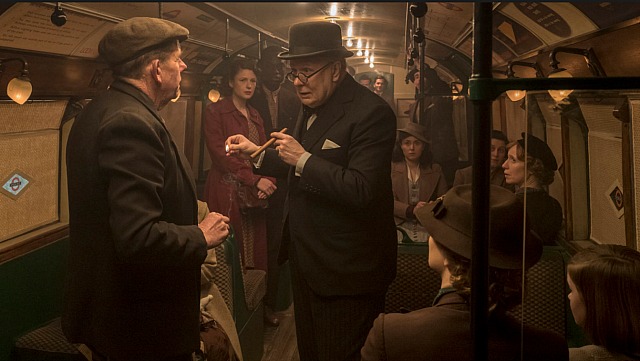
“Puppy Treat” Dogs in Berlin

Variety‘s Guy Lodge wouldn’t dare write a regular-guy, straight-from-the-shoulder, Hollywood Elsewhere-style review of Wes Anderson‘s Isle of Dogs. He’s too invested in presenting himself as elite, effete and eternally cutting-edge, and that means maintaining a constantly accommodating attitude toward cool-cat cinema, which of course includes all forms of animation.

Nonetheless, even with Lodge’s bending-over-backwards approach, the best he can offer in the way of an Isle of Dogs back-scratch is that it’s “puppy-treat cinema” with a “slender, precarious narrative…small, salty, perhaps not an entire meal, but rewarding nonetheless.”

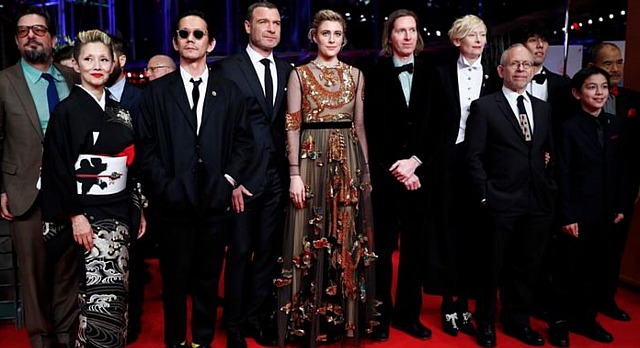
So this is why Fox Searchlight and IDPR’s Bebe Lerner decided to completely ignore my request to participate in a Berlinale junket for Isle of Dogs. (They had previously invited me to the 2014 Berlinale junket for Anderson’s Grand Budapest Hotel, and before that the London junket for Fantastic Mr. Fox.) They knew I was no fan of animation, fair enough, and that I’m not a fan of Japanese culture in general. They also knew they had a marginal film on their hands, and that they had to restrict themselves this time to hardcore animation devotees.

Lodge will forgive me, I’m sure, but he seems to be saying that Isle of Dogs is “rewarding” mainly for animation hipsters, for people who are inclined to feel rewarded going in. But that it’s a dicey proposition, perhaps, for Joe and Jane Popcorn.

I for one have always had a problem with the basic concept of Isle of Dogs because of the garbage. Who wants to hang with a bunch of dirty dogs who eat rotting garbage covered with white worms?

Isle of Dogs is really a film about its own enthusiasms: for four-legged fleabags of all shapes and sizes, of course, but also for the culture and cinema of Japan, which is woven with typical fastidiousness into Anderson’s magpie aesthetic,” Lodge writes. “That makes it a markedly more eccentric proposition than Anderson’s first feature-length foray into stop-motion, 2009’s Fantastic Mr. Fox — and with a PG-13 rating for its dry adult comedy, mostly played in a limbo-low key, a niche commercial prospect too.


Read more

“We Are Here For You”?

Just for the record, Hollywood Elsewhere is calling President Donald Trump a repulsive, sentiment-exploiting, NRA-embracing, side-stepping piece of slime…no offense. Trump: “We are here for you….whatever we can do”? “Let us pray for healing and for peace…God’s word…I have heard your prayers, I have seen your tears, I will heal you”…you make me want to vomit. “Family, faith, community and country…a culture in our country that embrqces the dignity of life”? “Assist in any way we can”?

Nikolas Cruz legally bought an AR-15 assault weapon when he was 18, but he wasn’t able to buy a handgun because he wasn’t 21 — that’s the law.

Read more

Hollywood Degradation

Yes, we know — winning an Oscar is about class, honor, pride, accomplishment. Or at least the illusion of same. About notching a moment in history and saying “Yes, I did that” or “I was a part of that, and therefore my life has a measure of value and meaning.” This kind of thing means more to serious filmmakers than, say, costarring in the latest Dwayne Johnson movie and saying “whoa, people really paid a lot of money to see this piece of shit!” Because one day they’ll be dead, and they can’t take it with them.

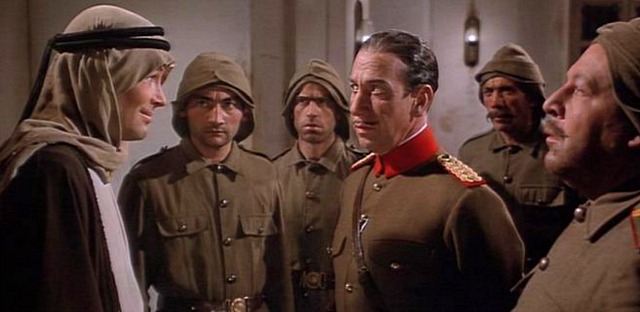
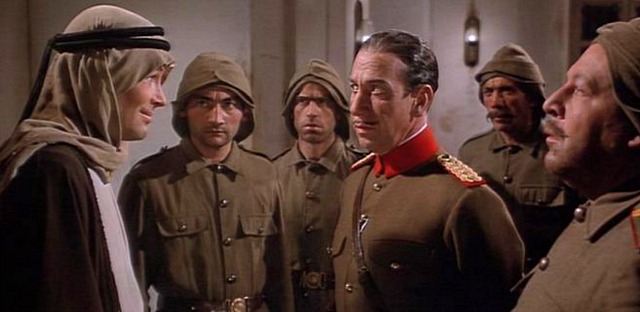
In David Lean‘s Lawrence of Arabia, Jose Ferrer portrays a Turkish Bey who feels alone and isolated in the remote city of Daraa. At one point Ferrer looks sadly at the stupid Turkish solders under his command and sighs to Peter O’Toole‘s Lawrence, “I am surrounded by cattle.”


Peter O’Toole and Jose Ferrer during the Daraa garrison scene in Lawrence of Arabia.

Today Hollywood Elsewhere readers can say the same thing with even greater conviction and melancholy. Who among them would argue that they’re not surrounded by tens of millions of primitives whose ADD appetites are incapable of processing anything outside the fantasy escapist woo-woo realm, at least as far as theatrical viewings are concerned?

Chris Nolan‘s Dunkirk, a Best Picture nominee, was the best-reviewed, the artiest, the most visually distinguished and thoroughly believable action-driven film of 2017. So far Dunkirk has made a fair amount of coin — $188,045,546, which is $12 million more than the $176 million earned domestically by Get Out, another Best Picture nominee.

But the megaplex morons paid much more to see Star Wars: The Last Jedi ($617,116,708), Beauty and the Beast ($504,014,165), Wonder Woman ($412,563,408), Guardians of the Galaxy, Vol. 2 ($389,813,101), Jumanji: Welcome to the Jungle ($367,410,756), Spider-Man: Homecoming ($334,201,140), It ($327,481,748), Thor: Ragnarok ($314,352,974), Despicable Me 3 ($264,624,300), Justice League($228,585,922), Logan ($226,277,068), The Fate of the Furious ($226,008,385) and Coco ($206,323,103).

Read more

Latest School Slaughter

Multiple fatalities have been reported following a shooting at a high school in Parkland, Florida — about an hour northwest of Miami. Broward County sheriff’s office has written on Twitter that the shooter is now in custody.

Senator Chris Murphy (paraphrased): “This is 2018’s 18th school shooting, and we haven’t even hit March. This happens nowhere else except in the U.S. of A. This epidemic of mass slaughter, this scourge of school shooting after school shooting…we are responsible for a level of mass atrocity that happens in this country with zero parallel anywhere else.”

Read more

Better Glimpsed Than Seen

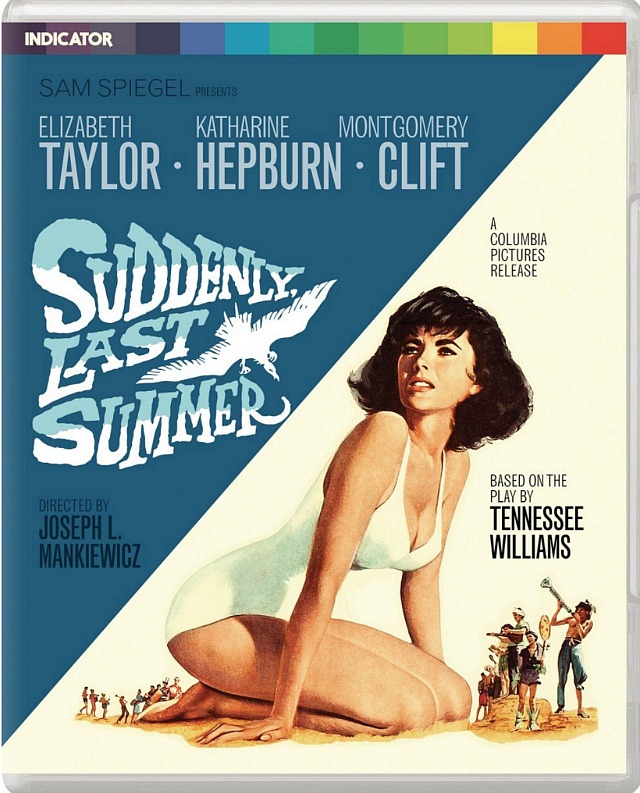
Joseph Mankiewicz‘s Suddenly Last Summer is good for one thing — the stills of 27 year-old Elizabeth Taylor that were taken during filming. She was still slender back then, or a couple of years away from that Cleopatra-era plumpness (heavy drinking + pasta) that began to overtake her features in ’61. Taylor was always a well-respected actress (Giant, Cat on a Hot Tin Roof, Butterfield 8), but she always seemed to be conspicuously “acting.” I always found her voice shrill and grating on some level, especially when called upon to show anger or outrage and emotional distress. But from the early to late ’50s she was quite the visual package.

Suddenly Last Summer ends with a shocking revelation about Taylor’s mentally unstable character having witnessed her gay cousin, Sebastian Venable, being eaten alive — cannibalized — by a pack of feral young boys.

The bizarre finale was obviously intended as some kind of metaphorical condemnation of gay sexuality. Sebastian’s rich mother (Katharine Hepburn) is so appalled and disgusted by suspicions of Sebastian’s lifestyle that she wants Taylor lobotomized in order to suppress any notion that the cannibal incident happened. It’s quite ugly and joyless, this film. Rage, repression, self-loathing.

From Wikipage: “Following A Streetcar Named Desire (’51) and Cat on a Hot Tin Roof (’58), Suddenly, Last Summer was the third Williams film that dealt with the subject of homosexuality, although it was far more explicit in its treatment than either of the previous films were allowed to be under the Motion Picture Production Code. Working in conjunction with the National Legion of Decency, the Production Code Administration gave the filmmakers special dispensation to depict Sebastian Venable, declaring, ‘Since the film illustrates the horrors of such a lifestyle, it can be considered moral in theme even though it deals with sexual perversion.”

Read more

Marquee Desperation

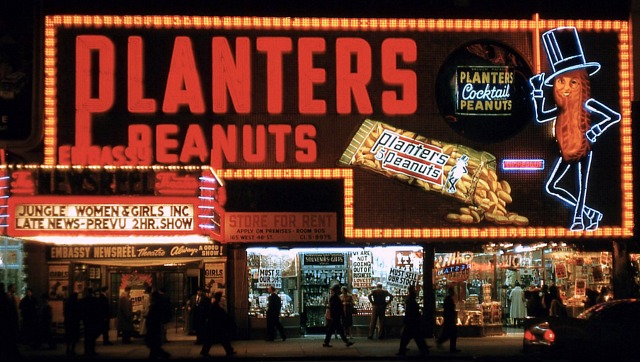
I’ve been searching for decent shots of pre-1965 Times Square marquees for several years now, and the pickings are getting thinner and thinner. The best of this group is a reposting of the Spellbound-premiere-at-the-Astor shot, which was taken on 10.31.45. I just called Larry Edmunds Hollywood Bookshop to see if they had any large coffee-table books devoted to old marquees, and the guy said “naahh, not really.” Obviously the Google well is running dry. I’ve probably posted 60 or 70 shots over the years. If anyone can point me to a fresh supply…

Read more

Takes All Sorts

Indiewire‘s Anne Thompson has questioned an Academy-member friend (i.e., an older liberal-minded white woman) about her Oscar preferences. She’s not that bright or hip, this woman, but she likes what she likes. For those who weren’t paying attention six or seven weeks ago, here are two Hollywood Elsewhere interviews — #1 and #2 — along similar lines.

Quote #1: “I don’t really understand the preferential ballot. But I prefer it when there are fewer choices. If there are too many choices, it waters everything down. Plus there are rarely more than five movies I really like in a year (not including foreign films).”

Wells reaction: This woman sounds quite lazy. Too many Best Picture nominees dilutes the field? Every year I compile a list of 15 or 20 films that I’ve categorized as excellent, very good or at least commendable, and she rarely likes more than five? This is a woman who feels overwhelmed by life, and who likes to nap in the late afternoons.”

Quote #2: “I had an odd experience with Darkest Hour. I enjoyed it while I was watching it, but afterwards, when I found out the subway sequence was totally invented, it diminished the whole movie for me.”

Wells reaction: What difference does it make if a scene has been invented or not? If it works, it works. I am among those who feel that the subway scene, imagined as it is, is hands down the most rousing and emotionally affecting scene in Darkest Hour. Without question. This woman doesn’t have to agree with me, of course, but to say it didn’t work for her after she discovered it was made up? What an idiot.”

Read more

Understatement of the Year

From 2.12.19 post by cnn.com’s Brian Lowry, “Three Billboards Backlash Flows From Debate Over Its Message”:

Three Billboards is one of a handful of films perceived as having a legitimate shot at being named best picture — an unusually wide-open field, given that the focus by now has usually concentrated around two or three. Part of that likely has to do with (a) the absence of many truly great movies this year, and (b) the fact that key contenders — like The Shape of Water (the pick by the directors and producers guilds) and Get Out (the WGA’s original screenplay winner) — come from genres that seldom receive top awards recognition.”


Variety art by Jonathan Bartlett.

Did he just say “seldom”?

What Lowry meant is that fantasy flicks about aquatic creatures lusting after human females (i.e., 1954’s The Creature From The Black Lagoon) have never been regarded as Oscar fare in years past. Ditto dark social satires with horror-zombie undertones (i.e., 1956’s Invasion of the Body Snatchers).

Neither Get Out nor The Shape of Water would’ve even been considered as Best Picture contenders ten or even five years ago, much less favored to win. But now they are, thanks to the younger, fringe-y Academy members who’ve been ushered in over the last two or three years.

Read more

Geometric Logic

Posted on 10.23.11: “I’ve finally seen Sony Home Video’s Caine Mutiny Bluray and the best I can give it is a B. I don’t think it’s all that fabulous looking. It’s more vibrantly colored and offers more detail than the previous DVDs so yes, it’s an improvement. But for a film shot in three-strip Technicolor, it doesn’t have that natural glow and special richness that ought to be there. The color feels a bit grainy and “pushed,” and a little too blown-up looking at times. Too many pinkish or spray-tanned faces.

“And I honestly do feel, as I said a week or so ago, that the 1.85 masking diminishes the compositions. Many of the scenes feel somewhat hemmed in and pushed down, like they’re in some kind of jail. I say to hell with Universal and Columbia having decided to scam-crop their 1.37 movies down to 1.85 starting in 1953. Movies from that era don’t breathe at 1.85. The Caine Mutiny should have been masked off at 1.66. My eyes know what they know, and they know what’s right.”