Will Dormer vs. Fitful Sleep

For decades my sleep pattern was to get about six hours, midnight or 1 am to 6 or 7 am. Over the last couple of years I’ve taken a one-hour nap around 2 or 3 pm on the couch. But every now and then (i.e., usually when I’m really stressed about something) I’ll become a fitful sleeper, and that means a 3 or 3:30 or 4 am wake-up, which always results in (a) moving to the living room couch for a 90-to-120-minute Twitter session. (b) finally returning to sleep around 6 or 6:30 am, and (c) waking again at 9 or even 9:30 am.

Tatyana and Arianna Huffington say it’s better to get at least seven if not eight hours straight. While I recognize the soundness of that advice, I have this nonsensical, deep-down notion that overnight slumber is a little slice of death, and that if I sleep too much I’ll miss stuff, and that too much sleep is for losers — the horizontal equivalent of taking extra-long showers.

Last night was particularly bad. I fell asleep on the couch during the second hour of Dave Chappelle’s Netflix special, and then stumbled into the bedroom and tossed and turned for 90 minutes. And then, Tatyana tells me, I began snoring, which in my book is 100% unforgivable. (I told her this morning that “if this happens again, wake me up and kick me out of the bedroom…seriously.”) And then I woke up at 4 am and did the standard fitful — Twitter, back to sleep at 6:30 or 7 am, wake up at 9 or 9:30 am.

I go through periods, in other words, in which I am almost Al Pacino in Insomnia. But not quite.

Down With This

From “Dave Chappelle Stumbles Into The #MeToo Movement,” a 1.2.18 N.Y. Times review by Jason Zinoman:

“In ‘The Bird Revelation,’ Chappelle…leans on the gravitas of Martin Luther King to pivot from the pain caused by sexual misconduct. He criticizes the ‘brittle spirit’ of the female comic who said Louis C.K. masturbating in front of her hurt her career, before imagining what would happen if Louis C.K. masturbated in front of the civil rights leader, prompting him to give up his movement.

“When suggesting a handsome man wouldn’t be accused of assault and rape, he says that if Brad Pitt did what Harvey Weinstein did, the response would be different. (‘Girl would have been like: I got the part.’) But Mr. Chappelle is just rehashing a Chris Rock bit on sexual harassment from the 1990s (‘If Clarence Thomas looked like Denzel Washington…’). It’s a joke that has not aged well, and this new version does not do Mr. Chappelle any favors.”

Hear Hear

“Going to the movies has become like a theme park. Studios making bad content in order to appeal to the masses and shareholders is like fracking — you get the best return right now but you wreck the earth. It’s ruining the viewing habits of the American population and then ultimately the rest of the world.” — Jodie Foster speaking two or three days ago to Radio Times magazine, as reported by the Daily Mail‘s Ross McDonagh.

Foster isn’t wrong, of course, but I’ve been using the term “theme-park cinema” since at least the late ’90s and possibly a bit earlier. I actually stopped using it a few years ago. I moved on to other disparaging terms.

Bam, Bam, Pop, Pop

Here’s to Gun Crazy star Peggy Cummins, who passed in London on 12.29 at age 92. Odd as this may sound, I never even saw Joseph H. Lewis and Dalton Trumbo‘s groundbreaking film until three years ago. Here’s a confessional that I wrote in this space:

“I was flipping through films on my new Roku player and came upon a high-def version on Warner Classics. I’d been told for decades that Gun Crazy was an essential noir that everyone loves, but I wasn’t expecting to be blown away.

“I was half-asleep when I started watching at 11:30 pm but I woke right up. It’s genius-level — a major groundbreaker, pulp art. Those long takes shot from the rear of John Dall and Peggy Cummins‘ moving car (particularly that legendary three-minute-long bank robbery sequence), the urgent sense of immediacy, that semi-improvised-sounding dialogue, those urgent close-ups, conflicted emotions, the sexuality, the fog-shrouded ending in the swamp…all of it.

“I hereby apologize to Lewis, Trumbo, Dall, Cummins and the whole team for missing this classic for so long.

Read more

Academy Member Shares Ballot Preferences

In years past The Hollywood Reporter‘s Scott Feinberg and others have run articles that quote opinions from this or that anonymous Academy member about Oscar contenders. But they never run them until the nominations have been announced in late January. Hollywood Elsewhere feels it’s more worthwhile to run these opinions now, while the nomination ballots are still being mulled over.

This morning I spoke to a director-writer with several reputable credits. I’ve re-ordered the sequence of some quotes, pruned and condensed some of them, and in some cases run them verbatim.

Best Picture: “Definitely Dunkirk. I think Dunkirk was an exceptional job of directing. I thought it was an amazing picture, a David Lean-level thing, a throwback to another time. Big Picture filming. For years younger generations have been saying ‘yeah, we’re used to watching these things on iPads’ but Nolan is saying ‘no, no, you’re missing the point…these are movies for the big screen…you’re missing the point.’ And those people who’ve been saying that [Dunkirk] wasn’t emotional enough? If you didn’t feel the emotion during that last swooping shot of Tom Hardy‘s plane out of gas and gliding over the beach…if you didn’t feel the emotion in that shot…c’mon.


Sam Rockwell, Best Supporting Actor contender in Three Billboards outside Ebbing, Missouri.

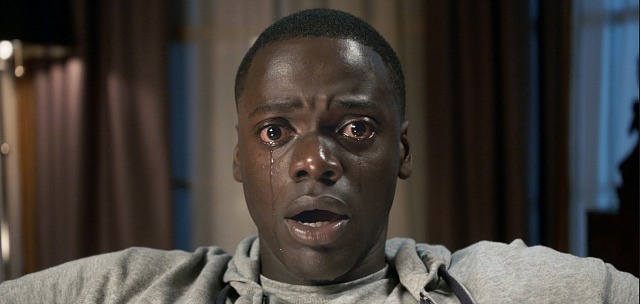
“I totally agree with you about Get Out. It’s a good movie, but it’s not a fucking great movie, c’mon! I wouldn’t be mad if it won a Best Screenplay Oscar, but it’s not a Best Picture! I have a daughter in the business [and] she loves it, thinks it’s a Best Picture [contender]. But if Get Out or The Post, which I don’t think is a very brave film…if these two win the big awards [the Academy] is going to be hurting itself because it’ll be all about politics. They’re going to devalue the Oscars [by turning awards-giving into] temporary, transitional political statements. They’re going to hurt themselves if the award choices are too political. They want to address #OscarsoWhite….okay, we get it, we get it.

Dunkirk, Lady Bird, Shape of Water, The Big Sick. Or Phantom Thread or Call Me By Your Name. These are real movies. They are about themselves, planting their own flag. The political thing might be a factor with Call Me By Your Name. Some are reacting to #OscarsSoStraight…it’s an agenda film. I think a lot of people would vote for it, for that reason.”

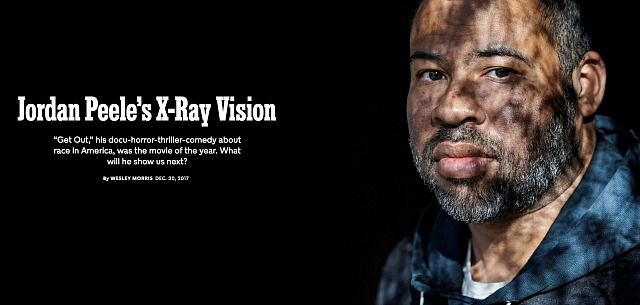
Best Director: “Again, Nolan. I have a lot of respect for [Get Out]’s Jordan Peele…he’s just not my idea of a Best Director nominee.. I also thought that Guillermo del Toro‘s work on The Shape of Water…it was like watching an old cobbler work…he purposely kept the creature work to a minimum….it made me feel like I was watching the story of the projectionist in Cinema Paradiso or, you know, the filmmaking in Amelie….it was like when I was a kid, falling in love with filmmaking.”

Best Actor: “I loved Gary Oldman in Darkest Hour. Oldman without a doubt. I thought he was just great, just great. Despite that London tube sequence when Churchill talks with the passengers, which I thought was one of the worst things…it totally ruined the movie for me. I couldn’t believe how badly that was done. Some say Oldman is ‘playing’ Churchill rather than channelling him. Well, how do you portray Churchill and not do that? I also really like the kid from Call My By Your Name. He reminds me of Saoirse Ronan in terms of ability and vulnerability.”

Read more

Subset of Mass Derangement

The flagrantly political instinct to over-praise and over-celebrate Get Outone of the most confounding and surreal episodes of mass derangement in any award season in memory — has caught fire among regional critics groups. Slightly less than a third of 33 regional critics groups have handed Jordan Peele‘s horror-satire their Best Picture prize.

The lemmings are leaping off the cliff, you bet, and for reasons that don’t really make sense to people who haven’t been affected by the “woke” virus, first and foremost being that Get Out is a popular, audience-rousing genre film that doesn’t begin to show exceptional chops or deliver “greatness” by any time-honored standard.

We’re talking about some kind of mind virus, propelled online and delivered through smartphones — a mass decision by younger Academy voters and the identity-politics crowd to radically up-end Best Picture criteria by supporting a film that no sane critic or prognosticator would have gotten behind ten or even five years ago.

“If you’re looking for more reasons to deplore the Get Out pack, the film was just named Best Picture, and Jordan Peele best director and screenwriter, by the North Carolina Film Critics Association, of which I am a member,” a friend just wrote me.

I am with you on the whole Get Out issue. A good film but not even close to being a great one, advanced by p.c. critics. As my grandmom would say, ‘Feh!'”

For sensible-minded regional critics, this reality-defying, Wayne Fontana and Mindbenders movement is partly about regional wokers wanting to demonstrate solidarity with big-city brethren (“We get it, guys…we’re with you in spirit”).

The Get Out-ers are massing under a political conviction that never enjoyed overwhelming currency during the Obama or Dubya administrations, but which, in today’s highly charged political climate (and especially within ardent liberal circles), is absolutely paramount in their eyes: Best Picture awards should no longer go to the best or boldest or most affecting artistic achievement but to films that (a) are most deserving of Hollywood’s political-social merit badge award, and (b) reflect favorably on the critics’ own progressive convictions.

As I wrote a couple of days ago, the “Get Out deserves to win Best Picture” thing is mainly about (a) extending the #OscarsSoWhite guilt complex by supporting a politically “woke” film, (b) industry POCs doing their usual identity-politics bonding and (c) GenX and Millenial coolios wanting to crown a horror-satire genre film for generational-solidarity reasons (“We’re the new crowd and we have different standards for Best Picture achievement!”) as well as sheer perversity’s sake, largely because Get Out doesn’t begin to exude Best Picture criteria.

Read more

Proust Questionnaire

Marcel Proust‘s answers to a series of questions about personality and values were originally recorded in 1890, when Proust was 21 or thereabouts. The Wikipage says the name and popularity of the Proust questionnaire is “owed to the responses given by Proust.” Vanity Fair publishes a one-page Proust Questionnaire at the back of each issue. (Why is “n” used twice in Questionnaire?) What follows is a selective HE run-through with variations.

Your greatest source of emotional comfort?: Being with my wife when she’s in a good mood. Walking around Rome or Paris or Hanoi without purpose. A warm, not-too-crowded cafe with lightning-fast wifi in the late afternoon. The way I feel after getting nine or ten hours of sleep, which happens maybe once a month, if that. The time I spend with my cats, Anya and Yanna, as I’m waking up from a nap.

Your proudest virtues?: Diligence, doggedness when it comes to writing. A general willingness to admit fault in many (though not all) instances. Excellent taste in clothing, particularly footwear, socks, jackets and T-shirts.

Your idea of perfect happiness?: There’s no “perfect” anything. Everything ebbs and flows. Impermanence is the only thing you can count on. It follows that the only perfect happiness one can hope to embrace is to constantly wander the globe with a flush guaranteed income and the freedom to visit here and there and then move on when the mood strikes. With the option of returning to favorite locales from time to time.

Source of your greatest irritation among mixed company?: Loud, vulgar people of all shapes and manners. People who throw their heads back and shriek with laughter in bars and cafes. People who lean their seats back too far in coach.

Which living persons do you most admire?: Presently speaking I admire hundreds of people. My list would change on a daily basis, starting today with Patti Smith. I admire adventurous and quick-witted people the most. I generally admire smart, considerate people who’ve been around the block and accomplished things under pressure, especially if they have a good sense of humor.

What dead persons would you most like to meet and hang with?: Stanley Kubrick, Cary Grant, Jesus of Nazareth, John Lennon, Honore de Balzac, Carole Lombard, Julius Caesar, Jim Morrison, Abraham Lincoln, Jimi Hendrix, Howard Hawks.

Your greatest regret? Allowing my anger at my father to determine the course of my life for too many years. Not getting my life into gear sooner. Not being a better father with my younger son, Dylan. Stupidly and fearfully beating the shell of a turtle with a piece of wood when I was five or six years old (I thought it was a snapping turtle that might bite my finger off).

If you were forced to choose exile to a single country with a reasonable guaranteed income…? Italy.

Read more

Beasts Are Worried

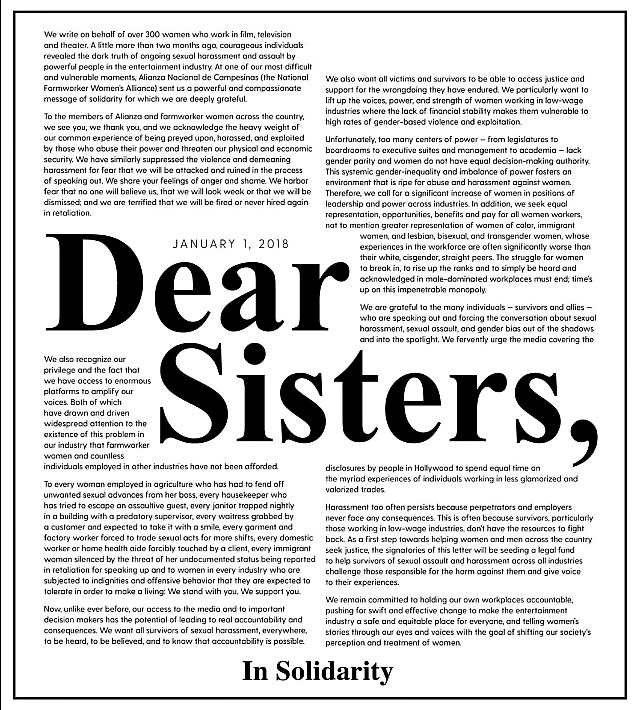
The just-announced Time’s Up initiative, supported by 300 prominent industry women and currently soliciting donations, is three things at once — a legal defense fund, a push for legislation to strengthen workplace harassment laws, and a renewed effort behind the “50/50 by 2020” push to discourage sexist hiring and promotion tendencies within the studios and talent agencies.

While the Hollywood boys club ethos is being challenged as we speak, there’s a 1.1.18 Guardian piece by Rory Carroll that feels even more persuasive in this regard.

Carroll quotes Peter Mehlman, an author and Seinfeld writer, as follows:

“The completely unjustifiable confidence that normally pervades this place is really shaken. You hear a lot of dinner conversation about where the lines are and what are the nuances of inter-office socializing. The saner, more decent people are asking questions like ‘Is that it for flirting?’ The dimmer, more entitled dinosaurs are saying ‘This business isn’t even fun any more.’

“This may be the most Pollyanna thing I’ve ever said, but I really think this is going to change things. A lot. It’s hard to imagine anyone in power sizing up a woman and saying ‘I’m all over her.’ Everyone’s getting conditioned to think twice, even the most predatory among us, or maybe especially the most predatory. I may be anthropomorphising here, but I really think the animals have no choice but to be civilized.”

The Poisoners

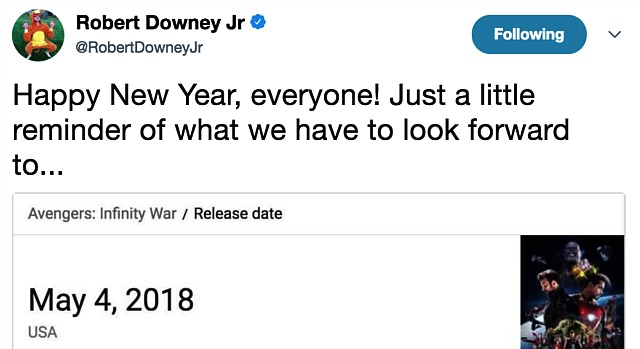
ForbesScott Mendelson and Robert Downey, Jr. appear to be two of a kind, at least in one respect. The first thing they’ve done on the very first day of a brand new year with a sense of hope and renewal in the air…the first thing these tools have done is shovel superhero product.

While I’ve been compiling a list of 2018 films that are likely to be pretty good or perhaps even award-worthy, Mendelson is continuing his tradition of forecasting the coming blockbusters. As he well knows, the majority of these 2018 films are sure to deliver profound corporate suffocation and indigestion, and in some cases head-hammering pain. But this is who Mendelson is — he lives for the next opportunity to inject CG serum into his veins. (That said, I’m still looking very much forward to Ant-Man and the Wasp.)

Downey, a Marvel shill and paycheck whore second to none, tweeted a reminder about the coming of Avengers: Infinity War on 5.4.18. (Part one, I mean — part two pops on 5.3.19.)

I was in a moderately good mood before these guys came along.

Missed It

For me, the editing of this Wolf of Wall Street YouTube clip is shattering because at the very end it truncates Jimmy Castor‘s “Hey Leroy” — it cuts right into this ineffably right 1966 tune right when the song is lifting Wolf into a groove-and-soothe mode. Leonardo DiCaprio‘s inspirational howling-alpha-male speech is the brick and mortar, and “Hey, LeRoy” is the combination quaalude and back-rub that follows. “Selling Steve Madden” is easily one the greatest scenes in the canon of 21st Century art-cinema. Historians will study it a thousand years hence, but will they get where Martin Scorsese was really coming from?

Read more