Streep Must Not Win

Posted within comment thread for “Smart Assesment, Subtle Denigrations,” an HE riff about Kris Tapley‘s Variety piece titled “Are you Ready For The Most Exciting Oscar Race in years?” piece: “If there’s one thing that Oscar race know-it-alls agree upon and with great passion, it’s that Streep, who will OF COURSE be nominated for playing Washington Post publisher Katharine Graham in Steven Spielberg‘s The Post, must be stopped at all costs. From winning, I mean.”

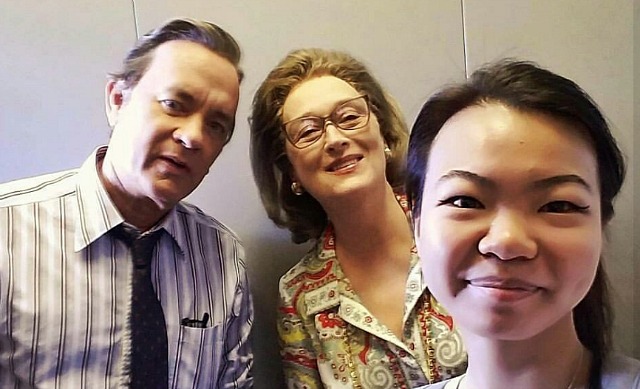
Over the last 30-plus years the feeling of Streep inevitability has always felt somewhat oppressive or at the very least irksome, but now she’s returning with a battalion of Sherman tanks on either flank. In the company of Spielberg, Tom Hanks, Sony Pictures and a big-deal, big-echo newspaper yarn that obviously reflects upon today’s pitched battle between Trump and the fact-beholden press, the Streep blitzkreig (which obviously hasn’t even begun yet) feels overwhelmingly favored, especially given her eloquent, unanimously well received speech about Trump that she delivered last January at the Golden Globe awards.

The culture, the fates and considerable industry heat will usher in a Streep nomination — we accept that, fine, no stopping it. And most of us are fine with Hanks being Best Actor nominated and perhaps even winning for portraying Ben Bradley, but Streep must not win….no! I don’t care how good she is in the film, and you know she will be.
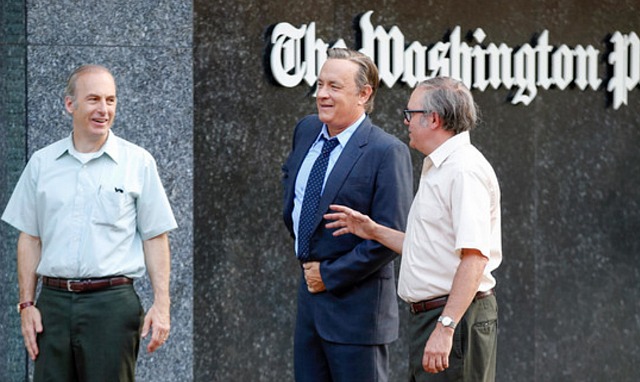
 

Tom Hanks as former Washington Post editor in chief Ben Bradley (center), Bob Odenkirk as former Washington Post editor Ben Bagdikin during filming of The Post.

Read more

Smart Assesment, Subtle Denigrations

Kris Tapley‘s latest award-season analysis piece (“Are You Ready for the Most Exciting Oscar Race in Years?“) appeared this morning. It’s mostly an accurate read. Especially if your definition of “accurate” is taking the pulse of your Gurus of Gold and Gold Derby go-alongers (i.e., the people who hold their moist fingers to the wind before deciding what they like or which film has the heat). How is Hollywood Elsewhere any different? I’m as aware as the next guy about which way the winds are blowing, but forecast-wise I go by insect antennae vibrations.

The four Best Picture biggies right now, Tapley is saying, are Dunkirk, The Shape of Water, Darkest Hour and Three Billboards Outside Ebbing, Missouri.

Two of these, Dunkirk and Three Billboards, are ballsy stand-outs that deliver something extra by setting out on their own paths. The Shape of Water is a geeky Beauty and the Beast thing attempting to slide into the Oscar fold on a current of emotion and erotic fantasy, and Darkest Hour is the most traditional or old-fashioned of the bunch, a historical drama that is both stylistically striking while walking a very familiar path, and with a lead performance that screams “I am doing almost everything that an Oscar-baity performance can possibly do to win your allegiance — clever mimicry of a famous voice, elaborate facial prosthetics, big cigar, quirky behavior, etc.”

I know what I’m about to say will irritate some people, but I wouldn’t be honest if I didn’t also describe Tapley’s article as a very cleverly phrased takedown thing (and I’m saying this with genuine respect). It manages, almost by sleight of hand, to lower the Best Picture chances of Luca Guadagnino‘s Call Me By Your Name. If the 98% Rotten Tomatoes rating and Toronto Film Festival reactions are any barometer (CMBYN was the 2nd runner-up in the TIFF people-ballot vote), this is certainly one of your Best Picture slam-dunkers. But Tapley has given it the elbow.

What’s happened is that Tapley (who, don’t forget, expressed vague annoyance last July at the “overbearing Call Me By Your Name mafia”) has thrown in with Davidpunching chancePoland as well as a modest fraternity of “older, vaguely prudish industry guys” in describing this Sony Pictures Classics as a deserving but struggling second-tier contender, trying like hell to climb aboard a moving train.

Respectful denigration is an art form, and Tapley has mastered it. I do this shit myself from time to time so don’t tell me.

Read more

Ron Shelton’s Ornery Old Horndogs

Oh, to have been in Ron Shelton‘s shoes in the ’80s and ’90s. The reigning auteur of soulful sports movies. 29 years ago the director of the great Bull Durham (’88) was at the top of the heap, and to have followed this up with the reasonably decent Blaze (’89), White Men Can’t Jump (’92), Cobb (’94) and Tin Cup (’96)….smokin’! Hell, I was even half okay with Hollywood Homicide (’03). But now this…a light-hearted septugenarian thing…a cock-of-the-walk cialis-boner comedy set in the Palm Springs area. Lo, how the mighty have fallen. Morgan Freeman, Tommy Lee Jones, Rene Russo, Joe Pantoliano, Sheryl Lee Ralph, Graham Beckel and the late Glenne Headly. Broad Green’s Just Getting Started pops on 12.8.

Blindness Good, Sight Not So Much

From David Rooney’s 9.10.16 Hollywood Reporter review: “Blake Lively might have been better off swimming with that shark in The Shallows than subjecting herself to the gummy toothlessness of Marc Forster‘s wet psychodrama All I See Is You. Whatever is happening onscreen, there’s very little here to engage the mind, making it more tempting to close your eyes and surrender to the blind blur of sleep.

“Had the performances been more interesting, the lame script might not have been such an insurmountable problem. But Lively doesn’t do much to stretch her limited range, while Jason Clarke shows none of the dangerous edge that has made him a distinctive screen presence in other movies. And their chemistry together isn’t exactly cooking.

Read more

Boxer Dog Nightmare

Here’s a description of one of the most vivid nightmares of my life, which invaded my head when I six or seven: I was inside an old-fashioned jail cell, the kind you see in old western movies. The lighting in the cell was dark, but there was a large gleaming kitchen at the end of a large hallway that was adjacent to the cell. I was a prisoner in the cell, and my imprisonment was part of an instructional TV show about cooking — i.e., how to prepare this or that gourmet meal. I was to be the main course, but instead of Julia Child in the kitchen the hosts were two boxer dogs walking around on their hind legs with white aprons tied around their waists. They were carrying large silver trays covered by large cloth napkins, and all sorts of knives were arranged on top. The show was being narrated by one of the dogs, and I remember that he sounded like an upper-crust butler — like William Powell in My Man Godfrey or Edward Everett Horton in Top Hat. The boxer dog explained very slowly and precisely how I was to be prepared just so. The legs and arms and the meat around the ribs were the tastiest, but the right sauces and spices had to be applied in the right way and the oven had to be pre-heated at a certain temperature, etc. The carving wasn’t part of the dream. The dream was about the dogs following the cook book instructions to the letter. The narrator was speaking in the calmest and most civilized of tones.

Hey, Spicey…Let’s Jump In The Van!

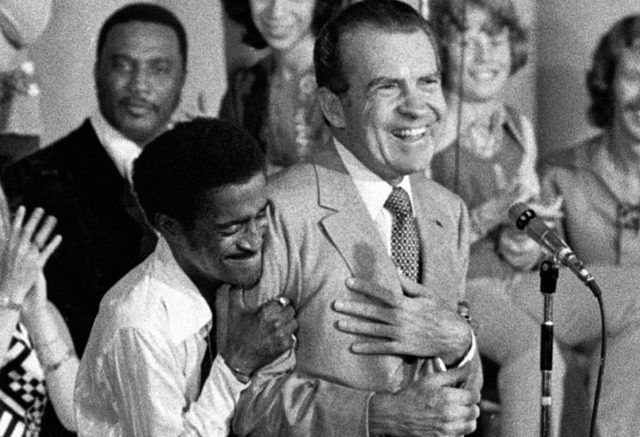
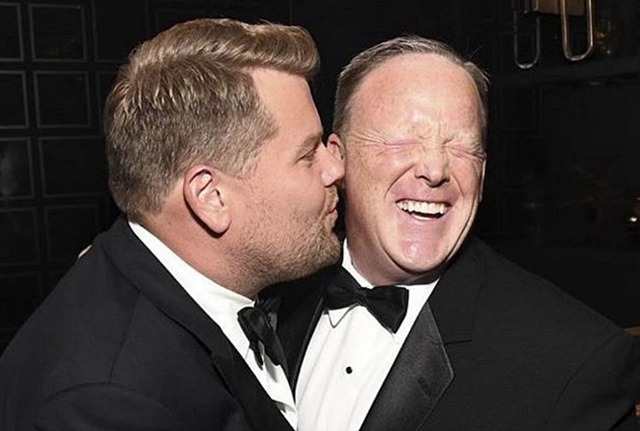
In a just, fair-minded world, this photo of James Corden kissing (!) Sean Spicer at the Emmys last night would be processed as the same kind of political faux pas as Jimmy Fallon mussing Donald Trump’s hair. Or, if you will, Sammy Davis, Jr. hugging President Nixon at a 1972 youth rally. Or the big studio chiefs of the early ’30s giving handshakes and back-pats to Georg Gyssling, the Nazi party member and ally of Joseph Goebbels who became the German consul to Los Angeles in 1933. Does Corden seem to be a soul-less, gut-less, unprincipled toady? Yes, he does. If Corden could be transported back to 1975 and flown to Phnom Penh, would he give a backrub to Pol Pot? I see Corden and Spicey singing Queen’s “Bicycle Race” together…no?


Read more

Night of Trump Push-Back

Hulu’s The Handmaids Tale won all those Emmys because it sent a message about resisting authoritarian governments. HBO’s Big Little Lies, essentially a series about women resisting and defeating men with cruelly perverse mentalities, won because the metaphor fit the political climate. Sean Spicer rolling onstage and more or less saying “I said some very questionable things and embraced assholery while serving as President Trump’s press spokesperson”…that spoke for itself. Alec Baldwin and Kate McKinnon winning, obviously. HBO’s The Wizard of Lies lost, in part, because despite Barry Levinson‘s obviously negative view of Bernie Madoff‘s widespread malice, there was a collateral ooze factor because Madoff came from the same New York financial culture as Trump.

Incidentally: (1) If eligible I would have never voted for HBO’s The Night Of in any capacity because of (a) the focus on John Turturro‘s problem with foot eczema (i.e., dermatitis), and (b) the writers doubling down by allowing the poor man to find a Chinese herbal cure for this revolting affliction and then bringing the foot eczema back at the very end — unforgivable! (2) I would have voted for Feud up and down, but Ryan Murphy‘s series lacked political resonance. (3) Three cheers for the total snub of HBO’s totally infuriating, puzzleboxing Westworld (“I hate this series with a passion for just layering on the layers, for plotzing, diddly-fucking, detouring, belly-stabbing, meandering and puzzleboxing to its heart’s content”)

“The Horror, The Horror”

I suffered through a few recurring-theme nightmares in my early childhood. Gorillas, drowning in quicksand, boxer dog chefs walking around on their hind legs and wielding carving knives, frying in the electric chair. But none of these generated the feelings of dread and terror that I developed in my teens and 20s over the prospect of a blue-collar, wage-earning life.

For many years I was absolutely horrified by the idea of having to get up at 6 am and report to work by 8 am or earlier, and being stuck with a physically demanding manual-labor job, especially in cold weather. My father was an advertising guy who always wore a suit. He commuted on a train and was never expected at the office before 9 or 9:30 am. That, to me, was a civilized, managable approach to work and earning a salary. Grunt-level blue-collar work always struck me as a brutal, punishing activity — the kind of work that was guaranteed to make you feel miserable and frustrated and drive you to drink in your off-hours.

I was stuck with miserable jobs in my late teens and early to mid 20s (working for a furniture company, driving a delivery truck for a lumber yard, chain-link fence, tree surgery). I was finally freed from that treadmill when I broke into New York journalism in the late ’70s. If I’d never broken out of that blue-collar cycle…I don’t want to think about it. But it would’ve been awful.

The Very Definition of “Weepie”

On 11.21 Kino Classics will release a Bluray of David O. Selznick and John Cromwell‘s Since You Went Away (’44), a domestic wartime drama that runs nearly three hours. The Bluray contains the 177minute roadshow version while Wikipedia lists a general release version running 172 minutes.

I can watch The Best Years of Our Lives over and over, but I can’t invest in watching a nearly-three-hour woman’s film starring Claudette Colbert. She was mildly alluring in the ’30s (Cleopatra, It Happened One Night, Midnight) but something intensely stodgy and conservative overtook her in the ’40s. Plus she was a Republican and a Reagan supporter, and she had a short neck.

Since You Went Away is famous for a sentimental railway station goodbye scene between costars Jennifer Jones and Robert Walker, who’d been married for four or five years at the time of filming. But Jones had been having an affair with Selznick since ’43, and the couple was going through a bitter divorce; they parted soon after Since You Went Away was completed. The farewell scene was parodied in Airplane! (’80 — clip after the jump)

The father of actor James Cromwell, the elder Cromwell was a kind of house director who churned out audience movies in the ’30s and ’40s (The Prisoner of Zenda, In Name only, Abe Lincoln in Illinois) before shifting into film noir (Dead Reckoning, The Racket). The poor guy was blacklisted from ’51 through ’58. His last significant film was The Goddess (’58), which was thought to be based on the unhappy personal life on Marilyn Monroe.

Read more

TIFF Launches Billboards Into Contention

The top vote-getter for The Toronto Film Festival audience poll (called for promotional purposes the “Grolsch People’s Choice Awards“) is Martin McDonagh‘s Three Billboards Outside Ebbing, Missouri. The first and second runners-up are Craig Gillespie‘s I, Tonya (stab me with a fork) and Luca Guadagnino‘s Call Me By Your Name.

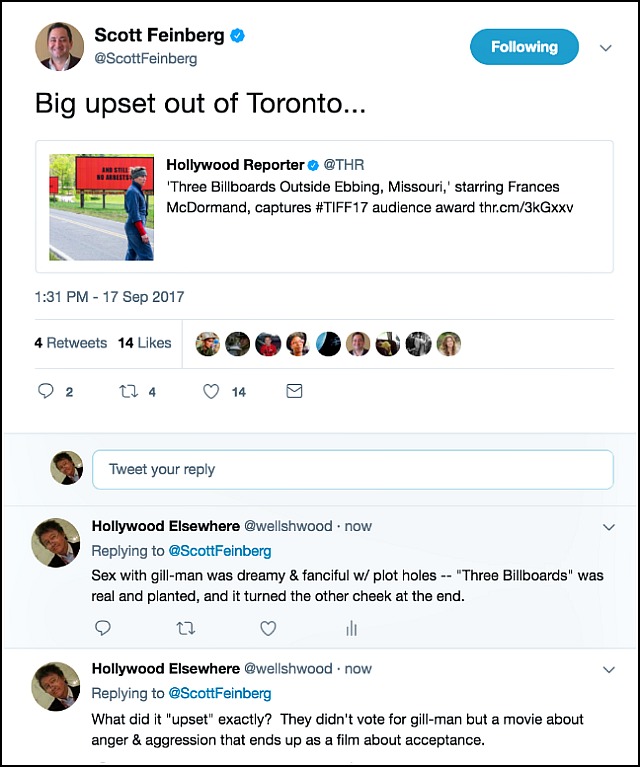
Hollywood Reporter award season pulse-taker Scott Feinberg called the Three Billboards win an “upset” because he’d been predicting Guillermo del Toro‘s The Shape of Water for the win. I suspect that TIFF audiences appreciated Shape as far as it went (i.e., sex with gill-man) but they really liked where Three Billboards went at the end — away from anger, turning it down, acceptance.

The Midnight Madness Award went to Joseph Kahn’s Bodied (winner), Craig Zahler’s Brawl in Cell Block 99 and James Franco’s The Disaster Artist.