Bloody White Apology

I saw George Clooney‘s Suburbicon earlier today…wow. Fargo-ish, it’s not. But it should have resembled Joel and Ethan Coen‘s 1996 classic at least somewhat, I was telling myself, because the original Suburbicon script, written by the Coens in ’86 and set in the mid ’50s, was their first stab at a Fargo-like middle class crime noir. Nine or ten years later the Coens went back to the same James M.Cain well and created Fargo, and the rest is history.

In Suburbicon, Clooney and producer and co-screenwriter Grant Heslov have reworked things, keeping the Fargo noir stuff but also, it seems, diluting or ignoring that sardonic deadpan wit that we all associate with the Coens, and deciding to paint the whole thing with a broad, bloody brush.

When it comes to tales about greed, murder and doomed deception, there’s nothing duller than watching a series of unsympathetic, unwitting characters (including the two leads, played by Matt Damon and Julianne Moore) play their cards like boobs and then die for their trouble. There’s just no caring for any of them.

Most significantly, Clooney and Heslov have added a side-plot about how Eisenhower-era white suburbanites were racist and venal to the core, and how things really aren’t much different today.

The Suburbicon victims are the just-arrived Meyer clan (Karimah Westbrook, Leith M. Burke, Tony Espinosa), and from the moment they move into their new, ranch-style home in a same-titled fictitious hamlet (i.e., an idyllic real-estate development right out of Martin Ritt‘s No Down Payment) their cappuccino skin shade incites ugly pushback from just about everyone. But the situation doesn’t develop or progress in any way. The Meyers keep absorbing the ugly, and that’s pretty much it.

Remember how those small-town citizens greeted the arrival of Cleavon Little in Blazing Saddles? Nearly the same broad-as-fuck tone prevails here. There isn’t a single non-racist white adult in Suburbicon. With the exception of Noah Jupe‘s Danny, who’s about ten, and the Meyers clan everyone in Clooney’s film has horns, hooved feet and a tail.

Clooney and Heslov to progressive industry hipsters and Twitter banshees: “We get it…whiteys carry the demon seed…a pox upon humanity…they totally sucked in the Eisenhower era and are probably no better right now…down with the curse of Anglo Saxon gene pools except, you know, for a certain small sliver of enlightened humanity that includes Glenn Kenny, Ellen DeGeneres, Greta Gerwig, Phillip Noyce and a few thousand others.”

Suburbicon is about a married middle-management milquetoast (Damon’s Gardner Lodge), obviously a close relative of William H. Macy‘s Jerry Lundegaard, scheming with his wife’s sister (Julianne Moore plays both roles) to scam a pile of dough by hiring a couple of thugs to kidnap and “accidentally” kill his wife. All kinds of hell breaks loose when the plan goes wrong.

Read more

Brutal Competition

Everyone’s catching Suburbicon at 11 am this morning, but after that it’s anyone’s game. Albert Tello is forcing me hike down to the Intercontinental on Front Street to pick up Molly’s Game tickets (screening + after-party), but should I wedge this in between Suburbicon and Stephen FrearsVictoria & Abdul or post-Abdul at 3:30 or 4 pm? Yes, I’ll regret missing the 5 pm The Death of Stalin screening but tomorrow’s another day. I don’t need to see Lady Bird again so soon after Telluride, but I’d like to drop by the after-event. 90% of this racket is about politely asking and then saying “thank you.”

Standing Ovation

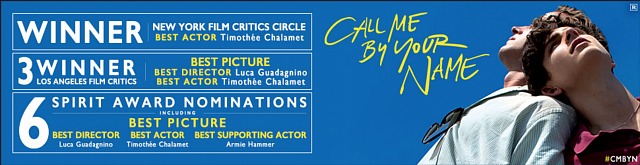
Hollywood Elsewhere attended a party this evening for Luca Guadagnino‘s Call Me By Your Name (Sony Pictures Classics, 11.24) at STK Toronto (153 Yorkville near Avenue Road) following a TIFF screening at the Ryerson. The film was rapturously received with a long standing ovation. The congenial Timothee Chalamet called me “Mr. Wells” (please!) and said he’s read all the stuff I’ve written about the film. He said he’ll begin shooting the new Woody Allen film (also starring Elle Fanning and Selena Gomez) on Monday in New York City. I chatted with Roger Friedman, Baz Bamigboye, Wilson Morales, et. al. Nice party, great food…thanks, Sony Pictures Classics.

Call My By Your Name star and likely Best Actor nominee Timothee Chalamet.


The guy standing to Timothee Chalamet’s left Giullian Gioiello.  CMBYN costar Armie Hammer at far right, next to yours truly. Director Luca Guadagnino to my immediate right.

Read more

Lady Bird Cat Fight

Yesterday the winners of a Telluride Film Festival Indiewire critics poll were announced, and the news was very good for Greta Gerwig‘s Lady Bird. Tied for first place were Gerwig’s semi-autobiographical dramedy and Guillermo del Toro‘s The Shape of Water, and the most admired performance “by a long shot” was given by Lady Bird star Saoirse Ronan. So we know where the Best Picture conversation is headed right now, at least in part.

And yet, believe it or not, there’s a fierce pushback narrative being mounted against Lady Bird by a certain nitpick contingent. It’s mainly about how they don’t care for Ronan’s lead character, whom director-writer Gerwig largely based upon her own teenaged self back in ’02. Not likable enough, they’re saying. Too bratty, too argumentative with her mom (Laurie Metcalf), disloyal to her fat best friend, too much of a social striver, etc.

I find this argument appalling as I believe Lady Bird to be an excitingly honest and beautifully assembled film that tells the often humorous, sometimes abrasive truth about what it’s like to be a bright, passionate 18 year-old with unformed ideas and serious hunger.  But you can’t order people to ditch their objections.

I was arguing with one of the nitpickers this morning. I reminded that Ronan’s character goes back to her best friend at the very end, and that kids say and do unattractive things to each other all the time in high school, and that mothers and daughters are often if not always at loggerheads during the teen years, and that Ronan says “I love you” to her mom at the finale. It’s honest, it’s real, it’s Greta’s life…c’mon. Some people are just dug in and unreachable.

Barber Blocking Coppola’s New Cotton Club

Francis Coppola‘s The Cotton Club Encore, an expanded and allegedly improved 139-minute version of the original 1984 film, played twice at last weekend’s Telluride Film Festival. I couldn’t fit it into my schedule, and I can’t find any reviews from any reputable or tough-minded critics whom I respect. Nor can I trust Jim Hemphill’s enthusiastic 9.6 review, which claims that the new cut is a “masterpiece”. But I’m certainly intrigued.

I didn’t care much for the original version, which I saw only once about 33 years ago. But Coppola’s new cut is said to feature more music and dancing, and to be less white, and less focused upon the romantic relationship between the two lead characters, played by Richard Gere and Diane Lane. It may do the trick and it may not, but who wouldn’t want to see it?

Coppola spent $500,000 out of his own pocket to create this new version. The restoration effort took four years, I’ve been told, and was completed about six months ago. Coppola was inspired after seeing an old Betamax version of an original cut that he liked better than the ’84 theatrical version.

Coppola archivist James Mockoski explained this morning that Coppola removed about 13 minutes of footage for the original 127-minute version, which took it down to 114 minutes or thereabouts. Roughly 25 minutes of new footage was added for a grand total of 139 minutes.

So why isn’t The Cotton Club Encore playing at the Toronto Film Festival or the forthcoming New York Film Festival? You’re not going to believe this, but the reason is MGM CEO Gary Barber, the same obstinate asshole who has blocked Robert Harris‘s long-hoped-for restoration of John Wayne‘s The Alamo.

MGM is the Cotton Club rights-holder, you see, and Barber, true to form, has not only objected to the film being shown in any kind of commercial venue (such as TIFF or NYFF) but is also uninterested in distributing or streaming Coppola’s expanded version, even though Coppola has paid for the whole thing.

Barber could theoretically (a) allow for a brief theatrical re-release of The Cotton Club Encore or (b) issue it on Bluray or via Amazon/iTunes streaming or (c) at least sub-license the home video rights to Criterion or some other dedicated, film-loving outfit. But the South African-born executive reportedly has no interest, just as he’s refused to even discuss the Alamo situation with Harris.

Read more

Finally…

I heard several weeks ago that the version of Ruben Ostland‘s The Square (Magnolia, 10.27) that was shown during last May’s Cannes Film Festival (and which resulted in a Palme d’Or win) has been edited slightly. The Wiki page says it runs 142 minutes but the Toronto Film festival page says 145 minutes. A Magnolia guy told me today that Cannes version actually ran around 149 minutes, and that Ostlund cut four to bring it down to 145.

From my Cannes Film Festival review: “The Square is a longish but exquisitely dry Swedish satire, mostly set among the wealthy, museum-supporting class in Stockholm. It’s basically a serving of deft, just-right comic absurdity (the high points being two scenes in which refined p.c. swells are confronted with unruly social behaviors) that works because of unforced, low-key performances and restrained, well-honed dialogue.

“Ostlund’s precise and meticulous handling is exactly the kind of tonal delivery that I want from comedies. There isn’t a low moment (i.e., aimed at the animals) in all of The Square, whereas many if not most American comedies are almost all low moments.

“The problem is that The Square stops being a perfect absurdist satire somewhere around the two-thirds or three-quarters mark and downshifts into a glumly moralistic thing that’s about the lead character (played by the handsome, Pierce Brosnan-ish Claes Bang) trying to face up to his errors and make things right.

“There are four stand-out moments: a post-coital confrontation moment with Elizabeth Moss, an interview with a visiting artist (Dominic West) interrupted by a guy with Tourette’s syndrome, the already notorious black-tie museum dinner ‘ape man’ scene with simian-channeller Terry Notary, and a hilariously over-provocative YouTube ad showing a little girl and a kitten being blown to bits.

“Yesterday Jordan Ruimy tweeted that The Square is Leo Carax‘s Holy Rollers mixed with Maren Ade‘s Toni Erdmann. Except I didn’t find Erdmann even vaguely funny (for me Peter Simonischek‘s performance was painful) and I was constantly chuckling and chortling during The Square, so what does that say? I’ll tell you what it says: Fuck Toni Erdmann, although I’m certainly open to the Jack Nicholson-starring remake, if and when it actually happens.”

The Hell You Say

Attention Darren Aronofsky loyalists: The word has gone out that mother! is an allegory about something or other. Climate change, haunted Biblical prophecy, invasive social-media malevolence, a personal Aronofsky confession…you tell me. It’s not about the images, behaviors and disturbances presented on the screen, but whatever may be suggested or implied by same. Go to town and kick it around, but don’t limit yourself solely to the visual and aural content.

Ben Croll’s 9.6 Indiewire review (“Aronofsky’s Audacious and Rich Cinematic Allegory Is His Most Daring Film Yet”) is one manifestation of this mode of absorption. As Croll writes, “Come for the house that bleeds; stay for the reflections on parenthood and the difficulty of living with fame.”

Excerpt #1: “Awash in both religious and contemporary political imagery, Aronofsky’s allusive film opens itself to a number of allegorical readings, but it also works as a straight-ahead head rush. Not just another baroquely orchestrated big-screen freak-out in the vein of Black Swan (though it is very much that), the film touches on themes that — if too hazily figurative to be in any way autobiographical — at least tread on factors in the director’s own life.

Excerpt #2: “The film is divided into two parts that roughly parallel one another for reasons that eventually make themselves clear. Both follow married couple Jennifer Lawrence and Javier Bardem (and yes, their nearly 20-year age gap is an important and oft-commented upon plot point), who go unnamed as a way of telegraphing that they’re meant to represent Bigger Things.”

Excerpt #3: “Aronofsky and Paramount have launched one of the more secretive marketing campaigns in recent memory, which is odd because “mother!” is a not a particularly twisty-turny affair. Both parts of the film play out like the first few chapters of The Hobbit, where a growing number of unexpected guests pop in to break the leads’ bucolic solitude, and twist them toward different ends.”

Read more

Travers on Flag, Wonder Wheel, Current War

Rolling Stone‘s Peter Travers has seen Richard Linklater‘s Last Flag Flying (debuting at New York Film Festival), Woody Allen‘s Wonder Wheel (ditto) and Alfonso Gomez Rejon‘s The Current War (TIFF). Here are his observations:

Last Flag Flying: “Bryan Cranston, Steve Carell and Laurence Fishburne all hit acting peaks in Richard Linklater’s look at three military buddies still trying to heal psychic wounds three decades after they served together in Vietnam. The trio is forced to reunite after years apart, however, when Carell’s son dies while fighting in Iraq. It’s the mission of these middle-aged men to bring the boy home for burial. The Boyhood director’s latest is a triumph that also features stellar newcomer J. Quinton Johnson (Everybody Wants Some) as a young marine.” Wells reaction: An acting “triumph” or a general triumph all around? Too vague.

The Current War: “How will today’s audiences, with notoriously short attention spans, react to a century-old battle between Thomas Edison (Benedict Cumberbatch) and George Westinghouse (Michael Shannon) over whose electrical system was better? For those who think AC/DC is just an Australian rock band, this period piece will be an education — though not a dull one. As directed by Alfonso Gomez-Rejon (Me and Earl and the Dying Girl) from a script by playwright Michael Mitnick (Sex Lives of Our Parents), this drama bursts with cinematic energy and is fueled by a plot as relevant as who’s building the next and best smartphone app. As for Cumberbatch and Shannon, they’re acting titans.” Wells reaction: Travers seems to imply that it’s strictly for 45-plus viewers due to Millenials not being the slightest bit interested.

Read more

Toronto Arrival, Telluride Clean-up

Hollywood Elsewhere’s Porter flight arrived in Toronto around 3 pm or thereabouts. I went straight to the Airbnb at 74 Oxford Street in the Kensington district, which may be my favorite Toronto neighborhood of all time. I picked up the press pass and other materials at the Bell Lightbox around 5 pm, and then hung in the press room until the 7 pm closing. I guess I’ll grab a salad and plan the next few days.


HE’s own Tatyana Antropova, taken as we left Telluride early Monday afternoon. The drive back to Albuquerque took five and a half hours.


Read more

In For it

I won’t be seeing Darren Aronofsky‘s mother! until Sunday morning (9.10), but I’m loving how it’s provoking intense reactions. From Daily Beast critic Marlow Stern: “This is a film designed to fuck with you. And fuck with you it does.”

The Playlist‘s Jessica Kiang: “An incendiary religious allegory, a haunted-house horror, a psychological head trip so extreme it should carry a health warning and an apologia for crimes of the creative ego past and not yet committed, it’s not just Aronofsky’s most bombastic, ludicrous and fabulous film, spiked with a kind of reckless, go-for-broke, leave-it-all-up-there-on-the-screen abandon, it is simply one of the most films ever.”


mother! director Darren Aronofsky, snapped a day or so ago at the Venice Film Festival.

There’s a paragraph in Todd McCarthy‘s THR review that strikes me as one of the most damning descriptions of of a reputable name-brand filmmaker that I’ve ever read by a reputable name-brand critic.

“Beyond the climactic free-for-all lunacy, this seems above all a portrait of an artist who has untethered himself from any and all moral responsibility,” McCarthy writes, “one so consumed by his own ego and sense of creative importance that he’s come to believe that nothing and no one remotely competes with the importance of his work.”

In other words, McCarthy is saying, Aronofsky is some kind of sociopath. This obviously argues with Aronofksy’s claim that mother! is meant to be some kind of climate-change allegory. If I were Aronofsky I would write a THR guest editorial and spell things out, especially about the necessary task of provocation that most major-league artists try to live up to.

Naturally, the McCarthy review makes me want to see mother! all the more.

Read more