With Hollywood Might-Have-Beens Hiding In Tall Grass, Another Mostly Euro-Centric Cannes

The first official roster of Cannes ’17 films has been announced. My immediate reaction: “Uhhm, okay, another shortfaller and what else is new? But at least there’s the Andrezj Zvyagintsev, the half-silent Todd Haynes, the Noah Baumbach and the 390-second Alejandro G. Inarritu virtual-reality short to look forward to.”

Many interesting-sounding films were on the early-speculation lists, but only those with nothing to lose and everything potentially to gain from an early Cote d’Azur peek-out will show up. Those with even a teeny-weeny bit to lose (i.e., films which may turn out to be admired but not loved)? Forget it.
In my book there are six Cannes ’17 hottiesAndrezy Zvyagintsev‘s Loveless (very high expectations for the director of Leviathan), Todd HaynesWonderstruck, Michael Haneke‘s Happy End, Noah Baumbach‘s The Meyerowitz Stories, Alejandro G. Inarritu‘s 390-second virtual reality short Carne y Arena (which rsvp’ed viewers will have to journey on a shuttle to see, apparently within a viewing space some distance from the bunker) and a special screening of Eugene Jarecki‘s Promised Land, which reportedly “juxtaposes contemporary American socio-political history with the biography of Elvis Presley.”

Oh, yeah, right…the first two episodes of David Lynch‘s new Twin Peaks series…calm down.

As I noted a month ago, the festival’s biggest highlights will most likely be European-produced, and that the American-made films that will likely appear are going to rank as…who knows? “I’m not calling it another deadbeat Cannes in terms of U.S. entries,” I wrote, “but the counsel of Oscar strategists along with generally cautious instincts across the board have all but killed this festival in terms of potential award-season titles.

Martin McDonagh‘s Three Billboards Outside Ebbing, Missouri (Fox Searchlight, 10.13) was test-screened last October to excellent notices and is, I gather, 100% finished and viewable, but it won’t be screening at the 2017 Cannes Film Festival. Frances McDormand‘s Best Actress campaign will launch around Labor Day instead.

Alexander Payne‘s much-anticipated Downsizing (Paramount, 12.22) was shown last night in Sherman Oaks and is therefore not that far from finished (raggedy, half-completed features are rarely shown to Joe and Jane Popcorn for research purposes), but it won’t be going to Cannes either. Appetites were whetted at Cinemacon last month when attendees were thrilled by a 15-minute excerpt (I thought it looked brilliant), but just because Payne took Nebraska to Cannes doesn’t mean he’s obliged to follow suit this year.

And while it’s entirely possible that Chris Nolan‘s Dunkirk (Warner Bros., 7.21) — another Cannes no-go — won’t be “ready” to screen in mid May, many of us suspect that a very-close-to-finished version could be shown if Nolan and his Warner Bros. handlers wanted to go there.

Read more

Pick Her Up Just To Say Hello

Until I saw Miguel Arteta‘s Beatriz At Dinner (Roadside / Film Nation, 6.9), I never realized how short Salma Hayek is. Look at her compared to her female costars in this trailer — she’s like a munchkin. I’m not saying this to be a dick, but to mention that her church-mouse proportions serve as a metaphor when Beatriz, a spiritual healer and massage therapist, has an unfortunate encounter with a group of Orange County synthetics. Poor Beatriz seems beaten from the start.

From 1.17 HE Sundance review: “Beatriz drives down to Newport Beach to give a massage to Cathy (Connie Britton), a rich client. But then Beatriz’s car dies, and so Cathy invites her to stay for the party. She first has to overcome the small-minded objections of her husband (David Warshofsky) because the dinner is basically about business deal with a rich, Donald Trump-like monster (John Lithgow). Also attending are Strutts’ wife (Amy Landecker) and are a smarmy Orange Country couple (Chloe Sevigny, Jay Duplass).

“But then Beatriz starts blowing it by ignoring the conservational flow and trying to pass along a moral or spiritual lesson whenever there’s a lull. Then she starts to drink too much wine. Then she throws a cell phone at Strutt over his disdain for society’s lessers. Then she insists on playing a song on her guitar. And then she begins to wonder if she might have a moral duty to stab Strutt in the neck. Then she has some more wine.

Read more

Ballhaus With The Godz

Michael Ballhaus, the renowned visual composer best known for his long and fruitful partnerships with Rainer Werner Fassbinder and Martin Scorsese, has passed at age 81. His most famous accomplishment is the long Goodfellas tracking shot in which Ray Liotta and Lorraine Bracco slip into the Copacabana through the kitchen, but God, I loved so much of his work. Ballhaus knew from steam, smoke, shadows, reddish glows and sunlight piercing down through windows…all the impressionist tricks of the trade. And above all about gliding movement.

The headliners: Fassbinder‘s The Bitter Tears of Petra von Kant, Fox and His Friends, The Marriage of Maria Braun, Lili Marleen. Steve KlovesThe Fabulous Baker Boys. Nancy MeyersSomething’s Gotta Give. James L. BrooksBroadcast News and I’ll Do Anything. Mike NicholsWorking Girl, Postcards From The Edge and Primary Colors. Wolfgang Petersen‘s Air Force One. Francis Coppola‘s Dracula. Scorsese’s After Hours, The Color of Money, The Last Temptation of Christ, The Age of Innocence, Gangs of New York, The Departed.

Read more

Stepped Into It

In a nutshell, Sean Spicer‘s Hitler gaffe was a claim that Nazi Germany’s immortal monster “was not using the gas on his own people” like Syria’s Bashar al-Assad “was doing…[not] in the way that Assad used them, where he went into towns, dropped them down [on] innocents…in the middle of town.” Remember that everyone is calling this much-apologized-for statement a gaffe — an accidental, inappropriate slip of the tongue that either reveals something truthful or (in this case) the mindset of the speaker. For what Spicer meant (and is now very, very sorry for having said) is that European Jews were not Hitler’s people, that they were the subversive, non-patriotic “other”, as Hitler and his Third Reich henchmen repeatedly described them in the ’30s. This indicates that Spicer himself, speaking from his 2017 Trumpian perspective, has bought into the same notion about European Jewry not being real Germans. He can apologize, but he can’t un-say what he said.

Read more

A Fine Madness

We’re approaching (i.e., are five months away from) the fifth anniversary of Rodney Ascher‘s Room 237. I don’t know what it’s earned on video/streaming since, but the fact that it only made a lousy $296,359 theatrically indicates hundreds of thousands if not millions of X-factor filmgoers never gave it a tumble. And it’s one of the best LQTM movies I’ve ever seen. Not “no laugh funny” like Ishtar but genuinely hilarious — just not in a way that makes you slap your thighs as you go “hah-hah.” Why such a small audience? Because (and I’ve heard this over and over) the people who saw it told their friends that it was bullshit — that Stanley Kubrick never faked the moon landing and never intended to insert all of those veiled allusions in The Shining and therefore the doc was a waste of time — an interpretation that is truly staggering in its stupidity. I just re-watched the below clip, the first time since mid ’13, and was chuckling all over again.

Oceans Of Time

Paramount’s Cinemacon presentation included a 15-minute-long sampling of Michael Bay‘s Transformers: The Last Knight (6.23), and the general reaction was (a) “whoa, complex…intense post-apocalyptic dystopia meets some kind of time-trippy Knights of the Round Table scenario shot in England,” (b) “nice effects” and (c) “this is gonna be a long-ass film…140, 150 minutes, something like that.” Neither the just-released trailer not the previous assemblies tell the tale as clearly as the Cinemacon reel, and that in itself wasn’t entirely clean and concise. Ambitious, obviously, but with layers upon layers upon layers. Not a sandwich or fast-food meal, but what felt to me like a potentially exhausting 10-course banquet. Mark Wahlberg, Isabella Moner, Anthony Hopkins, Laura Haddock, Stanley Tucci, Josh Duhamel, Tyrese Gibson, John Turturro, et. al.

Read more

Elegant Editing, Finely Judged

A couple of weeks ago three beautifully-cut assemblies of a select roster of Annapurna films were posted. “America”, “Photograph”, “Hustle” — to which I only paid attention this morning. They should have included clips from Detroit, Downsizing and the Untitled Paul Thomas Anderson fashion-in-the-’50s film, but otherwise very nice. Annapurna (along with Amazon, Netflix and Scott Rudin) believes in ’70s films made for 21st Century moviegoers, and thank God for that. Lawless, The Master, Killing Them Softly, Zero Dark Thirty, Her, Foxcatcher, Joy, Everybody Wants Some!, Wiener-Dog, Sausage Party, The Bad Batch, 20th Century Women, et. al.

Read more

“It’s Time We Knew”

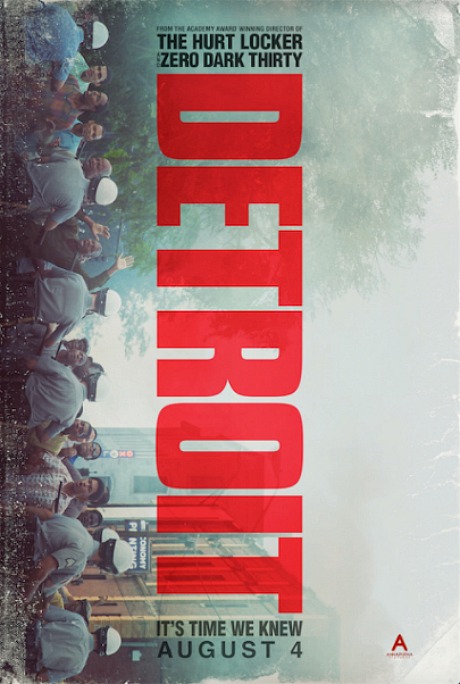
50 years later, the fire that time. Memory detour, flashpoint, cuts and close-ups, an inferno rekindled. A jarring, presumably riveting descent into hell. Directed in the usual bracing, deep-dive fashion by Kathryn Bigelow. Written by the intrepid Mark Boal. Shot by the legendary Barry Aykroyd (The Hurt Locker, United 93). Edited by the masterful William Goldenberg (Zero Dark Thirty, The Insider). A possible…call it a presumed award-season headliner that dares to open on August 4th. Go bold, break the mold.

“One of the bleakest chapters in American history — four days that stunned a nation and left scars on a great city that are still seen and felt today.” — from a 7.22.12 Time.com article showcasing the Detroit riot photos of Lee Balterman.

From Wiki page: “The 1967 Detroit riot, also known as the 12th Street riot, was a violent public disorder that turned into a civil disturbance in Detroit, Michigan. It began in the early morning hours of Sunday, July 23, 1967. The precipitating event was a police raid of an unlicensed, after-hours bar then known as a blind pig, just north of the corner of 12th Street (today Rosa Parks Boulevard) and Clairmount Avenue on the city’s Near West Side.

“Police confrontations with patrons and observers on the street evolved into one of the deadliest and most destructive riots in the history of the United States, lasting five days and surpassing the violence and property destruction of Detroit’s 1943 race riot.

Read more

Reluctant To Admit That Boredom Seeped In

Such is the ardor and devotion of the notorious James Gray cabal that when a fellow who is either a member or temporarily posing as one — New Yorker critic Anthony Lane — tries to gently dismiss Gray’s The Lost City of Z (Amazon Bleecker, 4.14), he can’t help but dance a little side-step. Which wouldn’t be a problem if you weren’t muttering to yourself, “C’mon, man…spit it out.”

One, do not trust the 89% Rotten Tomatoes rating — the foo-foos have been worshipping Gray for years and will almost always give him a pass no matter what. I’ve said two or three times that this film will empty the sand out of your hourglass and make you feel imprisoned in your theatre seat. On top of which you must always, always beware of the word “fantasia” if the speaker isn’t referring to a 1940 animated Disney feature. Remember also that Lane is obliged to show a certain deference to David Grann‘s “The Lost City of Z,” which ran in The New Yorker before being published in book form.


New Yorker illustration by Wesley Allsbrook.

Two excerpts tell the tale:

Lane excerpt #1: “Gray has borrowed the title [of the book], and he dramatizes many of the episodes to which Grann and other writers have referred. Yet the movie that results should not be combed for historical truth. It is best approached, I would say, as a fantasia on Fawcettian themes.”

Lane excerpt #2: “Does The Lost City of Z count as an action movie? It seems more like a study in restlessness. You could frame Percy Fawcett as desperate, deluded, and ill-prepared. [But] Gray’s Fawcett is a sturdy and somewhat monotonous creature, who, for all the strivings of Charlie Hunnam, does not consume us.”

I re-posted my reactions, originally penned after catching The Lost City of Z at the 2016 NY Film Festival, on 2.23.17.

After Months Without A Title, Bigelow’s Riot Pic Has Embraced Detroit

Wikipedia and other sources are reporting that the title of what used to be known as Kathryn Bigelow’s Untitled Detroit Riots Project (Annapurna, 8.4) will be…uhm, Detroit. The first teaser-trailer pops tomorrow (Wednesday, 4.12). Blogaroos are still scratching their heads over over that curious early-August release date, but I’m sure it’ll work out in the long run.

You Fuck Up, You Know What

Commentary from screenwriter William Goldman on the Butch Cassidy and the Sundance Kid Bluray, not transcribed but recalled: “We were lucky with Butch. We had a great director [George Roy Hill], and we had Connie Hall‘s phenomenal photography and a great crew and a solid script and a neat story and the casting was perfect. But if just one of these elements didn’t happen…it tells you that a good script and a good director and the right cast aren’t enough . The photography has to be right on, ditto the score and the editing…and if just one of these elements isn’t exactly right, you are dead. Nobody realizes how important the editing is, or how important the composer is…and there’s no reason for people outside the movie business to realize this, that movies are so fragile and anything can screw them up.” (Initially posted on 7.5.06.)

Greenberg Love Undimmed

John Lichman was kidding when he tweeted this, but I would be over the moon with joy if a Greenberg sequel could somehow happen. Seriously. Noah Baumbach directing, of course. Ben Stiller and just about any strong costar. Adam Sandler could save…okay, half-save his career if he costarred.

In actuality: “Noah Baumbach’s The Meyerowitz Stories, a potential Cannes title, will premiere in select theaters and on Netflix later this year. It stars Adam Sandler, Ben Stiller, Dustin Hoffman, Elizabeth Marvel (Homeland, House of Cards), Grace Van Patten (Tramps, Stealing Cars) and Emma Thompson.

“It’s described as an intergenerational tale of adult siblings contending with the influence of their aging father. Scott Rudin, Baumbach, Lila Yacoub and Eli Bush produced.”

Big Greenberg Divide,” posted on 4.3.10: I don’t know where the below photo below was taken (the guy who sent it to me didn’t say, and he hasn’t answered my follow-up e-mails) but I’m really, really hoping it wasn’t taken at the Angelika in lower Manhattan. If it was this would imply that supposedly ahead-of-the-curve New Yorkers can be just as stubbornly conservative in their tastes as hinterland types. Please tell me it was taken in Orlando or Natchez or Des Moines.

Read more