I’m crestfallen about the passing of the great Jonathan Demme, who was one of the leading hot-shit directors of the ’80s and early ’90s (Melvin and Howard, Something Wild, The Silence of The Lambs, Philadelphia). Demme died this morning in New York City from esophageal cancer and complications from heart disease. The cancer hit him in 2010, recurred two years ago, and then advanced in force over the last few weeks.
I knew Demme casually or slightly in a non-interview context. A run-in here, a party chat there. Once through the late Stuart Byron, the ex-Village Voice columnist who was friendly with him, and with whom I ran a consultancy business called re:visions. Demme seemed to be all about spirit, mirth, excitement. He was approachable, unpretentious. He loved Caribbean culture. If he was a worry wart behind closed doors, I never saw it.
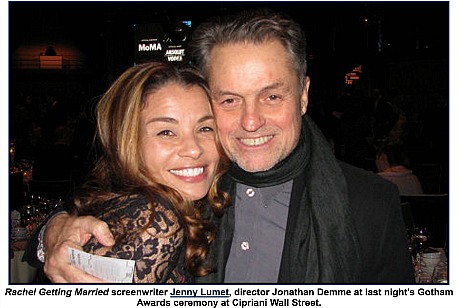
The last time I spoke to Demme was at the Gotham Awards in December ’08. He was hanging with Jenny Lumet, who had written the screenplay for what would later be regarded as Demme’s last hurrah as a top-ranked auteur — Rachel Getting Married. The forthcoming inauguration of Barack Obama came up. I asked if he thought it was a good idea to self-identify as “Barack Hussein Obama,” given recently voiced concerns about a U.S. President sharing a name with Saddam of Iraq. “The yokels won’t like that,” I said. Demme’s response: “Fuck ’em!”
Born in February 1944 (too late for the Baby Bust generation but not a boomer either), Demme had four distinct career phases:
#1: A low-budget, exploitation-tinged, Roger Corman-affiliated chapter (writing and/or producing Angels Hard as They Come, The Hot Box and Black Mama White Mama, and then directing Caged Heat, Crazy Mama and Fighting Mad). This was followed by a dicey period noir-thriller, Last Embrace (’79), which I re-watched four or five years ago and found wanting.
#2: His peak period as an assured, studio-supported mainstream director of seven films — Melvin and Howard (’80), Swing Shift (’84), Stop Making Sense (’84), Something Wild (’86), an inspired detour with Swimming to Cambodia (’87), the not-so-hot Married to the Mob (’88) and then his two greatest successes — The Silence of the Lambs (’91) and Philadelphia (’93).