

Milo Yiannopoulos vs. Larry Wilmore (“You can go fuck yourself, all right?”) with Bill Maher moderating and Rep. Jack Kingston, Malcolm Nance and Leah Remini costarring.
Son of No Man’s Land Meets 127 Hours
Yup, it’s the old “stepped on a land mine but can’t step off without being blown up” situation again. Bosnian director Danis Tanovic made this into something formidable 16 years ago in No Man’s Land, and now co-directors Fabio Guaglione and Fabio Resinaro have applied a slightly different spin with Mine. Instead of enemy combatants stuck in the same situation, Armie Hammer is more or less alone and facing terrible survive-or-die odds a la James Franco in Danny Boyle‘s 127 Hours.
Revised Letter to Criterion’s Peter Becker
Updated on Saturday, 2.18, at 7 am: Peter — I’ve just had a second look at the screen captures included in Gary W. Tooze‘s DVD Beaver review of Criterion’s 4K-scanned Blow-up Bluray (streeting on 3.28), and I’m feeling a bit foolish. Yesterday [i.e., Friday, 2.17] I wrote that it seemed obvious that Criterion’s decision to go with the dreaded 1.85 aspect ratio meant that extra information has been added to the sides. That may be the case, but the frame comparisons between an old DVD image and the new Criterion Bluray [below] didn’t prove anything as they were of different frames from a shot taken from the back of David Hemmings‘ moving car. Readers pointed this out last night — my bad.
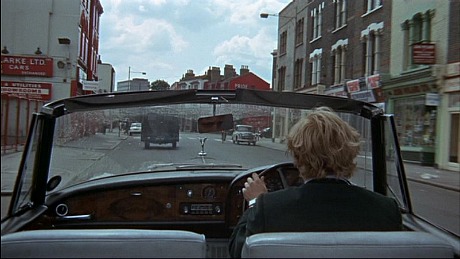
From a domestic DVD released 14 or 15 years ago…something like that.
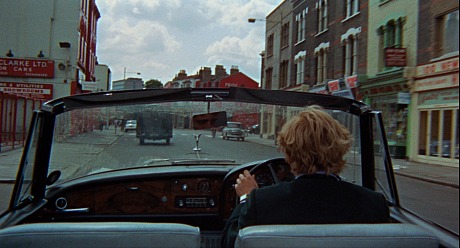
From Criteron Bluray — not the same shot.
The bottom line remains: The old Criterion organization stated on the back-cover notes for Criterion’s CAV laser disc of Michelangelo Antonioni‘s 1966 classic that the “correct” aspect ratio is 1.66. Why was 1.66 cool back then but not now? Or why not at least go with a 1.75 (which Criterion chose for its Bluray of A Hard Day’s Night) or 1.78 a.r.?
DVD Beaver‘s Gary Tooze says in his current review that the 1.85 a.r. will cause some anguish and consternation, and stated some years back that the film was definitely composed for 1.66.
I’ve stated time and again that 1.66 was a kind of default aspect ratio in England from the late ’50s to sometime in the early ’70s. Criterion’s Bluray of John Schlesinger‘s Sunday Bloody Sunday (’71), for one example, is perfectly masked at 1.66. It’s really such a shame. Back around the time of Criterion’s seminal, game-changing On The Waterfront video essay that compared the differences between 1.33 (or 1.37), 1.66 and 1.85, I thought that the case had been made that 1.85 croppings were too extreme and that 1.66 was a much more natural, liberal, eyes-of-God-and-the-universe aspect ratio. But no. 1.85 fascists are still embedded here and there, and I’m very sorry to admit that this pestilence persists.
On top of which Tooze’s observation that Criterion’s 1080p transfer is “darker than the previous DVDs, has warmer skin tones and a film-like thickness” is troubling. In what way is the look of a film enhanced by darkening the palette? Warming the color is okay within limits but why the hell would anyone want to deliver an image that looks like a screening with a dying projector bulb? And who pines for “film-like thickness”?
For the life of me I’ll never understand why the Criterion gremlins have chosen more than a few times to murk things up. The decision to go darker and inkier on Criterion’s Only Angels Have Wings Bluray was appalling — as an owner of a highly appealing Vudu HDX streaming version plus a TCM Bluray, I’ll never watch Criterion’s Bluray version again.
Question #1 — The adding of extra width to Criterion’s Blow-up Bluray may or may not be agreeable, but how do you explain Criterion staffers endorsing a 1.66 a.r. back in the ’90s vs. today’s team going for 1.85? (They couldn’t even compromise with a 1.78 a.r.?) Question #2: What’s with the darkness compulsion? — Jeffrey Wells, HE.
“I Don’t Have Anything Big To Say”
Michelle Williams owns this scene — feeds it, stirs it, delivers the lion’s share of the energy. All Casey does is deflect and dodge and slowly collapse, his character being who and what he is. But the two of them together….wow. The feelings seep out of Michelle while Casey mostly trembles and shudders…the sadness pours like sauce.
Beyond Meaningless
A few hours ago a Mashable post from Italian correspondent Gianluca Mezzofiore set the Stars Wars realm on fire…not. An Italian poster for Rian Johnson‘s Star Wars: Episode VIII — The Last Jedi (Disney, 12.15) suggests that the use of Jedi in this context could be plural. Seriously…who cares? We all know that movie and book titles using the adjective “last” always allude to a dying breed, the end of a tradition. And if you have even a limited understanding of what the force is, you know there never be a Jedi finale or cul-de-sac when everything explodes or collapses in a heap. Whether the “last Jedi” refers to (a) a generation of Jedi knights, (b) Daisy Ridley‘s Rey or (c) Mark Hamill‘s Luke Skywalker, finality doesn’t apply. In what way could Jedi-ism and the The Force be dying or running out of steam when it’s it an eternal cosmic current of incredible energy and wisdom for all Jedi knights? Absolutely 100% nonsensical bullshit.
All Those Years Ago
Six weeks ago I wrote that “if Broad Green wants anyone to talk about Terrence Malick‘s Song to Song (3.17) as a film of interest or possible excitement they’re going to have to assemble and release (gasp!) a trailer. And maybe even a one-sheet.” Today they finally released both. The trailer is nicely cut and thoroughly Malickian…that same old darting, dazzling, swirling Emmanuel Lubezki cinematography with a lot of wooing, nuzzling and giggling plus some keyboard playing and stage performing thrown in…a musical Son of Knight of Cups in Austin with a little relationship mood-pocketing from To The Wonder. Saying it again: this is a mid-Obama administration nostalgia flick (shot in 2011 and ’12) that nobody outside of Malick cultists could possibly care about. It’ll be world premiered on Friday, 3.10 at Austin’s South by Southwest film festival.
Respect For Mean Dreams
Filed from Cannes on 5.15.16: “Nathan Morlando‘s Mean Dreams isn’t blazingly original, but I found it a handsome, pared-down thing that doesn’t give in to the usual blam-blam when a gun is purchased and push comes to shove. If a cover band really knows how to perform classic Malick rock — Badlands meets Cop Car meets Ain’t Them Bodies Saints meets A Simple Plan meets No Country for Old Men — and they include a riff or two of their own then I really don’t see the problem.
“It isn’t how familiar something seems as much as how spare and straight the chops feel. Take, assimilate, make anew. And the quality of the performances, which in this case struck me as near-perfect in the case of co-leads Josh Wiggins and Sophie Nelisse, and a bad-cop, pervy-dad turn by Bill Paxton that…okay, felt a little moustache-twirly at times and yet acceptable enough in the context of greed, alcohol and obsession.
“Plus Colm Feore‘s slightly less corrupt lawman plus Steve Cosens‘ handsome cinematography and a sometimes slammy percussive score by Son Lux…solid as far as it goes.
“And then along came Variety‘s Guy Lodge and The Hollywood Reporter‘s David Rooney last night with pooh-pooh reviews, essentially calling it too derivative and/or not twisty enough. I felt a little queasy as I read these reviews around 11 pm last night, as if some kind of virus had gotten into my system from the wrong kind of seafood. Lodge and Rooney and whomever else are entitled to piss on anything they want but I know it when a film feels steady and restrained and is more or less up to something honorable.
“Well, You’re Black and They’re Black So I’m Presuming You Know Them…Am I Wrong?”
“This is who I am, take it or leave it. I’m smug, lazy, less than intellectually rigorous, committed to my preferred realm…and that’s as far as it goes. The two twains — mine and the one that the news media follows or subscribes to — will never meet. Ever. I’m here to restore and protect American whiteness and to repel or at least compromise any and all people of darker pigmentations. The good, average Americans who voted for me obviously support this. So basically I don’t back off and I’m keeping my guns holstered, and that’s that. If any of you have questions…I don’t know why I just asked that, knowing what the lying media will do with my answers…”
Transcending Of All Woes
Paris is probably the greatest aroma town I’ve ever sunk into. A feast wherever you go — Montmarte, Oberkampf, Montparnasse, Passy. The Seine at night, outdoor markets (especially in the pre-dawn hours), the aroma of sauces and pasta dishes coming from cafes, warm breads, scooter and bus exhaust, strong cigarettes, strong coffee, Middle Eastern food stands (onions, sliced meats, spices), gelato shops, etc.
And the only way to really savor these aromas, obviously, is to do so in the open air and preferably on a scooter or motorcycle so you can enjoy them in rapid succession. It’s the only way to travel over there, certainly in the warmer months. I’ve never felt so intensely alive and unbothered as during my annual Paris scooter roam-arounds.
From 3.16.15 post called “Symphonies of Scent“:
“When I let my cat Zak outside in the morning, the first thing he does is hop onto the fence and raise his head slightly and just smell the world. He’s revelling in the sampling of each and every aroma swirling around, sniffing and sniffing again, everything he can taste. I was thinking this morning how delighted and fulfilled he seemed, and how maybe I should do a little more of this myself. Take a moment and sample as many scents as possible.
“The problem with so much of Los Angeles today, of course, is that too much of it has been smothered by massive shopping malls and buildings and parking lots, and dominated by the faint aromas (if you want to call them that) of asphalt, plastic, trash bins, concrete, sheetrock and car and truck exhaust — which doesn’t smell like very much of anything.
Touched By This
Elia Kazan on Marlon Brando’s exterior toughness vs. inner gentleness and tenderness: “When Marlon plays those love scenes with Eva Marie Saint, I’m broken up. When he’s asking her to understand him. A tough guy revealing a side to himself that you didn’t expect…something in the audience that they recognize…some sort of tenderness…and at the same time he was a sonafabitch, a bad person, a betrayer.
“And yet people wanted to reach out and help him. I was lucky to have him. He’s both hardy and indifferent, and at the same time wants you to love him very much. That one person would need so much from another person. He had that ambivalence.
“We all do, don’t we? We all marry or hopefully marry or hopefully hook up with some lady [who’s] gonna make us feel ‘we’re okay’ or ‘we’re better’ and all that. We search for it and want it and crave it and all that, and sometime it happens and sometimes it happens for a while. And something in that basic story, I think, is what stirs people. Not the social-political thing so much as the human element.”