

It would be quite a thing if Dwayne Johnson was to somehow land the Republican Presidential nomination in 2024, and find himself running against Democratic Presidential candidate Cory Booker. It would be the first time in U.S. history that opposing Presidential candidates would so closely resemble each other. Who would be more likely to win? It pains me to admit that Johnson would probably do better with low-information types. I’m thinking about Booker because the other day a friend mentioned that he’s probably the hottest contender right now for the 2020 Democratic nomination. He also mentioned that he’s mostly persuaded, based on what he’s heard, that the rumors are true. I hate admitting this also as I couldn’t be less interested in such matters, but the Democratic powers-that-be are probably concerned along these lines.
Richly Rewarding “Trip” Is “Not For Dead Fans”
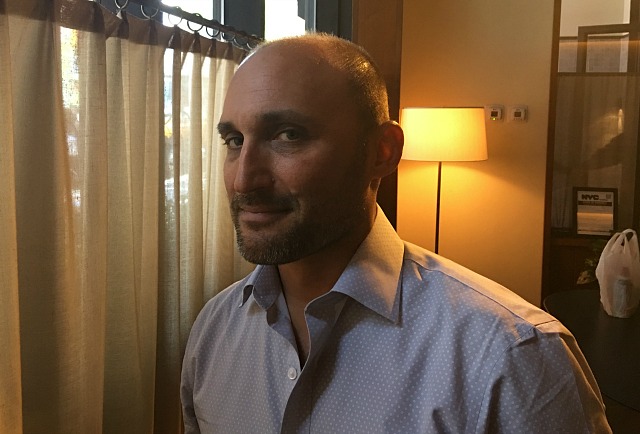
Yesterday I had a brief chat with Amir Bar-Lev, the highly respected director of My Kid Could Paint That, Trouble the Water, The Tillman Story, Happy Valley and, most triumphantly, Long Strange Trip (Amazon, 5.25). I’m a huge fan of this 241-minute doc, which more than justifies its length and winds up really bringing it during the second half. I went in as a marginal Grateful Dead fan and came out the other end as something of a devotee.
I’m sorry I won’t be in the States when Long Strange Trip has a one-night-only nationwide premiere on 5.25, but I’ll definitely be snagging the three-disc soundtrack CD. Amazon wil begin streaming the doc in 220 countries beginning on 6.2. Here, again, is the mp3. Here are some ABR excerpts from our discussion:
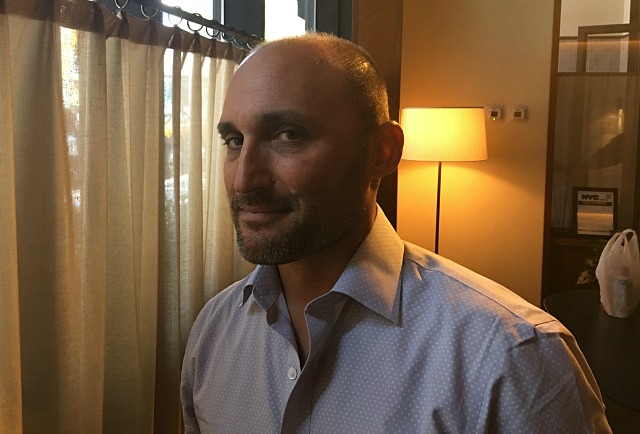
Long Strange Trip director Amir Bar-lev — Tuesday, 5.9, 12:35 pm.
Excerpt #1: “The film is not for fans…it’s for people who are not Dead fans. It’s meant to serve as a kind of marriage counselor between people who loved the band and people who never got them. Very few people are indifferent…this film is meant for people who never really understood the whole thing.”
Excerpt #2: “I’m not ready to start another film now. I’m tired. This one took a lot out of me. I remember being asked ‘if you could make any film, what would it be?’ And I said ‘I’ve just made it. This is the film I’m really the most proud of.'”
Excerpt #3: “The original idea was to make a 90-minute doc that would come out on the 50th anniversary of the start of the Grateful Dead‘s beginning, or two years ago. Everything doubled…the length, the budget, everything. It was meant to be a theatrical film, and then I couldn’t cut it down. I couldn’t cut it down. We fine-cut out way through it from the beginning, and [then] we had a working cut that was two hours long, which took the story up to 1974.”
HE review excerpt: “This is a first-rate chronicle of a great, historic American band. Don’t let the four-hour running time stop you because this time the length fits the scale of the tale. It’s one sprawling, Olympian, deeply-dug-into achievement, largely because it focuses on the story instead of the historical bullet points, and because it takes the time to explain the appeal of Grateful Dead music and the whole Deadhead ’80s culture thing, which I paid no attention to when it was happening.
“The first half is a good, comprehensive mid-to-late-’60s history lesson — efficient, amusing, well-honed and sometimes great. But Act Two (or the last two hours) really brings it home. This is where the heart is, what turned the light on — the thing that told me what Amir Bar-Lev is really up to.”
Return of Leon Vitali
Longtime HE readers will recall the Barry Lyndon aspect-ratio contretemps that happened six years ago. Lyndon costar and longtime Stanley Kubrick assistant Leon Vitali, retained by Warner Home Video as a technical consultant on a spate of Kubrick Blurays, has insisted that the Lyndon Bluray be issued at 1.77:1 rather than 1.66:1, an a.r. previously adopted when WHV released the 1975 classic on laser disc. I hit the roof when I read about this. I argued, howled, seethed.
Then Glenn Kenny posted a 12.8.75 “smoking gun” letter written by Kubrick and sent to U.S. exhibitors. It stated that Barry Lyndon had been shot in 1.66 and should ideally be projected this way.

Now there’s a documentary about Vitali, Filmworker, that will show in a few days time at the 2017 Cannes Film Festival, under the Cannes Classics subsection. The director is Tony Zierra.
Synopsis: “It’s a rare person who would give up fame and fortune to toil in obscurity for someone else’s creative vision. But that’s exactly what Leon Vitali did after his acclaimed performance as ‘Lord Bullingdon” in Stanley Kubrick’s Barry Lyndon. The young actor surrendered his thriving career to become Kubrick’s loyal right-hand man. For more than two decades, Leon played a crucial role behind-the-scenes helping Kubrick make and maintain his legendary body of work.
No Reviews Until 5.22
Without saying anything about War Machine one way or the other, I can at least mention that a pop-through supporting performance is given by Keith Stanfield. I’ve been paying attention to this 25 year-old actor for three years — Jimmie Lee Jackson in Selma, “Bug” in Dope, Snoop Dog in Straight Outta Compton and especially that creeped-ut guy passing along those weird vibes to Daniel Kaluuya during that backyard party scene in Get Out. Stanfield plays another haunted type in War Machine, an Army Corporal serving in Afghanistan who’s having trouble understanding Brad Pitt‘s convoluted strategy, and who also carries a climactic battle moment in Act Three. I’m just saying that Stanfield is the guy you’re talking about when it’s over. His character brings a couple of reality-check moments that stick.
Tap On The Shoulder
A writer never plans or knows anything in advance. He/she just lives, roams around, listens, watches. And then suddenly you’re “called.” You hear that whisper or feel a little tap on the shoulder, and either you decide that you’ve just heard something worth exploring or you don’t. The thing about good ideas (i.e., inspiration) is that they never shake you by the lapels or announce themselves like Roman trumpets. They’re like those tonal sounds that elevators make when they arrive on a certain floor….poon. Like the vibration of a phone that’s had the sound turned off. Whether or not you answer and listen is up to you.
“There’s No Crying In Baseball!”
I had a Tom Hanks-style exasperation moment inside Tribeca Cleaners this morning. I gave the guy some items (jeans, light green chinos, 2 T-shirts, pair of socks), adding that I need them by 5 or 6 pm tomorrow. He held up the socks and asked if I wanted them dry-cleaned.
Me: “Socks? No, I don’t want them dry-cleaned. In fact, I don’t want anything dry-cleaned. Don’t you guys offer laundry service?” Guy: “Yes, but most people want dry cleaning.” Me: “These are washables. Who wants jeans and T-shirts dry-cleaned?” Guy: “Most people. They want their jeans smooth.” Me: “Why? They’re just jeans.” Guy: “They don’t want any wrinkles.” Me: “Jeans don’t wrinkle. You wash them and you put them on. That’s what jeans are about…you know, the rugged authenticity thing.”
This tells you what kind of people are living in Tribeca these days. Phonies. Pod people. 21st Century Marie Antoinettes. People who would’ve run screaming from Tribeca if they’d come down here in the ’70s or ’80s.

Cannes Shitcans Netflix Fare
It’s been announced that as of next year, Netflix releases will not be screened in competition at the Cannes Film Festival. Unless, that is, the straight-to-streaming service changes its attitude about theatrical playdates. Amazon, Netflix’s biggest online competitor, has declared an intention to open films theatrically before going to streaming; Netflix has been fairly adamant about not doing that. French exhibitors have recently been venting much anger about this.
Official Cannes statement, released this morning: “A rumor has recently spread about a possible exclusion of the Official Selection of Noah Baumbach‘s The Meyerowitz Stories and Bong Joon Ho‘s Okja, which have been largely financed by Netflix. The Festival de Cannes does reiterate that, as announced on April 13th, these two films will be presented in Official Selection and in Competition.
“The Festival de Cannes is aware of the anxiety aroused by the absence of the release in theaters of those films in France. The Festival de Cannes asked Netflix in vain to accept that these two films could reach the audience of French movie theaters and not only its subscribers. Hence the Festival regrets that no agreement has been reached.
“The Festival is pleased to welcome a new operator which has decided to invest in cinema but wants to reiterate its support to the traditional mode of exhibition of cinema in France and in the world. Consequently, and after consulting its Members of the Board, the Festival de Cannes has decided to adapt its rules to this unseen situation until now: any film that wishes to compete in Competition at Cannes will have to commit itself to being distributed in French movie theaters. This new measure will apply from the 2018 edition of the Festival International du Film de Cannes onwards.”
Lettuce, Tomato, Mayonnaise
Does HE’s menu icon (three dots, three dashes) resemble a hamburger? I don’t see it but that’s the slang term used by code dweebs. I’m mentioning this because today HE consultant Dominic Eardley added three options to HE’s menu bar — Twitter, Facebook and Search. Just saying.

Trump Is Freaking
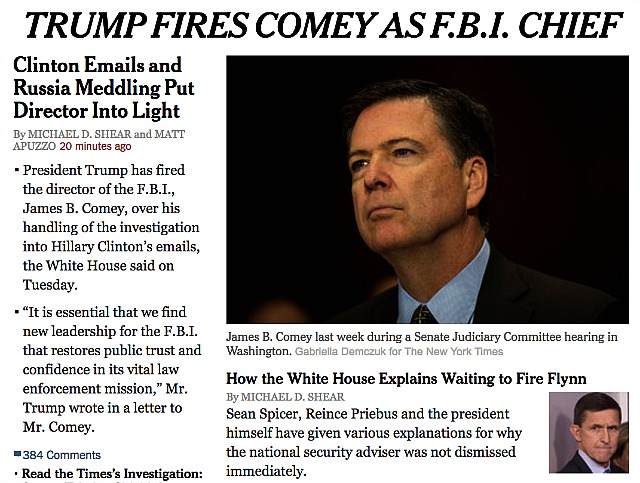
Opening graph of today’s N.Y. Times story about President Trump shit-canning former FBI director James Comey: “President Trump has fired the director of the F.B.I., James B. Comey, over his handling of the investigation into Hillary Clinton’s emails, the White House said on Tuesday.”
I seriously doubt that the reason for Trump’s action was about Comey’s handing of the Clinton email inquiry. I don’t think Trump gives one infinitesimal shit about that. I think the firing is an attempt to restrict or otherwise control the FBI’s investigation into whether members of the Trump campaign colluded with Russia to influence the ’16 election.
Comey was guiding or overseeing that investigation. I’m presuming that Comey’s replacement will be chosen based on his or her skepticism about the Russia/Trump thing, and/or a less-then-ardent interest in pursuing the matter.

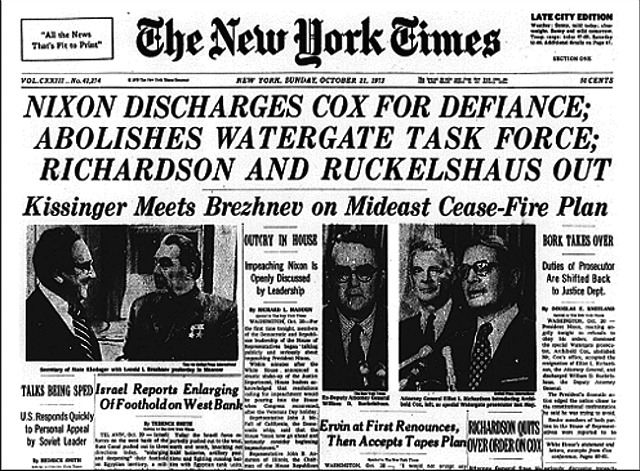
In short I think it’s a Nixon-firing-Cox episode all over again. Thoughts?
“While I greatly appreciate you informing me, on three separate occasions, that I am not under investigation, I nevertheless concur with the judgment of the Department of Justice that you are not able to effectively lead the bureau,” Mr. Trump said in a letter to Mr. Comey dated Tuesday. “It is essential that we find new leadership for the F.B.I. that restores public trust and confidence in its vital law enforcement mission,” Mr. Trump wrote.
Sense of Direction, No Urgency

I wrote for two or three hours this morning (i.e., the Sgt. Pepper piece, half the action flick piece), did my interview with Long Strange Trip director Amir Bar Lev at the Smyth Hotel (Church and Chambers). I lunched with Jett in eastern Chinatown, and then roamed around a bit, looking for the right cafe or a Starbucks to settle into. I went to Will Leather Goods on Prince Street and asked them to repair my black leather computer bag. (They never charge for repairs — always stand by their stuff.) I eventually parked it at a Starbucks on Spring and Crosby. This evening I’ll be seeing Obit at the Film Forum.



What’s Changed Over Last Four Years?

“Best Action Flicks of the 21st Century” was posted on 5.9.17. What if anything has changed in the action realm in the four years since?
To most people “action film” means violent, whoop-ass shit with lots of leaping around, automatic rifle fire, squealing tires and non-stop adrenalin. But when it comes to deciding on the best action films, most viewers aren’t that demanding. They love their jizz-whiz and don’t care about the shadings and subtleties. But I am demanding, you see. To really love an action film I have to believe that (a) what I’m watching bears at least some relation to human behavior as most of us have come to know it and is therefore delivering a semi-believable, well-motivated thing, and (b) what I’m watching could actually happen in the real-deal world of physics (i.e., no idiotic swan dives off 50-story office buildings).
I don’t care, by the way, if the action content in a film takes up the first 10 minutes or the last half-hour or the whole damn running time. All I care about is whether or not I believe what I’m seeing, or…you know, whether I’m distracted or dazzled enough so that I don’t pay attention to logic or realism factors. Whatever works. As long as action defines character and vice versa.
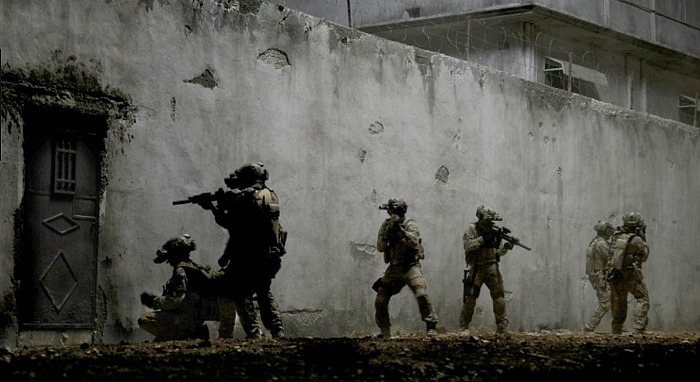
If I’m enjoying an action flick it’s because I fucking believe it, and I never believe anything that doesn’t respect some grown-up concept of reality. Fantasy flicks can blow me for the most part. I want an action movie that will plant its feet, look me in the eye and tell the fucking truth.
Very few 21st Century action films live up to HE’s rules and standards, or even give a damn about doing so. The Fast and Furious franchise is notorious for spitting in the face of reality. Almost all superhero comic-book movies revel in the fact that their realm allows them to ignore logic and believability. Once in a great while and in a very blue moon, a first-rate action flick will come along that defies HE rules but gets away with it. One of these was Ang Lee‘s Crouching Tiger, Hidden Dragon (’00), but that’s a very rare occurence. On the other hand Crouching Tiger led to the stars of Charlie’s Angels: Full Throttle flying around on wires, and that was an awful thing to behold.
Here are Hollywood Elsewhere’s choices for the 11 craftiest, best-made, most believable action films of the 21st Century, and in this order:
Don’t Ignore The Spiritual Awakening Aspect
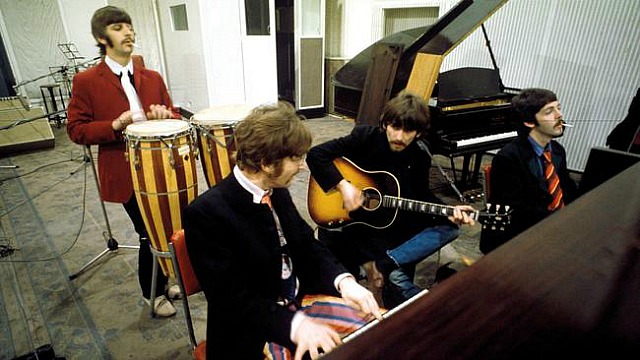
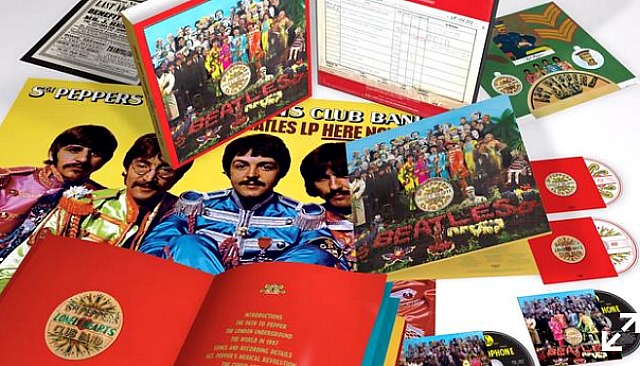
A 50th anniversary edition of Sgt. Pepper’s Lonely Hearts Club Band will pop in early June — a six-disc, all-in, bells-and-whistles cash grab.
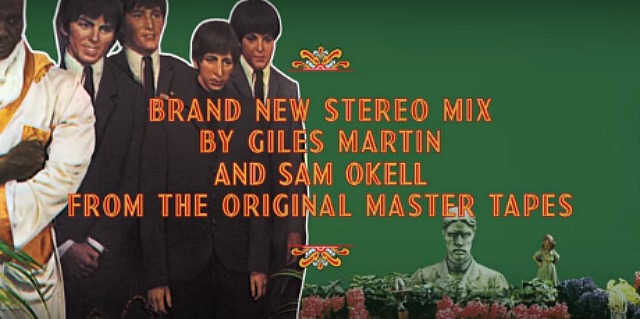
The selling point will be a a newly remastered stereo mix by Giles Martin and Sam Okell (a friend says it “sounds a bit more mono-ish” than previous editions). $117 and change. You can’t blame the keepers of the flame for trying to exploit the occasion, but no thanks. I’ve been all Pepper-ed out for longer than I’d care to acknowledge.
Expect a fresh torrent of looking-back assessments and tributes starting later this month. All will remind that Sgt. Pepper exerted a massive influence upon its time and realm, not just upon musicians and the music industry but the culture at large. I strongly suspect that a good portion and perhaps even a majority of these will ignore the psychedelic drug explosion that the album brought about. Those who do so will of course be ignoring the entire cultural earthquake that Sgt. Pepper incited, but that would be standard procedure for the corporate sector of 21st Century journalism.
Here’s an HE piece, posted in June ’07, about this very topic:
“Astonishingly and rather suddenly, beginning in June 1967 and continuing long after that, Sgt. Pepper’s Lonely Hearts Club Band persuaded a significant portion of America’s middle-class youths to throw out the basic rock ‘n’ roll rebel handbook and embark upon chemically-fortified, radiant-vision journeys of the mind and soul. This in turn led to a mass injection of satori/Godhead consciousness that literally upended liberal American society.