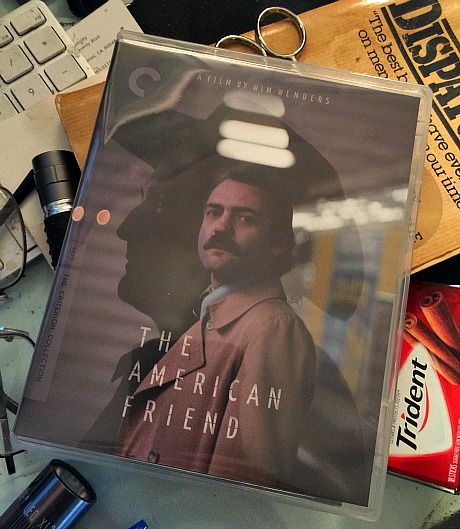
Last night I bought and watched the new Criterion Bluray of Wim Wenders‘ The American Friend. Oh, the power and the glory of that 1.66:1 aspect ratio! The disc presents the film exactly as it looked on the big screen at Alice Tully Hall when I first saw it at the 1977 New York Film Festival. No digital tweaking, like pure film. And quite perfect in that regard. But of course I wanted a little extra. I wanted my Bluray “bump” — a subtle but noticable enhancement that makes a film seem sharper and more robust than it did in theatres. But no. Wenders (who oversaw the mastering in Berlin) and the Criterion guys have shut that down. I’m not saying there’s anything “wrong” with a Bluray looking like film. I’m saying that in my heart of hearts I’m a wee bit disappointed. Just a bit.
This morning a N.Y. Times guy who had obviously read last night’s “Let It Go” post asked if I wanted to tap out 300 or 400 words about diversity in the film industry. I gave it a quick shot and sent it right off. He thanked me but said he’s heard from too many people deploring racial factors and asked me to try again. I said thanks anyway and no worries, but I’ll just post it myself:
There exists a certain constitution, sheen or formula that spells “Best Picture contender”, and the definition of these resides in the mind of your seasoned industry viewer. Many of whom look or sound like Kevin Costner or Bruce Feldman or Brenda Vaccaro or Rod Lurie or Rob Reiner or Hope Holiday, the actress from The Apartment who so angrily derided the crude bacchanalian aspects in The Wolf of Wall Street.
We all know what your classily generic, “aimed at older white people” Best Picture contender looks and behaves like — The King’s Speech, The Imitation Game, The Danish Girl. As lulling and tiresome as this equation is (British-favoring, tasteful, poised) there is still in these films an attempt to hone and refine and deliver some kind of thematic, observational summation. Who we are, what we are (or were), what this aspect or chapter in our lives amounts to in the end, etc.
Too few were willing or able to recognize this element in Cary Fukanaga‘s Beasts of No Nation, and the Academy’s failure in this regard is, many feel, arguably “racist.” This was the big 2015 outrage, if you ask me — not just a dismissal of Fukunaga’s art but a refusal to admit that the horrors of African tribal warfare are as much a part of our global narrative and social fabric as anything else.
From 1.15 story in Des Moines Register: Donald Trump has rented space at a Des Moines movie theater and is offering free tickets for a single 6 pm showing of Michael Bay‘s 13 Hours, which opens today. Excerpt: “Mr. Trump would like all Americans to know the truth about what happened at Benghazi,” the GOP presidential candidate’s Iowa co-chair Tana Goertz said Thursday night. “The [Urbandale] theater is paid for. The tickets are paid for…you just have to rsvp,” she said.
A pain-in-the-ass HE reader named Brad was putting me down yesterday for being inconsistent in my appraisals of subtle acting. When Sasha Stone and Erik Anderson labelled Rachel McAdams‘ Oscar-nominated performance in Spotlight as “robotic” during Oscar Poker #120, I suggested they were looking for “big” moments when none were written or intended. On the other hand, he complained, I’ve been dismissing Mark Rylance‘s Bridge of Spies performance as annoyingly, even arrogantly subtle. Let me explain something to Braddie-poo. Subtle acting is not just one, precisely quantified thing. There is overly subtle (Rylance), perfectly subtle (McAdams, Liev Schreiber‘s Marty Baron in Spotlight, Saoirse Ronan in Brooklyn) and not subtle enough (Brie Larson and Jacob Tremblay in Room come to mind). I’ll admit it’s rare to witness a performance that is irksomely underplayed and even smug, but Rylance takes the cake in this regard. If I was king Schreiber would be a Best Supporting Actor nominee right now, and he’d be favored to win.
More than a few award-season commentators (upscale thoughtfuls, sensitive to social currents) have repeated the “Academy racism robbed Straight Outta Compton of a Best Picture nomination” narrative today. Which is supported, some feel, by the fact that four white people — Jonathan Herman, Andrea Berloff, S. Leigh Savidge, Alan Wenkus — co-wrote the original script, which was the only Compton element that landed an Oscar nomination (i.e., Best Original Screenplay). Is there anyone bold and free-thinking enough to just blurt the truth, which is that Straight Outta Compton just doesn’t have that old Oscar schwingding thing? It’s compelling, accessible, well written, convincingly acted, and it doesn’t feel tricky or shifty. I believed it, went with it, respected it, came out tweeting its praises. But it’s just the N.W.A. story — this happened, that happened, this happened, etc. The p.c. kneejerkers would rather shoot themselves than acknowledge the simple fact that Straight Outta Compton is very good but nothing close to most learned people’s idea of great or transformative or extra-special cinema. It doesn’t wallop or shatter you — it just deals straight, credible cards about the emergence and the power and the cultural changeover of hip-hop in late ’80s and ’90s. I don’t see what’s so bad about that. Audiences and industry types seem to be equally content and pleased with what Compton is, and the fact that it earned $200 million. Why does it have to be a big Oscar thing?
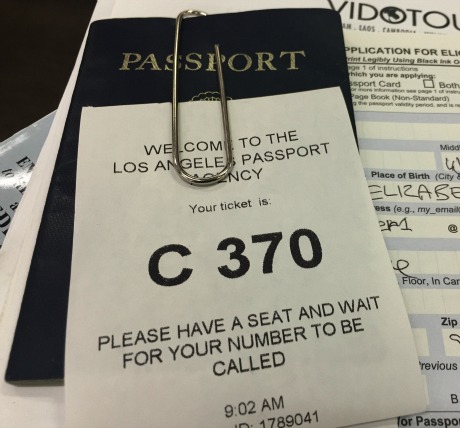
I always rise early when something’s pressing. This morning’s Oscar nominations woke me around 4 am. I finished my first filing just before 7 am, and then came the Oscar Poker podcast between 7:20 and 8 am. I left on the bike around 8:15 am for the Westwood Federal Building and a 9 am passport renewal appointment. It went fairly smoothly. A late breakfast and then back to the pad around 12 noon for an appointment with a Time Warner repair guy. And then more filing. And now a nap.
Deadline‘s Pete Hammondreminds that even though The Revenant and Mad Max: Fury Road collected 12 and 10 nominations respectively, which puts them in front of all other nominated films, their screenplays didn’t get nominated. And that, in Hammond’s view, might be cause for concern because “it’s rare for a movie to take Best Picture without a corresponding nod for its script.” The precedents are Titanic (’97), The Sound Of Music (’65), and Laurence Olivier‘s Hamlet (’48). And yet, he acknowledges, the films with the most nominations “are usually more likely to take Best Pic since it means they have more support throughout the entire Academy, which now participates in voting in all 24 categories.” Shorter Hammond: If The Revenant or Mad Max win Best Picture, which is fairly likely, it’ll constitute a statistical rarity.
Sasha Stone, Awards Watch‘s Erik Anderson and I discussed this morning’s Oscar nominations for the latest Oscar Poker. Sasha was initially upset about Ridley Scott not being nominated for Best Director, which means, of course, that The Martian has essentially been given a cottonball Best Picture nomination — i.e., a sop that means nothing. So Erik and I had to go kinda easy and let Sasha work through her feelings like a rational adult, which she did. Neither Erik nor Sasha would admit that The Revenant is far and way the likeliest winner of the Best Picture Oscar at this stage. Not would they grapple with my riff about current racial profiling gripes (i.e., why no nominations for Straight Outta Compton and Creed?) not being worth discussing except in the case of Beasts of No Nation‘s Idris Elba, who definitely should have been nominated for Best Supporting Actor. Again, the mp3.
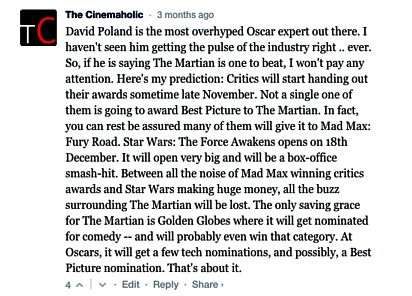
If you were any kind of perceptive, fair-minded person you knew from the beginning that Ridley Scott‘s The Martian was nothing more than a smart formula popcorn flick, at best. Obviously popular and successful but in no way deserving of a Best Picture Oscar. And yet an idea gradually took hold that Scott might snag a “gold watch” nomination for a Best Director Oscar — a kind of “hail Ridley for cranking out sharp, classy, good-looking commercial stuff for 35 years” award. The DGA went for this but not the Academy, and now everyone has accepted what I was saying four months ago, which is that The Martian might end up with a “soft” Best Picture nomination based on popularity but forget serious consideration. One of the “yay, Martian” guys (and there were quite a few of them) was MCN‘s David Poland, and you really have to give credit to the Cinemaholic for posting this three months ago on Hollywood Elsewhere:
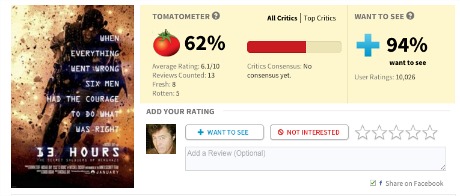
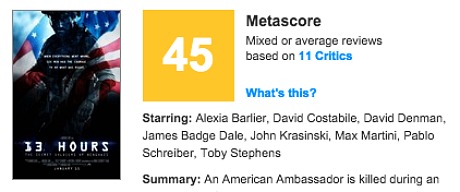
Right now (12:30 pm Pacific) Michael Bay‘s 13 Hours is at 53% on Rotten Tomatoes and 47% on Metacritic. That averages out to a failing grade, and yet I’m telling you it’s somewhat better than that. At the very least it’s a first-rate combat flick. Yes, it’s arguably a little too one-sided and swoony about the small team of mercenaries who defend the CIA annex in Benghazi, but there’s a significant moment at the end when Bay shows various women bemoaning the fallen bodies of anti-U.S. fanatics who attacked the compound, suggesting that humanistic doubts about perpetual warfare and relentless jihad are part of the current over there. Yes, Bay tries too hard to whip the film into a lather. Yes, it would have been better if he’d told the story in a plainer fashion. Yes, he repeats his famous Pearl Harbor “Bayo” when he followed a Japanese bomb dropped from a plane into a U.S, destroyer, this time following the path of a terrorist mortar. But it’s still an efficiently made, often breathtaking action thriller about stopping the baddies and defending lives. Not a burn, trust me.
Yesterday I posted a piece called “Dues and Don’ts,” which partly echoed a 2.20.15 Christopher Borelli Chicago Tribune piece that noted how actors often win Oscars for the wrong roles. This occasionally happens when (a) voters decide that a certain actor is due and to hell with how their latest performance stacks up against past triumphs, or (b) voters decide that this actor has earned a make-up for a relatively recent snub or a long string of them over the previous decade or two. One example of a delayed/makeup, Borelli wrote, was Denzel Washington winning an Oscar for Training Day after his nominated performances in Malcolm X and The Hurricane fell short on votes.
This angered a colleague. “How could Denzel have been ‘due’ for Training Day under your scenario when he had already won an Oscar for Glory?,” he wrote. “Training Day was his second win. Was he ‘due’ for a second Oscar?”
To which I replied: “Denzel’s Glory win didn’t entirely count because that was a nice-to-meetcha Oscar. The industry recognized a star in the making — a cool, charismatic, good-looking black actor of quality. Denzel was very, very good in Glory but the Oscar was mainly a vote-of-confidence thing — an ‘attaboy, keep doin’ that thing and we’ll all work together and make more good movies and tons of money’ gesture. The Training Day Oscar was the real Oscar, given to a mature, established superstar playing a ‘bad guy’ in quotes. On top of which Denzel was completely due after his performances in Hurricane and Malcolm X.”
I haven’t thought this through but I think this “nice to meetcha” vs. real Oscars thing holds water. Young, new-to-the-biz actors are in a position to win “nice to meetcha” Oscars and older, well-established actors obviously aren’t. If Brie Larson wins a Best Actress Oscar next month for her performance in Room, file that under “nice to meetcha.” If Scott Feinberg had managed to get Jacob Tremblay nominated for Best Actor, his winning would obviously qualify in this regard. But it won’t apply, obviously, if Charlotte Rampling wins. Nor can Leonardo DiCaprio‘s all-but-locked-down win for The Revenant qualify. “Nice to meetchas” are only for spring chickens.
The 2015/16 Oscar nominations are 20 minutes old, and the biggest headline is that Alejandro G. Inarritu‘s The Revenant is now the most likely Best Picture winner as evidence by 12 nominations. It might not win, but we all know what 12 nominations almost always mean. A lot of grumbling, a lot of pushback pieces to come…but the writing is on the wall and it’s not going to easily wash off.
The other big, percolating, machine-gun headlines:
(a) Spotlight, the widely presumed Best Picture front-runner all through Oscar season until last weekend, when The Revenant opened big and took the Best Picture, Drama award at the Golden Globes, is on the ropes and quite possibly toast in terms of Best Picture prospects. Speaking as a Spotlight worshipper from way back, this is very sad news. Comment: The Revenant may be the greater, more ambitious film, but I love Spotlight with all my heart. And yet I have to recognize what’s happened over the last six days — a complete turnaround for The Revenant beginning with last weekend’s $39 million gross, those three Golden Globe awards (Best Picture Drama, Best Director, Best Actor) and now this morning’s 12 nominations. It’s probably all over but the shouting. Tell me how Spotlight or another film can win.
(b) Alejandro G. Inarritu and dp Emmanuel Lubezski are in an excellent position to make Oscar history. What do you say to that, Sasha Stone?
(c) Ridley Scott‘s gold-watch Best Director nomination didn’t happen, despite his being DGA nominated a couple of days ago and The Martian having snagged a Best Picture nomination. Why didn’t Scott make the cut? I’ll tell you why. Room director Lenny Abrahamson (who hasn’t a tiny snowball’s chance in hell of winning) elbowed him aside.
(d) Love & Mercy‘s Paul Dano wasn’t handed a Best Supporting Actor nomination, to the eternal shame of the Academy and particularly because the majority of blogaroonies resisted the Dano movement by ghetto-izing Love & Mercy as a non-starter because it opened last summer — this is on you, blogaroonies!;
(e) “No black nominees” (particular attention is being paid to the absence of Straight Outta Compton and Creed noms) is not a story because racial quotas are bullshit — Compton and Creed are good, engaging, well-made films, but the Academy decided they weren’t quite good enough to be nominated, and that’s that;
(f) Charlotte Rampling landed a Best Actress nomination for 45 Years — the Academy overrides SAG consensus!
(g) All of those Jacob Tremblay supporters (first and foremost The Hollywood Reporter‘s Scott Feinberg) are shaking themselves off right now and saying “okay, okay, I got a little carried away but the kid nailed it”;
(h) The Academy bought the category-fraud narrative that Carol‘s Rooney Mara gave a supporting performance. Because, I’m guessing, they really liked Cate Blanchett‘s costarring performance and wanted to nominate her also, which meant slotting her into the Best Actress category. Right?
(i) How did Cheryl Boone Isaacs manage to screw up the pronunciation of Alejandro G. Inarritu‘s last name? The guy’s been a big deal in this town for the last 15 years.
What else? I’m still working on this but I don’t have oodles of time as I have a 9 am appointment at the passport office in West Los Angeles. It’s 6:31 am as we speak.