“Are you listening to me, asshole? Because I like you. I got a serious question for you. What the fuck are you doing? This is not shit for you to be messin’ with. Are you ready to hear something? I want you to see if this sounds familiar. Any time you try a decent crime, you got fifty ways you’re gonna fuck up. If you think of twenty-five of them then you’re a genius…and you ain’t no genius. You remember who told me that? I hope you know what you’re doing. You’d better be damn sure because if you ain’t sure then don’t do it. Of course that’s my recommendation anyway. Don’t do it.”
VFX Overkill, Musical Score Tries Too Hard, General Lack of Subtlety
Patrick Ness‘s “A Monster Calls” (published in 2011) has been described as a sad but transporting tale about a boy coping with his mother’s illness from terminal cancer, and about a realer-than-real fantasy realm that he retreats into or which sucks him in…you decide. No one knows how J.A. Bayona‘s film version (Focus, 10.14) has turned out, but the trailer indicates that a subtle approach has not been chosen. Liam Neeson‘s overly-enhanced voice and Fernando Velázquez‘s overbearing score tell you that the movie has been aimed at the family idiot trade. It seems to lack the quiet spookiness of Guillermo del Toro‘s somewhat similar Pan’s Labyrinth, and seems a far cry from the the carefully layered, exquisitely underplayed The Orphanage (’07), which is Bayona’s masterpiece.
Won’t Be Just Any Night
Anthony and Joe Russo‘s much-praised Captain America: Civil War (Disney, 5.6) is being screened tomorrow at Cinemacon, but I’ll be catching it tonight at the big Hollywood Blvd. premiere at the Dolby. Allegedly starting at 7 pm but most likely beginning closer to 7:45 or 8 pm, if that. If it’s as good as everyone is saying it is…well, the downside doesn’t seem to be on the table, does it? It’s a lockdown.
Cannes Countdown
The slate for the 2016 Cannes Film Festival will be announced in Paris on Thursday morning, which works out to sometime between 2 am and 3 am in Los Angeles, or basically late tomorrow night. I’ve already lamented some of the underwhelming predictions (Steven Spielberg‘s The BFG, Jodie Foster‘s Money Monster) and am feeling only modest enthusiasm for Woody Allen‘s Cafe Society, which will open the festival, or Jeff Nichols‘ Loving (i.e., the beware of Joel Edgerton factor) or Nicholas Winding-Refn‘s Neon Demon.
I really, really don’t want to sit through Terrence Malick‘s Voyage of Time, but I may have to if it’s part of the program. More whispery footage of dinosaurs and jungle leaves and forest streams and lizards and images of magma spewing out of volcanos? Are you fucking kidding me?
Pedro Almodovar‘s Julieta, approved. Perhaps an Asghar Farhadi or a Cristian Mingiu film, okay. Sean Penn‘s The Last Face, Xavier Dolan‘s It’s Only the End of the World, the Dardennes’ La fille inconnue (The Unknown Girl), Paul Verhoeven‘s Elle, Park Chan-Wook’s The Handmaid, Emir Kustrica‘s On The Milky Road, Pablo Larrain‘s Neruda, Ken Loach‘s I, Daniel Blake…who knows?
No Ben-Hur Love From Hammond
Deadline‘s Pete Hammond is one of the more gracious, turn-the-other-cheek columnists around. He doesn’t miss a trick but his natural wont is to be charitable or at least not backhand a film if it all possible. So his measured, less-than-cartwheely comments about Timur Bekmambetov‘s Ben-Hur (8.19) following yesterday’s Cinemacon presentation are instructive.

Referring to Paramount’s Las Vegas presentation of Teenage Mutant Ninja Turtles: Out Of The Shadows, Star Trek Beyond and Ben-Hur, Hammond wrote that he’s “not sure [if] any of these is necessary for anything but Par’s bottom line, but the crowd seemed happy to see them all.”
Then he said that Ben-Hur‘s “dog days of August opening gives one pause, but perhaps Paramount has discovered a faith-based audience dying to see a biblical epic like this at the end of summer.”
He added that Ben-Hur star Jack Huston, who showed up yesterday, “is trying to fill Charlton Heston’s shoes, and might come close based on the footage.” “Trying”? “Might”?
Where’s The Screening Room Beef?
A week or so ago Exhibitor Relations analyst Jeff Bock told the Guardian‘s Rory Carroll that Sean Parker‘s Screening Room proposal (immediate access to new movies for $50 a pop) “is no doubt going to be the talk of the town at CinemaCon…this could be a massive game-changer.”
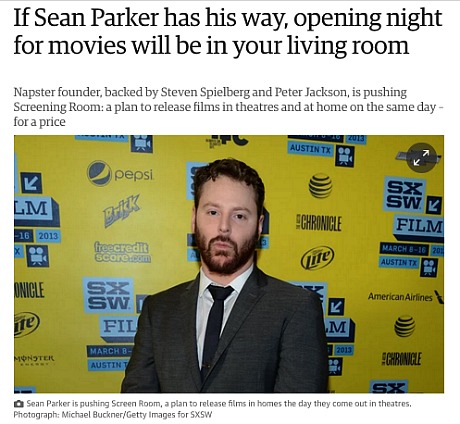
There’s talk about Parker and his crew offering some kind of presentation this week in Las Vegas, but not in any official capacity.
“If they’re coming because they have a hotel room…they are not on our official schedule,” CinemaCon managing director Mitch Neuhauser told TheWrap’s Matt Donnelly in a piece that posted last night. “CinemaCon is all about movies on the big screen.”
So when and where will the Big Debate occur? At what Cinemacon forum will voices be heard pro or con? If and when Parker shows up will anyone throw a drink in his face or trash Screening Room in some vocally demonstrative way, or is the whole Cinemacon-vs.-Screening Room brouhaha just a lot of hot journalistic air?
Odious Vibe of Golfers
Like everyone else I was impressed — amused — by yesterday’s hole-in-one by Louis Oosthuizen. But he just got lucky is all. I’ve never felt any contact highs from golf. Those grotesque shirts, shoes, caps. An elitist sport for well-off conservatives, salesmen, clubby guys from the financial sector. A few years ago ago I met some business-affairs guy who was going to the Cannes Film Festival, but had decided to bring his golf clubs along so he could play 18 holes somewhere on the Cote d’Azur. I immediately said to myself “what an asshole.” I vaguely hate the idea that golf even exists. I respect the skills, of course, but the only time I even half-related was during that sequence in Kevin Costner‘s Tin Cup when he keeps whacking the same difficult shot and dropping the ball in a pond. I worked as a caddy a couple of times when I was 16 or 17 and I hated the vibe. If a woman tells me she plays golf, I immediately write her off.
Cryin’ Over You
There’s a kick-in-the-pants sequence in Luca Guadagnino‘s A Bigger Splash that uses the Rolling Stones’ “Emotional Rescue.” Sing it, feel it…infectious. But it brought back a misheard-lyrics issue from way back. Go online and the song ostensibly begins as follows:
“Is there nothing I can say, nothing I can do?
Change your mind. I’m so in love with you.
You’re too deep in, you can’t get out.
You’re just a poor girl in a rich man’s house.”
I’ve never heard “too deep in.” Idiotic as it sounds, I’ve always heard “bootie bear.” Here’s how the opening stanza sounds to my ears:
“Is there nuttin’ I can say, nuttin’ I can do?
Change yo’ mind. Ahm so in love wit you.
Bootie bear, yuh can’t get out.
You’re just a poor girl…rich man’s house.”
All these years I’ve told myself that “bootie bear” was a romantic nickname that the guy had given the girl in question. People do this. A girlfriend from the mid ’80s used to call me “huggie bear” so it’s not that crazy.
Much Better Splash Than Expected — Perverse, Noirish, High-Style, Sensual
Luca Guadagnino‘s A Bigger Splash (Fox Searchlight, 5.13) is a noirish Mediterranean hothouse thing — a not-especially-sordid sex and betrayal story that builds so slowly and languidly it feels like there’s nothing going on except for the vibe, and honestly? It’s so lulling and flavorful and swoony and sun-baked that you just give in to it. The undercurrent is…well, gently mesmerizing, and that was enough for me. I can’t wait to see it again, or more precisely go there again. I felt like I was savoring a brief vacation. I’m not saying the dramatic ingredients are secondary, but they almost are.
,
The title comes from a David Hockney painting, and that in itself should tell you where Guadagnino is coming from. A Bigger Splash is about island vibes and coolness and louche attitudes and to some extent the splendor of the druggy days, and particularly the legend of the Rolling Stones.
This is Guadagnino’s second collaboration with Tilda Swinton after I Am Love, the Milan-set family drama that opened seven years ago, and the newbie is…I don’t what it is exactly.
In my mind the island of Pantelleria, which is halfway between Tunisia and the southwest coast of Sicily, isn’t just the setting but a kind of lead character. It colors and tonalizes and blows little mood gusts.
Swinton plays Marianne, a late 40ish rock star (a sort of female David Bowie type) who’s vacationing there with boyfriend Paul (Matthias Schoenaerts), a distinctly younger fellow who’s a rock-industry photographer/filmmaker.
“Pound Them, Charlie…Pound Them”
So Devin Faraci‘s 3.31 report about Suicide Squad doing extra shooting to add “more humor and lightness” is incorrect, according to a tweet posted by director David Ayer this morning. And yet additional shooting has occured, according to costar Jai Courtney. His comment to Entertainment Tonight: “I wouldn’t say we’re trying to make it funny…there’s some additional action stuff that we’ve been doing that’s pretty dark.” HE comment #1: The Suicide Squad trailer footage has been fairly arch and meta-jokey so it seems unlikely that any kind of additional material would be “pretty dark.” Faraci wrote that “[they’re] not inserting jokes left and right but that they’re beefing up fun character moments and interactions.” HE comment #2: With Suicide Squad not opening until 8.5.16, Warner Bros. will presumably be carpet-bombing with promotional materials for the next five months…right? I’m already half-sick of this thing.
The Father Of It
If Bernie Sanders hadn’t decided to run for President against Hillary Clinton, the despair and depression out there right now would be overwhelming. Heroin use would be three or four times what it is now. Sanders will not win the Democratic nomination but he’s ignited fresh political kindling, a communal sense that “the old ways are only going to keep pushing us down so we have to get rid of them,” and a belief in fundamental fairness and corporate pushback that never would have happened if Hillary had run more or less unchallenged. She’s a smart, driven, reasonably decent person whom I intend to vote for in the fall, but she’s a corporate player who is glomming on to the Sanders spiritual wave because it benefits her campaign. God knows what she’d be saying or proposing (or what she’ll try to do as President) if Sanders hadn’t come along. Sidenote: Documentarian Matthew Cooke smiles and nods too eagerly when Mark Ruffalo is expressing a thought. Tone that shit down.
The Devil Probably
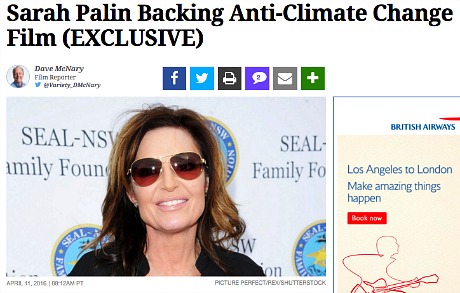
Who will historians point to 100 or even 80 years hence, when the waters of the Hudson and East River will have begun to lap onto the streets of Manhattan, as the most rancid and villainous figures of early 21st Century culture? Indeed, who at the moment of their deaths are sure to be seized by feral, growling, sharp-clawed demons and plunged into the hottest caverns of hell? Climate-change denialists, for openers, but even more deserving of damnation will be the anti-climate-change propagandists. And so I dream of Sarah Palin, naked and howling and roasting on a spit. But with her glasses on. Palin and her ilk just keep coming, keep spewing. Not God Herself nor the wonders of all creation will get in their way.