Are You Socially Astute Enough to See "The Invite" Next Weekend?
June 20, 2026
A Poster Image Like This Would Never Pass Muster These Days
June 19, 2026
Cruel Stalinist World, You Bet
June 19, 2026
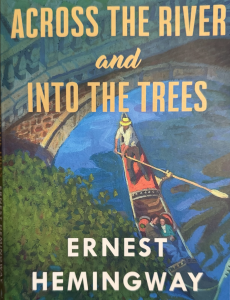
The title of Ernest Hemingway‘s “Across The River and Into The Trees” came from the dying Confederate general, Stonewall Jackson: “A smile of ineffable sweetness spread over his pale face, and then he cried quietly and said with an expression of relief, ‘Let us cross over the river and rest under the shade of the trees’, and then, without pain or the least struggle, his spirit passed from earth to the God who gave it.”
Hemingway: “I ought to live here. On retirement pay I could make it all right. No Gritti Palace. A room in a house like that and the tides and the boats going by. I could read in the mornings and walk around town before lunch and go every day to see the Tintorettos at the Accademia and to the Scuola San Rocco and eat in good cheap joints behind the market, or mayb, the woman that ran the house would cook in the evenings.
“I think it would be better to have lunch out and get some exercise walking. It’s a good town to walk in. I guess the best, probably. I never walked in it that it wasn’t fun. I could learn it really well, he thought, and then I’d have that. It’s a strange, tricky town, and to walk from any part to any other given part of it is better than working crossword puzzles.”
HE has never seen Frank Oz‘s The Score, which opened two months before the 9/11 tragedy. I steered clear because I immediately sensed an insignificant, fuck-all, hack-level vibe. Plus I never liked Oz’s Yoda voice…that’s honestly why I avoided this fucking film. Marlon Brando didn’t like Oz either, calling him “Miss Piggy” and refusing to take direction from Oz during portions of the shoot blah blah. The irony is that fatfuck Brando, unable to control his ice-cream eating habit, deserved the Miss Piggy label more than Oz. The below scene (which I had never seen before today) was kind of half-assedly directed by Robert DeNiro. Marlon’s dialogue was improvised to a certain extent.
There’s a scene in Casablanca that is uniquely, unmistakably American to the core. Major Heinrich Strasser asks Richard Blaine if he can imagine German forces on the streets of New York City, and Blaine replies, “Major, there are certain sections of New York I wouldn’t advise you to invade.” That‘s America, but that’s only one scene.
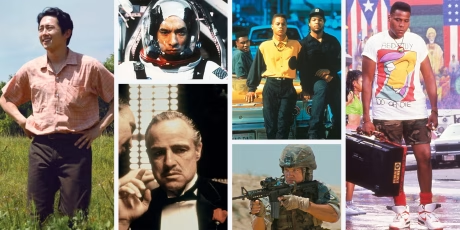
“The most American movies”? What the hell does that even mean, Anthony Breznican? Movies that radiate Democratic ideals? No longer — not in the America of 2026. Films that convey something essential about scrappy, outspoken Americans in times of trouble? Movies about American adventures, arguments, unfairness, brutality, pushbacks, patriotism?
Here are a few off the top of my head: The Grapes of Wrath, Twelve Angry Men, The Godfather I and II, Mississippi Burning, Spotlight, All The King’s Men, Do The Right Thing, To Kill A Mockingbird, The Ox-Bow Incident, Shane, Manchester By The Sea, The Talk of the Town, Home of the Brave, Network, The General or The Great Locomotive Chase orboth, Serpico…I can’t even do this. What first-rate, hard-hitting drama set in this country isn’t “American” in this or that sense?
The late Clint Hill was only a few feet away from JFK’s limo, and then he was right on top of the trunk. And then in Parkland’s trauma room #1. And he always shot straight.
There’s nothing else to consider or discuss. The grassy knollies and the occipital head wound crowd (i.e., those bullshit Parkland surgeons) can all take a hike. No badgeman, no umbrella man, no nuthin’.
“The trauma surgeons realized almost instantly there was nothing they could do. They didn’t even turn the president’s body over. They only looked at him from the front. Two bullet holes in the back. One in the neck, [which] exited where the necktie is…nicked the knot. The other one low in the back of the head that exited above the ear….the one that they saw immediately. No brain matter there, the eyes were fixed and dilated. [JFK] was breathing a little bit when we got him into the emergency room, [which] I guess was just an involuntary situation, but it didn’t last long. There was no blood pressure and…nothin’.”
It was late and I gave in to a “fuck it” impulse. It had been several years since I actually sat down with Green Book, and I thought I’d just, you know, briefly sample — just to see if this or that scene or section still holds up. Certainly with no intention of going the distance. I must have watched Peter Farrelly’s film five or six times in late 2018 and early ‘19.
But it hooked me within seconds — the assured Kennedy-era vibe, ultra-concise editing, spot-on character brushstrokes, perfect performances, the bounce of it all. And I happily settled in for the duration. I’d honestly forgotten some of the laugh lines, emotional hits, subtle pings. It ended around 1:40 am, and I felt fully taken care of (placated?) as I walked upstairs.
Allow me to once again convey my deepest loathing for the proverbial mob…all of those fascinating canker growths who, seven and a half years ago, relentlessly pissed on this admittedly mild but exceptionally well-made moral fable.
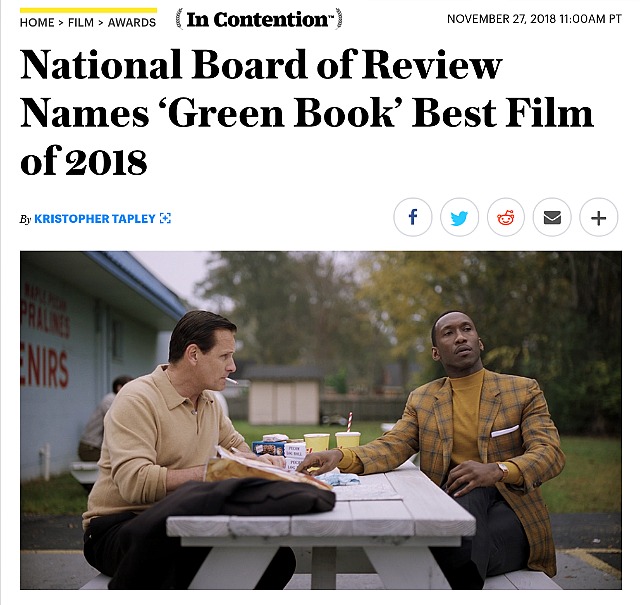
Worse in their view, the NBR has given its Best Actor trophy to Viggo Mortensen, whose chances of winning any acting awards had been dismissed by NAPSCA reps after he mistakenly used a verboten term in a post-screening discussion.
In a joint statement, NAPSCA co-chairs Brooke Obie and Inkoo Kang have said that “the NBR is obviously entitled to hand out its top awards to any film or filmmaker or performer it chooses…we wouldn’t want to inject ourselves into any private voting dynamic.
“However, we would be derelict in our duties as moral and ethical arbiters if we didn’t express disappointment that they chose to honor Green Book, which, as we’ve patiently explained, fails to reflect the current politically correct values and conversations that we would prefer to see in commercial cinemas these days.
“Peter Farrelly‘s decision to craft an admittedly well-honed, racially-stamped, deftly humanist road saga, not by way of a 2018 instructional scold manual but according to the unfortunate cultural norms of 1962 (“yes, life for POCs could be cruel and ugly back then but not altogether due to a random capacity for moral growth…yes, even among under-educated Italian streetcorner goombah types”)…Farrelly’s approach obviously goes against the grain of current progressive thought, and we strongly disagree with this.
“Moreover, we and our woke brethren will be doing everything we can to trash and belittle Green Book between now and the 2.24.19Oscarnighttelecast. We will certainly be meeting later today to discuss measures that will hopefully nip such odious celebrations in the bud.”
The other NBR awards: Best Director — Bradley Cooper, A Star Is Born, Best Actress — Lady Gaga, A Star Is Born, Best Supporting Actor — Sam Elliott, A Star Is Born, Best Supporting Actress — Regina King, If Beale Street Could Talk, Best Original Screenplay — Paul Schrader, First Reformed (yes!) Best Adapted Screenplay — Barry Jenkins, If Beale Street Could Talk (really?) Best Animated Feature: Incredibles 2 (give me a break!) Breakthrough Performance: Thomasin McKenzie, Leave No Trace Best Directorial Debut: Bo Burnham, Eighth Grade, Best Foreign Language Film: Cold War Best Documentary: RBG.
A smart, well-educated friend hated Al Pacino‘s “ice-man” performance…”he’s playing an effing dead man…the whole film happens inside a tomb,” he complained. I tried to convey my much more approving impressions…no dice.
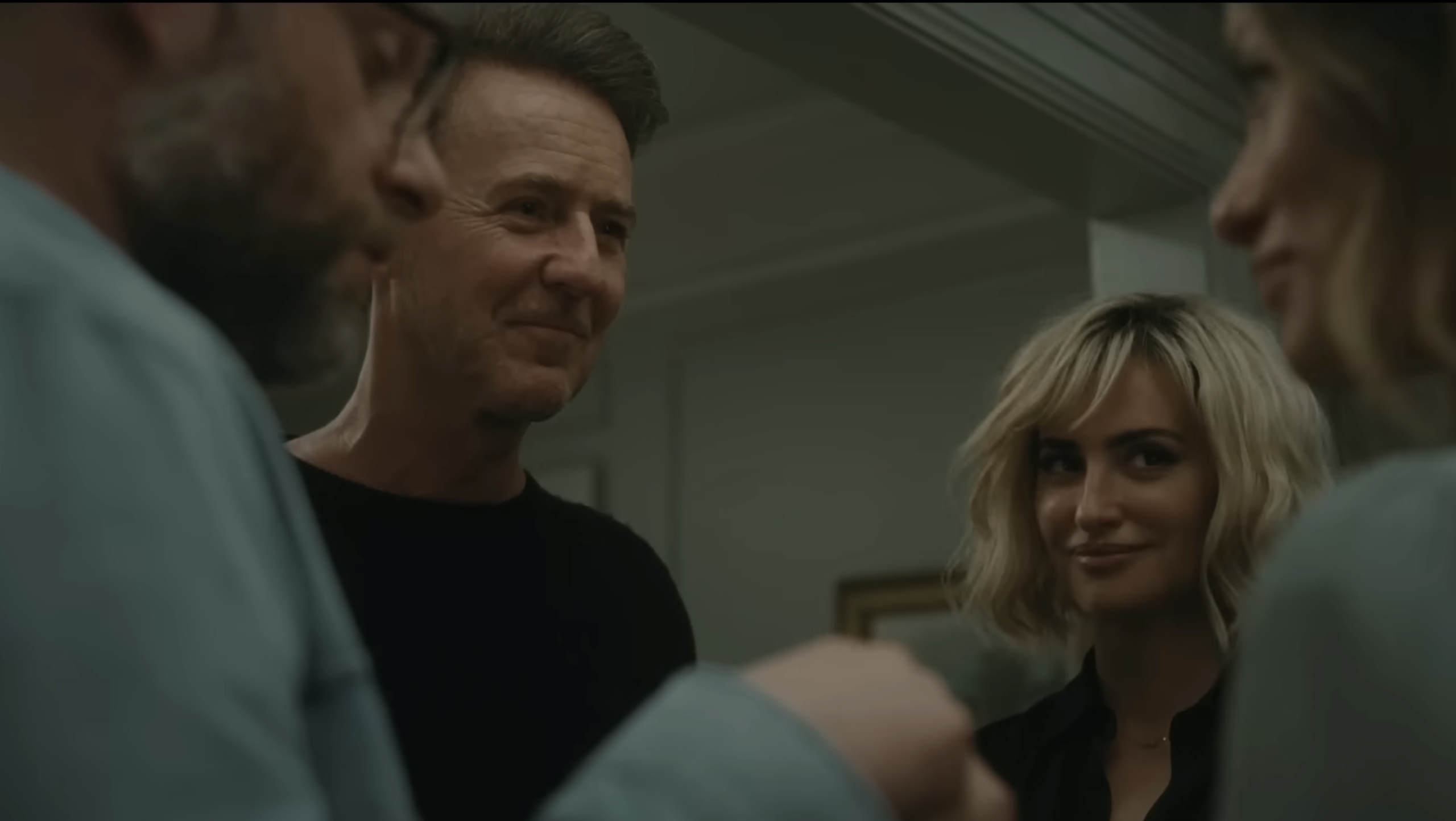
At long last, Olivia Wilde‘s The Invite is about to open. The very first showings will happen on Thursday, 6.25, but — but! — only if you live in a big-ass city. A24 has decided that suburbanites aren’t hip enough to show up in sufficient numbers, and as far as I can discern The Invite isn’t even booked to play Connecticut a week or two later.
A24 to suburban schlubbos: Sorry but we don’t trust you. You’re too slow, too lazy, too myopic…you lack a sense of adventure!
Why does A24 feel this way? Because The Invite is about a swinging couple (Ed Norton, Penelope Cruz) inviting their married downstairs neighbors (Seth Rogen, Wilde) to swap or whatever, and they’re convinced that suburban rubes would be turned off by the idea or, God forbid, the reality of Cruz going down on Rogen.
If I was Cruz there’s no way I’d be down with having any kind of sex with Rogen. No way on God’s green earth.
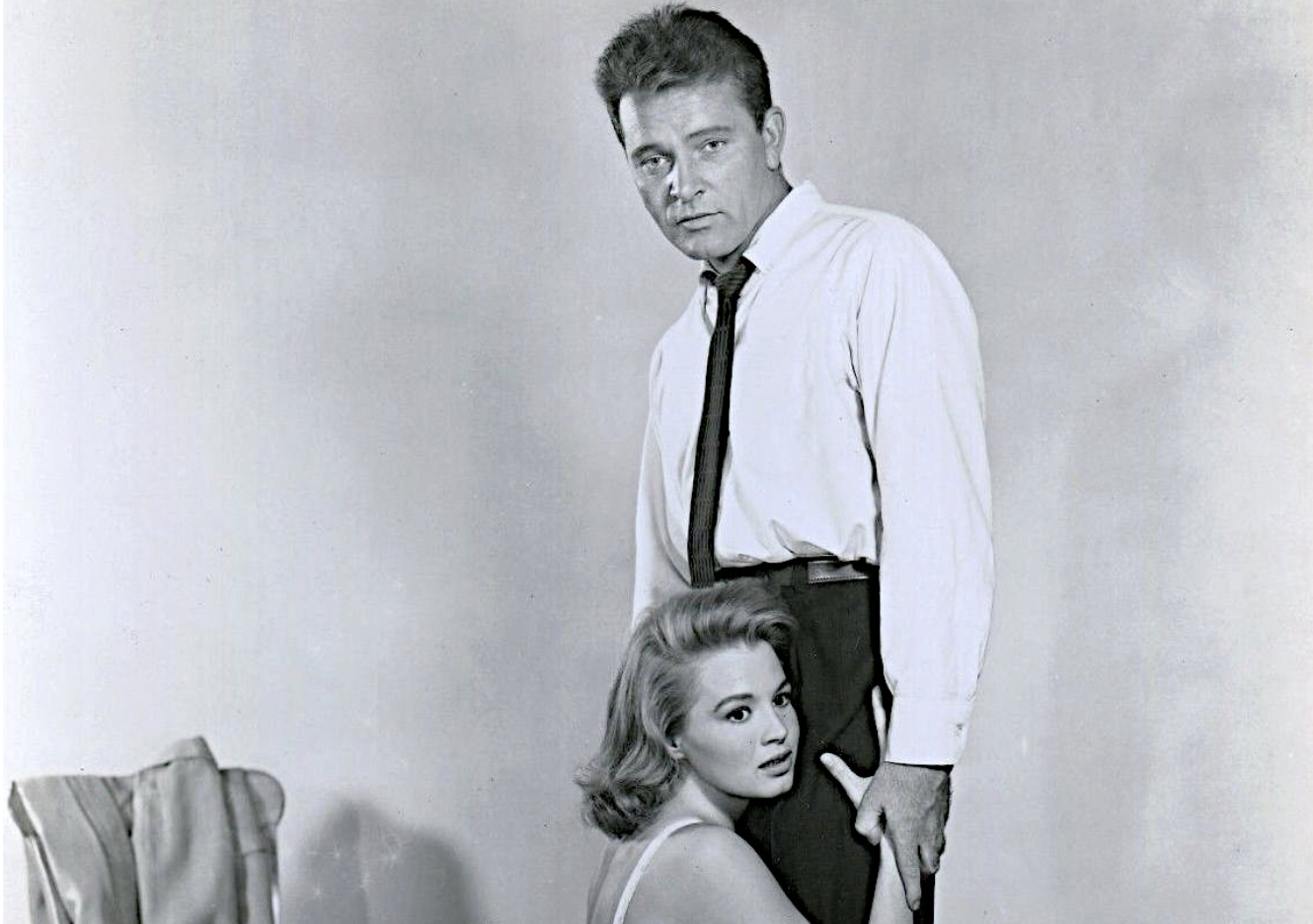
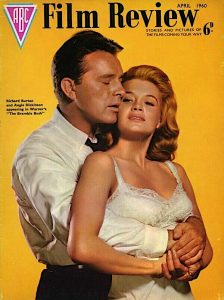
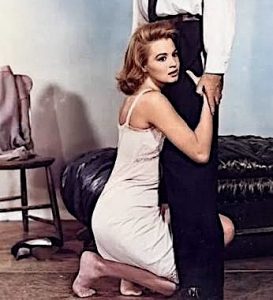
In TheBramble Bush (‘60), Richard Burton played Guy, a doctor, and Angie Dickinson played Fran, a nurse. The image is meant to convey Fran’s trust in Guy and her gratefulness for his manly protections. Filthy-minded moviegoers interpreted it another way.
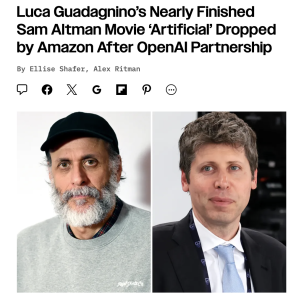
OpenAI’s Sam Altman, presumably irate about Luca Guagdagnino‘s Artificial portraying him as some kind of shithead, civilization-destroying villain, has seemingly persuaded Amazon’s Jeff Bezos to drop Artificial and cast it out upon the heaving seas.
Another distributor will step into the breach, of course, but this obviously means that Artificial absolutely, positively has to premiere at the 2026 Venice Film Festival, going right up against Aaron Sorkin‘s The Social Reckoning. Because it’s now officially a controversial hot-potato film, and there can be no wimping out any more. No more candy-assing! This situation needs real men.
Puck reported the news first; Variety‘s Ellise Shafer and Alex Ritmanquickly followed up.
Variety #1: “The move notably comes after Amazon struck a massive partnership with the tech company in February to expand OpenAI’s use of Amazon Web Services and develop custom AI models, which included a $50 billion investment on Amazon’s part.” Altman and Bezos are pally-wallies. Variety has reported: that Altman attended Bezos’s Italian wedding last year.
Variety #2: “Variety understands that, prior to being dropped by Amazon, Artificial already had several test screenings, which went down very positively, and screened for other studios on Thursday. According to an insider who has seen the movie, the characters of Altman and Musk are the least sympathetic and the ones audiences would “like the least”. It’s also understood that Amazon had seen all the early iterations of the script, before Guadagnino boarded the project.”
The leading good guy in Artificial is Yura Borisov‘s Ilya Sutskever, the former OpenAI chief scientist. Borisov scored big-time as the tender, considerate, bald-headed goon in Anora.
Andrew Garfield plays Altman, Monica “Joan Baez” Barbaro is former OpenAI CTO Mira Murati, and Ike Barinholtz plays effing Elon Musk. Cooper Hoffman, Jason Schwartzman, Cooper Koch, Billie Lourd, Zosia Mamet, Angus Imrie, Chris O’Dowd and Mark Rylance costar. Penned by Simon Rich, the script is primarily about a brief period in ’23 when Altman was canned from his position at OpenAI, and was then rehired.