What’s The Big Deal? Not Getting It.

Will someone explain what’s so friggin’ Oscar-y about Geeta Gandbhir‘s The Perfect Neighbor (Netflix), which premiered 9 or 10 months ago at wokey-woke Sundance?

It’s a very compelling, skillfully edited police-bodycam-footage doc of a boilerplate racial-animus-in-a-neighborhood killing. Hate-driven, agitated-by-noisy-kids Karen (who probably drinks) pulls a gun, loses control, plugs her POC neighbor in the chest…par for the course in Ocala, a boondocky burgh in northern central Florida …a downmarket tabloid American town.

An unfortunately commonplace occurence these days, but on the other hand (a) what’s the big deal?, (b) what else is new? and (c) so what?

What about a Netflix doc about Iryna Zarutska, the innocent young Ukranian blonde who was recently stabbed to death by that mentally unstable black dude, Decarlos Brown, in the Charlotte area?

Or about that 2023 NY subway episode in which Daniel Penny restrained the mentally unstable Jordan Neely and inadvertently choked him to death?

No way, Jose. One, no documentarian operating within the iiberal Hollywood filmmaking bubble would dare make a doc about either incident. And two, neither Sundance nor Netflix would ever screen either one, mainly because of content that would inevitably reflect negatively on DOCs (dudes of color).

I’m obviously not defending that seemingly scabrous Ocala woman who shot her neighbor point blank. But docs about real-life killings have to cast frowning judgment upon paleface aggressors.

Leave Poor Neil Diamond Alone

Craig Brewer‘s Song Sung Blue (Focus Features, 12.25), a period musical about a Neil Diamond tribute duo, will be screening soon for Critics Choice members on both coasts.

Before film writers start digging into Diamond’s music and career history and especially his recent, very sad encounter with Parkinson’s disease, let’s get one thing out of the way — the blackface sequence in Richard Fleischer‘s The Jazz Singer, a remake of the 1927 original that starred Al Jolson.

The Fleischer film came out 50 years ago, and even then critics were raising their eyebrows…just leave it there.

Gleiberman Is Way, WAY Wrong On This One…Sorry

I’m sorry but herewith is a bellowing HE ixnay in response to an outrageous, forehead-slapping assertion from Variety‘s Owen Gleiberman, to wit:

No, no, no, no, no…no way.

First, Owen says that the “OBAA is hardcore leftwing girlboss agitprop” accusation is primarily coming from “commentators on the right, the far right, and the extreme alt-right, from Ben Shapiro to film critic Armond White.”

But wait…he acknowledges that Brett Easton Ellis is saying this also.

And hey…what about little old me, bruh?…a sensible centrist who voted for Kamala Harris, Barack Obama and John Kerry, who wears Italian-crafted lace-ups and has undergone three Prague touch-ups, continues to swear by David Bowie, Lou Reed and Warren Zevon on the headphones while telling Big Star cultists to go fuck themselves, dropped acid at least 10 or 12 times in the old days, and so on? I’m no rightie! I’m an odd blend of Honore de Balzac, Georges Danton and Robert Ryan‘s Deke Thornton in The Wild Bunch, for Chrissake.

And what about John Nolte‘s recent, thought-through assertion that One Battle After Another is a grand inverse of D.W. Griffith’s The Birth of a Nation?

HE to Gleiberman: “I’m very, very sorry but OBAA definitely celebrates or at least emotionally supports or sympathizes with vigorous hard-left agitation and sweaty-ass-cheek insurrectionism

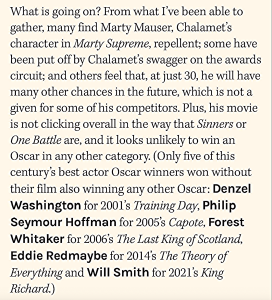
“On top of which it’s totally fucking finished as a prospective Best Picture Oscar winner. Nominations, sure, but no Best Picture cigar. The four finalists with an actual chance of winning the top prize are Hamnet, the totally masterful and elevational Sentimental Value, possibly Marty Supreme but not really, and Ryan Coogler’s bullshit mediocre schlocksploitation vampire flick.

“The nationwide vibe shift has changed everything. Charlie Kirk (whose views I mostly found appalling, no matter how civil his debating manner was) was shot in the neck by a young, ferocious-minded gay lefty…a dude who thought and acted and burned within like Perfidia Beverly Hills. Stick a fork into One Battle After Another. Stick it in and break it off.”

Owen again:

Mamdani Obviously Has This

I must admit that I was impressed by Zohran Mamdani‘s razor-quick mind and general debating skills the other night. He’s obviously going to be the next NYC mayor, but his seemingly pro-Muslim, anti-cop, anti-Jewish agenda…I guess I shouldn’t say stuff like this. Give the guy a chance, right?

But his mayoral administration will probably be, I’m guessing, a little bit like London Breed‘s term as San Francisco mayor (2018 to 2025), and you know how that fucking turned out.

Mamdani wants to make bus service free for hard-working plebes struggling to make ends meet…fine. But you know who’s going to become a permanent fixture on those buses, right? Bums. Smelly, drooling bums.

Hedren Radiated A Certain Barren Quality

HE-posted on 1.20.24:

Tippi Hedren’s characters in The Birds and Marnie have always struck me as curiously prim, overly tidy mannequins. She fit that immaculate, early ‘60s department store window persona — not just conservative, but a bit chilly and brittle.

I’m sorry but you don’t believe for a second that either character has ever been possessed by a single erotic impulse. Alfred Hitchcock was once quoted saying that Hedren “didn’t bring the volcano.” He wasn’t wrong.

Grace Kelly had a similar porcelain quality, but one always sensed an undercurrent of suppressed hunger and passion from her performances.

There’s nothing wrong with inhabiting or conveying a curiously chilly and brittle persona, but if that’s your main game there has to be at least a hint of some range implied.

Try to imagine Hedren as Blanche DuBois — you can’t.

She radiates a certain cool officiousness, a real-estate agent vibe. As such Hedren has reminded me of many women of wealth and assurance that I’ve run into or have known in upscale circles. There’s nothing false or ungenuine about this.

Is the private, off-screen Hedren a woman of kindness, elegance, poise, compassion, etc.? Allegedly so and good for her. She’s lived a good, long, healthy life, and she loves her big cats.

But remember Mitch Brenner mentioning that salacious news item about Melanie Daniels having allegedly taken a nude dip in a large Roman fountain? The instant he brings this up you say to yourself “no way…Melanie Daniels isn’t the type to disrobe in public, drunk or sober, and she never will be.”

And that’s fine. No disapproval — just a statement of fact.

Arguably Sadder Than Everett Sloane’s “Citizen Kane” Memory (Staten Island Ferry, etc.)

This Indecent Proposal scene was written by Amy Holden Jones, who was around 40 when this not-all-that-great Paramount film was released. But Robert Redford‘s subway car recollection is a wee bit devastating. Because I’ve been there myself.

I’ve lost count of how many brief eyeball romances I’ve had with women on the NYC subway, or on the Boston MTA or the Paris Metro. When I was young or youngish, I mean. Each and every one was at least a little bit heartbreaking.

Loss hurts, and that includes lost opportunity. “Of all words by thought or pen, none so said as ‘it might have been.'”

Agreeable Profile of Keaton’s Early Years

In the immediate wake of poor Diane Keaton‘s death it would’ve been bad form to share my completely honest view of her interpretation of Louise Bryant in Warren Beatty‘s Reds, but I guess I can share it now.

My view is that Bryant is irritating — during the first hour she’s always seething and pouting — because she’s angry about not being talented enough to measure up to Jack Reed.

A friend said that her resentments weren’t really period-accurate — that Keaton/Bryant’s anger was primarily fed by the fires of 1970s feminism. I agreed but added that early feminism and the suffragette movement and free love were certainly starting to bloom in the early teens — it wasn’t as if there was nothing resembling ’70s feminism going on before World War I.

Read more

All Hail Downfall of Taika Waititi

For six long years I’ve been waiting for the demise of Taika Waititi, or, you know, for his streak to run out of gas. At least that.

And now, to go by the Critical Drinker, it finally has. I’ve been secretly hoping for the Waititi torch to go out since sitting and suffering through JoJo Rabbit, which I called “a stylistic wank-off and about a quarter-inch deep” in September 2019.

Only now can it be told: In my 9.25.19 JoJo Rabbit review I reported that “there was a seasoned industry guy sitting behind me who couldn’t stop laughing, and heartily at that. At one point I half turned in my seat as if to say ‘what the fuck?’, but I didn’t turn all the way around.” That industry guy was no one else but Jeff Sneider.

When Dervish-like Speed Demon Met The “Stupefied Languor of Anomie”

Eureka! Late last night I watched the first three episodes of Rebecca Miller’s Mr. Scorsese, and I felt so roused and super-engaged I didn’t even notice that episode #3 (which ends with the rightwing hate that greeted The Last Temptation of Christ in ‘88) ended just after 2 am.

We’re all fully familiar with the frenzied, 60-year, up-and-down-but-mostly-up saga of the career of Martin Scorsese, of course, but there’s something primal and alive and almost cleansing in the fissures and textures of Miller’s five-hour doc.

Why did it hold me so? Because it didn’t just feel like Scorsese’s story but my own. At every juncture I was “there” in real time, communing with each and every film — emotionally, instinctually, aesthetically — and I mean going all the way back to Boxcar Bertha, which wasn’t much (after seeing it John Cassavetes gave Scorsese a fatherly hug and said “you’ve just spent a year of your life making a piece of shit”) but at least had one good sex scene.

In a phrase Mr. Scorsese is really great stuff. First-rate, up close and searingly personal. It reminds you that Scorsese led a very anxious and shadowed and haunted life for at least his first half-century on the planet. No bowl of cherries, no walk in the park.

I’m thinking now of an oncamera Paul Schrader quote about how Travis Bickle, the proverbial Underground Man, was speaking to “no one” in the early ‘70s…the isolation was all but total back then.  Now almost the same kind of guy is online, and he is legion…the solo Underground Man thing has become an online community…the “Internet Man”.

Please re-read Pauline Kael’s 2.9.76 New Yorker review of Taxi Driver.

Friendo: “The persistent sneers of dismissal that now frequently greet Pauline’s name are one more sign that 2025 film culture has lost its marbles.”

DeNiro Was Always Better When Playing Eccentric, Wackazoid, Cut-Loose Characters

Being a highly skilled thesp, Robert DeNiro has always been able to play mellow or solemn or soft-spoken. He’s performed in this vein more often than not.

But except for five low-key, major-value performances — his Vito Corleone in The Godfather, Part II, Jack Walsh in Midnight Run (full of inner conflict, regret about past mistakes), the inwardly chilly, mostly pragmatic Neil MacAuley in Heat, timid Chicago cop Wayne Dobie in Mad Dog and Glory, and that super-moderate, restrained, gentle-feeling performance that he gave in Nancy Meyers’ The Intern — DeNiro has generally failed to make truly vivid impressions unless he’s played characters with some kind of manic vibe or a violent impulse thing or, you know, a loose screw aspect.

The more “normal”, sensible and schlubby his characters were, the less effective DeNiro has been. The more “ruled by inner demons” they were, the better he was.

Those five perfs aside, DeNiro was born to play edgelords.

Think about it — Johnny Boy in Mean Streets (hyper nutter), Jake LaMotta in Raging Bull (animal), Travis Bickle in Taxi Driver (psycho with a messiah complex), Rupert Pupkin in The King of Comedy (delusional would-be comedian), Satan in Angel Heart, Al Capone in The Untouchables (fiendish, baseball-bat-wielding, Prohibition-era monster), Jimmy Conway in Goodfellas (Brooklyn mob sociopath), Max Cady in Cape Fear (evil psychopathic pervert), Louis Gara in Jackie Brown (stupid lowlife criminal), Jack Byrnes in Meet The Parents (obsessive psycho-dad), Pat Solitano in Silver Linings Playbook (obsessive Philadelphia Eagles gambling junkie), Frank Sheeran in The Irishman (contract killer).

These twelve performances are where the DeNiro gold is…twelve edgelords…twelve sociopaths or obsessives…twelve lit fuses.

Bald As Fuck

Luca Guadagnino‘s exceedingly thin thatch looks naturally pleasing and fine all around, but Bing
Crosby‘s mostly hairless crown always looked like a bad idea. Surely Crosby knew that and yet he rarely wore a rug. Why was that?