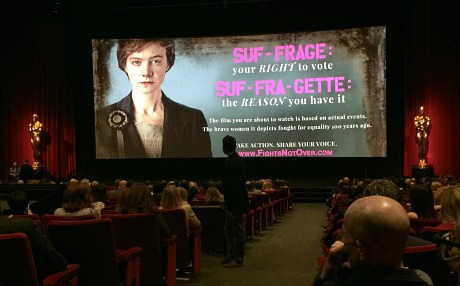
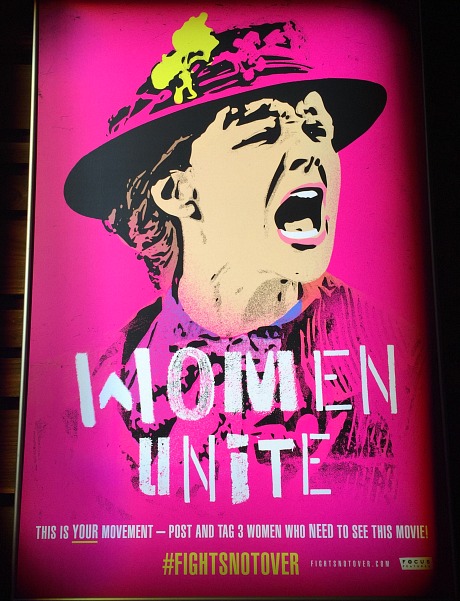
I spoke with Suffragette director Sarah Gavron and screenwriter Abi Morgan because I wanted to do something besides write about how affecting and well-made their film is. Sappy as this sounds I felt obliged to do something for an experience that had really gotten to me. And then I saw Suffragette for the second time last night at the Academy premiere, and it sank in like it did five or six weeks ago in Telluride. No diminishment.
What’s with the 79% Rotten Tomatoes verdict? Suffragette is too stirring, too important, too well captured for any “well, yes but” responses. I was speaking to an older guy at last night’s after-party who shrugged and said “well, yes but a bit too much like a longform British TV drama.” No, not accurate. It’s a movie that lays it down and brings it home in 106 minutes. It pays tribute to rebels and tells the hard truth about what it costs to push back.
Suffragette is about the civil disobedience phase of the England’s women’s suffrage movement of 1912 and ’13, and much…actually most of it is about the hurt and the bruising.
It focuses on a group of five or six women (Helena Bonham Carter‘s Edith Ellyn, Natalie Press‘s Emily Davison, Anne-Marie Duff‘s Violet Miller, Romola Garai‘s Alice Haughton) but mostly on Carey Mulligan‘s Maud Watts, an exhausted and all-but-drained mother and factory worker who gradually “sees” and succumbs. Somewhat like Thomas Becket, she gradually falls for the honor of rebellion.