How slow on the pickup do you have to be to not understand that consonants often get lost in the shuffle on a cell-phone call, and that phonetic spellings are a natural remedy when you’re conveying a name or proper noun with a few “e”-sounds? What kind of a gorilla brain doesn’t realize that “t” sounds like “d”,”e”, “p”, “b”,”g” and even “v” or “c” if your English is compromised by a heavy Asian or Latin accent? Every time I tell someone my email address I always say “g as in George, r as in robert, u as in uncle, v as in victor,” etc. Maybe they don’t need to hear the phonetic but it can’t hurt. How many times during the tens of thousands of cellular calls I’ve made over the last 25 or so years has a caller offered a phonetic spelling? Less than 20 or 25 times, I would say, or once a year. I almost always have to say “would you please spell that phonetically?” They never offer this — the concept of “e” letters sounding all but interchangeable has never penetrated their membrane.
Not Another Bowl of Kubrick Ghoulash
Anyone can assemble a bunch of clips from Stanley Kubrick‘s films and produce some kind of alluring mood riff. I’ve probably watched at least 40 or 50 impressionistic essays along these lines. But this month-old montage by a Canadian dude who calls himself Somerset VII really stands out. Tell me I’m wrong.
“A film is — or should be — more like music than like fiction. It should be a progression of moods and feelings. The theme, what’s behind the emotion, the meaning…all that comes later.” — Stanley Kubrick.
Standards & Practices
Every now and then The Hollywood Reporter‘s Scott Feinberg will send me a link to one of his articles or interviews. Which I definitely appreciate as Scott’s stuff is always well-phrased and I’m always looking for interesting material to re-post. An hour ago he sent me a just-posted discussion with The Martian director Ridley Scott. A nice one, actually. But I have concerns. My reply: “Thanks, Scott. I’m listening to the mp3 now — good stuff, relaxed vibe, very candid Ridley. But I really do feel that I have to do my part to nip this ‘Martian for Best Picture’ stuff in the bud. I don’t agree with it. You know, I know and Ridley definitely knows that it’s a first-class popcorn movie, and as such it simply doesn’t belong in the Best Picture conversation. But good work.”
Revenant Peek-Out on Fox Lot
A guy who’s fed me stuff before and who has seemed fairly reliable says that a three-hour version of Alejandro G. Inarritu‘s The Revenant was research-screened last night on the 20th Century Fox lot. The source didn’t attend but he talked to a guy who did, and this guy says it’s his #1 film of the year, and this is a guy who’s seen nearly everything.
Random remarks: “Crazy harrowing stuff…visually stunning…the natural-light photography works perfectly…’scenic-porn’…Leo is all but unrecognizable…a fair amount of dialogue…Tom Hardy‘s accent is a little tough to deal with.” Another five or six weeks remain before the final cut will be locked down so I would imagine the running time will be trimmed by 10 or 15 minutes or a tad more…who knows? But it sounds like it’ll end up a bit north of two and a half hours or thereabouts.
Take this with a grain but the guy (the one I’ve dealt with before) adds that a three-and-a-half-hour cut of Quentin Tarantino‘s The Hateful Eight was tested a while back. (Remember that many movies test long to help the director decide what to cut. Django Unchained was around three hours at one point, I once heard.) The film contains Tarantino’s first full-out sex scene, the source says. “What kind of sex scene?,” I asked. “Does it involve Jennifer Jason Leigh or is it…what, a gay thing?” He said he wasn’t sure. The guy he talked to about this cut gave it four out of five stars.
Gentleman, Scholar, Creator of Nether-Realms
With the opening of Crimson Peak about ten days off, the great Guillermo del Toro will sit tomorrow night for some kind of interview or deliver some kind of master class commentary about everything — his films, imaginings, themes, obsessions, etc. I’ll be attending. Where’s the after-party?
Surrounded By LGBTs and Multiculturals Led by General Santa Anna, Righties Feel Scared & Disempowered As They Huddle Behind Alamo Walls
A 10.5 Salon piece by Amanda Marcotte contains one of the cleanest and most concise explanations of why the right is so adamant about the holiness of guns (i.e., refusing to regulate their use like the government regulates cars and drivers): “Conservatives aren’t lying when they say they need guns to feel protected. But it’s increasingly clear that they aren’t seeking protection from crime or even from the mythical jackbooted government goons come to kick in your door. No, the real threat is existential. Guns are a totemic shield against the fear that they are losing dominance as the country becomes more liberal and diverse and, well, modern.” (“Diverse” is, of course, a code word for fewer whites calling the shots.) “For liberals, the discussion about guns is about public health and crime prevention. For conservatives, hanging onto guns is a way to symbolically hang onto the cultural dominance they feel slipping from their hands.”
Silicon Valley Christmas Carol
My experience with Danny Boyle‘s Steve Jobs (Universal 10.9) has been both a charge and a puzzlement. I fell in love with Aaron Sorkin‘s jackhammer script when I read it last summer, but I didn’t like Boyle’s version as much when I saw it in Telluride. Sorkin’s dialogue had flown off the page and sunk into my system like pure cocaine. I had such a great time with it that I convinced myself that the film would come together perfectly if the director just gets out of the way and shoots it with top-tier actors. That’s what Boyle has more or less done, and yet somehow the infuriating, obnoxious dickishness of Steve Jobs’ character seemed much more palatable on the page than it does when performed by Michael Fassbender. And what felt pungent and drill-bitty in the script feels repetitive and hammered in the film.
It’s a month later and Steve Jobs is opening this Friday, and I feel I need to give it another shot at tonight’s all-media Arclight screening. Because I’ve been telling myself that the reason I wasn’t knocked out after seeing it in Telluride (I called it “more impressively conceived and poundingly ambitious than affecting or, truth be told, likable”) was because of my own blockage. Not Boyle’s or Fassbender’s fault, but mine. Because for all the difficulty, this is a movie about what genius often behaves like and feels like. About how life-changing things come about. And that’s not nothing. So what’s my problem?
The film is basically a dialogue-driven, three-chapter stage piece set during three launches of three Jobs products — the ’84 Macintosh, the ’88 NeXT cube and the ’98 iMac. A brave, pushy “talk opera” (Sasha Stone‘s term) or “verbal action film” (a guy at Universal suggested that one) or aggressive cine-theatre (my own). Obviously an audacious concept — again, loved it on the page — but when you boil it all down Steve Jobs is basically about a demanding, hyper-drive genius being an abrasive dick to his employees, friends and ex-partners for two hours, and especially being an astonishing world-class dick by refusing to admit to his daughter that he’s her biological dad. Really, seriously…what an asshole.
And after the first 45 minutes to an hour the tone of Steve Jobs becomes a bit strident and fatiguing — a torrent of argumentative, badgering jabbermouth about the joys of obstinacy and belligerence and trying to bend people to your immaculate will. It was fascinated by it, but I can’t honestly say I “enjoyed” it.
Balls and Honor
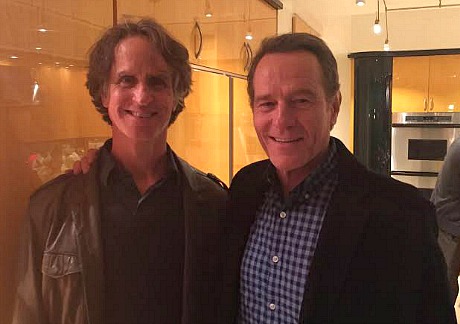
“There’s nothing wrong with being an intelligent, pruned-down, HBO-level biopic, which is pretty much what you get with Jay Roach‘s Trumbo (Bleecker Street, 11.6). A political biopic, I should say — an above-average portrait of the Hollywood blacklist era, and a better-than-decent capturing of one the most gifted and industrious blacklisted screenwriters ever. A moustachioed, sandpaper-voiced Bryan Cranston portrays the stalwart titular hero; I felt completely at home with the guy. Trumbo was one of the most gifted wordsmiths in Hollywood history — a winner of two screenwriting Oscars (Roman Holiday, The Brave One) during his under-wraps period, and also the author of A Guy Named Joe, Thirty Seconds Over Tokyo, Cowboy, Spartacus, Exodus, Lonely Are The Brave.” — from “Naked, Extremely Prolific Writer in Bathtub,” a 9.13 HE post from the Toronto Film Festival.
Latest Idiotic Outburst About Use of Word “Slave”
In January 2014 Anti-slavery.org‘s Aidan McQuade struck a blow for worldwide idiocy when he slammed director David O. Russell for describing Jennifer Lawrence‘s contractual obligations to the endless Hunger Games franchise as a form of slavery, “Talk about 12 years of slavery, that’s what the franchise is,” Russell told the Daily News on 1.10.14. McQuade complained that Russell’s comparison was “glib” and insensitive. Russell “apologized” but the whole brouhaha was headache-inducing.
What McQuade was saying, in fact, was that the word “slave” can never be used as a metaphor or a figure of speech, that it can only be used if the speaker is referring to actual slavery as it existed in the United States in the 19th century and as it exists today in cultures around the world or, in another context, back to the ancient Egyptians and Romans using Hebrews as slave laborers. The point is that “slave”, which basically alludes to economic subjugation, must be used in a literal or historical context. And that means somebody has to go after the Rolling Stones.
In any event two more knee-jerkers — educator/activist DeRay McKesson and writer-editor Jemilah Lemieux — have stepped into the breach to carry on McQuade’s tradition. Two days ago a Guardian article noted objections from McKesson and Lemieux to a slogan — “I’d rather be a rebel than a slave” — on a promotional T-shirt recently worn by Meryl Streep, Carey Mulligan, Romola Garai and Anne-Marie Duff to promote Sarah Gavron‘s Suffragette, which will open the BFI London Film Festival on Wednesday, 10.7.
“White women have said a lot of terrible things over the course of history, [but that] doesn’t mean you wear it on a shirt,” Lemieux tweeted. “Meryl Streep has to know better. And if not, her publicist should have,” tweeted McKesson.
Drugs, Money, Sex, Drums, Guitars, etc.
Vinyl pops on HBO in January so three more months of trailers. Everyone has a sense that record executive Richie Finestra may turn out to be Bobby Cannavale‘s best role ever — the trailers certainly aren’t letting anyone forget this. But I’m equally excited by the prospect of Ray Romano‘s Zak Yankovich, Richie’s confidant and head of promotions. Why? Because Romano gave the only solid, rooted performance (“Low-key, totally in the moment, in the scene, never acting”) in the otherwise disposable Rob The Mob. What’s in a series like this for a sober person? That’s the question.
“Just Give It To Me…”
A little after 9 pm I followed Truth director-writer James Vanderbilt and producer Brad Fischer to the Harmony Gold theatre, where a showing of their film was just finishing. We ran into a spiffily dressed Elizabeth Moss next to the rear parking-lot entrance. And then we all moved inside to the “green room.” There we found a very casually dressed Cate Blanchett, who looked, in the coolest way imaginable, like she’d just gotten off a plane from Australia and hadn’t had time to change into uptown duds. Oversized sweater, dress of some kind, white sneakers. She probably didn’t care one way or the other. They were only going to chat about the film with a bunch of slumbering SAG members so what did it matter if she looked red-carpet ready? This is what serious artists do — they wear whatever and shine the dress code when the mood suits. They do whatever the fuck.

(l. to r.) Truth director-writer James Vanderbilt, costar Elizabeth Moss, star Cate Blanchett during last night’s post-screening discussion at Harmony Gold.
I had spoken to Blanchett two and a half years ago during an after-party at the Santa Barbara Film Festival, but celebrities don’t hang onto this stuff. (The average famous actor says hello to thousands of unfamiliar faces every year.) I told her that I’d fallen for Truth in Toronto and had seen it twice so far. She asked if I’d read anything in-depth about it, and I confessed I hadn’t even read Mary Mapes‘ book (“Truth and Duty: The Press, the President, and the Privilege of Power“). She said she’s read Mapes’ daily notes to herself about the events as they were unfolding and was struck by how meticulous and even-toned they seemed. “And then she went home and wrote the book and let go with the anger,” Blanchett said (or something close that).