

“Despite some bumpy tonal shifts and inconsistencies of characterization, Hello, My Name Is Doris impresses as a humanely amusing and occasionally poignant dramedy about a spinsterish office drone (Sally Field) who develops a romantic fixation on a much younger co-worker (Max Greenfield). The plot could have been played as a flat-out broad comedy or an anxiety-inducing psychological drama, and there are times when it feels like helmer Michael Showalter is striving for a mash-up of both. But Field keeps the movie on an even keel, for the most part, with an adroit and disciplined lead performance that generates both laughter and sympathy, with relatively few yanks on the heartstrings.” — from Joe Leydon‘s Variety review, posted from SXSW on 3.14.15.
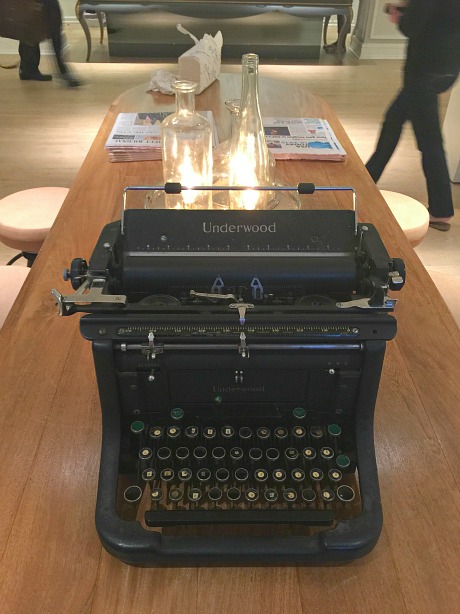
Music That Watches The Film With You
“Gently alerting” is one way to describe Howard Shore‘s all-piano Spotlight score. It indicates that the movie is up to something solemn and real and worth your time. You hear a few bars and right away you’re saying to yourself, “Okay, there’s something going on here…I’m gonna focus because something of substance will probably come of it….I can just tell.” And yet at the same time it doesn’t instruct you how to feel; nor does it emphasize or underline. It’s one of those scores that watches the film with you. It musically reiterates what you’re feeling or thinking from point to point. Here are samples.
Best Feature Doc Shortlist Preferences
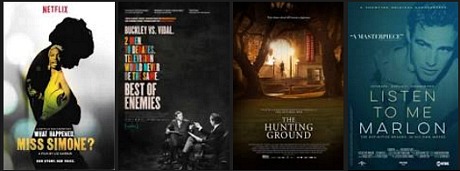
Last Friday 124 feature-length documentaries were submitted for Oscar consideration. A short list of 15 will be revealed in early December (less than five weeks hence), and the final quintet will be announced when all the Oscar nominees are announced in mid January. And of course I’ve been slacking on this front so here’s a roster of my personal short-list preferences. There are more than a few I haven’t seen (including Jill Bauer and Ronna Gradus‘ Hot Girls Wanted, Geeta and Ravi Patel‘s Meet The Patels, Marc Silver‘s 3 and 1/2 Minutes, Jimmy Chin and Elizabeth Chai Vasarhelyi‘s Meru, Matthew Heineman‘s Cartel Land, Benjamin Statler‘s Soaked in Bleach) but here are 11 docs that — for me, in this order — burned through in some extra, commanding, head-turning way:
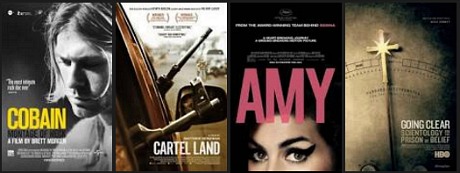
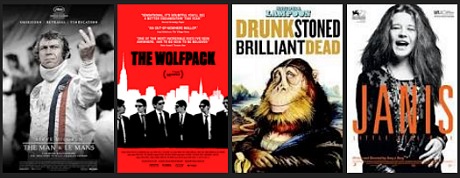
1. Alex Gibney‘s Going Clear: Scientology and The Prison of Belief / HE review.
2. Colin Hanks‘ All Things Must Pass / HE review.
3. Ondi Timoner‘s Brand: A Second Coming / HE review/coverage.
4. Doug Tirola‘s Drunk Stoned Brilliant Dead / HE review.
5. Stevan Riley‘s Listen To Me, Marlon / HE review.
6. Gabriel Clarke and John McKenna‘s Steve McQueen: The Man & Le Mans / HE review.
7. Michael Moore‘s Where To Invade Next / HE review.
8. Kent Jones‘ Hitchcock Truffaut / HE review.
9. Morgan Neville and Robert Gordon‘s Best of Enemies / HE review.
10. Amy Berg‘s Janis Little Girl Blue / HE review.
11. Asif Kapadia‘s Amy / HE review.

I’ll Say It Again
A surprising thought occured yesterday afternoon as I was reading the comments for “Martian Award Buzz Is Almost As Skillful As The Film Itself.” While the Best Picture Oscar will, I believe, almost certainly go to Joy, The Revenant, Spotlight or The Big Short, if (and I say “if“) they were to be elbowed aside for whatever reason and the final either-or was between The Martian and Room, it would be better if the Best Picture Oscar went to Room. As much as I felt imprisoned and almost suffocated by Lenny Abrahamson’s film, at least it’s up to something urgent and “real” as opposed to escapist. At least it’s not a Jerry Bruckheimer-styled popcorn movie. It’s creepy in some ways, but at least it’s about an unusual situation in a striking, strongly personal way. Then again this is sheer fantasy as Spotlight will not be elbowed aside. It’s bullet-proof.



Martian Award Buzz Is Almost As Skillful As The Film Itself
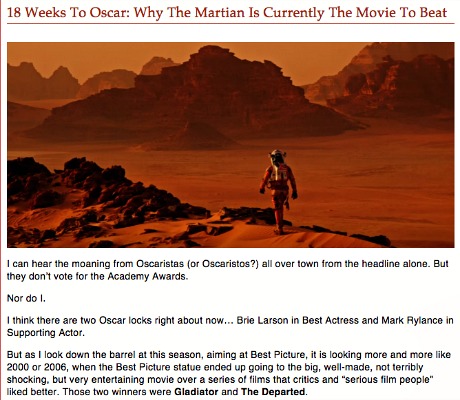
The Best Picture Oscar will go to either Joy, The Revenant, Spotlight or The Big Short…period. The Martian will be nominated, of course, but that’s where it stops. (Sasha Stone, who just arrived in Savannah, insists it’s The Martian vs. Spotlight.) Steve Jobs has dropped in estimation and is probably out. Carol looks like a struggle. Room will be nominated but that’s all. Bridge of Spies, meh. There should be renewed excitement about Love & Mercy but the stubbornness of the “yeah, okay but it came out last June” crowd is almost breathtaking. Brooklyn is exquisite but quiet. Beasts of No Nation, Mad Max: Fury Road, Suffragette, Son of Saul…all mesmerizing. The Hateful Eight is already a punching bag, but wait until the Samuel L. Jackson blowjob + “n” word controversies heat up.
HE to Oscar Spitballers: Get A Grip on Dano
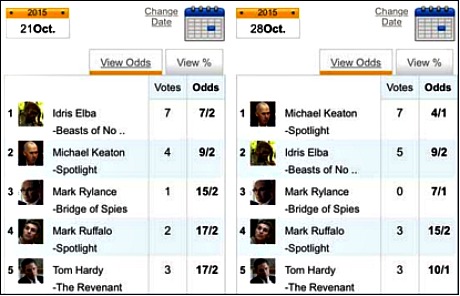
According to a just-posted Gold Derby chart, the leading contenders for Best Supporting Actor are, in this order, Spotlight‘s Michael Keaton (sure), Beast of No Nation‘s Idris Elba (of course), Bridge of Spies‘ Mark Rylance (probably the favorite to win), Spotlight‘s Mark Ruffalo (full agreement but if he and Keaton are both nominated they’ll cancel each other out) and…The Revenant‘s Tom Hardy? Sez who? Based on what? And Love & Mercy‘s Paul Dano is in sixth place?
Will you wake up, please? Paul Dano should be in the #1 spot among all the potential BSA nominees. Ask the Movie Godz — his inhabiting of Brian Wilson is/was the stuff of legend…period. Stop this ridiculous “yeah but Love & Mercy came out last summer and Roadside isn’t a regular Oscar player” crap. Hardy out for now, Keaton or Ruffalo but not both, Rylance in, Elba probably…Dano is in.

DeNiro’s Norbit?
If and when Robert DeNiro‘s performance as Jennifer Lawrence‘s dad in Joy results in Best Supporting Actor heat (and I know nothing about that), Dan Mazer‘s Dirty Grandpa (Lionsgate, 1.22.16) might get in the way. Maybe, possibly. DeNiro’s grandpa to Zac Efron, verbatim: “The greatest gift a grandson can give his grandfather is a hot college girl who wants to have unprotected sex with him before he dies.”
Skull of Goliath
I wanted to chuckle at or…you know, quietly enjoy Jared Hess‘s Don Verdean (Lionsgate, theatrical/VOD 12.11), a satire of rightwing religious foolery and fraudulence. But it just wouldn’t let me go there, and I’m saying this as a fan of Sam Rockwell, who plays the titular character, a bullshit archeologist and discoverer of Biblical relics. The only good thing is New Zealand-based actor-comedian Jermaine Clement, who plays Boaz, a corruptible Israeli guide.
Absorbing Nixon’s Spirit, Furnishings, Sense of Taste
A New York-area research screening of Liza Johnson‘s Elvis & Nixon (Amazon/Bleecker Street, 2016) happens tonight. We’re all presuming that Kevin Spacey will deliver a better-than-decent Richard Nixon, and that Michael Shannon‘s Elvis…who knows? But the supporting cast looks great — Alex Pettyfer, Colin Hanks, Evan Peters, Johnny Knoxville, Sky Ferreira and Tracy Letts. Unless it’s a disaster I’m presuming Elvis & Nixon will have its first peek-out at the 2016 Sundance Film Festival.
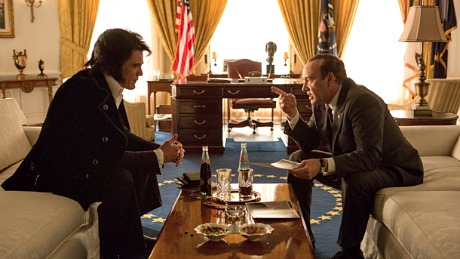
How many of us have visited the Oval Office, or even the West Wing of the White House? I’ll almost certainly never go there, but I’ve visited highly detailed, movie-set recreations of the Kennedy and Nixon Oval offices, and in a way they were almost cooler than the real thing.
It was 20 years and nine months ago that Oliver Stone and his publicist Stephen Rivers allowed me to pay a brief visit to the Nixon West Wing — Oval Office, cabinet room, hallways, various offices, etc. Production designer Victor Kempster had built the amazingly detailed set (including an outdoor portion with grass and bushes) on a massive Sony sound stage.
I was let in just after Stone and his cast (including Anthony Hopkins) and crew had finished filming. It was sometime around late February or early March of ’95. I wrote up my impressions for an L.A. Times Syndicate piece. Nixon opened on 12.20.95.
Grief Is A Many-Layered Thicket
A guy asked me this morning if I was going to post some kind of review of Reed Morano‘s Meadowland (Cinedigm, 10.16). My first response: To what end?
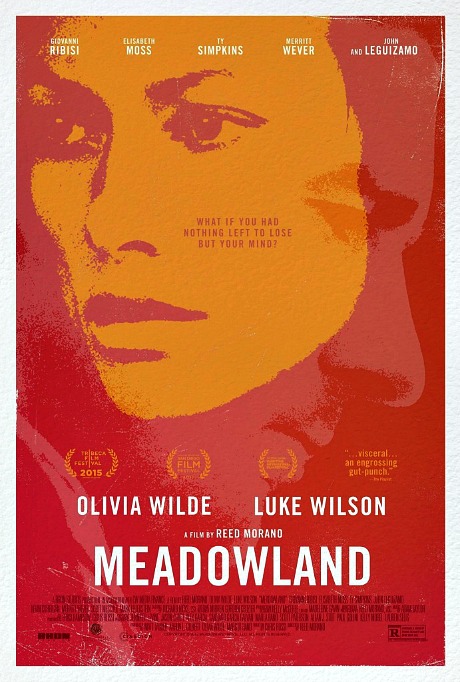
Meadowland is about the Big Numb of grief. Grief wanderings, grief enzymes, grief injections. Grief as a huge swimming pool filled with jello and no escape ladders. In short, the kind of movie that you definitely want to visit and immerse yourself in. But don’t listen to me. Listen to Guardian critic Jordan Hoffman, who has called Meadowland “terrific.”
None of Meadowland works unless you buy that a young couple can leave their three- or four-year-old kid inside a bathroom inside a service station with the dad waiting outside, and then the dad knocks on the door and…nothing. The kid just magically disappears. No trace of him here, there, anywhere. And no one ever sees him or reports him. The vanishing. Speaking as a father of two sons I didn’t buy it at all and so the whole movie, for me, was untrustworthy bullshit. A highly indulgent downhead sink-in.