Won’t Suffer Fools

I love Mike Leigh‘s personality, his manner. He just says it and come what may. To me that’s the mark of a real artist. Several years ago he upbraided me at the Spirit Awards for asking the wrong kind of question. He didn’t like my attitude. He’s very blunt and real. In this Hollywood Reporter round-table discussion he’s asked about the prospect of developing a film for 12 years, and Leigh says “I haven’t got 12 years.” Neither Mr. Turner nor Leigh are likely to be nominated for Best Picture or Best Director, but he’s a very good guy. You know who might be nominated for Best Director? Angelina Jolie. Because Unbroken made so much money over the Christmas holiday.

Read more

Let Me Get This Straight

Everything all along has pointed to North Korea being the prime mover behind the Sony hack. The North Korean government has denied involvement but otherwise indicated it was completely delighted with the results of the hack. On 12.17 N.Y. Times reporters David Sanger and Nicole Perlruth ran a story saying that “senior administration officials who would not speak on the record about the intelligence findings have concluded that North Korea was ‘centrally involved’ in the hacking of Sony Pictures computers.” An apparent response followed when North Korea’s internet was blacked out, presumably by Obama administration operatives.

But now UPI.com’s Francis Burns is reporting that the hacking may have been an inside job by a disgruntled former Sony employee. A woman, in fact. Kurt Stammberger, a senior vp with the security firm Norse, believes [that] “the hacking was an inside job. Stammberger said the team has even identified one possible perpetrator, a woman who worked for Sony for 10 years before losing her job in a recent reorganization.”

Hold on…I’m not following. The whole North Korea narrative is, what, imaginary? Or did this woman somehow feed information to someone else who assisted the Guardians of Peace, the hackers who claimed responsibility for the Sony hack? I’m completely confused.

Read more

“I’ve Never Felt Freer”

In response to Joseph Califano‘s 12.26 Washington Post Op-Ed piece that sharply disputed Selma‘s portrayal of President Lyndon Johnson as being reluctant to support voting rights legislation, director Ava DuVernay tweeted yesterday that “folks should interrogate history…don’t take my word for it or LBJ’s rep for it…let it come alive for yourself.” I tried that yesterday by reaching out to LBJ historians Robert Caro, Robert Dallek and Ronnie Dugger…no dice. DuVernay’s film essentially portrays Johnson as a pragmatic, vaguely patronizing racist (i.e., that dismissive pat on the shoulder of David Oyelowo‘s Martin Luther King) who had to be pressured into pushing for the 1965 Voting Rights Act. Tom Wilkinson‘s LBJ “offers a few shadings and nuances,” as I noted yesterday, “but mainly you remember his disagreements with King and saying ‘not now.’” So this morning I captured this anecdote from former Johnson administration attorney Roger Wilkins in David Grubin‘s LBJ, a PBS American Experience doc that originally aired in 1991.

How reluctant was Johnson to push for voting rights legislation in early ’65? Was he in fact reluctant, as Selma dramatizes? Perhaps he expressed concerns along these lines at some point. But yesterday’s HE story contains a White House recording of a 1.15.65 discussion between Johnson and Martin Luther King that undermines Selma‘s view.

David McCullough‘s narration of LBJ quotes Johnson as saying that while some men have called the White House a prison, “I’ve never felt freer.”

There’s a story that came from James Farmer, leader of the Congress of Racial Equality, in an 8.24.08 New Yorker story by George Packer called “LBJ’s Moment”: “I asked him how he got to be the way he was,” Farmer recalled. “He said, ‘What do you mean?’ I said, ‘Well, here you are, calling senators, twisting their arms, threatening them, cajoling them, trying to line up votes for the Civil Rights Bill when your own record on civil rights was not a good one before you became Vice President. So what accounted for the change?” Johnson thought for a moment and wrinkled his brow and then said, ‘Well, I’ll answer that by quoting a good friend of yours and you will recognize the quote instantly. ‘Free at last, free at last. Thank God Almighty, I’m free at last.’”’

Read more

Tell Me A Story

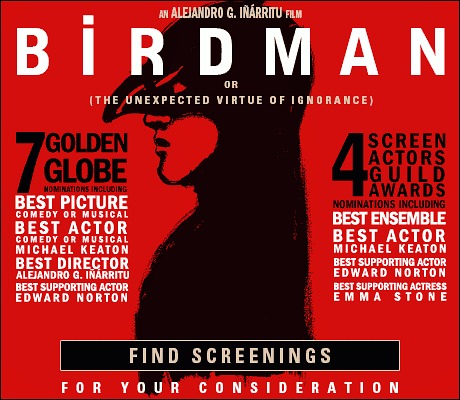
Thanks to Awards Daily‘s Ryan Adams for slapping this together. I didn’t know he had the skill set. The bird-helmet hair is really quite exacting. Must have taken a while to get right. Hats off.

Paint It Black

“Misery in Abderrahmane Sissako‘s Timbuktu, which is set in the Timbuktu region of Mali, a mostly barren African nation that few people in this country have heard of, is very hard-core. Shot in Mauritania, it’s about the 2012 occupation of Timbuktu by Ansar Dine, a relentlessly purist, wacked-out Islamic militia dedicated to enforcing Sharia law and order. The film was partly inspired by a public stoning of an unmarried couple in Aguelhok, in eastern Mali, but that’s just another pebble in the pond. I think we all know about the pitch-black souls of nutter Islamics by now.

Timbuktu is in no way boring. Sissako knows how to tell a riveting tale and keep you engrossed, but good God. This is a film about dirt-poor hardscrabble types living in various states of misery and deprivation, powerless, at times terrified and always subject to rigid judgments and brutalities. An awful way to live. If there’s an uglier, crueler, more inhumane, more rancid belief system or culture than Islamic fundamentalism, I’d like to know what it is. The earth needs to be absolutely cleansed of this scourge. Welcome, western audiences, to life in one of the worst ideological desert prison camps ever created.” — from my 11.18 review, titled :Hell In The Desert.”

Selma Oscar Hopes Bruised by Califano Op-Ed Piece

I’ve always regarded Lyndon Johnson with mixed emotions. He ruined his legacy with his horribly misguided Vietnam policies, of course. But domestically he wanted to be a benevolent Big Daddy — a compassionate liberal whose instincts found fruition with his Great Society programs along with his support of the 1964 Civil Rights Act and the 1965 Voting Rights Act. I know that Johnson’s rural-type manner always reminded me of my paternal grandfather, an earthy guy who hailed from Kentucky and spoke with a drawl. LBJ was also known to be crude in certain ways and I suspect that deep down he probably had less than fully enlightened attitudes toward blacks. But I’ve never believed he was a patronizing racist who didn’t take blacks all that seriously and who pushed for the Voting Right Acts only when he was politically forced to. But that’s how Johnson is more or less portrayed in Ava DuVernay‘s Selma. Tom Wilkinson‘s LBJ offers a few shadings and nuances, but mainly you remember his disagreements with Martin Luther King (i.e., David Oyelowo) and his saying “not now” and dismissively patting King’s shoulder in the Oval Office.

Last Friday (12.26) a Washington Post op-ed piece by Joseph Califano, Jr., President Johnson’s top liaison for domestic affairs from 1965 to 1969, called bullshit on Selma‘s portrayal of Johnson. “The film falsely portrays President Lyndon B. Johnson as being at odds with Martin Luther King Jr. and even using the FBI to discredit him, as only reluctantly behind the Voting Rights Act of 1965 and as opposed to the Selma march itself,” Califano wrote. “In fact, [the] Selma [demonstration] was LBJ’s idea, he considered the Voting Rights Act his greatest legislative achievement, he viewed King as an essential partner in getting it enacted — and he didn’t use the FBI to disparage him.”

I’m no LBJ scholar but I was surprised to see Wilkinson’s Johnson tell J. Edgar Hoover to use the MLK sex tapes to pressure King into backing off. I know that Hoover told Johnson about King’s philandering (and that he might have played portions of the tapes for him) but I’ve never read that LBJ used them to make things uncomfortable for King, and I frankly doubt that he did that.

Read more

Spitballing 2015 Best Picture Winner

The consensus that 2014 had been, relatively speaking, a weak year will not be repeated in 2015. Entertainment Weekly‘s 2015 preview barely has a clue, but the coming year, above and beyond of the locust plague of franchise films, will be good in terms of quality-level, Hollywood Elsewhere-supported fare. Over the last 24 hours I’ve done a bit more research and am now looking at what will almost certainly be the top Best Picture candidates 12 months from now. You almost don’t need to see them to “know.” All you need are the basic elements — filmmakers, budget, story, theme — and the aroma. I don’t know very much but nine…okay, eight times out of ten my instincts are correct. And they’re telling me that Steve Jobs, Truth, St. James Place, The Walk and Collision are probably going to be at the top of the heap after it all shakes out.

What do I actually know about these films? Next to nothing, but I have a pretty good nose for this stuff. The more comments, the better. This needs to be kicked around.

Read more

Annual New Year’s Blessing

Posted eight years ago: “I’d say ‘Happy New Year’ to everyone, but…all right, ‘Happy New Year.’ But I’ve always hated those words. Nothing’s ‘happy’ by way of hope. Happy is discovered, earned, lucked into. At best, people are content or…you know, joyously turned on for the moment or laughing or telling a funny story or a good joke. Placated, relaxed, enthused, generous of heart…but ‘happy’? Clams are happy. There’s only the hum. Either you hear it or you don’t.

Posted in 2010: “Nothing fills me with such spiritual satisfaction as my annual naysaying of this idiotic celebration of absolutely nothing.

“I love clinking glasses with cool people at cool parties as much as anyone else, but celebrating renewal by way of the hands of a clock and especially in the company of party animals making a big whoop-dee-doo has always felt like a huge humiliation.

“Only idiots believe in the idea of a of a midnight renewal. Renewal is a constant. Every minute marks the potential start of something beautiful and cleansing, and perhaps even transforming. So why hang back and celebrate a rite that denies this 24/7 theology, and in a kind of idiot-monkey way with party hats and noisemakers?

Read more

Click here to jump past HE Sink-In

By all that is right, fair and profound, a film that wins the Best Picture Oscar should pass the “wow!” test. Agreed, many past winners haven’t lived up to this standard. Time and again Academy voters have rewarded films that comfort or affirm basic truths or remind us, movingly, how things are. Or how we’d like them to be. And there’s nothing wrong with that. Well, now and then there is. Within the last 12 years the Best Picture Oscar has been handed to Chicago, Crash, The King’s Speech and The Artist, or what I call The Four Embarrassments. But in the hearts and minds of those who watch over this town and this industry, Best Picture winners should turn heads, open doors, make history, raise a few eyebrows and rock the rafters on some level or another. They should make you say “Wow, I just saw something!” And they should at least make you want to watch them a second time, if not a third or fourth.

A few days ago I watched Alejandro G. Inarritu‘s Birdman for the fifth time, on a 55-inch TV with friends who hadn’t seen it before, and I swear to God it hadn’t diminished. It still pops and chortles and lurches around and slides into home plate like a champ. Lord knows I’m not saying it’s a “better” film than Boyhood or Selma or The Imitation Game, its three biggest competitors. (What does that mean anyway?) But it’s the only film that melts into itself like music and which flies above Tin Pan Alley and reminds that the spirit of Federico Fellini’s 8 1/2 is alive and well in the 21st Century. And it’s one of the few comedies I’ve seen in my life that could be called sad or autumnal or…what’s the word, whiplashy? Or which foregoes the mere telling of jokes or eliciting of laughter for what you might call withering God’s-eye humor.

Is “God” capable of laughing at anything? Can He/She even be bothered? Perhaps not, but if He/She has the slightest interest in our struttings and frettings, Birdman suggests that He/She might have a sardonic attitude. Certainly when it comes to the spectacle of an older, used-to-be-hot actor who mocks Twitter and doesn’t even have a Facebook page…a guy with problems and demons trying to re-float his boat in choppy seas…a guy who isn’t hip enough to understand that nobody wears white Fruit-of-the-Loom underwear…a guy who’s trying to make it all come out right despite the fact he’s scared shitless and wondering what the hell…a guy who’s teetering like a bowling pin…a guy who certainly could use and for the most part deserves heavenly compassion (i.e., a break) but is forced to do without it for most of Birdman’s running time.

Read more

2015: Trying Again

12.29, 9 am Pacific Update: On 12.22 I posted a rundown of 2015 films that seem fairly promising. A few other films were posted by commenters over the next day or so. Here’s another rundown with an attempt to break them into unfair categories but…call it a work in progress, like anything else. We’re talking at least 17 films that look really good, and about 15 that seem at least moderately intriguing and might be better than that. In all likelihood, the 2015 Best Picture winner is among the top 17. Top contenders: Steve Jobs, Silence, St. James Place, Hughes, The Revenant, Truth, Our Brand Is Crisis, Money Monster, Demolition.

X-Factor “Extra”, Semi-Fresh, Social Undercurrent…Something More (17):

Steve Jobs (Universal — shooting begins filming next month or January 2015, which indicates an intention to bring it out by late ’15) — Danny Boyle (director), Aaron Sorkin (screenplay), Scott Rudin (producer); Cast: Michael Fassbender, Seth Rogen, Michael Stuhlbarg, Katherine Waterston.

The Revenant (20th Century Fox) — Alejandro González Inarritu (director/screenplay); Mark “nobody can remember my middle initial” Smith (screenplay); Leonardo DiCaprio, Tom Hardy, Will Poulter, Domhnall Gleeson.

Money Monster (TriStar/Sony — apparently shooting in early ’15) — Jodie Foster (director); Jamie Linden, Alan DiFiore, Jim Kouf (screenplay). Cast: George Clooney, Jack O’Connell, Julia Roberts. Question: Same as Silence, will it shoot early enough?, etc.

Hughes (no distributor) — Warren Beatty (director, writer); Warren Beatty, Alden Ehrenreich, Lily Collins, Matthew Broderick, Annette Bening, Alec Baldwin, Martin Sheen, Taissa Farmiga, Chace Crawford, Candice Bergen.

Truth (no distributor) — James Vanderbilt (director, writer — based on the 2005 memoir “Truth and Duty” by Mary Mapes); Cast: Robert Redford, Cate Blanchett, Elisabeth Moss, Topher Grace, Dennis Quaid, Bruce Greenwood.

Our Brand Is Crisis (Warner Bros.); David Gordon Green (director); Peter Straughan (screenplay); Sandra Bullock, Scoot McNairy, Billy Bob Thornton, Anthony Mackie, Ann Dowd.

Everest (Universal) — Baltasar Kormákur (director); Justin Isbell, William Nicholson (screenplay); Jake Gyllenhaal, Josh Brolin, Jason Clarke, John Hawkes, Sam Worthington, Keira Knightley, Robin Wright.

Demolition (Fox Searchlight) — Jean-Marc Vallee (director); Bryan Sipe (screenplay); Jake Gyllenhaal, Naomi Watts, Chris Cooper.

Black Mass (Warner Bros.) — Scott Cooper (director/screenplay); Johnny Depp, Joel Edgerton, Benedict Cumberbatch, Sienna Miller, Dakota Johnson.

Hail Caesar (Universal — listed as a February 2016 release but if the film turns out to be half as good as the crackling script, it’ll be criminal to relegate it to a dump month); Joel and Ethan Coen (directors, screenplay); Josh Brolin, George Clooney, Channing Tatum, Tilda Swinton, Ralph Fiennes, Jonah Hill.

St. James Place (Touchstone / DreamWorks / 20th Century Fox) — Steven Spielberg (director); Matt Charman, Ethan Coen, Joel Coen (screenplay); Tom Hanks, Mark Rylance, Amy Ryan, Alan Alda, Billy Magnussen, Eve Hewson.

Life (no distributor) — Anton Corbijn (director); Luke Davies (screenplay); Robert Pattinson, Dane DeHaan, Ben Kingsley, Joel Edgerton.

The Walk (TriStar / ImageMovers) — Robert Zemeckis (director/screenplay); Christopher Browne (screenplay); Joseph Gordon-Levitt, Ben Kingsley, James Badge Dale, Charlotte Le Bon.

Carol (Weinstein Co.) — Todd Haynes (director); Pyllis Nagy (screenplay, based on Patricia Highsmith novel); Cate Blanchett, Rooney Mara, Sarah Paulson, Kyle Chandler.

By The Sea (Universal) — Angelina Jolie (director, screenwriter). Cast: Angelina Jolie, Brad Pitt, Niels Arestrup, Mélanie Laurent.

Sea of Trees (no distributor) — Gus Van Sant (director); Chris Sparling (screenplay); Matthew McConaughey, Ken Watanabe, Naomi Watts, Katie Aselton, Jordan Gavaris.

Knight of Cups (no distributor) — Terrence Malick (director); Hanan Townshend screenplay); Christian Bale, Cate Blanchett, Natalie Portman, Brian Dennehy, Antonio Banderas, Freida Pinto, Wes Bentley, Isabel Lucas, Teresa Palmer.

May Not Be Released in 2015:

Silence (Paramount) — Martin Scorsese (director); Jay Cocks (screenplay); Liam Neeson, Andrew Garfield, Issei Ogata, Adam Driver, Ken Watanabe.

Intriguingly Commercial (14):

Tomorrowland (Disney) — Brad Bird (director, cowriter); Damon Lindelof (co-writer); George Clooney, Britt Robertson, Hugh Laurie, Raffey Cassidy, Thomas Robinson, Kathryn Hahn, Tim McGraw, Keegan-Michael Key, Judy Greer.

The Hateful Eight (Weinstein Co.) — Quentin Tarantino (director-writer); Samuel L. Jackson, Bruce Dern, Jennifer Jason Leigh, Walton Goggins, Tim Roth, Michael Madsen, Demián Bichir, Kurt Russell.

Ricki and the Flash (TriStar) — Jonathan Demme (director); Diablo Cody (screenplay); Meryl Streep, Mamie Gummer, Kevin Kline, Sebastian Stan, Rick Springfield, Ben Platt.

Midnight Special (Warner Bros.) — Jeff Nichols (director/screenplay); Cast: Michael Shannon, Kirsten Dunst, Adam Driver, Joel Edgerton.

The Last Face (distributor) — Sean Penn (director); Erin Dignam (screenplay); Charlize Theron, Javier Bardem, Adèle Exarchopoulos.

Read more

Most Idiotic Battle Scene Ever

In my 80% positive 11.12 review of Clint Eastwood‘s American Sniper I mentioned a scene that I found hugely irritating. And still do, having seen the film twice now. Sniper‘s been playing four or five days now so some will know what I’m referring to. It’s an Act Two scene in which Bradley Cooper‘s Chris Kyle is suddenly caught in a Iraqi firefight while phoning his wife Taya, played by Sienna Miller. She’s naturally startled, and as the battle quickly intensifies she gets more and more riled and as she cries out to Cooper, asking him what’s going on and is he okay and so on (“Baby? Baby?”). As soon she said those words, I went nuts. What does she expect him to say? Does she actually think he’s going to put down his weapon and explain to her what’s going on, as if she can’t figure it out?

Miller knows, of course, that Cooper is in a combat zone in order to shoot guys, and that firefights are part of the basic drill. So why does she freak out? Is she hoping he’ll get back on the line and say, “Hi, baby…yeah, yeah, I know…they’re shooting at us now…but don’t worry! Anyway, I can’t really talk right now, okay? I might get, you know, killed if I don’t defend myself so if it’s cool I’ll call you back later. I’ll be okay, sweetheart. I just have to put the phone down and focus on killing the enemy. You understand, right? It’s not that I don’t love you or don’t want to talk to you. It’s just now is not the best time to talk…okay?”

Read more

Sometime Around 1946

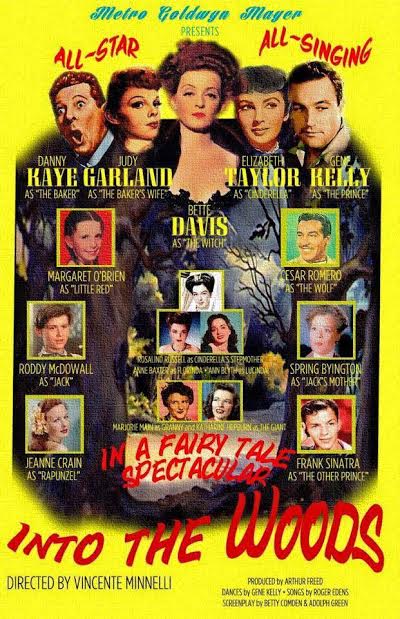
This is not only a solid professional job, but the casting choices for a 1946 version of Into The Woods are spot-on. I’m looking around for the name of the artist.