Last Licks

The Kino Svetozor is a film lover’s theatre. Located in the cellar of an office building, just off Wenceslas Square. A good crowd attended Friday night’s showing of Nymphomaniac, Vol, 2. Two theatres plus a nice wifi cafe downstairs. Very worthy establishment. This and the Bio Oko are my favorite Prague cinemas. Update: Packing bags, cleaning up. Heading back to Berlin tomorrow on a 6:30 am train.

Black Coal, Budapest, Boyhood Take Berlin Honors

Diao Yinan’s Black Coal, Thin Ice, a Chinese murder thriller, won the Berlinale’s Golden Bear this evening, and Wes Anderson‘s The Grand Budapest Hotel (here’s my 2.6.14 review) won the Silver Bear Grand Jury Prize. Richard Linklater was handed the Silver Bear for best director for Boyhood (which I saw and reviewed at last month’s Sundance Film Festival). Alain ResnaisLife of Riley which took the Silver Bear/Alfred Bauer Prize for “feature film that opens New Perspectives.” (I’m sure Glenn Kenny levitated upon hearing this news.) Dietrich Brueggemann’s Stations of the Cross which won the Silver Bear for best screenplay.

Pompeii For Cretins

Paul W.S. Anderson‘s Pompeii (Sony, 2.21) is obviously CG-driven exploitation schlock aimed at the submentals. What else to expect from the low-rent director and producers (Jeremy Bolt, Don Carmody) behind Resident Evil: Afterlife? The CG alone is cartoonishly excessive. (There is nothing more loathsome than CG that doesn’t make the slightest effort to look organic — that flaunts its digital nature.) Imagine if Roman Polanski‘s Pompeii project, based on Robert Harris’s historical novel, had made it to the screen. Imagine a semi-realistic recreation of what ancient Pompeii and the Mt. Vesuvius disaster of A.D. 79 really looked and sounded like. Literate dialogue, believable characters, etc. Or if that reported Sony minseries, also based on the Harris novel that Robert Towne (Chinatown, The Firm) adapting, had been brought to fruition. A shame all around.

“Smallest Hunch” of All Quasimodos

Guillermo del Toro‘s use of the term “sentimental favorite” means “it was pretty bad but it made a big impression on me anyway because I watched it a lot when I was young and it saturated my brain.” The definitive film versio of Victor Hugo’s The Hunchback of Notre Dame is William Dieterle’s 1939 version, with Charles Laughton in the lead role. Maureen O’Hara, Sir Cedric Hardwicke and Edmond O’Brien costarred.

No Salami, No Movie

Yesterday TheWrap‘s Jeff Sneider reported that David Permut and Reunion Pictures “have begun developing” a film about the 27-year romance between Spencer Tracy and Katharine Hepburn. But is the material really there? Tracy-Hepburn had on-screen chemistry, for sure. And they certainly cared for and seemed to complement each other — no one’s disputing that. Except the alcoholic Tracy never left his wife and Hepburn, while devoted to Tracy, was married only once (at a very young age), never had children and always lived with women when she got older. Tracy and Hepburn were soulmates but I’ve never been convinced that they were lovers. Google around and the general belief is that she was basically gay and he was too guilty or drunk or depressed or cantankerous to be much of a classic-styled lover.


Spencer Tracy, Katharine Hepburn.

Tracy-Hepburn’s relationship was common knowledge within the industry, and of course the public loved them — they made nine films together. But I wonder if they ever actually “did it.” I don’t think Permut or David Rambo, who has written the script, know the answer to that, but I suspect they’re intending to color the relationship as romantically as they can. If so the movie is going to feel ungenuine on some level, or seem a bit of a vague mish-mash. A lasting, deeply felt platonic relationship is not without meaning, of course. But where’s the firewood? Where’s the dramatic conflict? The fact that Tracy-Hepburn kept their relationship private and never went to restaurants or travelled together isn’t enough.

Standing Up In Las Vegas

Early last night Ellen Page (X-Men: Days of Future Past) announced she was gay. Good move, took some guts, hugs and salutes. The 26 year-old actress announced her orientation at a Time to Thrive conference for LGBT youth at Bally’s Hotel and Casino in Las Vegas. Yes! The audience rose to their feet and cheered, but what’s with the audio on this YouTube clip? You have to listen with earphones.

Nothing has changed except that Page has shown she’s made of something. She will, of course, still be cast as scientists and eco-terrorists and roller-derby girls and spunky, pint-sized girlfriends and nobody will give a shit because everything’s everything, man. We’re all good.

Read more

The Deadening

Last night I paid to see Lars Von Trier‘s Nymphomaniac, Volume Two. At first I thought it was “better” than Volume One, which I saw a few days ago in Berlin. The opening minutes seemed more tightly organized, more montage-y, more engaging…something. Then I changed my mind and began slipping into that same kind of zoned-out numbness that Volume One acquainted me with. Not the exact same dosage but close enough. As before, I didn’t “dislike” it as much as succumb to a kind of detached scientific curiosity mixed with…what, spiritual novocaine? Not so much a deadness of the soul as a kind of temporary shutdown.

Read more

Richard Donner Would Approve

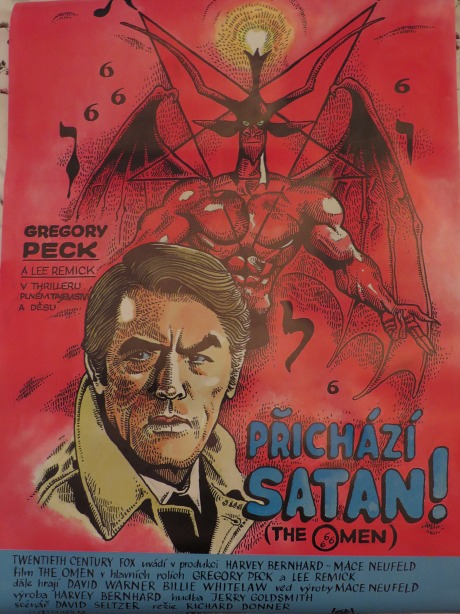
Original (i.e., not a dupe) native-designed poster, bought Friday night at Kino Svetozor (Vodickova 41, Prague 1) prior to showing of Lars Von Trier‘s Nymphomaniac, Volume Two. At first I thought it was better than Volume One. It seemed more tightly organized, more clear of purpose…something. Then I changed my mind. It’s the toned-down version, of course, but I won’t see it again. I’m done.

Robocop Needs To Meet Gort

I’ve just seen Jose Padilha‘s Robocop at the Cinema City plex in Prague, and the general critical view is more or less correct, I’m afraid. It’s an efficient, smartly scripted high-tech actioner, but you can’t help thinking that it just wasn’t necessary to remake Paul Verhoeven’s 1987 original, which had more style, verve and humor. The social allegory is more about the present than the future. Joel Kinnaman does a decent job as Alex Murphy (Peter Weller‘s role in the original) but he’s not star material — he slightly resembles the young Keith Carradine but lacks that X-factor snap. The story is more complex and convoluted, and there’s a persistent effort to explore Murphy’s conflicted emotions as he copes with suddenly being 90% mechanical with only vague ties to his previous organic self.

The irony is that the film doesn’t really kick into gear until Murphy is temporarily shorn of emotion and allowed to ruthlessly enforce Robocop law. Before that happens it’s like “okay, he’s unhappy and confused about no longer being human…we get it, fine…but let’s get to the good parts.”

Read more

No Love For Waltons

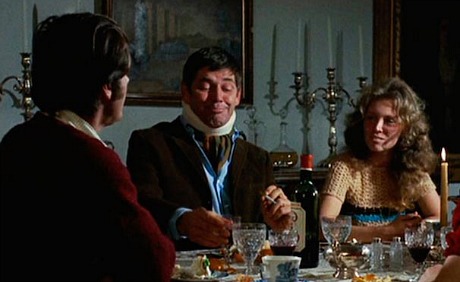
One of the most admirable aspects of my youth is that I never once watched The Waltons. Seriously, not once. I’ve never even looked at YouTube clips. Not even last night when I read about the passing of Ralph Waite at age 85. I never wanted to because I hated the idea of The Waltons from the get-go. Condolences to family, friends and fans but Waite had a long and fruitful life. My most distinctive memory is his portrayal of Jack Nicholson‘s brother, Carl Fidelio Dupea, in Five Easy Pieces (’70). Waite wore a neck brace in every one of his scenes. Nicholson’s character had it off with Carl’s wife, played by Susan Anspach, but it never came to anything.


(l. to.r.) Jack Nicholson, Ralph Waite and Susan Anspach in Bob Rafelson’s Five Easy Pieces.

Does Not-Quite-Trashy Joe Half-Deliver?

On 9.13.13, Rope of Silicon’s Brad Brevet wrote this about David Gordon Green‘s Joe: “[It] works and it doesn’t. The tragic narrative has its hiccups along the way, but improves as it builds its story around two strong performances from Nicolas Cage and Tye Sheridan, elevating it slightly above similar exploitative white trash weepers. [It] mines backwoods hick territory, finding a slight narrative kinship with Jeff NicholsMud combined with the tonal darkness of Winter’s Bone. The strongest thread holding the three films together is obviously the focus on down-on-their-luck families with bad dental hygiene, drinking problems and poor living conditions, all of which are traits I typically loathe.”