Once He Held Mountains In The Palm of His Hands

Apologies to the ghost of the great Sid Caesar for not posting sooner about his passing, which happened earlier today. (Or yesterday if you’re in Prague, where it’s currently 5:10 am on Thursday.) A comic genius of live television who peaked between ’50 and ’57 (or from the ages of 28 to 35), Ceasar was a mountain, a creative collossus and a reflector and definer of the Eisenhower zeitgeist. “In the’50s Caesar was to comedy what Marlon Brando was to drama,” it says on a blurb of Ceasar’s 2004 autobiography. Ceasar was “the ultimate…the very best sketch artist and comedian that ever existed,” said Carl Reiner. Mel Brooks, who worked as one of Caesar’s sketch writers, called him “a giant…maybe the best comedian who ever practiced the trade.”

Read more

Kenny Has Posted His Last

Glenn “Toxic Waste Dump” Kenny has been deep-sixed from Hollywood Elsewhere. His spray-piss attitude is beyond rancid. I will not tolerate his bile. I told him we’re done and he said “go ahead…I was done with you three weeks ago anyway. And forget the bet that you’re going to lose. I won’t even take money from you.” Oooh, Glenn forfeits $50 so he can make a point about his integrity! All he had to do was rein himself in and not behave like a belligerent, supercilious dry-drunk. Alas, too tough a task.

Calculatingly Cute Little Girl Who Knew How To Turn It On

Here’s a tip of the hat to the late Shirley Temple for her acting in Victor McLaglen‘s deathbed scene in John Ford‘s Wee Willie Winkie (’37). Let’s just hang on to this and…I guess we could mention her lightly amusing performance in The Bachelor and the Bobby-Soxer (although Cary Grant, Myrna Loy and Ray Collins were the standouts). In the same way it’s better to remember Elvis Presley from ’54 to ’58 and forget the rest, it’s better to remember Temple as a cute little kid and forget that she became a Republican sometime in the ’60s.

Read more

Heat In The Kitchen

Mark Harris‘s latest Grantland piece is titled “Oscar Season Turns Ugly.” Many Oscar seasons have been ugly to some extent. Some years back David Poland wrote that “every Oscar-bait film is its own little war” or words to that effect. Oscar campaigns are an extension of this mindset, and it follows that they, like any political campaign or debate, are colored by combativeness and certain forms of cruelty. Oscar campaigns don’t exist in a Marquess of Queensberry realm and they never will. Besides last year’s torpedoing of Zero Dark Thirty by a gang of leftist Stalinists over accusations that Kathryn Bigelow and Mark Boal‘s film was allegedly endorsing torture was much, much uglier than anything going on this year. I still feel nauseous about that episode when I think back on it.

Read more

Counselor’s Fighting Weight

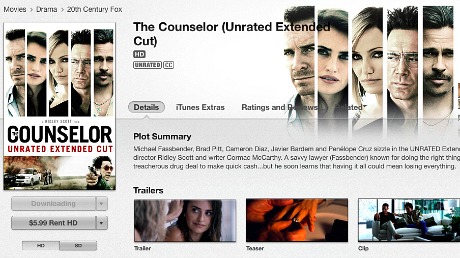
The extended-cut Bluray of Ridley Scott‘s The Counselor (138 minutes vs. the 118-minute theatrical version) streets today. I’ve rented it on iTunes for viewing this evening. In the view of Forbes.com’s Mark Hughes, the theatrical version was over-abbreviated but the long version allows the characters to breathe easier and and stretch their legs and fill things out. If this view turns out to be widely shared, people will call it a repeat of the extended Bluray cut of Scott’s Kingdom of Heaven — a significantly better version than what was shown in theatres.

Read more

Dismissed

In the view of Indiewire‘s Jessica Kiang, Hossein Amini‘s The Two Faces of January, based on a 1964 novel by Patricia Highsmith and screening at the Berlinale, is a letdown. “Something is lost in the translation,” leading to “little more than a competent disappointment, and a strangely old-fashioned one at that,” she writes. “The problems are script-deep, because as a director, Amini shows himself capable if uninspired, but here as screenwriter, he’d appear to be back on the same kind of form that led to the reverent but rather mechanical literary adaptations Jude and The Four Feathers.”

All But Erased

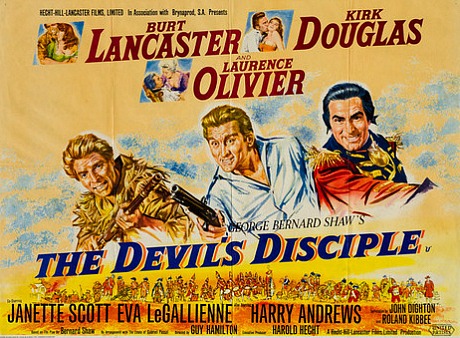
The Devil’s Disciple, a respectable 1959 adaptation of an 1897 George Bernard Shaw play, has been pretty much forgotten. It costarred three big movie stars — Kirk Douglas, Burt Lancaster, Laurence Olivier — at their respective peaks, but it’s not on DVD (let alone Bluray) and you can’t watch it on Netflix, Hulu or Vudu. (The VHS version is for sale on Amazon.) It must have lapsed into public domain. It was co-produced by Douglas’s Bryan Prods. and Lancaster’s Hecht-Hill-Lancaster Films (even though Harold Hecht is listed as the sole producer). It was shot on black-and-white with a 1.37 (or 1.66) aspect ratio by British director Guy Hamilton (Goldfinger, Funeral in Berlin). I saw it eons ago on TV, and watched about half of it last night on YouTube. It’s not half-bad — spirited, intelligent, witty, impassioned, well-acted. It’s a shame that it’s teetering on the brink of extinction.

Riley Can Wait

Right around the time I shot this iPhone video during yesterday afternoon’s Berlin-to-Prague train trip, Glenn Kenny was calling me “worthless” on Twitter for not dropping everything in order to see Alain ResnaisLife of Riley (a.k.a., Aimer, boire et chanter) at the Berlinale. Serious respect to a venerated master, but Resnais’s greatest period of vitality lasted for 20 years, or between Hiroshima, Mon Amour (’59) and Mon Oncle d’Amerique (’80). It’s great that he’s still creating at age 91 but I’ll see Life of Riley when I get around to it.

Crawl Under A Table

Six or seven years ago I was chatting with the late Andy Jones at an Academy screening when an African-American professional woman walked by. I waved and greeted her effusively. Two seconds later I was mortified because I’d addressed her with the name of another African-American professional…good God. After she left Andy chuckled and said, “That’s okay, Jeffrey…all black women look alike so it’s understandable that you made that mistake.” I’ve never felt so completely humiliated. White man! All to say that while KTLA’s Sam Rubin appropriately apologized for briefly thinking that Samuel L. Jackson had performed in a Super Bowl commercial that belonged to Laurence Fishburne, the bottom line was that he had confused the two because of his…uhm, cultural perspective. These things happen every so often, I suppose, but I know it’ll never happen with me again.

Read more