“We are not the mistakes of our past. We’re the resources and capabilities that we glean from our past.” — Jordan Belfort, who is played by Leonardo DiCaprio in Martin Scorsese‘s The Wolf of Wall Street.
Marginalizing of Moral Tales
I don’t believe that the two finest, boldest and most morally definitive films of the year are Steve McQueen‘s 12 Years A Slave and Martin Scorsese‘s The Wolf of Wall Street — I know that they are. And yet the critics groups, so far, don’t seem to fully get this. Or maybe they do but they’d rather not. They haven’t been dismissing these masterpieces — everyone is respectful — but they’ve been kind of half-blowing them off and certainly not giving them the love they deserve. The Scorsese especially. Both films should be standing tall and proud on the mountaintop right now. Critics, guild members and film buffs alike should be bowing and cheering, but they seem to be hedging somewhat. Responses have been mixed and fluid and less fervent than initially anticipated.
I was euphoric when I came out of The Wolf of Wall Street and so far…well, some agree with me at least. I knew I’d seen a masterpiece when I first caught 12 Years A Slave in Telluride and now…what has happened exactly? I know about all the grumbling by long-of-tooth Academy members about how they respect it but don’t like it, blah blah. But why have the critics done a slight but noticable fade on Slave?
Nympho Lowdown
Two or three days ago I announced an intention to fly to Copenhagen sometime after 12.20 to catch Lars von Trier‘s Nymphomaniac while expressing hope that Magnolia, the film’s U.S. distributor, might screen the two-part, four-hour film domestically (NY or LA) for trades and certain columnists to allow them to post reviews on the 12.17 worldwide embargo date. I was eventually informed that Magnolia will not be screening Nymphomaniac any time soon for U.S. critics. I was then told by Premier‘s Liz Miller that Danish publicists are planning a 12.17 screening for Scandinavian press in Copenhagen, and that Nymphomaniac‘s U.K. distributor is currently “deciding whether to do that here (in London) on that date.” I wrote Magnolia again, noting that “the worldwide conversation about the film will begin for European critics on 12.17 and continue henceforth. It seems a shame that you and yours are deciding to make U.S. critics pay at least $1800 in air fare plus hotel and everything else in order to take part in that discussion on a timely basis.” I can’t attend any 12.17 press screenings in Europe, but I’m thinking of flying to Denmark and seeing the film commercially on Christmas Day. I’ll be happy to bang out a review (different than the one I’ll post here) for any publication that wants to throw me a grand for my time and trouble. I’ll eat the rest.
Logistical Lament
Two Boston critics said today that the decision by Paramount-linked Allied Marketing to screen The Wolf of Wall Street only at the very last minute (i.e., two days ago) led to Martin Scorsese‘s debauched epic not winning in as many as five Boston Society of Film Critics categories. And now New Orleans’ filmmaker Dave DuBos informs that “a female gal pal who votes for the SAG awards…has not received her Wolf screener and guess what? Last day to vote for the SAG awards is Monday. Did Paramount drop the ball here?” We all know that Wolf was finalized only a little more than a week ago, meaning there wasn’t the usual amount of time to prepare screenings and screeners. It’s a shame considering that the film is affecting some viewers (i.e., the more perceptive ones) as phenomenal.
Jonah, Donnie, Marbled Steaks
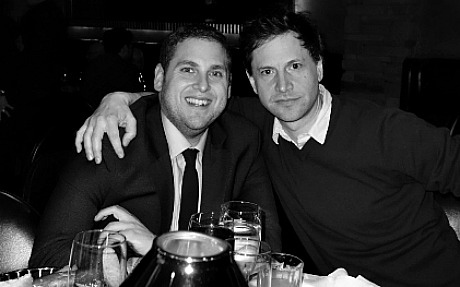
On behalf of Wolf of Wall Street costar Jonah Hill, director Bennett Miller (Moneyball, Capote, the forthcoming Foxcatcher) hosted a Saturday screening of Martin Scorsese‘s film and then a dinner at Mastros (246 No. Canon Drive, Beverly Hills). Paramount sponsored the non-press event. Attendees included Anne Hathaway, Brett Ratner, Rebel Wilson, Simon Baker, Walton Goggins, Mickey Rooney, Robert Forster. Hill’s performance as the buck-toothed Donnie Azoff is joyfully diseased — high torque, manic, snap-crackle-pop, etc. The Best Supporting Actor race is Hill vs. Dallas Buyer’s Club‘s Jared Leto vs. Enough Said‘s James Gandolfini.
LAFCA Splits Best Picture, Best Actress and Best Supporting Actor Prizes
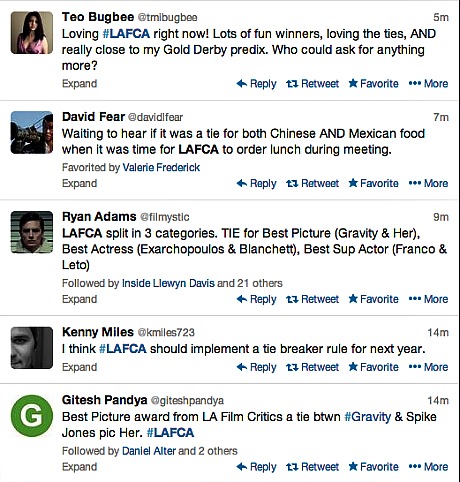
The Los Angeles Film Critics Association has given its Best Picture prize to both Gravity and Her — a little weird but okay. Obviously the soft consensus voters went for Gravity while those with more particular passions went for Her. Nebraska‘s Bruce Dern won for Best Actor. The Best Actress decision was a tie between Blue Jasmine‘s Cate Blanchett and Blue Is The Warmest Color‘s Adele Exarchopoulos. Gravity‘s Alfonso Cuaron was named Best Director. (Runner-up is Her‘s Spike Jonze.) Best Supporting Actor was/is also a tie between Spring Breakers‘ James Franco and Dallas Buyers Club‘s Jared Leto. Slave‘s Lupita Nyong’o has won the Best Supporting Actress prize. (Runner-up: Nebraska‘s June Squibb.) LAFCA’s Best Screenplay award has gone to Before Midnight‘s Richard Linklater, Julie Delpy and Ethan Hawke. Blue Is The Warmest Color was named Best Foreign Language Film.
Boston At Least Voted Distinctively
12:01 pm Pacific: 12 Years A Slave has won the Boston Film Critics Society’s Best Picture award. Boston Globe critic Ty Burr is suggesting that Paramount/Allied screwed up by not screening Wolf of Wall Street for Boston critics sooner — roughly a third of the voting body missed the one last-minute Beantown screening. In the view of Boston Phoenix critic Brett Michel, “Paramount completely fucked The Wolf of Wall Street here in Boston. Because five people in the [BSFC] room today couldn’t make it to Friday’s 11th-hour screening, Marty’s film was doomed to come in second in no less than five(!) categories: best picture, director, actor (DiCaprio), screenplay (Terrence Winter) and editing.”

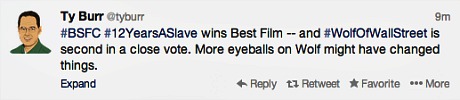
11:46 am Pacific: 12 Years A Slave‘s Steve McQueen has won the Boston Film Critics Society’s Best Director award. Which means Slave has the Best Picture award in the bag or…?
11:32 am Pacific: The Boston Film Critics Society has handed its Best Actor award to 12 Years A Slave‘s Chiwetel Ejiofor, and its Best Actress award to Blue Jasmine‘s Cate Blanchett. The late James Gandolfini has won the Best Supporting Actor trophy for his performance in Enough Said — a nice respectful gesture but why? JG was tender and vulnerable in Nicole Holofcener‘s film, but are you telling me he delivered a more affecting performance than Jared Leto in Dallas Buyer’s Club or Jonah Hill in The Wolf of Wall Street? Nebraska‘s June Squibb was won the BFCS award for Best Supporting Actress.

Slave Needs Help From LAFCA, Boston
The Los Angeles Film Critics will vote today (i.e., Sunday). Steve McQueen‘s masterful 12 Years A Slave, a seeming shoo-in for several critics-group awards after ecstatic receptions at Telluride and Toronto, is now on the ropes due to industry hesitance and recent no-wins with the New York Film Critics Circle and the National Board of Review. To maintain vitality in the Best Picture race, Slave needs a LAFCA Best Picture win. And another, for good measure, from the Boston Film Critics, who will also vote today.
If LAFCA and Boston don’t step up to the plate and do the right thing by Slave, the Fox Searchlight release will face at least a somewhat steeper hill as far as potential industry support is concerned. But if LAFCA and Boston don’t “friend” Slave, they should do the other good thing, and that’s give their respective Best Picture prizes to Martin Scorsese‘s wild and mouth-frothy The Wolf of Wall Street — a madly brilliant slash across the canvas by our greatest filmmaker.
Overcoats and Scarves
I walked a couple of miles for the exercise this evening. Not quite like Arctic winds howling through Chicago, but certainly bone-chilling by Los Angeles standards. Frigid, gusty. It felt to me like the coming of winter in Cleveland or Syracuse or northern Ireland.
New Orleans Poker
Earlier today I spoke with the New Orleans-based Dave DuBos, director-writer of a forthcoming horror film called Bayou Tales and host of WSGO’s “Movie Talk” on Saturdays. We began by kicking around The Wolf of Wall Street but mainly discussed Howard Hawks‘ definition of a good film (see related HE piece) and how that applies to this year’s crop of Best Picture contenders. Again, the mp3.

Howard Hawks Wants To Know
It’s time once again to apply Howard Hawks’ definition of a quality-level film to this year’s Best Picture contenders. A good movie, said Hawks, is one that has “three great scenes and no bad ones.” It shouldn’t be too much to ask that a Best Picture Oscar winner should live up to this, right?
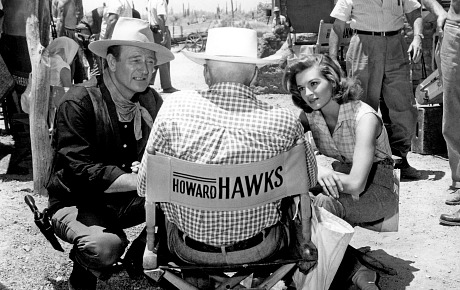
John Wayne and Angie Dickinson conferring with Mr. Hawks on the 1959 set of Rio Bravo.
In my first Hawks criteria piece, I wrote that “great scenes are ones that you can’t forget because they’ve sunk in or hit a solid crack note of some kind. They deliver some kind of bedrock, put-it-in-the-bank observation about life or human behavior or just the way things usually are, and when they’re over you always say to yourself, ‘Wow, that worked.'” So let’s review a few Best Picture contenders and see if they cut the mustard.
Best Picture contender: The Wolf of Wall Street. Three great scenes?: Yes, but more in the realm of over-the-top bravura scenes as Wolf is a dark fantasia of corruption and venality, and not, you know, a straight-from-the-shoulder “drama” in the business of conveying fundamental human truths. The Leonardo DiCaprio-Matthew McConaughey chest-thump lunch scene. The Leo gives a pep talk to the Stratton-Oakmont troops scene (“Pick up the phone”). The Leo chats with the FBI guy (Kyle Chandler) on the yacht scene. The quaalude meltdown scene. The yacht-nearly-sinks-at-sea scene. How many is that? Wolf is one engine-rev scene after another.