
They Bought It

A publicist pal asked this morning if I saw Nick Ryan‘s The Summit (IFC Films, 10.4) at last January’s Sundance Film Festival, and I said “nope…can I get a screener?” And then I remembered that I’d not only seen it but had posted a review. What does that indicate? Obviously that this absorbing, highly complex doc didn’t stick. Why? Because its examination of the death of 11 climbers on the notorious K2 in August 2008 is a little too even-handed. It’s so fair-minded (i.e., reluctant to call a spade a spade) that butter wouldn’t melt in its mouth.

“The story of the 2008 tragedy demands specificity and exactitude, and Ryan’s film (which is partly re-enacted) certainly provides that,” I wrote last January. “But in the name of thoroughness and looking at all the angles, it declines to judge or point fingers. Ryan decides to not say in clear, talking-to-a-dumb-guy fashion if this or that climber was guilty of carelessness or negligence. He just says, ‘This happened, and a lot of factors came into play. Either way I’m not going to give you, the viewer, the satisfaction of being able to say ‘this guy screwed up’ or ‘this guy should have known better.’ You can figure that out yourself on your way home, if you want. Or you can do some in-depth reading about it.”

Read more

Two Pop-Outs

I’ve seen two of the films opening on Friday, 9.27 — Joseph Gordon Levitt‘s Don Jon (formerly Don Jon’s Addiction) and Greg ‘Freddy’ Camalier‘s Muscle Shoals. I meant to see James Franco’s As I Lay Dying in Cannes but then the word got around and other stuff came up and then the one-sheet surfaced — the film (like the 1930 William Faulkner book it’s based upon) is an ensemble piece and the poster image is no-big-deal snap of a frowning Franco?

Read more

Slight Slave Diminishment?

A 9.22 Michael Cieply N.Y. Times article (in the 9.23 print edition) quotes two U.S. history scholars who question whether Solomon Northup actually wrote “12 Years A Slave“, the 1853 novel that is the basis for Steve McQueen‘s highly acclaimed film and more particularly John Ridley‘s script. Chiwetel Ejiofore plays Northrup, a free New York State citizen and family man who was kidnapped and sold into slavery and remained in that realm from 1841 through 1853.

If Cieply’s story had been published in, say, late November or December, it would be seen in some quarters as a typical award-season hitjob on a leading Best Picture contender. But appearing as it is now, a good two months before the Oscar race will begin to heat up, it seems like a fair-enough examination of certain historical anecdotes and particulars. The article isn’t really a hitjob as much as a “hmmm”-job.

Read more

Mild Quibble

In his mostly ecstatic review of Alfonso Cuaron‘s Gravity (Warner Bros., 10.4), TheWrap critic Todd Gilchrist describes it as “a hard-science tale.” The $80 million dollar 3D epic certainly feels technologically realistic but the term “hard-science” suggests something dry and matter-of-fact and perhaps even 2001-ish. That’s not how the film plays. Director-cowriter Cuaron spends a lot of time exploring the emotional travails of Sandra Bullock‘s novice-astronaut character, Dr. Ryan Stone. Gravity, truth be told, is basically an emotional-woman-in-peril movie first and a “hard science” thing (if you want to call it that) second. Gilchrist calls it “a virtuoso technical achievement and a powerfully visceral cinematic experience” — definitely. He also says “it offers a uniquely poetic portrait of hope and survival.” I’m less sure about “uniquely” since Bullock’s response to her life-threatening situation isn’t radically different from the responses of Doris Day and Karen Black in vaguely similar films of the past, as I pointed out on 9.19. Gravity is a brilliant achievement, but “hard science” it’s not.

Opened Seven Days Apart

Kyle Patrick Alvarez‘s C.O.G. (Focus Features, 9.20) is a personal-odyssey drama about a Yale graduate (Jonathan Groff) trying to immerse himself in some form of rural reality (i.e, an apple farm) as a way of shaking himself out of his elitist academic realm…or something like that. (C.O.G. is an acronym for Child of God — is there anyone on the planet who can’t be so described?) Jeremy Seifert‘s GMO OMG is a doc about a guy looking for naturally grown, non-corporate foodstuffs. GMO is an acronym for “Genetically Modified Organism.”

Checklist

I’ve seen and reviewed four of the 18 films that opened two days ago — Rush (positive as far as it goes), Prisoners (mixed positive), Haute Cuisine (positive) and The Wizard of Oz 3D (mostly positive). I walked into a Toronto Film Festival screening of The Art of The Steal and walked right out again 20 to 25 minutes later because it seemed too genre-ish. I haven’t seen A Single Shot, After Tiller, Battle of the Year 3D, C.O.G., The Colony, Generation Iron, IP Man: The Final Fight, Jerusalem, My Lucky Star, Plus One, The Short Game, Thanks for Sharing and Zaytoun. This is the way of the movie world these days. I should have seen one of two more openers, I suppose, but a one-man band can’t keep up and write this kind of column (six or seven stories per day).

Short-Timer

“There’s no escaping that [this] film will jerk tears, but it doesn’t deserve the pejorative label that might suggest…Felix von Groeningen seems to innately understand that sorrow truthfully communicated and shared can be cathartic, rather than depressing.” — The Playlist‘s Jessica Kiang, filing from the Karlovy Film festival.

Read more

Waiting Game

I was mildly okay with Ron Howard‘s Rush (Universal 9.20) for the most part, but I haven’t felt moved to review it. I’m still not there. I’m waiting for the insight or ignition. I admired the craft and verisimilitude and the ’60s/’70s vibe, and I enjoyed the visceral vroom-vroom…but it didn’t stay with me, possibly because I didn’t sense much of an undercurrent (or at least an undercurrent that meant something to me personally). Is it because I didn’t care all that much about James Hunt (Chris Hemsworth) or Niki Lauda (Daniel Bruhl)? The former struck me as an instinctual, good-natured, hot-dog libertine with a lion-like mane ; the other as an edgy, screwed-down, not-especially-likable hardass. Am I glad I saw Rush? Yeah. Would I see it again? Possibly. Will I buy the Bluray? No offense but probably not. And that’s not a putdown. I might rent the HD version on Vudu.

Lifestyle Choice

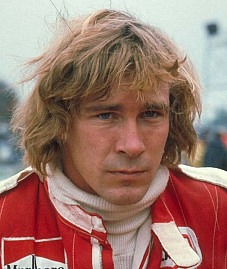
Formula One race-car driver James Hunt, who is portrayed by Chris Hemsworth in Ron Howard‘s Rush, died at age 45. The film doesn’t exactly say that Hunt paid the price for being a chronic party animal, womanizer and cigarette smoker who burned the candle at both ends, but that’s obviously what happened. He died of Harry Nilsson‘s disease — “He liked to party and he got that, and in the end it got him.” It’s funny how this pathology, which has been dramatized over and over by party-hound types in Hollywood and the music industry for decades…it’s fascinating how this never seems to have the slightest effect upon people in their 20s who love the wild life. Almost everyone in their 20s thinks they’re bulletproof. Or that they’ll start living more moderately down the road. Or that it’s better to burn out than to fade away.


(l.) Chris Hemsworth; (r.) James Hunt.

Trigger Mechanism

I might be kidding myself, but I believe there’s a difference between (a) mindless smartphone distraction as a way of avoiding mystical silences and pushing back on loneliness and (b) constantly searching sites and refreshing Twitter and checking emails in an 18/7 search for material, which is more or less what I do.