

When it comes to Machete flicks, slapdash genre-wanker Robert Rodriguez — a man who has lived in torment for 20 years over his inability to make another movie as good as El Mariachi, his debut film which cost $7000 — morphs into Zucker Abrahams Zucker. Amusing as a trailer (the Charlie Sheen menage a trois gag works), probably very trying as a feature. You can’t sustain this kind of tonal attitude over 95 or 100 minutes — it turns into cottage cheese. No name-brand director is as deeply opposed to infusing his films with thematic or spiritual content as Rodriguez. He would sooner slit his throat than have one of his films deliver subtext (except for his “let’s have fun with this or that exploitation cliche by overcranking it” bullshit). You’ll never get more than what you see when you watch a Rodriguez fick.
Best One Yet
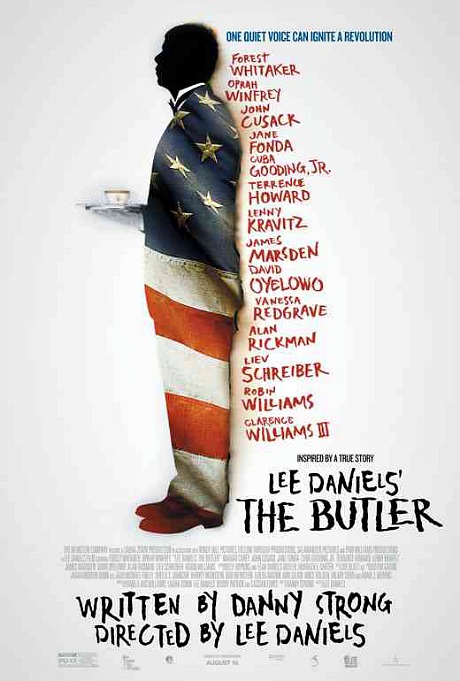
I need to speak to someone who can tell me how to pronounce David Oyelowo‘s last name. I hesitate every time I try to say it. My tongue shrinks from the challenge. Oh-yay-low-woe? My inner ten-year-old wants to say oh-yellow.
Blues and Blacks
The Shane Bluray is “simply astonishing,” Blu-ray.com’s Michael Reuben wrote on 7.30. “Details, densities, black levels, textures and colors are all revelatory. I literally felt that I was seeing a film I had never seen before.
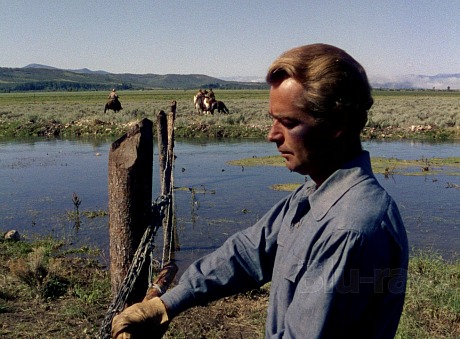
“It’s not just in the obvious scenes, such as the mountain vistas around the Starrett farm. It’s also in the subtler shadows of the day-for-night sequences (what director George Stevens called the ‘Rembrandt lighting’), such as the encounter between Ryker and Joe Starrett after the Fourth of July celebration, where the shadow detail is just sufficient and the shades of black and blue layer over each other in just the right proportions to create the sense of depth and danger that Stevens and dp Loyal Griggs intended.”
Get Lost
“J.C. Chandor‘s All Is Lost has completely blown everyone away at the Cannes Film Festival. It’s a knockout — a riveting piece of pure, almost-dialogue-free cinema, a terrific survival-on-the-high-seas tale and major acting triumph for Robert Redford, who hasn’t been this good since…what, Brubaker? All The President’s Men? A long time.

Hot-Shot Movies
I have to fly back to Los Angeles this evening. I’ll return to New York after Telluride (9.2) and stay until flying to Toronto on 9.5, and then I might return here again. (Or not.) But that’s not the issue. The issue is whether or not to re-launch an L.A. screening series that I ran in the late ’90s, which I called Hot-Shot Movies. It would be no different than all the other screening series around town. $175 or $180 bills for nine sessions consisting of a new un-opened film plus the director or one of the stars doing a short q & a (i.e., no longer than 30 minutes).
I have a relatively high profile these days and a bit of a following. Plus I have good talent relations (especially with directors), and I’m guessing I’ll have a pretty good shot at getting guys like Alfonso Cuaron and George Clooney and other big dogs to drop by. Hopefully. Maybe.
Distinctive Minds
In the view of Grantland‘s Wesley Morris, 2 Guns boils down to Denzel Washington and Mark Wahlberg “having a good time robbing banks and blowing up buildings and barreling through military security checkpoints and double-crossing people and shooting each other because none of it really means anything. You rarely get to see a pair of stars mired in this much danger but playing the whole thing as if they were on vacation. Wahlberg all but walks around the film with a paper umbrella behind one of his ears.”
I said roughly the same thing on 7.25, calling it “a silly late-summer jagoff that’s about Washington and Wahlberg playing ‘catch’ with each other — i.e., the old chemistry-rapport-mutual backscratch put-on/goof-off thing. Call it ‘attitude-surfing.’ The movie has no undercurrent, no themes — nothing except the wank-off vibe of everyone just making the damn thing and collecting their paychecks and taking their dicks out and stroking them as they cash their checks and hack around between takes.”
Military Intelligence Effed Up
Peter Berg‘s Lone Survivor (Universal, 12.27) is basically about an anti-Taliban military operation that went wrong and resulted in the deaths of a lot of good homies. The source of Berg’s screenplay is Marcus Luttrell‘s “Lone Survivor: The Eyewitness Account of Operation Redwing and the Lost Heroes of SEAL Team 10.” Pic costars Mark Wahlberg, Taylor Kitsch, Eric Bana, Emile Hirsch, Ben Foster and Alexander Ludwig. Deadline‘s Mike Fleming reported on 3/17.11 that Berg wanted to make Lone Survivor immediately after The Kingdom, but Universal wouldn’t do it unless he agreed to make Battleship first.
They Done Her Wrong
I don’t doubt the veracity of Linda Lovelace‘s “Ordeal.” She was used and abused by the porn industry, and especially by her Svengali-pimp boyfriend Chuck Traynor. Which is what Rob Epstein and Jeffrey Friedman‘s film (Radius-TWC, 8.9) essentially conveys. I just don’t believe this is the whole story. I especially don’t believe that Lovelace was the innocent, wide-eyed, golly-gee victim that Amanda Seyfried portrays. I think she was more of a willing if not enthusiastic participant in her porn celebrity (at least during the early ’70s) than the film lets on. I was touched and saddened by Lovelace, but I finally felt more skeptical than persuaded.
Tone Deaf
I can’t sing like a professional or even a gifted amateur, but I can definitely sing “Happy Birthday” on-key. Which is more than 97% of your Average Joes and Janes can manage. I can’t tell you how many times I’ve listened to a table of restaurant revelers try to sing it and not hit a single true note. It’s pathetic. We’re not talking about singing “The Star-Spangled Banner” here. “Happy Birthday” is a popular tune because any whoop-dee-doer can sing it, except most folks can’t find the key of G to save their lives and forget holding onto the melody if they could. Bad singing is all about emotional timidity. Singing on-key takes a certain open-heartedness. You can’t be covert about it. All I know is that every time a table launches into “Happy Birthday” I grimace and go “oh, God…here we go.’
Ambitious Oldboy Fight Scene
A trustworthy source informs that Spike Lee and Josh Brolin shot an ambitious fight sequence for the forthcoming Oldboy (FilmDistrict, 11.27) that was timed at 14 minutes and 30 seconds without a cut. I asked Brolin about this and he replied as follows: “Your source doesn’t understand that if I did a non-stop 14 minutte and 30-second second fight sequence, I’d be dead now. To get through 45 seconds (when we started rehearsing it) left me blanched and heaving. I won’t tell you how long the fight is but it is unique. ”
Reluctance
“After splitting her time between New York and Paris, Nico got the lead role in Jacques Poitrenaud‘s Strip-Tease (1963). She recorded the title track, which was written by Serge Gainsbourg but not released until 2001, when it was included in the compilation Le Cinema de Serge Gainsbourg.” — from Nico’s Wiki page.
Go Easy On Elysium
The basic thrust of Brooks Barnes‘ 7.30 N.Y. Times article about Neil Blomkamp‘s Elysium (Sony, 8.9) is that tracking is looking iffy due to possible audience perceptions of familiarity and repetition (I noted the similarities to Tom Cruise‘s Oblivion six weeks ago) and that (b) Sony can’t afford three tanks in a row following the After Earth and White House Down shortfalls.