I won’t be around for the upcoming Rolling Stones concert at the Staples Center (no announced date but probably around 5.1), but if you want to stand in the “tongue pit” in Oakland’s Oracle arena it’ll set you back $1500 bills. The pit will be filled with bald or white-haired guys in T-shirts with their 39 year-old girlfriends (total cost for getting laid that night: $3 grand.). They should sell some cheap tickets on a lottery basis for younger fans.
DATE: 4.5.13
FROM: Jeffrey Wells, HE
TO: Martin Scorsese c/o Margaret Bodde, Thelma Schoonmaker
RE: Shane aspect ratio controversy
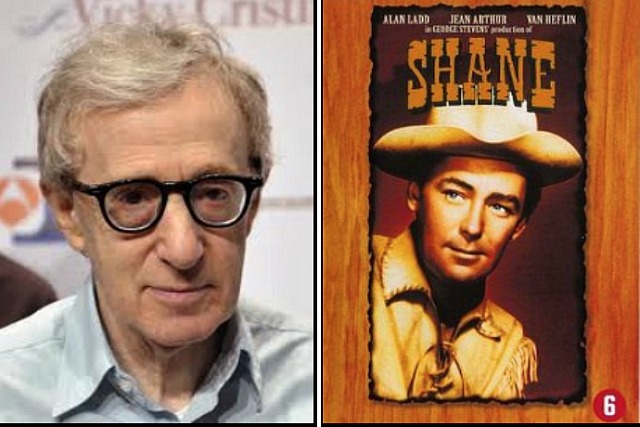
Just following up, Marty, on my Shane letter addressed to you 7 days ago. I also wrote Woody Allen about this matter, and he replied yesterday as follows: http://www.hollywood-elsewhere.com/2013/04/woody-allen-on-shane-debacle/. If you can spare the time a reply would be greatly appreciated. — Jeffrey Wells, Hollywood Elsewhere
Here’s a little taste of Robert Trachtenberg‘s Mel Brooks: Make A Noise, which will premiere on Monday, 5.20. It’s a little riff about The Critic, the 1963 Oscar-winning short that Brooks voiced. I’ll be watching the show this weekend.
“Shane Carruth‘s Upstream Color is the only Sundance film I’ve seen so far that totally jettisons narrative in favor of an impressionist, oddly spooky, catch-as-catch-can paint-splatter whatever experience. It’s very cool and commanding and climatorial. I became an instant fan. You’re free to piece together all the fragments and good luck with that, but Upstream Color has something to do with 21st Century anxiety, malevolent micro-manipulation, love, bodily invasions, Ridley Scott-like worms and definitely pigs. Lots and lots of little pigs.
“You don’t want to hear what I think it all amounts to. Whatever I might write would just get in the way or feel like a mosquito. It’s entirely between you and Upstream Color.
“Director-writer-producer Carruth is self-distributingUpstream Color on April 5th. HE readers are advised to grapple with the experience. All serious cineastes, I mean. I honestly don’t think you’ll be able to call yourself a man if you don’t.
“It’s certainly worth catching for Amy Seimetz‘s mesmerizing lead performance. And Carruth’s costarring one, come to think. They play lovers (named Chris and Jeff) who may have been invaded/afflicted by the same quietly malevolent, William S. Burroughs-ian bad guys, and Carruth is cool — a fascinating actor in that he doesn’t seem to “act” much but is indisputably interesting. His intense eyes especially.
“But Semetz (an indie actress-director who strongly resembles early Juliette Binoche) is the shit. She’s the primary victim, the person who struggles with weird micro-aggression and malevolence that makes no real “sense,” who tries to hold on, who bears the burden and somehow muddles through. Seimetz has been around for years, but this is the first time I’ve sat up and said ‘wow.'”
Portion of Dargis review: “For all of Mr. Carruth’s cosmic reaching and despite the jigsaw montage, Upstream Colorisn’t an arduous head-scratcher if you don’t worry about what it means and just go with the trippy flow. (Mr. Carruth helped cut and shoot the movie, and wrote its mood-setting score.)
“It is, instead, a sometimes seductive, sometimes tiresome melange of ideas that are by turns obvious, hermetic, touching and sweetly dopey. Much of it involves an emotionally fraught romance that Amy Seimetz’s Kris strikes up with Mr. Carruth’s Jeff, a relationship that dovetails with a freaky tale of dead pigs, blue orchids, those mind-altering worms and another mystery man, Sampler (Andrew Sensenig), whose mailbox bears the words ‘Quinoa Valley.’
“You may laugh, but if that’s an intentional joke, Mr. Carruth isn’t saying. He’s a man of few words and less exposition, and Upstream Color doesn’t come across as satirical even if it edges close to absurdity. Sampler is similarly taciturn and is mostly seen walking about recording sounds, like the papery rustle of dry leaves and the happy gurgle of streams. He also tends to his swine and conducts a shivery, creepy deworming procedure with Kris and a pig.
“At times, he walks among people as undetected as the soulful angels in Wim Wenders’ Wings of Desire. In one scene, he drifts among his adorable herd of little porkers Christ-like, the fingers of one hand trailing through the air as the camera closely follows, a shot and a gesture that strongly evoke Mr. Malick’s work.
Mr. Malick’s imprint on Mr. Carruth, however deliberate, runs deep. It’s evident in Mr. Carruth’s emphasis on the natural world; his use of ‘Walden’; the hushed voices and many images, including some time-lapse photography of a dead pig decaying underwater, which registers as the catastrophic inverse of the time-lapse sequence of a seed sprouting underground in Days of Heaven. (Mr. Carruth’s movie at times feels like days of hell.)
“Mr. Malick’s influence also extends to shots of Kris and Jeff walking, whispering and touching that are not moored in a specific time but could be from the past, present or future. In these Malick Moments, time becomes as circular as the rising and setting of the sun. ‘Time is but the stream I go a-fishing in,’ Thoreau wrote in ‘Walden.'”
Here I am paying oblique tribute to Malala Yousufzai, who was shot in the head and neck by a Taliban psycho last year for advocating female education in Pakistan. I’m posting this because Angelina Jolie gave a speech about Malala earlier today at the Women in the World Summit in Manhattan. I happened to run across the video as I was surfing around in search of Roger Ebert material.
Congrats to David & Goliath, the ad agency that created this spot. It’s probably the most blissed-out, magical-feeling advertisement for a government-sponsored con aimed at society’s losers ever made. Kudos to D&G’s chief creative offier David Angelo, exec creative director Colin Jeffery, ssociate creative director Jason Rappaport and art director Todd Rone Parker.
How many decades have directors of horror films been using scratchy, high-pitched howls to make sure that audiences understand that something horribly scary is happening? I guess it began with Bernard Herrmann‘s screechy violins on the Psycho soundtrack. I only know that you can’t watch a horror film or a trailer for one without hearing that shrieking laryngitis banshee wail — the universal sound for all ghosts, demons, banshees and monsters. I’d really love to be spared every so often.
I’m thinking of hiking up to the San Francisco Film Festival on Saturday, 4.27 to hear Steven Soderbergh deliver a “state of the cinema” speech as well as an explanation of his reasons for taking a taking a little time out, a.k.a., a “Frank Sinatra retirement.” No more gratis hotel bookings so we’re talking round-trip air fare plus two nights at some flophouse or b & b plus the usual expenses or roughly $700 bills just to hear Soderbergh give a speech.
I’ll also be doing the 16th annual Sonoma International Film Festival from roughly Thursday, 4.11 through Sunday, 4.14. I’ve been there before and its a nice, agreeable, intelligently programmed affair. When I was drinking it meant something to be staying in the middle of wine country; now not so much. But I get to park it here so it’s all good.
“I know it is coming, and I do not fear it, because I believe there is nothing on the other side of death to fear,” Roger Ebert wrote in a 9.15.11 Salon piece. “I hope to be spared as much pain as possible on the approach path. I was perfectly content before I was born, and I think of death as the same state. I am grateful for the gifts of intelligence, love, wonder and laughter. You can’t say it wasn’t interesting. My lifetime’s memories are what I have brought home from the trip. I will require them for eternity no more than that little souvenir of the Eiffel Tower I brought home from Paris.
“I don’t expect to die anytime soon. But it could happen this moment, while I am writing. I was talking the other day with Jim Toback, a friend of 35 years, and the conversation turned to our deaths, as it always does. ‘Ask someone how they feel about death,’ he said, ‘and they’ll tell you everyone’s gonna die. Ask them, In the next 30 seconds? No, no, no, that’s not gonna happen. How about this afternoon? No. What you’re really asking them to admit is, Oh my God, I don’t really exist. I might be gone at any given second.’
“Me too, but I hope not. I have plans. [But] I have no desire to live forever. The concept frightens me. I am 69, have had cancer, will die sooner than most of those reading this. That is in the nature of things. In my plans for life after death, I say, again with Walt Whitman:
I bequeath myself to the dirt to grow from the grass I love,
If you want me again look for me under your boot-soles.
Last last week I wrote to Woody Allen about the Shane aspect-ratio brouhaha. I wrote him in care of his publicist Leslee Dart of 42West. About a half hour ago I received a letter from Woody via Leslee as follows:
“Dear Jeffrey,
“I wanted to add my strenuous objection to putting out an edition of Shane in any format other than the precise original.
“Black bars are much preferable and years before they were acceptable to audiences I always insisted on them for my movie Manhattan rather than giving in to what may be a more commercial but is definitely an artistic degradation of how the movie should look.
“The compromise of putting out two versions, an original and one commercially modified, would certainly not be acceptable to me on a film of mine. While I don’t like the idea of [this compromise happening to] one of America’s Greatest Westerns and one of its finest all-around films, I suppose it’s better than riding roughshod over the original masterpiece and losing it to attempt with version.”
Woody apparently wrote this in some haste and I’m not quite sure how to properly edit the last six words of the last sentence, but I presume he means it’s better to have a dual-aspect-ratio Bluray (containing a 1.66 plus a 1.37 version) than to not have a 1.37 version available at all.
Woody’s last line is directed not at myself but at Warner Home Video and/or Paramount Home Video executives, to wit:
“I hope you will consider this before an irrevocable mistake is made.”