

Stripped Down
I don’t know when I last listened to this Moody Blues track, but it was probably the Pleistocene era. Simple, concise, unpretentious. It’s off The Magnificent Moodies (released in July ’65), and recorded before Denny Laine and Clint Warwick left the band and especially before Mike Pinder and Ray Thomas got into acid and Edwardian lace shirts and big choruses and psychedelic dreamscapes.
Boiled Down, Translated
The gist of this 12.5 Pete Hammond Deadline piece (“Zero Dark Thirty Gives Sony Early Awards Heat But Will It Last?”) is that a lot of people don’t know what to stand by Best Picture-wise, but they don’t like the idea of giving the Oscar to another Middle-Eastern conflict film made by the great Kathryn Bigelow and Mark Boal.
I’m presuming that older Academy milquetotast types are telling Hammond “Bigelow again?” and “more Middle East terror tension?” and “why can’t we find a nice consensus movie that fits the warmly emotional paradigm that we all want to give the Best Picture Oscar to, and…you know, without anyone getting blown up or double-tapped…something that explains who we are and what we really want and need?”
Some would like to give it to Lincoln or Les Miz but they’re not feeing the current in the rapids and they can feel the ardor cooling down (certainly with Lincoln). They’ve found a film that “fits that warmly emotional paradigm” in Silver Linings Playbook, of course, but that’s not knocking everyone down either. Cattle are happiest when they’re being led along. And if they’re not being led along they wander around in search of water and grass. What Hammond is telling us is that Academy members don’t know which way to turn.
They have two choices. They can go with the unassailable Zero Dark Thirty — the flinty, pruned-down CIA docudrama with Jessica Chastain‘s super-tough heroine, or with the jazzy, spazzy, warmly emotional and hyper-intelligent Silver Linings Playbook, the movie that restored respect to the seriously tarnished romantic comedy genre and confirmed that director-writer David O. Russell is at the top of his game these days, and that Bradley Cooper (NBR’s Best Actor winner as of today) and Jennifer Lawrence are forces of nature and growth-spurters extraordinaire.
NBR Chooses ZDT for Best Pic; Cooper Over DDL
The National Board of Review is a mostly discredited organization that carries no real weight or sway, but the fact that they’ve given their Best Picture award to Zero Dark Thirty feels like a whoo-hoo nonetheless. They’ve also given their Best Director award to ZDT‘s Kathryn Bigelow and Best Actress trophy to Jessica Chastain…three fresh biggies for ZDT!
Memo to Indiewire‘s Anne Thompson: Daniel Day Lewis has always been a top Best Actor contender, but Lincoln itself has either run out of gas or never had it to begin with. Certainly not the high-octane brand. Yes, it’s Steven Spielberg‘s best since Saving Private Ryan, but events aren’t falling into place. It’s over or close to it.
There’s also a little Silver Linings momentum kicking in with Bradley Cooper snagging the NBR’s Best Actor trophy. Cooper, it seems, has acquired solid-gold cred today as a Best Actor contender. No pushing him off to the sidelines or going “yeah, maybe” anymore. David O. Russell also won the Best Adapted Screenplay award for Silver Linings Playbook. SLP haters need to bow and back off and scatter for the time being.
I’ve seen Django Unchained, and if you ask me the NBR giving their Best Supporting Actor award to Leonardo DiCaprio is bullshit. They’re kowtowing to a big movie star. DiCaprio’s venal plantation-owner character has no arc, no depth…it’s just showboating. SLP‘s Robert De Niro is a far more deserving recipient. Ditto Lincoln‘s Tommy Lee Jones, The Master‘s Phillip Seymour Hoffman, Arbitrage‘s Nate Parker, or Magic Mike‘s Matthew McConaughey.
Ann Dowd winning Best Supporting Actress for Compliance is a nice thing and well deserved — good for her.
Congrats to HE’s very own Rian Johnson for winning the NBR’s Best Original Screenplay for Looper.
Wreck-It Ralph won for Best Animated Feature. The Oscar in this category will go for this or Tim Burton‘s Frankenweenie…right? The Best Directorial Debut award has gone to Benh Zeitlin for Beasts of the Southern Wild…great.
Michael Haneke‘s Amour has won the Best Foreign Language Film award. And Searching for Sugar Man has won the Best Documentary award.
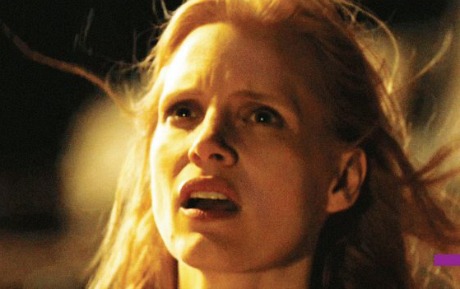
Jessica Chastain in Zero Dark Thirty.
Death Comes Suddenly
An iMac I bought in early ’09 has been showing signs of age over the last year or so. Today it fell out of the wheelchair and started gasping and talking gibberish. I knew it would die sooner or later, but I’ve been hoping it might last a little bit longer. Every string runs out sooner or later. I’m taking it down to a Mac specialist over lunch in hopes of at least saving data. I have two Macbook Pro 13-inchers in fine shape, but I’ve never synched the iPhone with them. Learning curve.
Stinko
Even though I couldn’t make myself sit through Cloud Atlas when I caught a Toronto showing, I respected that it was a huge passion project for co-directors Lana and Andy Wachowski and Tom Tykwer, and that it took a lot to shoot and piece together. I can be cruel at times, but it seems a little too cruel of Time‘s Mary Pols to call it 2012’s worst film. Worse, even, that John Carter — that’s saying something.
Edge Of It
“This is a phenomenal piece of action filmmaking, and an even better piece of nonaction filmmaking,” New York‘s David Edlestein has written about Zero Dark Thirty. “It also borders on the politically and morally reprehensible.” And yet he’s calling ZDT his #1 film of the year. Or maybe that’s why.
I Solemnly Urge
Remember nobody giving A Better Life‘s Demian Bichir a chance to land a Best Actor nomination last year because Life was too indie and he didn’t have a well-funded campaign behind him? And his getting nominated anyway? The same needs to happen this year with Middle of Nowhere‘s Emayatzy Corinealdi, winner of the 2012 Gotham Awards’ Breakthrough Award and a 2013 Spirit Awards nominee for Best Female Lead. Because she delivers with such bearing, for one. And because it’s necessary (if you want to be fair) to nominate at least one actress from a smallish indie.
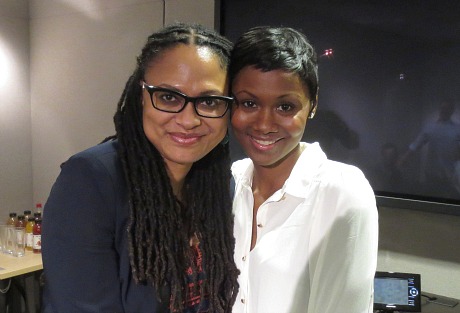
(l.) Middle of Nowhere director-writer-producer Ava Duvernay; (r.) Emayatzy Corineladi — 12.3, 9:15 pm.
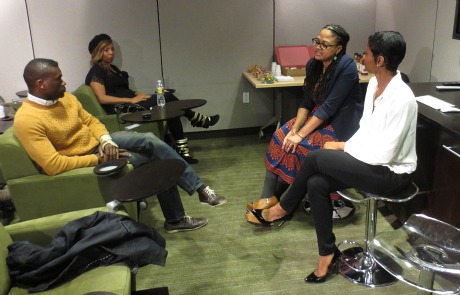
Corinealdi and director-writer Ava Duvernay attended last night’s Hollywood Elsewhere- and Participant-sponsored screening of Middle of Nowhere, and then sat for a nice little q & a. It was great to see Nowhere again and to recall my first reaction (“Nowhere Deserves Everything“), which I posted on 10.21.
So in a perfect world the 2013 Best Actress nominees would be Corinealdi, Silver Linings Playbook‘s Jennifer Lawrence, Zero Dark Thirty‘s Jessica Chastain, Amour‘s Emmanuelle Riva and Rust & Bone‘s Marion Cotillard.
Yes, Corinealdi’s best shot is with the Spirit Awards. But she really does give “one of those performances” that stands out big-time, and I mean just as inescapably as Bichir did last year. With a quiet, steady, home-run performance as an emotionally torn wife of a convict, she’s that real, that good.
Duvernay’s film has also been nominated for the Spirit’s John Cassevetes Award, and two of her supporting actors — Lorraine Toussaint and David Oyelowo — have been respectively nominated for Best Supporting Actress and Best Supporting Actor.
“The script is an interior story of a woman,” Duvernay recently told Script interviewer Jeanne Veillette Bowerman. “You’re in her head. You’re with her when she’s alone. You’re facing her challenges with her, which is not exactly the purview of most studio films. Add onto that she’s a black woman, then you add onto that you’re doing something with a black woman but it is not a comedy, and it’s not an historical drama, it didn’t fit into any paradigm that was currently in the industry.
“For me, as a part of that industry, it was clear, and I place no blame, that is what the industry is. So the question became, if you’re on the outside of that dominant culture, what do you do? Nothing? Complain? My solution was to make my own stuff on the outside.”
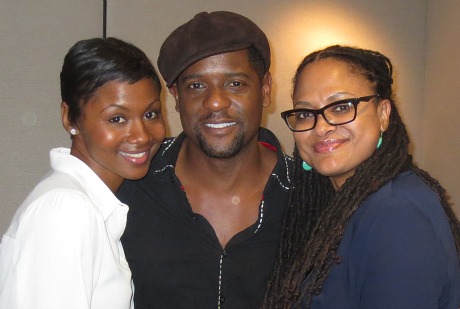
(l. to r.)) Corinealdi, Blair Underwood, Duvernay.
Fron HE reader Ben Lauter, who attended last night:
“Middle of Nowhere is an incredible emotional journey of quiet intimacy. With assured writing and directing by the talented Ava DuVernay and astonishing, fully-realized lead and supporting performances by Emayatzy Corinealdi, David Oyelowo, Lorraine Toussaint, Omari Hardwick and Edwina Findley, it marks one of the year’s great cinematic surprises.
“Corinealdi occupies just about every scene of a story that effectively details the tug of war between heartbreaking, lingering love and the tentative renewal found in fresh romance. The character may face much ambivalence, but the performer shows no such signs of it, offering up a revelatory, captivating performance full of both vulnerability and toughness.
“Her interactions with the somber and regretful Hardwick stand as a neat contrast to the quietly playful ones involving Oyelowo’s world-weary, but lighthearted jocularity. Both of her love interests offer a nice relief from the domestic scenes at home, in which Ruby, Ruth and Rosie separately reflect upon their triumphs and tragedies of life and love.
“These scenes are as loving as they are rough, and from that complex contradiction comes some of the film’s most evocative scenes. Toussaint in particular does a marvelous job of showing her matriarchal power, knowing what’s best for her children and why, even when they themselves may not, skillfully riding the edges of her advice-giving boundaries to modest success.
“Mention must also be made of the movie’s wonderful, crisp visual style, which by far makes full use of a mere $200,000 budget. Middle of Nowhere is the kind of film that lives or dies by the strength of its characters, the performers who breathe life into them, the writing, and the confidence of their creator. Because these are all present here, this is a movie to discover.”
Play It As It Lays
A combination of the title (why a “glimpse”? who cares about Roman numeral III?), the cowboy hat, the arrow in the chest, the banana and pickle posters and the ’70s hair has me worried, or at least has given me pause. Every time I say the title it comes out as A Glimpse Inside the Mind of Charles Schwab, Investment Broker. Directed and written by Roman Coppola, opening in mid February and distributed by A24 and Film Buff.
Bedside Moment
This isn’t just another Silver Linings hammer post. The intriguing part begins at the 3:00 mark, and it’s basically David O. Russell and Bradley Cooper explaining that Robert DeNiro‘s choking-up confession scene with Cooper in the attic bedroom just happened. But after the first take DeNiro delivered the emotion five more times for the sake of coverage.
What Is & What Could Always Be
This is a couple of days old, but I just think it’s worth noting how exceptional it is — historically, culturally — to hear a U.S. President riff knowledgably and comfortably on the legacy of Led Zeppelin.
Kenny on ZDT
Somewhat brazenly, I decided to prune this latest Oscar Poker chat (# 103) down to 16 minutes and 47 seconds. This is because MSN critic Glenn Kenny (in his third visit) is highly articulate and perceptive in discussing Zero Dark Thirty, and because everything else we discussed doesn’t stand up to this portion. A good one.
