“I Was Cured, All Right”

“I look at these huge movies that come out, and some of them are really, really impressive [but] I think I couldn’t do it,” Magic Mike director Steven Soderbergh recently told Miami Herald critic Rene Rodriguez. “Haywire was really fun to do. I was stretching in a way I was comfortable with. Even though Contagion may not appear that way, it was really fun to make too. That’s all that motivates me now. After Che, I have no desire to make another quote-unquote important movie. I’ve been cured of that.”
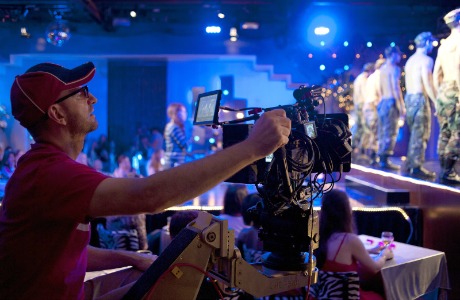

Steven Soderbergh during filming of Magic Mike.

In other words, the ‘meh’ reception to Che broke his heart. In response to which Soderbergh began to say to himself, “You know that? Eff this shallow culture that refuses to at least consider and appreciate to some degree something that I know is real and solid and true. I can find more spiritual fulfillment in another line of art.”

“But since Che, Soderbergh has remained as prolific as ever,” Rodriguez writes. “He’s directed several films including Contagion and Haywire. The Bitter Pill, his follow-up to Magic Mike, is already wrapped, and he’s currently preparing to direct Behind the Candelabra, a biopic of the famed pianist Liberace starring Michael Douglas and Matt Damon.

“So what gives? Here’s what Soderbergh said about his recent career choices and why he’s been working on noticeably lower budgets and smaller scales.

“‘In retrospect, the most frustrating thing about Che was that the quality of the discussion wasn’t where I had hoped it would be. It broke out so obviously along ideological lines and nothing else was discussed. I always knew it would be a polarizing movie. I just thought there would be a more wide-ranging discussion.

“After that, I’ve been consciously looking for things that would be more fun to do. With Contagion, I was trying to push into a genre category as far as I could. Even though it came out in the fall, I didn’t want it to feel like important Oscar-bait. I wanted to make something really entertaining. As far as the smaller scale goes, that hasn’t necessarily been by choice.

“I was fired off Moneyball [he was replaced by Bennett Miller] and then got sort of shoved off The Man from U.N.C.L.E.. Those movies were on a larger scale. Contagion was $60 million. When I was on it, Moneyball was $50 million. When you get into those kinds of numbers, the amount of time you spend doing the things you like to do decreases. I like being in a room with actors. But when the scale of a film grows, you are forced to wrangle with a bunch of other elements. And that’s not fun for me.”

A $50 Sears gift certificate to anyone who can identify the source of the headline. No, make it $25.

Stand By Your Own

Bloomberg’s Bob Drummond reported two and a half days ago that while 19 out of 21 top constitutional scholars feel the individual mandate of the Affordable Care Act ought to be upheld on the basis of legal precedent, just eight think the Supreme Court will actually do so.

Why? I’ll tell you why. Because the five conservative Supremes (John Roberts, Antonin Scalia, Anthony Kennedy, Clarence Thomas, Samuel Alito) have made it clear they’re commited to standing by their homies above everything else. That was apparent after Bush v. Gore, and extra-clear after they decided in 2010 that corporations have the same rights as people. Now it’s a running joke.

More from Drummond: “‘The precedent makes this a very easy case,’ said Christina Whitman, a University of Michigan law professor. ‘But the oral argument indicated that the more conservative justices are striving to find a way to strike down the mandate.”

“Five of the 21 professors who responded, including Whitman, said the court is likely to strike down the coverage requirement. Underscoring the high stakes and complexity of the debate, eight described the outcome as a toss-up.

“‘There was certainly a lot of hostile questioning by the more conservative members of the court,” said Jesse Choper, a law professor at the University of California at Berkeley who described the court as likely to support the mandate. ‘It’s relatively straightforward — if they adhere to existing doctrine, it seemed to me they’re likely to uphold it.'”

A “Word-of-Mouth Sensation”?

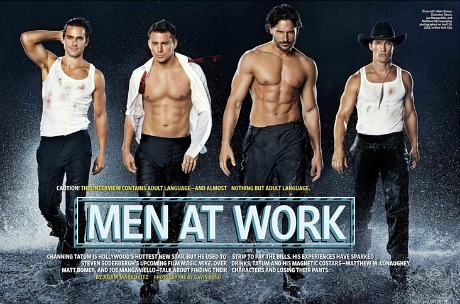
“Ladies are gonna love Magic Mike,” enthuses Variety‘s Peter Debruge. “A lively male-stripper meller inspired by Channing Tatum‘s late-teen, pre-screen stint as an exotic dancer, it supplies more low-calorie fun than any Steven Soderbergh movie since Ocean’s Eleven. This breezy offering ought to be subtitled ‘How Steven Got His Groove Back,’ as its typically high-minded director drops pretentions like tear-away pants.

“Meanwhile, enlisting a squad of Hollywood hunks to strip down to their thongs alongside him, Tatum (backed by producing partner Reid Carolin) drains the shame from a profession that gets no respect, serving up a guiltless girls’ night out likely to rank among the summer’s word-of-mouth sensations.

“Soderbergh is in excellent form here, putting aside the ambitious experimentation that threw a wet blanket on such ostensibly sexy projects as Full Frontal and The Girlfriend Experience, while re-embracing the shooting techniques missing from Contagion and Haywire. (Once again, he serves as his own d.p., under the pseudonym Peter Andrews.) Tatum reportedly first approached Nicolas Winding Refn about making Magic Mike, but here he has the benefit of not only Soderbergh’s commercial savvy, but also the good-humored generosity and keen anthropological interest the helmer brings to every project.

“No moment captures that sensibility better than an oblique glimpse of backstage ‘fluffing’ — sure to rank among the year’s most amusing shots.”

Magic Mike opens on Friday, 6.29.


Channing Tatum, Alex Pettyfer.

The Room Is Ours!

It’s 7:20 am in Munich with heavyish rain outside, and I’m having breakfast in the bar/restaurant of the moderately priced Acanthus hotel (93 euros per night). And writing stuff at the same time, of course. And wrestling with a feeling of disapproval about a group of seven Americans who are sitting two or three tables away and yappity-yap-yapping. I’m not very proud of being a grouch and a killjoy, but it just comes out of me sometimes. I’m thinking of funny stuff all the time inside.

On one level I can roll with groups of people chit-chatting over breakfast (it’s a vacation, enjoy it), but whatever happened to wake-up meditation and the joys of a quiet coffee and croissant as you silently mull over the previous day and contemplate the one to come? When I say “yappity-yap-yap” I mean that these people aren’t talking to each other in a probing, thoughtful way — they’re anecdoting and entertaining each other to death, grinning as if their lives depend on it, “laughing” at each other’s bon mots. I’m guessing they’re here as a tour group, probably arrived on a bus.

It would be one thing if these guys were talking about Mohamed Morsi, but discussing anything substantive is a violation of the rules. They’re about “It’s breakfast! Nice clean hotel! Fresh croissants! Yappity-yap-yap! Just took a shower!” And especially, “It feels so good to be part of a large group and therefore protected to some extent from the exotic and the unknown…why, except for the German-language menus and that exciting but strange city outside we could be at a Marina del Rey Hyatt!”

And here I am on the other side of the room…the internally grouchy but externally polite and more or less fair-minded Macbook Pro guy in the T-shirt and jeans with tousled hair…Rodin’s Thinker, the Rilke-ish meditator, God’s Lonely Man…slowly shaking my head and remembering a line from Charles Bukowski: “Beware of those who seek constant crowds — they are nothing alone.”

8:04 am update: They all just left and are now walking past my window or vantage point, each one carrying an umbrella and walking almost in pairs. Not one umbrella is brightly or vividly or weirdly colored. They’re all black or gray or olive green.

Yeah, yeah, I know…

IRA PARKS SAYS…

JEFFREY WELLS SAYS…

“In this corner — Jeffrey Wells, Auguste Rodin, Rainer Maria Wilke, Steve Jobs and Charles Bukowski. In the other corner — bus tourists. No contest!”

Needs A Lucas-Styled FX Upgrade?

Warner Home Video is releasing a Bluray of Ken Russell‘s Altered States (’80) on 7.10. I’m not sure if the primitive FX are going to look worse or better in high-def. I love how William Hurt, Blair Brown, Bob Balaban and Charles Haid tear through Paddy Chayefsky‘s whip-snap dialogue during the first three quarters, but the film loses dramatic tension when Hurt turns into an ape man.

And yet Brown’s line about having sex with Hurt — “I feel like I’m being harpooned by some raging monk in the act of receiving God” — will live forever.

Baldwin Letterman

Okay, so I’m a little late to Alec Baldwin‘s “Here’s The Thing” interview with David Letterman, which posted on 6.18. Okay, six days…whatever. I’ve heard portions of Letterman’s stories about starting out in other interviews, but this is an easy soothing chat that just flows along — I could have listened for another hour or two. Letterman is a tiny bit upset when Baldwin says “we’re done.” So was I, somewhat.

Read more

Hurts To Miss Out

My inability to access HBOGo, which I subscribed to eight weeks ago in order to watch Aaron Sorkin‘s The Newsroom in Europe, means I can’t take part in the backlash or the counter-backlash or anything. But sight unseen, my first reaction to the criticism is “what’s so terrible about a miniseries that does what it can to make rabid righties look as ridiculous as they actually are? Are they not the Lords of Insane Obstinacy right now? The Newsroom may be dramatically flawed and perhaps even insubstantial in terms of presenting the dips, twists and turns of real journalism, okay, but it sound like candy for people like myself. What’s not to ‘like’?”

Read more

A Democratic Islamic Government?

In the wake of today’s announcement that the Muslim Brotherhood‘s Mohamed Morsi has won Egypt’s first competitive presidential election and has, given the opposition to his agenda by the Egyptian military, a limited grip on power, the question is this: given the autocratic tendencies of Muslim leaders in other Middle-Eastern countries, is it in the cards for Morsi and his team to play it straight and fair and operate as guys who really believe in a democratic form of government, or is there something in the Muslim psychology that inevitably submits to Islamic absolutism, Mullah-ism and all the rest of that primitive yahoo jazz?

Lynch Hasn’t Thought Of This?

“I haven’t gotten the big idea,” director David Lynch told L.A. Times/”24 Frames” guy Steven Zeitchik in this 6.22 piece. “I’ve got some fragments that are coming, but not the big idea. If I got an idea that I fell in love with, I’d go to work tomorrow. I just haven’t.”

Okay, here’s an obvious suggestion: Lynch needs to buy the remake rights to Leos Carax‘s Holy Motors, easily the best Lynch film I’ve seen in ages, and do it his way. Set it in L.A. and throw in some local wackitude, create his own dream episodes, his own ending…whatever. But you know 80% of the American hipsters who should definitely see and would certainly appreciate Carax’s film won’t go because of the subtitles (because so many allegedly “cool” people are lazy, not wild, at heart, and because even the adventurous won’t be able to find their way into it with Denis Lavant as the maestro/tour guide), but will buy a ticket to Lynch’s English-language version in a second, especially if Johnny Depp, say, plays Lavant’s role.

Are you going to tell me this part, if and when someone remakes Holy Motors for the U.S. market, doesn’t have Depp’s name on it?

I know — Lynch is a visionary and it wouldn’t be right for him to remake someone else’s surrealistic loonscape…right? But Lynch wouldn’t able to remake Carax’s film — he just needs to start on it and something else will just flow out in his own way. Maybe he’ll wind up making Son of Holy Motors — a companion film that ignores the Carax particulars but expands upon the basic idea or weirds it up in some fashion.

“If only an American filmmaker was this mad, this imaginative, this unchained, this willing to leap,” I wrote in my 5.23 Holy Motors review. “I wonder if any American has it in him or her to create something like this. If he or she did, Americans would probably say ‘what the fuck?’ and stay away in droves. It’s in the realm but well beyond anything David Lynch has ever done. It’s so perfect to have seen this in Cannes, and to be among a crowd clapping and cheering on their feet, and then to come onto a street filled with sun and warmth.”

Had To Be Done

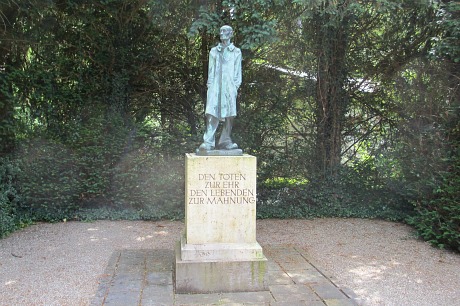
The boys and I visited the Dachau concentration camp memorial early yesterday afternoon. It’s located 9 miles to the northwest of Munich. You take a subway (about a 20 minute ride) and then grab a bus or a taxi when you hit town. It’s surprising when you reach the entrance, which is located on a fragrant, curving, tree-lined street. Maybe 150 visitors were there, some with tour guides. At first it feels like you’re walking into a large, well-tended city park. It’s attractive. And then you get to the main gate.


The words on the base of the statue, translated into English: “To honor the dead, to admonish the living.”

How can you visit a place like this and not feel sickened and somewhat depleted? I felt like I wanted to nap minutes after I began walking around the grounds. My system was feeling the odious signals and just wanted to shut down and escape, I guess. Obviously going there was not about me but about them. But I was thinking all kinds of tedious and banal thoughts. Some kind of blocking mechanism?

The main pebble-covered yard separating the German command and SS barracks and the area where the prisoner barracks stood is flat and wide and quite vast. Only two barracks — simulations of the actuals — remain on the grounds; only the gravel-based foundations of the rest remain. We saw it all and felt as much as we were able. Some 31,000 people were killed there. I was imagining what it might have felt like to be stuck at Dachau in the ’30s and ’40s, and how it might’ve felt to survive on a day-to-day basis. I can never know, of course, but my imagination was aflame and then some.

The ceiling on the gas chamber in the main crematorium building, located on the extreme southwest corner of the grounds, is quite low. The gas-dispensing “shower” holes on the ceiling were only eight or nine inches from the top of my head. There was one small window near the cement floor, covered with hard-metal chicken wire.

I couldn’t take any shots. The thought of raising my camera occured two or three times, and then it went away. At the end I forced myself to take a shot of a statue of an inmate (the model was Kurt Lange, a gay guy who served two “rehabilitation” sentences), and then one of the entrance.

Last night I read about the Dachau massacre, and I felt very, very gratified to read that after the camp was liberated in late April 1945, some U.S. soldiers gave handguns to some of the prisoners and allowed them to go to town on some of the SS guards.

We met a young Turkish guy at a food stand near the Dachau train/subway station, and his friendly personality and general vibe were really nice. “You from California?,” he asked. “Yeah, Los Angeles.” He has a brother in California, he said. “What town?,” I asked. “I don’t know, just California,” he said with a shrug and a smile. He’d obviously love to visit. It could have been anyone, but it was just beautiful on a certain level to meet and talk with him a bit. Some people just have an aura.

Exceptional Episode

I scour the web and YouTube every weekend during Real Time‘s too-short seasons, and I’ve never found an entire show, HD start-to-finish, on YouTube 36 hours later. Clips, yes, but never the whole thing. Anyway, you can’t get HBOGo in Europe (it’s only good for the continental U.S.) and it was a nice surprise, sitting here in a Munich hotel room on a Sunday afternoon. One of Bill Maher‘s best shows in a long stretch.

Gangsta Bankas

From Matt Taibbi‘s 6.21 Rolling Stone piece about the parallels between Wall Street finaglers and the Al Capone mob of the 1920s, figuratively speaking:

“Someday, it will go down in history as the first trial of the modern American mafia. Of course, you won’t hear the recent financial corruption case, United States of America v. Carollo, Goldberg and Grimm, called anything like that. If you heard about it at all, you’re probably either in the municipal bond business or married to an antitrust lawyer. Even then, all you probably heard was that a threesome of bit players on Wall Street got convicted of obscure antitrust violations in one of the most inscrutable, jargon-packed legal snoozefests since the government’s massive case against Microsoft in the Nineties – not exactly the thrilling courtroom drama offered by the famed trials of old-school mobsters like Al Capone or Anthony “Tony Ducks” Corallo.

“But this just-completed trial in downtown New York against three faceless financial executives really was historic. Over 10 years in the making, the case allowed federal prosecutors to make public for the first time the astonishing inner workings of the reigning American crime syndicate, which now operates not out of Little Italy and Las Vegas, but out of Wall Street.

“The defendants in the case – Dominick Carollo, Steven Goldberg and Peter Grimm — worked for GE Capital, the finance arm of General Electric. Along with virtually every major bank and finance company on Wall Street – not just GE, but J.P. Morgan Chase, Bank of America, UBS, Lehman Brothers, Bear Stearns, Wachovia and more – these three Wall Street wiseguys spent the past decade taking part in a breathtakingly broad scheme to skim billions of dollars from the coffers of cities and small towns across America.

“The banks achieved this gigantic rip-off by secretly colluding to rig the public bids on municipal bonds, a business worth $3.7 trillion. By conspiring to lower the interest rates that towns earn on these investments, the banks systematically stole from schools, hospitals, libraries and nursing homes – from “virtually every state, district and territory in the United States,” according to one settlement. And they did it so cleverly that the victims never even knew they were being -cheated. No thumbs were broken, and nobody ended up in a landfill in New Jersey, but money disappeared, lots and lots of it, and its manner of disappearance had a familiar name: organized crime.

“In fact, stripped of all the camouflaging financial verbiage, the crimes the defendants and their co-conspirators committed were virtually indistinguishable from the kind of thuggery practiced for decades by the Mafia, which has long made manipulation of public bids for things like garbage collection and construction contracts a cornerstone of its business.

“What’s more, in the manner of old mob trials, Wall Street’s secret machinations were revealed during the Carollo trial through crackling wiretap recordings and the lurid testimony of cooperating witnesses, who came into court with bowed heads, pointing fingers at their accomplices.

“The new-age gangsters even invented an elaborate code to hide their crimes. Like Elizabethan highway robbers who spoke in thieves’ cant, or Italian mobsters who talked about ‘getting a button man to clip the capo,’ on tape after tape these Wall Street crooks coughed up phrases like ‘pull a nickel out’ or ‘get to the right level’ or ‘you’re hanging out there’ — all code words used to manipulate the interest rates on municipal bonds. The only thing that made this trial different from a typical mob trial was the scale of the crime.”