McCarthy on Sarris

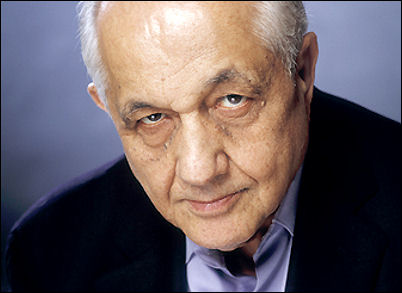
In a brief but eloquent obit for the late Andrew Sarris, Hollywood Reporter critic Todd McCarthy recalls the long-running battle between Sarris and Pauline Kael, which re-ignited to some extent when McCarthy chaired a New York Film Festival panel discussion about Kael last fall. He explains here why he decided early on to side with Sarris:

“Andrew Sarris was the man who taught me how to do what I do,” McCarthy begins. “Without him, I would never have experienced the cinema in the way that I have or been provided with such an inspiring road map to pursue what, for all of us in the critical and historical film world, is the endless quest for discovery of little-known works and artists.

“Certainly, Pauline could be the more dynamic crusader both for and against a film. Sarris was often dizzyingly eloquent and quite funny, but, especially as he got older, had a tendency to ramble. What it came down to, in the end, was that, with Kael, what you’re left with is all opinion — brilliantly and eloquently expressed opinion, to be sure, but subjective impressions nonetheless. By contrast, Sarris’s initially controversial method of creating a hierarchy of talent [in “The American Cinema“] had the automatic effect of establishing priorities and, in a broader sense, inspiring a deeper plunge into film history.

One of Sarris’s categories in ‘The American Cinema‘ was ‘Subjects for Further Research,’ and that seems to apply to nearly everything I’ve done professionally since that time. Once you’ve gotten a handle on the personalities and artistic tendencies of certain directors, you begin more carefully tracking the careers of writers, cinematographers and other contributors to a film’s accomplishment.

“My first book, ‘Kings of the Bs: Working Within the Hollywood System,” which I embarked upon directly out of college, was conceived entirely as an extension of ‘The American Cinema’, having been inspired by Sarris’s phrase, ‘Eventually we must speak of everything if there is enough time and space and printer’s ink.’ From my point of view, Sarris’s perspectives opened many windows and doors, while Kael’s work had the feel of a judge’s gavel.
Certain Contender

This trailer knows exactly what it’s doing, and it does it quite well. I’m now convinced that Joe Wright‘s Anna Karenina will be, at least in part, an early ’70s Ken Russell film, and that’s a very high compliment. Keira Knightley as Anna, Aaron Johnson as Count Vronsky and Jude Law (who always scores in character parts) as Alexei Karenin. Matthew Macfadyen, Kelly Macdonald and Olivia Williams costar. Screen adaptation of Leo Tolstoy‘s novel by Tom Stoppard.

The cinematography is by Seamus McGarvey, and the original score is by Dario Marianelli.

So Well Remembered

I was strolling through the smallish medieval city of Bern this evening when I read that revered film critic Andrew Sarris, 83, had passed away a few hours earlier. I’d been on friendly-as-far-as-it-went terms with Sarris since ’77, and the news hit me in the gut. I tweeted that “a great film critic, a seminal influencer, a gentleman, gracious and kindly & always good humored…Andrew Sarris left us today. Sadness.”

Everyone will once again write about his two legendary feats — popularizing the auteur theory, which he’d appropriated from the Cahiers du Cinema gang, in a 1962 essay called “Notes on the Auteur Theory,” and writing “The American Cinema: Directors and Directions 1929-1968,” which anyone and everyone with the slightest investment in Film Catholicism had to read backwards and forwards, particularly if you came of age in the ’60s and ’70s.

But for me, Sarris was about kindness, wit, laughter and a generosity of spirit — the last trait in particular.

In the fall of ’77 Sarris agreed to talk about movies in front of a crowd at the Westport Country Playhouse Cinema, where I was working at the time. I drove down in my beater Mercedes and picked him up at his Upper East Side apartment and took him up the 95 to Westport, and then back to Manhattan three or four hours later. We obviously enjoyed some chat time, but what I primarily remember was his energy — a genuine inspiration for me. He seemed indefatigable. And I loved his rambling confessional tone. He always spoke of himself in humble terms, and always with a sardonic chuckle about some vague failing or two.

A year or two later I was a struggling New York freelancer, doubtful of my talent and unsure of my footing. I was at a black-tie New York Film Festival party, and I remember suddenly putting on a pair of jet-black Ray-Bans as I joined a group of five or six that included Sarris. He made me feel very much part-of-the-gang when he remarked a few seconds later that I looked “like a Roman pimp in a Fellini film.”

I’ve always half-despised the New York film dweebs who made me feel so awful during that period in my life, but never Sarris. I don’t know if he knew or cared about what I’d been writing and reporting in the late ’70s and early ’80s. I do know that he offered respect and camaraderie and comfort, and I will always love him for that. Warm hugs and condolences to all who knew, read, respected and loved him as well.

Miniscule Stirrings

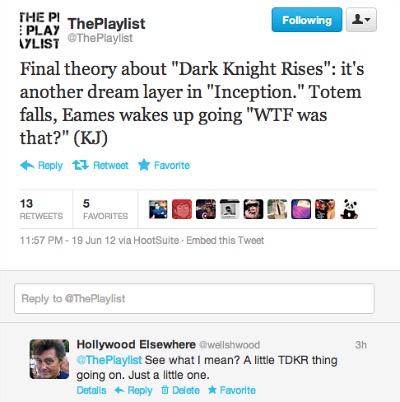
I’m not even half-suggesting that the embryonic mini-Dark Knight Rises Twitter backlash is going to amount to anything. At most it’s a gnat flitting over a blitzkreig. But I’ve found myself guffawing whenever I find one of these…sorry. I’m as much of a Chris Nolan fan as the next guy, but for some reason they’re making me giddy. Another Playlist shot: “I hope the finale of The Dark Knight Rises has Bane and Batman arm-wrestling Over The Top-style. (KJ)”

Painterly

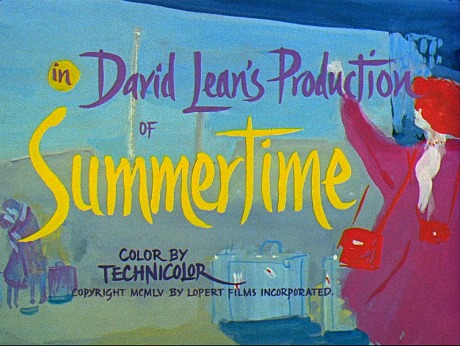
Two especially arcane sub-genres: movies that you’ve never much liked or felt especially caught up in, but which you’ve watched a few times anyway because (a) the photography is magnifique exceptional — so good that all the other aspects pretty much fall by the wayside, and (b) movies that you’ve never much liked but you’ve watched occasionally because the opening credit sequence is seriously mesmerizing. I feel this way about the 1963 Cleopatra; ditto David Lean‘s Summertime (’55), which has been Blurayed by a Japanese outfit.

Resistance Is Futile

As Bluray.com’s Jeffrey Kauffman notes, Olive Films’ Bluray of Don Siegel‘s Invasion of the Body Snatchers “is presented with an AVC encoded 1080p transfer in 2.00:1. This somewhat unusual aspect ratio is the result of the film being repurposed prior to release in Superscope, a short-lived widescreen process that producer Walter Wanger was vehemently opposed to since he felt it deprived the image of clarity and fine detail.

“Interestingly, Superscope was a post-production process which converted nonanamorphic source elements to an anamorphic format. The result is that there is a certain softness to some aspects of the film and this transfer, specifically with regard to midrange and far shots.

“That said, this high definition presentation is remarkably crisp most of the time, with very pleasing fine detail in the many close-ups, and decent if occasionally problematic contrast and some very deep and convincing black levels. Olive continues its tradition of releasing product that does not appear to have been even slightly digitally tweaked, so this retains a very natural filmic appearance. This is certainly heads and shoulders above the previous DVD releases, and despite some niggling problems should please the film’s ardent fans.”

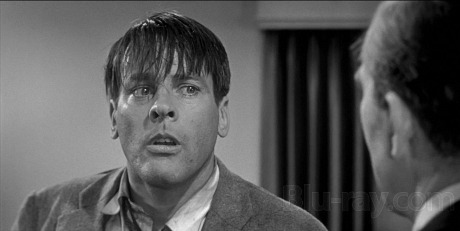
I’ve always wanted to see a double billing of this paranoid classic about the 1950s conformity blanket, released in 1956, with The Man in the Gray Flannel Suit, also released that year. Joined at the hip in more ways than one.

Formidable But Challenging

Warner Bros.’ decision to move up the release of Tyker/Wachowski’s Cloud Atlas from December 6th to October 26th means one thing, I suspect. The nearly three-hour-long time-tripping fantasia has been described as a marketing challenge, so I suspect that WB sharpies decided it needs to time to germinate and grow in the minds of ticket-buyers, journalistic know-it-alls and Academy/guild members. It’s not a one or two weekend wham-bam, thank-you-ma’amer for ADD fools. It’ll have to be poked and dissected and settle into the cultural bloodstream.


One of Hugh Grant’s many Cloud Atlas guises.

But isn’t it time for a few officially sanctioned photos? It’s almost July and you still can’t find anything online except surreptitiously captured set photos. And when are we going to see the first teaser? Within the next three or four weeks, I’m guessing. And where’s the official Cloud Atlas website?

This’ll Do For Now

I don’t think I can watch any more Dark Knight Rises trailers after this. This is it. I’m done, spent. I’m even feeling a very slight Dark Knight backlash impulse building within. (Just a little tiny trace of one.) Is it me or does this trailer seem to emphasize Joseph Gordon-Levitt just as much if not a bit more than Christian Bale?

Newsroom Gets Slapped

In a review dated 6.25, New Yorker critic Emily Nussbaum conveys some admiration for Aaron Sorkin‘s The Newsroom (HBO, premiering 6.24). She says it has the same kind of energy that The West Wing and The Social Network had. But mostly she rips into it, and into Sorkin’s writing style. Episodes 3 and 4 suck, she says. Especially 4. She hasn’t seen 5 through 10.

But I don’t know. There’s something about Nussbaum’s own fevered writing style that suggests she might have been thinking about picking a fight with this show no matter what. She seems to enjoy being pissy and ultra-particular, or so I’m sensing. In any event, The Newsroom needs someone to ride in on a white horse and say, “Nussbaum is a smart and feisty writer, but she has a stick up her butt! Listen to me instead!”

“This is not to say that The Newsroom doesn’t score points now and then, if you share its politics,” Nussbaum writes. “It starts effectively enough, with an homage to Network ‘s galvanizing ‘I’m mad as hell’ rant, as McAvoy, a blandly uncontroversial cable big shot whom everyone tauntingly calls Leno, is trapped on a journalism-school panel. When the moderator needles him into answering a question about why America is the greatest country on earth, he goes volcanic, ticking off the ways in which America is no such thing, then closing with a statement of hope, about the way things used to be.

“This speech goes viral, and his boss (Sam Waterston) and his producer, MacKenzie McHale (Emily Mortimer), who’s also his ex-girlfriend, encourage him to create a purer news program, purged of any obsession with ratings and buzz.

“Much of McAvoy’s diatribe is bona-fide baloney — false nostalgia for an America that never existed — but it is exciting to watch. And if you enjoyed The West Wing, Sorkin’s helpful counterprogramming to the Bush Administration, your ears will prick up. The pilot of The Newsroom is full of yelling and self-righteousness, but it’s got energy, just like The West Wing, Sorkin’s Sports Night and his hit movie The Social Network.

“The second episode is more obviously stuffed with piety and syrup, although there’s one amusing segment, when McAvoy mocks some right-wing idiots. After that, The Newsroom gets so bad so quickly that I found my jaw dropping. The third episode is lousy (and devolves into lectures that are chopped into montages). The fourth episode is the worst. There are six to go.”

Bring It On

Great, just what we need — another scheming ego queen of a certain age, out to destroy a fair young maiden. The similarities between Angelina Jolie‘s raging bitch in Malificent and the animated queen in Disney’s 1959 Sleeping Beauty are something to start with. No harm in it. But after the last two Snow White movies…you know what I’m saying.

Jungfrau

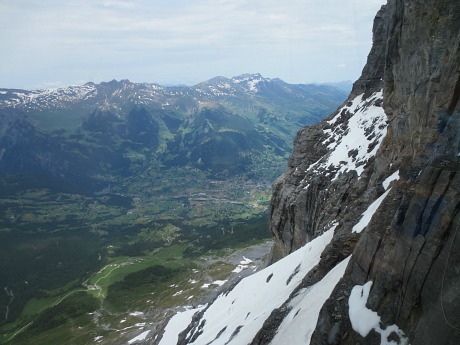
The Jungfrau (German for “virgin”) is one of the main summits in the Bernese Alps. Together with the Eiger and Monch, the Jungfrau forms a massive wall overlooking the Bernese Oberland. Visually thrilling, awesome, fascinating — adjectives fail. The journey to the Jungfraujoch — at 3454 metres Europe’s highest altitude railway station — is two hours each way from Lauterbrunnen. That plus hiking uphill for 90 minutes through snow and clouds lasted six and a half hours.

Read more