Naked Man Eating Cereal

I’m sorry because I don’t like to get out the whip when there’s no need, but this is what I wrote last September after seeing Bruce Beresford‘s Love, Peace and Misunderstanding (IFCFllms, 6.8) at the Toronto Film Festival:

“If you’ve ever been stuck in some hippy-dippy atmosphere or environment that you couldn’t escape from…if you’ve ever been more or less forced to spend time with graying, balding, pot-bellied, granola-slurping doobie-tokers…a prisoner of smiling people dressed in Mexican peasant shirts and sandals and beads and easy-fit jeans who won’t stop speaking in ’60s psycho-babble platitudes…if you’ve ever had to suffer this way, as I have once or twice over within the past 15 or 20 years, then Bruce Beresford‘s Love, Peace and Misunderstanding will bring it all back home.

“It’s pretty close to excruciating. How could the director of Breaker Morant and Tender Mercies make something like this? How could Jane Fonda, so bright and brilliant and transporting in B’way’s 33 Variations, give such an oppressively banal, cliche-spouting performance as an aging hippie grandma?

“The script is by Christina Mengert and Joseph Muszynski, and if I was an actor those names alone would scare me off.

“The only actor who comes through unscathed is Jeffrey Dean Morgan, who plays a local carpenter-musician who falls for Fonda’s uptight daughter, played by Catherine Keener. Morgan brings his own alpha force field to the game. It’s not that Elizabeth Olsen and Chace Crawford, who play Keener’s children, are painful to watch but they give off a vibe of feeling vaguely trapped, which is how I more or less felt as I watched it.

“I talked to the son of a critic friend as I left, and he said ‘that might be the worst film I’ve ever seen.'”

Irresistible Impulse

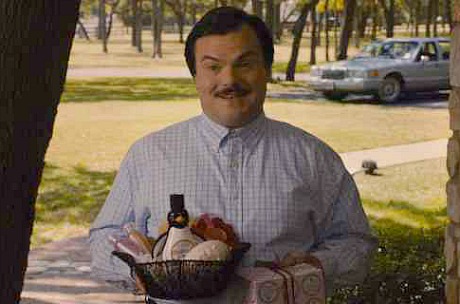
It’s pleasing to note that Richard Linklater‘s Bernie, which I liked even more after catching it a second time, is doing reasonably well with critics — 77% on Rotten Tomatoes and 73% on Metacritc. Some have issues because it’s not any one thing — not a comedy or a study of bizarre closeted psychology or a straight murder-in-a-small-town tale, but all these things and more. And Linklater’s direction is so clean and true and precise. It’s a dark but amiable delight.

And as I noted nine or ten days ago, Bernie says something about human nature that everyone will recognize as rock solid when and if they see it. Which is basically that feelings and likability rule, that Americans trust beliefs more than facts, and that we’re governed less by laws than emotions. You can say “yeah, I know that without seeing a film” but the observation sinks in extra-deep after hanging with Richard and Bernie.

Linklater based this half-drama and half-odd duck comedy on a true story by Skip Hollandsworth that appeared 14 years ago in Texas Monthly. It was about a story that occured in the ’90s in Carthage, a nice little pine-tree town in East Texas.

Jack Black‘s Bernie is a sweet, impeccably mannered mortician who’s much loved by the townfolk, and Shirley MacLaine is Marjorie, a rich, miserable, foul-mannered and acutely disliked woman whom generous-hearted Bernie becomes special friends with, and then her employee and then her travelling companion on trips to Europe and such.

He likes her money, of course, but even gracious and super-patient Bernie can’t quite handle her temperamental personality. He abruptly loses it one day and shoots her four times in the back, and then stuffs her body in a freezer in Marjorie’s garage because he hasn’t the heart to bury her or otherwise hide the body.

Bernie is eventually found out and tried and convicted, but it struck me that his crime is roughly the same crime of passion (or temper) that Ben Gazzara was tried for in Otto Preminger‘s Anatomy of a Murder. The difference is that Gazzara’s Lieutenant Manion is found not guilty because the jury accepted a temporary insanity defense urged by attorney James Stewart.

The specific scenario was that Manion was seized by an irresistible impulse to shoot Barney Quill, a tavern owner who had raped Manion’s wife (Lee Remick). For whatever reason the Texas jury that weighed Bernie’s case didn’t buy this, but what’s good for the goose should be good for the gander, no?

The Wiki page says that “in criminal law, irresistible impulse is a defense by excuse in which the defendant argues that they should not be held criminally liable for their actions that broke the law, because they could not control those actions” due to “some form of insanity.”

When the Bernie jury announces their guilty verdict, I wanted to climb right through the screen like Jeff Daniels in The Purple Rose of Cairo and say to the jurors, “Hold up, people, wait a sec…did any of you guys ever see Anatomy of a Murder? ‘Cause this is pretty much the same deal, and from what I can tell Bernie’s irresistible impulse to shoot Marjorie was at least as justified as Ben Gazzara’s was, and to hear it from the people of Carthage a lot more so. So how come Lt. Manion walked and Bernie didn’t? Lorena Bobbitt was found not guilty when her defense argued that an irresistible impulse led her to cut off her husband’s penis, and that was surely a weaker circumstance than the one that befell poor Bernie.”

Stop The Bleeding

Every so often I have the feeling that money is just pouring out of me. Everything I do and everywhere I turn I’m bleeding 20s, 50s and 100s. Hundreds, thousands. Sooner or later this awful feeling attains critical mass and I have to stomp on the brakes and shut down because I just need the hemorrhaging to stop. Need a tourniquet, getting short of breath.

My 21-inch suitcase is looking a little ragged so I was looking at new ones yesterday in the Swiss Army store in the Beverly Center. I liked a modest one that went for $260-something but with the tax it was just about $300, and something in me said “no! no!” and I thanked the sales guy and left. This morning at LAX I bought a New Yorker and a N.Y. Times and a Tic-Tac and some gum and it cost $15 bucks…what?

I can’t go back to LA so I want to retreat to some podunk town and stay in a rented room and eat apples and take long walks and just not spend anything…Jesus.

Compulsion

Who flies LA-to-NY with five bulky suitcases plus a carry-on? It’s surely the height of plebianism to load yourself down like the Joad family in The Grapes of Wrath. Big-weight packers are apparently upset by travel and trying to take as much of their lives with them so as to minimize the trauma of being someplace new. If you’re moving to another town or city you load your stuff into a U-Haul or send it by train. Nobody needs to haul this much weight on a flight.


Taken at LAX Virgin America terminal — Friday, 4.27, 9:25 am.

Departing

Attention should nave been paid last night to Joel Silver‘s departure from Warner Bros., to those rave reactions to yesterday’s Cinemacon screening of a portion of Ang Lee‘s 3D Pi, to the announcement of a Cannes Film Festival screening of a cleaned-up, digitally enhanced 4K Lawrence of Arabia. Plus I wanted to run more particular reactions to Richard Linklater‘s Bernie, etc. But the taxi’s here. I’ll have to file from the Virgin America flight to NYC. Arrival at 7 pm.

Damp Pistol

Directed by Derick (brother of Dirty?) Martini and based on a novel by Andrea Portes, Hick is about a none-too-bright girl (Chloe Grace Moretz) who “runs away to Vegas to find a sugar daddy”…Jesus. You can imagine the rest. Costarring Blake Lively and Eddie Redmayne. Pic will open in select theaters and be available on iTunes and VOD on 5.11.12.

Flux Capacitor

I don’t know if I want to see another Back to the Future film, but this guy (name?) is obviously sharp, inventive and passionate. So if nothing else he could get a production gig out of this and…you know, be somebody’s whippersnapper. I love the way he exhales after finishing the riff. And by the way, it’s definitely flux capacitor and not flux capacitator.

Slip of The Tongue

In his review of the French Bluray of Pork Chop Hill (’59) DVD Beaver’s Gary W. Tooze has shown his 1.85 fascist colors by writing that the disc’s aspect ratio “is a surprising 1.66 where I believe the original film would have been 1.85:1.”

Actually, a 1.66 aspect ratio, despite what the fascists will tell you about everything being shown at 1.85 starting in 1954 or ’55 or thereabouts, is completely in keeping with the general aesthetic of the late Eisenhower years. But Tooze doesn’t want to hear it. To paraphrase Gen. Jack D. Ripper, “This is how your hardcore 1.85 commie fascist thinks.”

Outcast Washes Up

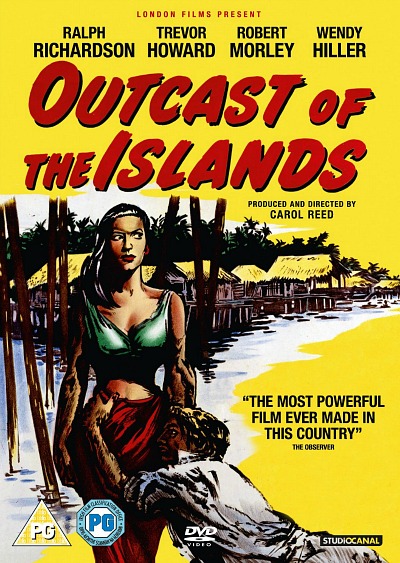
I’ve been moaning about not being able to buy a DVD of Carol Reed‘s Outcast of the Islands (1951) off and on for the last four years, and now it’s finally available this month via Amazon UK.

The irony is that I saw it on the tube so many years ago that i can’t remember much of it, but I have a recolleciton of something exceptional. I remember Trevor Howard, of course, who plays the lead. The story mostly takes place in Malaysia. I don’t remember the particulars. I’ve never read the Conrad book, but I’ve been told it’s a bit grim. Ralph Richardson and Wendy Hiller costar. The striking black-and-white cinematography is by Ted Scaife and John Wilcox.

Pauline Kael called Outcast of the Islands “a marvellous film (drawn from Joseph Conrad’s work) that relatively few people have seen. It’s probably the only movie that has ever attempted to deal in a complex way with the subject of the civilized man’s ambivalence about the savage. It also contains some of the most remarkable sequences ever filmed by the English director Carol Reed; it’s an uneven movie, but with splendid moments throughout.

“Trevor Howard is superb as Willems, who makes himself an outcast first through contemptible irresponsibility and through betrayal of those who trust him, and finally and hopelessly when, against his will, he is attracted to the silent, primitive girl, the terrifying Aissa (played by Kerima). Willems is wrong in almost everything he does, but he represents a gesture toward life; his enemy, Almayer (Robert Morley), is so horribly, pathetically stuffy that his family unit (with Wendy Hiller as his wife and Annabel Morley as his child) is absurdly, painfully funny.

“With Ralph Richardson, whose role is possibly ill-conceived, and George Coulouris, Wilfrid Hyde-White and Frederick Valk. The screenplay is by William Fairchild.”

Bad Text Lady

Regal Entertainment CEO Amy Miles became infamous yesterday for suggesting during a Cinemacon panel discussion that texting during a movie might be an okay thing, especially during films “that appeal to a younger demographic.”


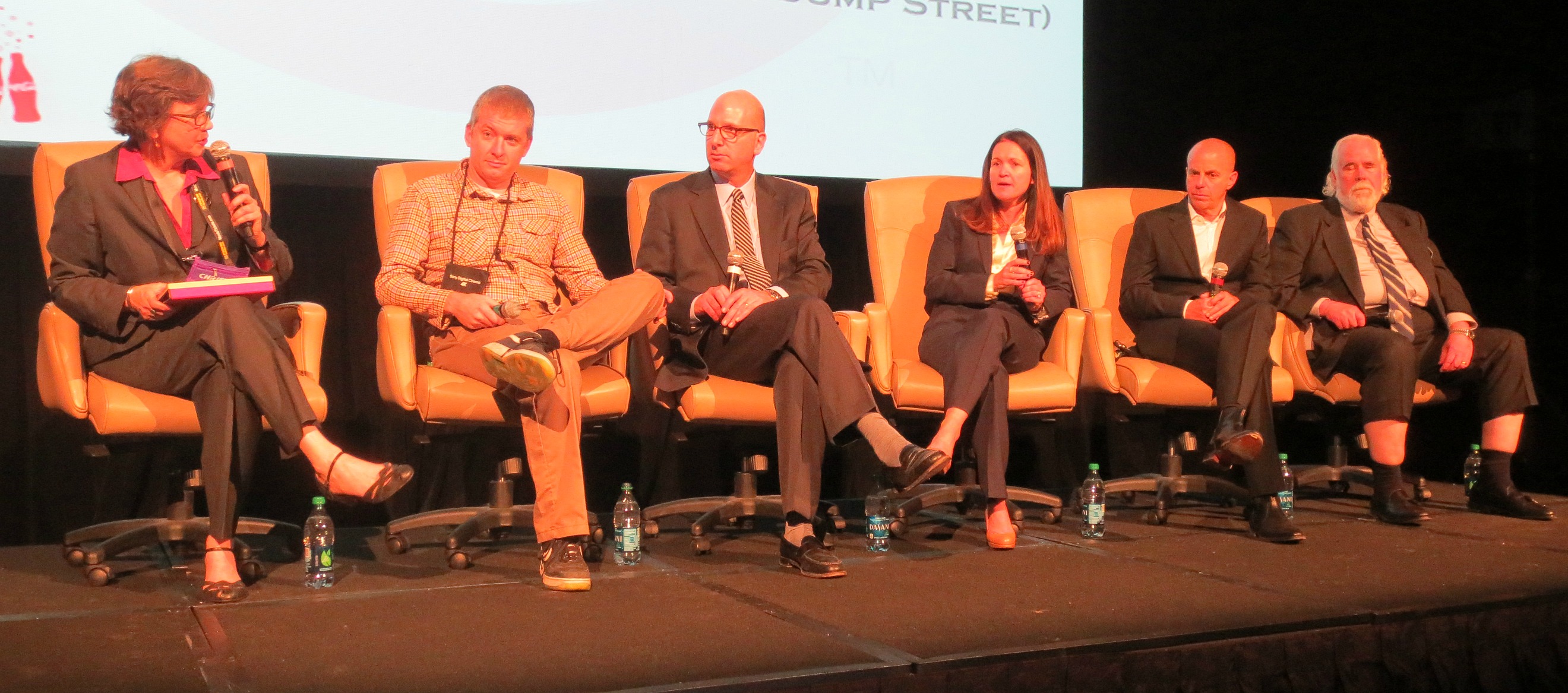
Regal CEO Amy Miles

Panelists during yesterday’s Cinemacon discussion about satisfying “savvy” moviegoers, moderated by Anne Thompson (l.) Alamo Drafthouse CEO Tim League is second from left. Regal CEO Amy Miles is third from right.

A couple of hours later Miles showed up at the beginning of Sony’s product-reel show and riffed about how delightful it was that they had so many standard-issue tentpole attractions coming out in 2012 and blah blah.

Between her Sony exhilaration, her views about texting and her good-old-girl cracker accent, Miles become a poster lady for low-rent, anything-for-a-buck, to-hell with-refinement yeehaw attitudes among US. exhibitors. Miles’ “make the money at all costs” ethos combined with her lack of sympathy for decent movie-watching standards indicates that she‘s probably a Republican.

Miles said during a Cinemacon panel discussion about satisfying discerning moviegoers that Regal frowns upon cell phone use during films “but if we had a movie that appealed to a younger demographic” — like 21 Jump Street, she later said — “we could test some of these concepts…something you can offer in the theater that I would not find appealing but my 18-year-old son” might.

That statement didn’t go down well at all with Alamo Drafthouse CEO Tim League, who despises the idea of texting during films and totally forbids it in his theatres. “Over my dead body will I introduce texting into the movie theater,” he said yesterday. “I love the idea of playing around with a new concept, but [texting] is the scourge of our industry…it’s our job to understand that this is a sacred space and we have to teach manners.”

League said that it should be “magical” to come to the cinema. Miles replied that “one person’s opinion of magical isn’t the other’s,” and League replied, “But my opinion is correct.” He’s right, of course. People like Miles are the enemy.

Turn Of Phrase

N.Y. Times critic Ben Brantley has pointed out an interesting political current in The Columnist, David Auburn‘s “scrupulously assembled historical drama” about hard-hitting columnist Joseph Alsop (John Lithgow) that has just opened on Broadway.

“The political part presents Joe as a fearsome dinosaur,” Brantley notes, “a fierce advocate of the war in Vietnam whose power begins its inexorable decline with the assassination of Kennedy. The play ends with the dawning of the Age of Aquarius, with Joe recoiling from the light like a vampire at sunrise.”

I had dinner with Lithgow in Cortina d’Ampezzo , Italy, almost exactly 20 years ago. I was doing a N.Y. Times interview with Sylvester Stallone during the filming of Cliffhanger, and it was suggested by the unit publicist that I should hang with Lithgow a bit. Lithgow didn’t say anything too specific, but the tone of his comments provided the first hint that Cliffhanger might be somewhat dismissable.

Django Flavorings

Entertainment Weekly has posted two stills from Quentin Tarantino‘s Django Unchained (Weinstein Co., 12.25) along with a chit-chat between staffer Anthony Breznican and costar Jamie Foxx.
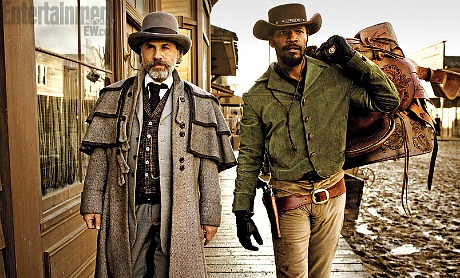

Pleae take note of the Entertainment Weekly logo in the upper left portion. That means they were given this photo as an exclusive.

Does Foxx think Django Unchained will be controversial?,” Breznican asks. “Naah,” says Foxx. “It’s going to be kind of a quirky but sorta mild-mannered, laid-back Monte Hellman-type film with nice long shots of pastoral western vistas and a kind of you-are-there historical verisimilitude with prairie dogs and snakes and coyotes howling in the night.”

I’m kidding…kidding! Foxx actually says, “Oh, hell yeah…you kidding me?”

I’ve read the script but here’s the EW synopsis: “After being sent to a chain gang after rebelling against his owners, Django is recruited by a German bounty hunter (Inglorious Basterd‘s Oscar-winner Christoph Waltz) to help him settle an old score. Django has information that Waltz’s Dr. King Schultz needs, so the German mercenary liberates the slave and promises that if he helps him kill the Brittle Brothers, Django’s old owners, he’ll make it worth his while.”

“He says, ‘I’ll kill ’em, and you’ll get some money and be on your way as a free man,'” Foxx tells Breznican.

The Brittle brothers? Is that like the Vega brothers only 150 years earlier?

“Along the way, the duo end up crossing paths with Leonardo DiCaprio‘s hammer-wielding character, a deranged plantation owner named Calvin Candie, who likes to make his toughest slaves fight to the death in gladiatorial combat. ‘Candie is a business man who owns a plantation called Candie Land, and that’s where my wife ends up being,’ Foxx says. To find her, ‘we have to get in good with Candy, by me playing a valet for Christoph’s character.’
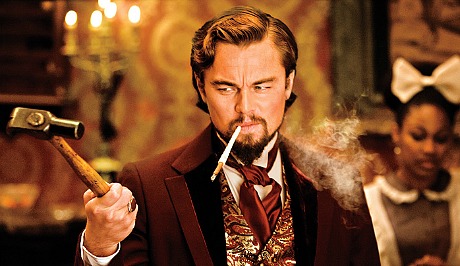

Leonardo DiCaprio as the hammer-wielding Calvin Candie — a mixture of Daniel Day Lewis’s Bill the Butcher from Gangs of New York mixed with Simon Legree.

“Candie Land”? Like an amusement park? How many employees? Is there a big “Candie Land” sign illuminated by candles at night? Did DiCaprio’s character get that name from a relative of P.T. Barnum? Does Mr. Candie sell hot dogs and popcorn and hard candy on the side?

“There’s a beautiful way [Tarantino] found for the characters to talk to each other,” Foxx explains. “It’s mindblowing. You’ve never heard it this way. You’ve seen movies deal with slavery or westerns that never dealt with slavery. Do it the safe way. This way is like…wow.”

Ultimately, Breznican writes, Django Unchained “is a story about the heart, and the way cruelty can destroy the things we love most.” Sorry but I kinda doubt that. I suspect that Django Unchained is ultimately about the movie references and spaghetti western memory threads in Tarantino’s head. All QT does (and all he ever will do) is riff on genre movies that he loved back in the ’70s and ’80s.

“All Django wants to do is get his wife,” Foxx concludes. “He’s not trying to cure or solve slavery. He just wants to get his life back.” So he and his wife can return to their home in a trailer park near Orlando and kick back with the brewskis and ESPN on the flat screen and the barbecue in the back yard and play with the kids and their pet alligator?

In April 2007 Tarantino told the Telegraph‘s John Hiscock that Django Unchained would be “a southern,” or a kind of spaghetti western set in America’s Deep South. He said he wanted “to do movies that deal with America’s horrible past with slavery and stuff but do them like spaghetti westerns, not like big issue movies. I want to do them like they’re genre films, but they deal with everything that America has never dealt with because it’s ashamed of it, and other countries don’t really deal with because they don’t feel they have the right to.”

So while Inglourious Basterds was a revenge-payback movie about making Nazis suffer for being anti-Semitic swine, Django Unchained is some kind of payback-revenge movie about American racism and slavery.