Blanket Apology

I’d like to offer a sincere, down-on-my-knees apology to all those who’ve tweeted derisively today about a sentence in this morning’s piece about critical reactions to The Hunger Games, to wit: “Be wary of reviews by certain female critics, or at least those who may be susceptible to the lore of this young-female-adult-propelled franchise (‘You go, Katniss!’).”

It was incorrect to suggest that some female critics might be stirred by or responsive to the rugged and courageous hunter-protector aspects of Jennifer Lawrence‘s Katniss Everdeen character, or that their opinion about the film might be influenced to some degree by knowing that millions of under-30 women are going to be breaking down theatre doors to see it this weekend, or that Suzanne Collins‘ trilogy is hugely popular with under-30s, etc.

I’ve thought it over and decided there’s absolutely no chance in the world that female critics could be anything but completely neutral and 100% un-invested in Everdeen or this film or the interests of their female readers, and that only a scurvy sexist dog would imply otherwise. I don’t know what I was on about, but I’m sorry. We all mess up from time to time. What can I say?

I’d also like to apologize for implying several times in this column that geeky fanboy critics might be especially responsive or susceptible to geeky-fanboy ComicCon FX fantasy flicks — that was way, way off the mark. And that female critics who write ecstatic-cartwheel reviews of Kate Hudson movies might be on the payroll of magazines that cater to girly-girls. And that critics who admire Tyler Perry movies might…you know, think or look at life a certain way. (Except for Stu Van Airsdale.) And that people who write admiring reviews of Criterion Blurays of films by Jean-Luc Godard, Robert Bresson and Alain Resnais might be mostly older white guys with airs of dweeby, Dave Kehr-like erudition.

When you get right down to it nobody plays favorites of any kind. Nobody is especially susceptible to anything based on their own gender or experience. Every movie is seen and absorbed on a completely neutral, even-steven, Switzerland basis. Nobody’s taste in movies is influenced by particular likes, loyalties or interests….none of that. Just so we’re clear. So I apologize. Really. Especially to Eric Snider.

Underwater

Last night I finally saw Jon Shenk‘s The Island President (Samuel Goldwyn, 3.28), having missed it at last September’s Telluride and Toronto film festivals. Shot in late ’09 and absorbing as far as it goes, it’s a portrait of the efforts of former Maldives president Mohamed Nasheed, the first democratically elected leader of this low-lying, multi-island nation, to try and save his homeland from drowning. But it’s us, really. We need to be saved from our own blindness and complacency.

The Maldives will be underwater within decades if emerging industrial nations (principally India and China) fail to cut carbon emissions and thereby push the general level of down to 350 parts per million. The narrative is about Nasheed’s efforts to persuade the big carbon boys and coal burners to accept the urgency of the crisis and to wake up and do something about it, for Chrissake. It ends with a modest victory in this regard at the end of the December 2009 Copenhagen Climate Conference.

The film is a basically about Nasheed attending a series of meetings and discussions inside conference rooms, hotel rooms, private planes, limos and on sidewalks and pathways during roam-arounds on the Maldivean capital of Male.

It’s been claimed that over the last century Maldivean sea levels have risen about eight inches. The island nation stands only a little more than 4 feet above sea level. Do the math.

The Island President is a good intelligent doc, but I had a whopper of a problem with the version that I saw last night at the Samuel Goldwyn screening room. The closing epiloque addressed only the climate-change situation and didn’t mention — hello? — that Nasheed was forced to resign from office last month due to a military coup by those loyal to his predecessor, Maumoon Abdul Gayoom, an autocrat and dictator who ran the Maldives from ’78 to ’08.

I called and asked this morning why this recent event wasn’t part of the epiloque. I was told that the epilogue had been updated with this info, but the version I I saw happened to be an older version. Here’s how the epilogue will read on the final release print:

COPENHAGEN MARKED THE FIRST TIME IN HISTORY THAT CHINA, INDIA, AND THE UNITED STATES AGREED TO REDUCE CARBON EMISSIONS.

THE FOLLOWING YEAR, ATMOSPHERIC CO2 CONTINUED TO RISE FROM 387 TO 390 PARTS PER MILLION.

IN FEBRUARY 2012, MOHAMED NASHEED RESIGNED THE PRESIDENCY UNDER THE THREAT OF VIOLENCE IN A COUP D’ETAT PERPETRATED BY SECURITY FORCES LOYAL TO THE FORMER DICTATOR.

“IT IS GOING TO BE VERY DIFFICULT FOR US TO ADAPT TO CLIMATE CHANGE

ISSUES IF WE DO NOT HAVE A SOLID AND SECURE DEMOCRATIC GOVERNANCE.”

— MOHAMED NASHEED

Malick + Oodly-Doodly

I missed last Sunday’s Just Jared story about Terrence Malick having filmed a scene for Lawless last Friday (3.16) during SXSW. Lawless star Rooney Mara and Neon Indian frontman Alan Palomo did a scene together at Austin’s Fader Fort, according to the piece.


Lawless costar Rooney Mara, Neon Indian‘s Alan Palomo during shooting in Austin last Friday.

I’ve also missed descriptions of Lawless being “an indie-rock thriller” about “two intersecting love triangles, sexual obsession, and betrayal set against the music scene in Austin.” I knew about the music scene backdrop, but I thought it would be about loss and young love and birds and light and leaves and wheat fields and beautiful young men.

Let me explain something. It’s not in Malick to make a “thriller.” It just isn’t. His sensibilities are too delicate and ethereal to effectively serve the occasionally coarse requirements of a thriller.

Neon Indian is an oodly-doodly hipster band. I described the oodly-doodly sound last November as the product of “oh-so-dry-and-clever musicians wrapped in a fey musical head-space attitude who create songs that are kind of precious and tweedly-deedly…songs that fiddle around with melody without really feeling it or lifting it off the ground…bands that seem to be going ‘eewww, this is cool’…bands who perform with a kind of dorky, dispassionate irony.”

Lawless costars Ryan Gosling, Natalie Portman, Christian Bale and Cate Blanchett. The lensing of Lawless will be followed by the filming of Malick’s Knight of Cups.

Malick’s untitled Oklahoma love story (formerly referred to as The Burial) is, some say, due to hit screens later this year. I’ll believe that when I see it. Mr. Wackadoodle likes to take his sweet time in the editing room. I’ve said over and over that he needs a tough Bert Schneider-type producer who isn’t afraid to push him around and occasionally read him the riot act.

A Baahing Noise

Somebody needs to say this plain and straight. Numerous film critics have been cowed by the expected box-office avalanche of The Hunger Games and are therefore being extra-generous in their reviews. Right now it has a 89% and 72% rating from Rotten Tomatoes and Metacritic, respectively, and mainly for one reason. Critics are terrified of sounding cranky or out-of-touch. Buck the tide? Not we!

Be wary of reviews by certain female critics, or at least those who may be susceptible to the lore of this young-female-adult-propelled franchise (“You go, Katniss!”). I don’t even know what to make of this declaration by Movieline‘s Stephanie Zacharek: “The surprise of The Hunger Games isn’t that it lives up to its hype — it’s that it plays as if that hype never even existed, which may be the trickiest achievement a big movie can pull off these days.” If there’s one thing that defines Gary Ross‘s film, it’s a feeling that he and his Hunger Games producers were acutely aware they were adapting a wildly popular literary property, and that they’d best serve the fantasies and sensibilities of its young female readers.

The only reviewers who’ve stood up and given this annoyingly photographed film the slapdown it deserves are Salon‘s Andrew O’Hehir, the Miami Herald‘s Rene Rodrgiuez, Time‘s Richard Corisss and two or three others.

“The ultimate failure of The Hunger Games as a movie is not its derivative nature or its chintzy production design or even its lack of one single memorable set piece,” Rodriguez has written. “The film’s biggest flaw is the complete absence of vision or imagination – anything that would justify the movie’s existence as something other than a way to cash in on the novel. The Harry Potter pictures brought visual imagination and wonder to J.K. Rowling’s intricate fantasy world. The Twilight series has been a smash because of the chemistry between its lead actors. The Hunger Games, though, offers nothing.”

“Hash Job”

The Hunger Games “is precisely the thing it pretends to disapprove of: a pulse-elevating spectacle meant to distract us from the unsatisfying situation of the real world, and to offer a simulated outlet for youthful disaffection and anxiety (in this case, the anxieties of girls and young women in particular). Bread and circuses, only without the bread, and pretending to be anti-circus.

“I’m not claiming that’s anything new in pop culture, and it certainly isn’t a crime. Furthermore, the shapeless politics of The Hunger Games have very little to do with the question of whether it’s any good, although they do illustrate how calculated the whole project is.” — from Andrew O’Hehir‘s 3.20 review on Salon.

Also: “[It] offers intriguing moments of social satire and delightful supporting performances, but subsumes much of the book’s page-turning drama to sub-Twilight teen romance. Of course it will make a zillion dollars opening weekend, but I’m not convinced this franchise will be as ginormous, in the long run, as Hollywood hopes.”

Career Gift

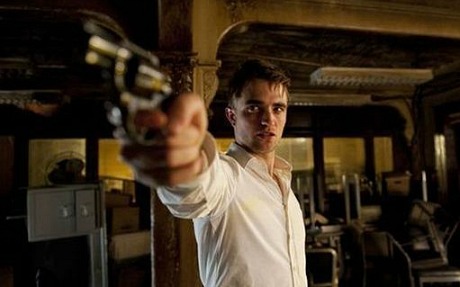
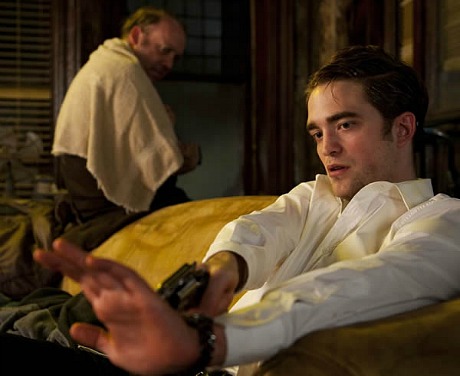
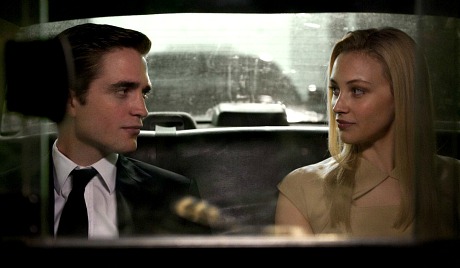
Wherever Cosmopolis ultimately ends up on the rank-o-meter, it’s apparently going to be the best film that Robert Pattinson has ever been in (or will be in, probably…let’s face it). That’s the David Cronenberg benefit.

Don DeLillo‘s Cosmopolis (published in 2003) “is the story of Eric Packer (Pattinson), a 28 year old multi-billionaire asset manager who makes an odyssey across midtown Manhattan in order to get a haircut.

“Like James Joyce‘s Ulysses, Cosmopolis covers roughly one day of time and includes highly sexed women and the theme of father-son separation. Packer’s voyage is obstructed by various traffic jams caused by a presidential visit to the city, a funeral procession for a Sufi rap star and a full-fledged riot.

“Along the way, the hero has several chance meetings with his wife, seeing her in a taxi, a bookstore and lying naked in the street, taking part in a movie as an extra.

“Meanwhile, Packer is stalked by two men, a comical ‘pastry assassin’ and an unstable ‘credible threat’.

“Through the course of the day, the protagonist loses incredible amounts of money for his clients by betting against the rise of the yen, a loss that parallels his own fall. Packer seems to relish being unburdened by the loss of so much money, even stopping to make sure he loses his wife’s fortune as well, to ensure that his ruin is inevitable.”

Jay Baruchel, Paul Giamatti, Kevin Durand, Juliette Binoche and Samantha Morton costar. So will Cosmopolis turn up in Cannes or Toronto?

“I Can No Longer Associate Myself…”

No confirmation that Criterion will release a Bluray of Roman Polanski‘s Rosemary’s Baby, but if it happens — if — it’s been hinted they may crop it at 1.85 to 1 instead of the more correct 1.66 to 1. That would be dead wrong.

Only two years before he was shooting Rosemary’s Baby Polanski shot Repulsion at 1.66 to 1. He’s a European traditionalist at heart, and while he knew that the film would be projected at 1.85 by U.S. exhibitors, I strongly suspect that he composed it for 1.66. Go ahead — call him up.

It’s not just me claiming that 1.66 is the preferred aspect ratio, and that precedents have been established. 12 years ago DVD Talk‘s Geoffrey Kleinman noted that a 2000 DVD version presented the film at 1.66 to 1. Some wingnut at Turner Classic Movies declared a few years back that Rosemary’s Baby‘s aspect ratio is 1.66. And a commenter at Velocity Reviews asked a while back why Polanski’s film was completely occupying a 16 x 9 screen when a 1.66 a.r. would dictate windowbox bars on the side.

I know how this one is going to go. The fascists are going to carpet-bomb me with their usual goose-stepping crap and I’m going to respond with my usual counter-accusations, etc. It’s an old hymn. Except I’m really, really right this time.

Pain Of It

I mentioned in my Hunger Games review that I’d worked as a tree surgeon as a wily youth. Some expressed surprise at this or found it revelatory or whatever. Almost three years ago I posted the following recollection:

“Before I started trying to make it as a journalist I worked as a tree surgeon. Ropes, pole saw, chain saws, leather saddles, metal climbing spikes, etc. In L.A. I worked for an eccentric guy who had a temper. He usually had a steady crew of two or three, and we all got barked at a lot. He never got violent but there was always that threat. I remember his face turning pink with rage.

“One time he was spiked into a half-removed tulip tree, about 35 feet up. Myself and a guy named Gary Swafford were assisting from the ground, and at one point we were filling up a king-sized chain saw with gas. Except Swofford didn’t screw the gas cap on properly. The pissed-off boss hauled the chain saw up with a rope, turned it on and then raised it above his head to make a cut. And right away the cap popped off and at least a quart of gas spilled out onto his neck and chest and stomach. The burning sensation on his genitals must have been brutal.

And the boss lost it. Not by yelling but by crying. I literally heard him cry out the words “whoa-hoa…hoo-hoo!” Except the weeping was a little too dramatic. He was bellowing like a wounded animal. And Swofford and I — God help us — were quaking with laughter, our chests aching with efforts to hide the truth. It was obviously the worst possible reaction we could’ve had, and there was no stopping it for the longest time.

“Others have surely experienced such moments.”

Wasn’t The Dead Horses

Luck producers David Milch and Michael Mann have told Vulture‘s Matt Zoller Seitz that they cancelled the show after the third horse died because they knew that the karma of three dead horses was fatal. “Three horses is three too many, and when this third one went, you felt sort of the resounding sense of, you know, ‘This can’t work,'” Mann says. “It’s like trying to negotiate with gravity. Because of the media attention as well as the fact of it, it just becomes an impossibility.”

But the fact that the show wasn’t drawing enough of an audience made it easier to pull the plug, I’m sure.

There two reasons why Luck‘s audience wasn’t all that sizable. One, it featured too many grizzled guys in their 60s and 70s. A hit show has to costar at least one or two guys in their 30s or 40s (i.e., an age for having children). Too many shots of white hair and white beards and turkey necks and creased leathery skin and pot bellies and raspy voices, and people tune out. And two, that opening credits tune (“Splitting The Atom” by Massive Attack) started to drive me up the wall after the third or fourth viewing. I heard it a couple of weeks ago and said to myself, “Fuck…I’m getting sick of his song!” So that’s what happened, I think. Tens of thousands of people had the same reaction. The song was too hip for the room.