Bite Your Tongue

In a deliberate effort to take ad money out of Hollywood Elsewhere’s pocket, a piece by “agent turned manager turned producer” Gavin Polone about the over-ness of the Oscars appeared in New York magazine on 1.23:

“Any film thought to have a shot at an [Oscar] award has to be released in the late fall or early winter, meaning that almost every film released between January and September is pretty much out of the running. Distributors select the films they think can garner awards and release them during the last quarter of the year all at once, meaning that the holiday season is hugely overserved by prestige projects and all other seasons woefully undersupplied.

“As a result, the Oscars damage the prospects of the very movies they’re designed to promote. If there were no Academy Awards, there would probably be a more even release of quality films throughout the year, making it more likely that additional people would see those films, since most moviegoers don’t schedule their year to make room for increased movie attendance in November and December. Instead, it’s a battle royale for ticket buyers, and too many movies lose out.

“Many in Hollywood would say that the financial reward of Oscars success makes the cost and loss of dignity worthwhile, but the facts indicate otherwise. A detailed statistical analysis of the Oscars’ box-office effect by Boxofficequant.com showed that almost all of the ticket money flowed in after the nomination, not the win. But this is also misleading, since it is difficult to know how a film that was nominated would have performed had it not received a nomination.

“Of course, some people do benefit from the Oscars, aside from publicists, the trade press, the New York and Los Angeles Times (have you ever seen any kind of anti-Oscars article in those publications?), and Los Angeles billboard owners: the individuals who win. Directors, screenwriters, actors, editors, and anyone else with a nomination or a win gets a big bump in pay after being so honored — as much as $5 million, it’s said, for a Best Actor trophy.

“Unfortunately for the payer of this Oscar bonus, there is no correlation between anyone’s winning an award and future box-office success, despite the big deal made about Oscars in marketing campaigns. PopEater‘s Jo Piazza showed that of the top 100 highest-grossing films of 2010, 40 percent of the top twenty featured Oscar winners, while 50 percent of the bottom twenty did. If possessing a statuette was actually worth something, shouldn’t there be some direct correlation between casting an Academy Award winner and higher box office?

“Really, I see no point to any of it, other than the kitschy fun of the spectacle, which, as with the Miss America Pageant, certainly can be entertaining in limited doses. But by the third speech of someone thanking his spouse, agent, manager, psychic, dog walker, and the person who clears his chakras, I am always bored and left wondering why he couldn’t just have a private conversation with the person to whom he wishes to express his gratitude, and then find something more interesting or entertaining to talk about on television.

“Fortunately, the public seems finally to be losing interest. The Oscar broadcast has evidenced a pretty steady decline in audience share since the mid-seventies. Last year, obviously feeling the need to bring in a younger viewership, the Academy hired James Franco and Anne Hathaway as hosts. The plan didn’t work; there was a 12 percent drop in the 18-to-49 demographic and a 9 percent decrease in overall viewers. Clearly, this is because the audience feels alienated from the choices of nominations and winners, not how they are presented. As with any cultural institution, when the interest and support of the young are lost, it is just a question of when, not if, that institution becomes fully irrelevant. I can’t wait.”
Wells to Angie Han

What do you mean people should take the comments I recently passed along about Darren Aronofsky‘s Noah “with a grain of salt”? Are you thinking Matty Libatique isn’t a straight shooter or someone to be trusted? Because he’s only a dp and isn’t the heavy-hitter authority that Aronofsky is? Or are you thinking…what, that I was drunk when I spoke to him? (I wasn’t.) He said what he said and I said what I said during the last Oscar Poker.

Rock Shock

I hadn’t read good things about Katie Asleton‘s Black Rock, a kind of chick mumblecore Deliverance thriller, so I didn’t expect much when I finally sat down to see it yesterday at the Egyptian. But I was still appalled at how lame it is. Asleton and husband Mark Duplass, who wrote the script and exec produced, need to stay the hell away from the action-thriller genre henceforth, or at least up their game. Because Black Rock — surprisingly, stunningly — verges on the incompetent.

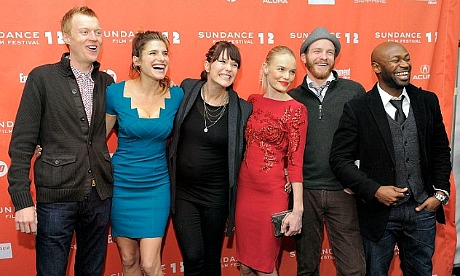
Black Rock costars at Sundance Film festival premiere (l. to r.):
Jay Paulson, Lake Bell, Katie Asleton, Kate Bosworth, Will Bouvier, Anslem Richardson.

The film has three basic problems. One, the event that triggers violence between three camping girlfriends (Aselton, Kate Bosworth, Lake Bell) and three dishonorably discharged soldiers (Jay Paulson, Will Bouvier, Anslem Richardson ) isn’t believable. Two, the women frequently act like morons before and after the violence occurs. And three, even as they’re in danger of being shot or knifed or beaten to death they still place a high premium on settling their emotional conflicts and can’t shut the fuck up as they’re crawling around in the mud and the brush.

Preparation suggestion for all feminist female directors thinking about making a thriller of this sort: Watch Ted Kotcheff‘s First Blood three or four times. It might teach you that when your life is in danger in the boonies you need to (a) Rambo up, (b) be quiet like an animal and (c) save the emotional sharing for when you get back to safety.

Asleton, Bosworth and Bell are camping on a remote island off the coast of Maine when they run into the three above-described assholes. The remote location and lack of any legal recourse if things turn weird would naturally lead any sane woman to play it very, very carefully if confronted by three guys with rifles. But not Katie! She not only decides to flirt with the best looking of the three (i.e., Bouvier) but entice him into the woods for sex. And then the booze suddenly catches up with her and she does a 180 and says “whoops, sorry…changed my mind.” Brilliant! Bouvier decides to force himself upon her and Asleton resists and squirms and freaks and finally stops him by thunking him in the head with a large rock. His spirit leaves his body and rises into the night sky above.

The break from reality happens when Paulson, the most rabid and unstable of the three, decides to waste the three women as revenge for Asleton killing their buddy. Duplass and Asleton are trying to sell the idea that this guy is so whacked and such a woman-hater that he’s ready to become a murderer and a lifelong fugitive from justice in order to affirm the bonds of buddyhood. I could maybe accept these two creeps deciding to sexually assault the three women for revenge, but not kill them. That’s too much. The women explain that it wasn’t deliberate and that Asleton was just trying to defend herself, and that doesn’t matter to Paulson. His willingness to jump into the pit of death and madness happens way too easily, and it’s especially bothersome that he and Richardson act like they don’t know much about soldiering (i.e., shooting, tracking, hand-to-hand combat) when things turn nasty.

The last 15 or so minutes are especially awful. There’s a skill and an art to delivering good do-or-die combat sequences. And there had to be a way for these three women to handle themselves in such a way that wouldn’t invite disbelief and derision. People sitting in front of me at the Egyptian were smirking and chortling. I kept silent but was truly amazed.

Kasdan Needs To Up Game

I’m leaving Park City today and arriving late this evening at the Santa Barbara Film Festival, which kicked off last night. The opener was Lawrence Kasdan‘s Darling Companion (Sony Classics, 4.20), a lost dog movie which is very, very slight. Variety‘s Lael Lowenstein said it “won’t be long before this one turns up at the Netflix pound.”

It’s basically about an older, well-to-do Denver couple (Kevin Kline, Diane Keaton) getting in touch with their issues through a relationship with a mixed collie they’ve adopted after Keaton and her daughter (Elisabeth Moss) find him huddling on the side of a road. The dog is soon being attended to by a friendly vet (Jay Ali), enjoying a nice hot bath, and given the name of Freeway.

During a Rocky Mountain vacation Kline, an emotionally curt surgeon who’s constantly phoning and texting, lets Freeway slip the leash…gone. Keaton, emotionally invested in her relationship with Freeway in lieu of a dry and distant one with Kline, is hugely pissed and is soon leading a major log-cabin campaign to find the dog. Helping out are Kline’s sister (Dianne Wiest), her easygoing boyfriend (Richard Jenkins), Penny’s doctor son (Mark Duplass) and a sexy exotic European (Ayelet Zurer) who has gypsy-like, extra-sensory insight into Freeway’s whereabouts. And a local sheriff (Sam Shepard) is aware of the hunt and peripherally involved.

I thought maybe Kasdan might be up to something clever here. Perhaps using the lost-dog plot as a way into a kind of Big Chill flick about four or five old farts hanging around a Rocky Mountain cabin and evaluating their lives and times…something like that. But for the most part, Darling Companion is just about finding the dog. Okay, Kline comes around to admitting that he’s too aloof and work-oriented, but this is hardly the stuff of keen audience engagement.

A septugenarian Big Chill would make sense as Kasdan isn’t concerned in the least with Freeway’s whereabouts or adventures. All we do is hang out with the oldsters and Duplass and Zurer and blah blah, and then the story comes to a nice wholesome conclusion.

At one point Kline and Jenkins encounter a kind of Unabomber guy living in a rundown cabin in the woods, and there’s an implication that Freeway might have been kidnapped and/or is being held by this dog of a human being, but this possibility is quickly discarded.

Why does Freeway run away from Kline in the first place? Dogs don’t just run away from their masters. Are we to suppose that Freeway is just as put off by Kline’s selfish cell-phone existence and can’t wait to escape his company? That’s a stretch.

Darling Companion made me feel really old on top of everything else. I’ve known Kline, Keaton, Weist and Shepard since the late ’70s and early ’80s, and they’re all looking and especially acting like people in their late 60s and early 70s with their aching joints and arms falling out of their sockets and their gray hair and Shepard’s teeth looking small and gnarly with his pot belly hanging out…Jesus! Shepard was a smooth romantic figure in the ’80s.

If you’re going to be an older working actor, you have to look younger than you are. That’s the rule. If you’re 75, you have to look 60 or 65 after you’ve just had a facial and been worked on by a skilled hair colorist (i.e., a little gray around the edges). If you’re 60 or 65, you have to look like a 50 or 55 year-old physical trainer. No limping, no paunch, in good shape, no complaining about aching joints. Because I’m telling you it’s really depressing to watch Kline and Keaton stumbling along a mountain trail like refugees from a retirement community.

And yet the film’s best scene happens on that same mountain trail when Kline’s right arm becomes dislocated and Keaton has to help him pop it back in.

My basic reaction as I left the screening room was “why is Kasdan degrading his once-proud brand with a feathery little project like this? A movie about finding a fucking dog in the Rocky Mountains? That‘s what the once-great Kasdan is up to?”

Kasdan’s last truly tasty film, Mumford, came out 12 and a half years ago. I will never stop respecting or believing in his craft and vision, but over the last decade he’s generally been regarded by the media mob as M.I.A. or “on hold” or past it. As soon as I heard about Darling Companion I began wondering if it’s a potential rebound or a place-holder or what. Because my suspicions were, no offense, skeptical. And now I know — it’s a place-holder. It’s actually kind of a mild embarassment.

I don’t mean to speak dismissively of one of the strongest and most distinctive director-screenwriters of the ’80s and ’90s. Body Heat, The Big Chill, Silverado, The Accidental Tourist, Grand Canyon, Wyatt Earp, Mumford — that’s a hell of a 20-year run. But writer-directors have only so much psychic essence, and the prevailing view is that after they’ve shot their wad (as most wads are lamentably finite), that’s it.

For whatever reason Kasdan tells us that the mountain-search portion of the film is happening in Telluride, Colorado, as we’re shown an establishing shot of Telluride’s main street. But it was shot in and around Park City’s Wasatch Mountains. I’m betting that part of the pitch to the Darling actors was “you get a nice five or six-week vacation in the Rockies as part of the deal.”

Still Screwed Up

High-Def Digest‘s Josh Zyber has assembled a four-panel video that shows that the allegedly “fixed” overture sequence in the West Side Story Bluray still isn’t right. Here‘s how he explains it:

“As you can see [in the video], the original version of the sequence dissolved from a red (or orange) still image, to green, and finally to blue. In the first Blu-ray, the green section was missing entirely, replaced with a fade to black and then a fade back up to blue. In the new ‘fixed’; version, the green is still missing.

“Instead, the red still fades about halfway to black, freezes, and then dissolves directly to a darkened version of the blue frame. After a second, the blue comes back up to regular brightness and the sequence resumes normally.

“I’m left to assume that whatever film elements MGM used for the Blu-ray transfer were missing the green section of the footage, and the studio tried to disguise this with the fade-to-black. When consumers complained, rather than search for another source of the green frame, MGM digitally manipulated what it had on hand and gave us this half-assed ‘fix.’

“This is a static still frame of a simple image. How hard could it be to sample either the red or blue frame, digitally recolor it green, and insert it into the middle with new dissolves? I feel like a clever fan could probably do this at home on a laptop. Yet a major Hollywood studio can’t? I find this very bizarre.”

Zyber has apparently never tangled with Yvonne Medrano, MGM Home Entertainment vp technical services, before. The evidence suggests that she doesn’t fool around.

Which One, Dammit?

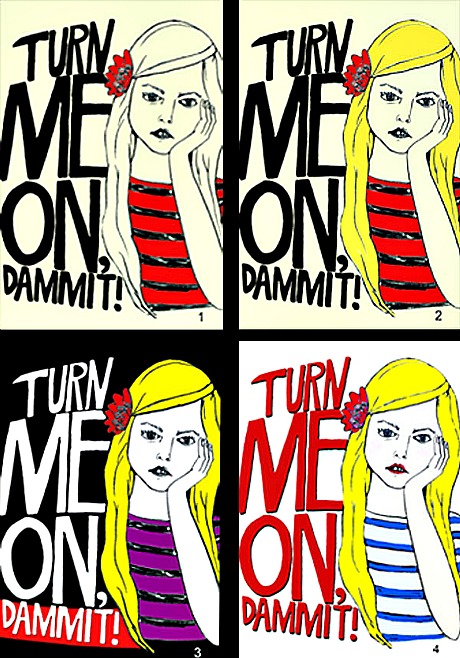
Here are four non-finalized versions of Reid Rosefelt‘s one-sheet for Turn Me On Dammit! (New Yorker, 3.30). He’s asking HE readers to rate them in order of preference plus offer up any comments that might occur. The line illustration is by Kelly Lasserre. Three of the color treatments are by Ron Ramsland of New Yorker Films; one is by Rosefelt.

“As you can see the poster is not in any stretch of the imagination in Saul Bass territory,” Rosefelt writes. “Along the way I had to make compromises and one of them was that the girl in the ad had to resemble Helene Bergsholm, the star of the film.

I have bigger individual versions which I’ll post later.

Here’s my Palm Springs Film Festival review of the film. And here’s a rave from anomalousmaterial.com’s Nick Prigge, and an excerpt:

“It might seem strange that a film featuring a fairly gratuitous moment of, uh, (brief) full frontal nudity when considering its most essential plot point is a male counterpart of our 15 year old female protagonist taking out his, uh, ‘dick’ and pointing it at her is more subtle, thoughtful and genuine than just about any teen sex comedy of any nationality with no (brief) full frontal nudity of any kind that I’ve come across but that’s the truth. It’s one of the best films of 2011.

“It’s not unlike Mean Girls in the way that it displays how quickly and brutally these high-schooled aged ladies can turn against one another and how one little white lie can transform a life. What it doesn’t do, though, is make these rather harsh story complications an excuse for comedic setpieces and exaggerated characters. There is funny to be seen and heard, to be sure, plenty of it, but what could have been crass is just honest.”

Boner Boys

Every new movie generation delivers its own attitude and aesthetic. I was reminded of this when I first saw Wes Anderson and Owen Wilson ‘s black-and-white Bottle Rocket short in ’94. And I was reminded again today when I caught Andrew Edison and Luke Loftin‘s BINDLESTIFFS early this afternoon at Slamdance. They’re only 20 and 21, respectively, but they’re probably a two-headed version of the new Todd Phillips, or maybe they’re a new hybrid of Wes Anderson mixed with John Waters or something like that. I haven’t quite figured it out.


(l. to r.) Andrew Edison, John Karna, Luke Loftin following’s today’s BUNDLESTIFFS screening.

Set in Houston, BINDLESTIFFS is raw and outrageous at times, but often quite funny in a scattershot deadpan fashion. It’s fast and brazen and lewd, and as hip in its own curious way as Tiny Furniture but way, way crazier and goofier and (this being a testosterone comedy) driven by erections. It has a certain manic energy that I haven’t gotten from any Sundance film this year, and it revels in absurdist raunch.

It looks and sounds ragged (like it was shot on a family home-video camera in the late ’90s) but it could play right now in theatres and make a decent pile of change. I didn’t laugh out loud all that much, but then I’m more of a heh-heh type of guy. I was comforted by the fact that Edison-Loftin know from farce, and that their film is smart, nervy and extreme.

I was especially impressed by the fact that BINDLESTIFFS was blocked out action-wise but entirely and hilariously improvised in terms of dialogue. These guys are really good at keeping the ball in the air and batting it around.

It starts out in a semi-farcical, rat-a-tat vein that reminded me of the Bottle Rocket short, principally due to the three leads — Loftin, Edison and John Karna — playfully bouncing off each other’s personalities and proclaiming their allegiance to J.D. Salinger‘s The Catcher in the Rye, which their high-school has just banned from the curriculum. But when they all get suspended for an idiotic non-reason things suddenly shift into Road Trip-without-a-car meets Better Off Dead meets Pink Flamingoes or…whatever, you figure it out.

The only difficult aspect is the film’s callous attitude about a mangy homeless woman who is photographed without a face as a kind of “thing”, and treated by two of the three leads as a sub-life form, a dog. It’s not funny to me when you completely remove a person’s dignity, even that of a filthy, gray-haired skank. But many in the audience today were laughing.

The only issue is that an R rating will be impossible, and trying to cut BINDLESTIFFS down in order to get an R would defeat its whole purpose. It’s not in the comic realm of Superbad (guys like Jonah Hill come along very rarely), but it does have its own personality and ‘tude and way of delivering a joke.

Two or three or four films from now Edison-Loftin could deliver the next $100 million comedy…maybe. It’s hard to predict who’s really got it or not, but these guys definitely understand themselves and have come up with a kind of humor that feels and plays a little differently than what I’ve been suffering through in the plexes over the last two or three or four years.

Last Full Day

It’s 8:50 am, and I’m committed to catching a 9:30 am screening of Room 237, the doc about wackjob fans of Stanley Kubrick‘s The Shining, followed by a 1 pm Slamdance screening of Andrew Edison‘s Bindlestiffs. The final viewing of the day will be a 6 pm Egyptian showing of Katie Asleton‘s Black Rock.

Yesterday I wrote for half a day and then saw Shut Up and Play The Hits, Lynn Shelton‘s Your Sister’s Sister and finally California Solo. Too shagged to write about any of these late last night, and no time to get into them now.