

It doesn’t matter if Occupy Wall Street (which has expanded to Boston and San Francisco and elsewhere) is lacking a specific goal, or if it feels unfocused or futile or whatever. The fact that a miniscule speck of GenY anger is being expressed is at least something. Or…you know, is better than watching Jimmy Kimmel. Any expression of dismay or loathing or rage about the sociopathic stacked-deck, rich-favoring U.S. economy led and exploited by the Wall Street machine gets my vote. That’s why I’m going down there this afternoon…yeah!
My Own Guy
I spoke last night to a guy who caught a research screening of Extremely Loud and Incredibly Close last Sunday night at Leows’ Lincoln Square (B’way at 68th). And he agrees with Kris Tapley’s guy that Max Von Sydow‘s wordless performance as Thomas Horn‘s grandfather “will certainly get an Oscar nomination, perhaps the award itself.”
And he has a slight dispute with Stu Van Airsdale’s guy about the opening with “falling bodies, crushing thuds, and other vividly horrifying reminders of the initial scene at the World Trade Center.” My guy’s dominant impression is “an obliquely falling body in a white suit. If this wasn’t a 9/11 film, it could easily be mistaken for a Cirque Du Soleil routine.”
“One surprising thing about the film,” he adds, “is that James Gandolfini, credited in both the trailer and the poster, has had his role entirely cut. John Goodman‘s role is reduced as well, adding up to a few short scenes.” I don’t know how he’d know that Goodman’s role has been reduced unless he’s read a draft of Eric Roth’s script or whatever. I forgot to interrogate about this.
“And as for all those folks that pointed out that there’s snow on the ground in a few scenes in the trailer, it’s important to note that the film takes place a few years after 9/11; those scenes aren’t meant to reflect 9/11.” But of course the trailer, despite the MD80 thing, is looking to evoke precisely that.
Still "Too Soon"?
Movieline‘s Stu Van Airsdale has spoken to a guy who’s allegedly seen Extremely Loud and Incredibly Close, and one of his reactions, Van Airsdale writes, is that “the film’s current introduction — which features falling bodies, crushing thuds, and other vividly horrifying reminders of the initial scene at the World Trade Center — was less emotionally affecting than just inappropriate” and “too soon.”
Ten years later is too soon? I got fairly angry with people who were saying this five years ago when United 93 was about to open, but anyone who says this now is taking the post-traumatic thing into obsession. “Too soon!” is the mantra of people who aren’t breathing in and out, who are basically coming from a place of emotional denial or suppression. I have eight words for Van Airsdale’s guy: It happened, life moves on, get over it.
Put another way, if you shudder and moan for too long in response to a given traumatic event, if you refuse to heal and accept the natural shedding of skin, there comes a point when people start regarding you as a grief monkey.
For What It's Worth
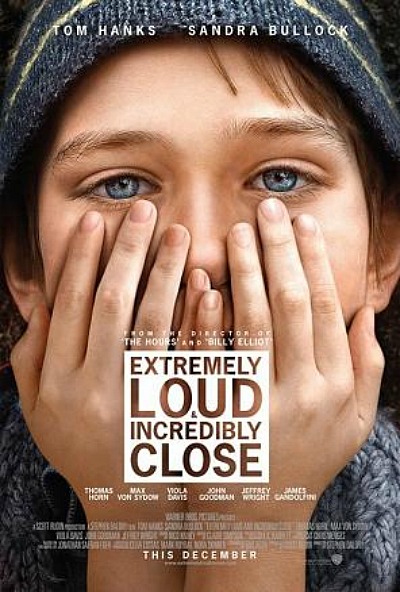
I think that the close-up image of Thomas Horn in the Extremely Loud and Incredibly Close poster is oddly intriguing. Hands to the face means shock or alarm, but Horn’s eyes are laid-back, almost serene. He could be listening to a lecture by a teacher or watching a TV show or staring at a sleeping cat. An opaque expression in the midst of heavy drama about 9/11 and death and whatever else…cool.
Make and Model
At the 40-second mark in the just-released traiier for Stephen Daldry‘s Extremely Loud and Incredibly Close (Warner Bros, 12.25), we see Thomas Horn, who plays the son of Tom Hanks and Sandra Bullock, react to the sound of an overhead jet. As this is a 9/11-related drama, it’s naturally presumed that Horn is hearing (and perhaps seeing) American Airlines #11, the Boeing 767-223ER jet that hit the North Tower at 8:54 am that morning.
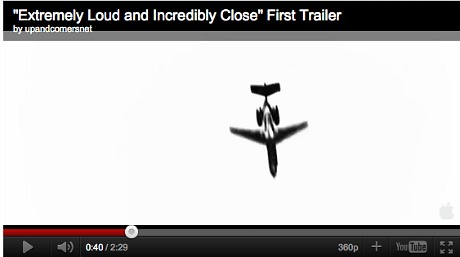
But the jet we briefly see in the trailer has twin engines mounted on the rear of the fuselage — a characteristic of an MD-80 jet. Boeing 767 engines are mounted on the wings. So…I don’t get it.
Presumably this is an error that’s exclusive to the trailer, and that everything will be fixed when the film appears three months hence. (It’s inconceivable that Daldry could make a mistake this obvious and elemental in the film itself.) But it still boggles the mind that persons involved in assembling the trailer chose to use footage (or a CG simulation) of a flying MD-80 jet when they had to know that people like me would spot this right away.
United #175, the plane that hit the South Tower at 9:03 am, was a 767-200, which also has its engines mounted on the wings.
Even if the portion of the trailer in question is based on a sequence in the film in which Horn is looking at some random jet passing over and imagining that it’s one of the two jets that hit the towers, it’s needlessly misleading to show us an aircraft of this type, certainly in the context of a trailer in which the information and associations are expected to be simple and direct and easy to process. What could possibly be the point?
Figure It Out
I always thought that DreamWorks’ decision to open Steven Spielberg‘s War Horse on 12.28 was a little strange to begin with, so switching the opener to Christmas Day feels like a shoulder-shrugger.
“After seeing the film, it became clear to us that War Horse is something audiences should be able to see when they’re together with their families on Christmas Day,” DreamWorks spokesman Chip Sullivan told EW‘s Anthony Breznican. “They have the time to see multiple movies during the holidays, and we want to be one of their choices when they are most available.”
And the reason for the previous determination that War Horse shouldn’t be a Christmas holiday option was what again?
Marking Time
In a 9.29 piece called “Generation Next: The Realignment,” Marshall Fine makes various calls about where certain actors are in their careers, sinking- or rising-wise. Most of Fine’s assessments are no-brainers, but I’m wondering if HE readers generally agree or not.
Assertion #1: “Larry Crowne marked Tom Hanks, who is now 55, as a star who can no longer open a movie. [He] isn’t a star who is attractive to the demographic — the 18-to-34 crowd — that crowns box-office stars. And the audience that is interested in Hanks — i.e., those closer to his own age — aren’t rushing out to see movies on their opening weekend.” Wells response: Larry Crowne fizzled because it wasn’t good enough.
Assertion #2: Hanks “had his best decade as an actor in the 1990s,” but “like Harrison Ford, Tom Cruise, Bruce Willis, Mel Gibson, Kevin Costner and a few others, he came into stardom in the 1980s” and, Fine implies, is not likely to revisit that plateau again. Wells response: Agreed — Hanks is no box-office powerhouse, but he’s still “Tom Hanks.”
Assertion 3: “Tom Cruise still remains a force. But the young generation of moviegoers accepts him as a star because, to them, it’s received wisdom; they didn’t crown him and, before we know it, they’ll ignore him the same way they ignore other superstars in their 50s – as someone their parents liked. (Sean Penn is part of Cruise’s cohort – but he’s never been a box-office force.)” Wells response: The older Cruise gets, the more interesting he becomes. Nobody pushes harder at delivering quality goods.
Assertion #4: Descendants star and Ides of March director-cowriter-star George Clooney “has hit his superstar peak, and is now at about the same point where, say, Cary Grant was in the 1950s.” Wells response: For whatever reason I hadn’t thought of Clooney in this light. He’s at his To Catch A Thief phase, which is to say he’s got 10 good years left, 15 at the outside.
Assertion #5: “Everyone knows who Clooney is, as well as his cohort: Brad Pitt, Hugh Grant, Robert Downey Jr., Johnny Depp, Will Smith, Denzel Washington, Russell Crowe. They’re a generation of actors who picked up the gauntlet in the 1990s, battled their way through heartthrob and flavor-of-the-month status to achieve a certain longevity. They’ve now reached their prime or are just gliding past it.” Wells response: All these guys are right in their moment. No fade, no leaky gas tank, no starting to glide past it.” Except, possibly, for Smith because he’s so afraid of doing anything that isn’t in his popular fan-base wheelhouse.
Assertion #6: “Ryan Gosling is now where Clooney or Pitt were 15 years or so ago: an actor with some strong credits but not quite the mass-audience awareness.” Wells response: There are people out there who are still going Ryan who”? Really? Even that dumb-sounding girl who took the video of Gosling breaking up a Manhattan street fight called him “that Notebook guy.”
Assertion #7: “Leonardo DiCaprio is the biggest superstar among the youngest group of name actors — Gosling, Joseph Gordon-Levitt, Jake Gyllenhaal, Ewan McGregor, James Franco, Adrien Brody, Seth Rogen and Jesse Eisenberg.” Wells response: Yeah, sure, whatever.
Assertion #8: “It’s a marker when Paramount has dumped a Warren Beatty project (i.e., Hughes), but also a symptom. Jack Nicholson is Jack Nicholson; if he hasn’t retired (as Gene Hackman has), he’ll show up and surprise us sometime soon. Robert De Niro and Al Pacino keep working and undoubtedly still have great work in them; whether they’ll be offered material worthy of their talent (and whether they’ll select it) is another question. And Clint Eastwood, ever the contrarian, keeps directing (and occasionally acting) into his 80s.”
“So there it is — a glimmer when you can see both into the past and into the future at the same time,” Fine concludes. “Time is the conqueror – and the wheel keeps turning.
Respecting Mr. Krim
For about 40 years Arthur Krim (1910 – 1994), the distinguished chairman of United Artists and then Orion Pictures from the early ’50s to early ’90s, put out a run of quality-level, award-winning films that eclipses the record of Harvey Weinstein in terms of Oscar nominations and awards.
On top of which the soft-spoken Krim never took a producing credit and because of that “he was trusted by talent,” a former confidante says.
Under Krim’s guidance and final approval a long healthy run of Academy Award-winning productions as The African Queen, Marty, The Apartment, West Side Story, Tom Jones, In The Heat of the Night, Midnight Cowboy, One Flew Over the Cuckoo’s Nest, Rocky, Annie Hall, Amadeus, Platoon and The Silence of the Lambs were released by UA/Orion. Not to mention several critically-favored and/or culturally important titles such as Some Like It Hot, One, Two, Three, Dr. No, It’s A Mad, Mad, Mad, Mad World, A Child is Waiting, A Hard Day’s Night, Help!, Hannah and Her Sisters, Hoosiers, Robocop, No Way Out, 10, The Great Santini, The Bounty and A Little Romance. The list goes on and on.
"Procedural"
In an interview posted today (9.29), Empire‘s Helen O’Hara quotes Steven Spielberg saying a couple of things about Lincoln, which begins shooting in October. Spielberg begins by explaining that the source material, Doris Kearns Goodwin‘s Team Of Rivals, “is much too big a book to be a movie, so the Lincoln story only takes place in the last few months of his Presidency and life.
“I was interested in how he ended the war through all the efforts of his generals…but more importantly how he passed the 13th Amendment into constitutional law. The Emancipation Proclamation was a war powers act and could have been struck down by any court after the war ended. But what permanently ended slavery was the very close vote in the House of Representatives over the 13th Amendment — that story I’m excited to tell.”
Asked if Lincoln will bear any similarities to Amistad, Spielberg says that his Anthony Hopkins-starring 1997 historical film “is much more visual than Lincoln is going to be. It feels very much like a procedural. It shows Lincoln at work, not just Lincoln standing around posing for the history books…arguably the greatest working President in American history doing some of the greatest work for the world.”
Farhadi On Stage
It took me a while to upload this clip from yesterday’s New York Film Festival press conference with A Separation director-writer-producer Asghar Farhadi, moderated by NYFF honcho Scott Foundas.
During a Telluride Film Festival chat Tilda Swinton mentioned her admiration of Farhadi’s About Elly. A questioner at yesterday’s press conference brought it up also. I’ve never seen it so I obviously need to man up and buy the DVD on Amazon.
Here, again, is my rave response to yesterday’s screening. All press screenings and conferences are happening at the Walter Reade theatre on West 65th Street.
Salute to Walter Tevis
A little less than a month ago Wall Street Journal critic Joe Morgenstern mentioned an alleged fact to myself and a few others at a Telluride Film Festival dinner. He said that the colloquial term “loser” was first coined in Walter Tevis‘s 1959 book “The Hustler.” It caught on in a bigger way two years later when Robert Rossen‘s The Hustler, an adaptation of Tevis’s book, opened.
The line was spoken at the end of Act One by George C. Scott, referring to Paul Newman‘s Eddie Felson: “Stick with this kid…he’s a loser.” It was used two more times in the film by Newman.
Until Morgenstern mentioned this I never knew that prior to ’59 (or ’61 or sometime during that end-of-the-Eisenhower-era period) Average Joes never used this term in common conversation. I realize it has a psychological connotation that relates to post-World War II ennui among the go-getter classes, but I thought it had been kicking around since…I don’t know, the late ’40s or something.
I do know that three years after The Hustler opened the Beatles cut a song called “I’m a Loser,” and a year later Bob Dylan referred to a nurse being “some local loser” in the song “Desolation Row.”