"Persona non grata"?

The Cannes Film Festival Board of Directors has just issued a statement that not only condemns Melancholia director Lars von Trier for his put-on “I’m a Nazi” comment at yesterday’s press conference, but declares that he’s officially been shunned.

“The Festival de Cannes provides artists from around the world with an exceptional forum to present their works and defend freedom of expression and creation,” the statement reads. “The Festival’s Board of Directors, which held an extraordinary meeting this Thursday, 19 May 2011, profoundly regrets that this forum has been used by Lars Von Trier to express comments that are unacceptable, intolerable, and contrary to the ideals of humanity and generosity that preside over the very existence of the festival.

“The Board of Directors firmly condemns these comments and declares Lars Von Trier a persona non grata at the Festival de Cannes, with effect immediately.”

Well, Von Trier obviously touched a highly explosive nerve, and the Cannes team is politically obliged to say something admonishing. But this is such an over-reaction I don’t know where to begin.

Lars von Trier has, press conference-wise, often played the role of a provocateur, a kidder — he loves to poke and agitate and whip the press into a lather. Nazi-winking, even in jest, in a huge no-no, of course, but we all know that Von Trier is a serious artist and a humanitarian who, despite his impishness, has time and again made films that see through to the sad soul of things. Due respect to the Cannes team, but this is excessive. They’re swatting a fly with a double-barrelled shotgun.

Von Trier apologized for his remark yesterday, saying that “if I have hurt someone this morning by the words I said at the press conference, I sincerely apologize. I am not antisemitic or racially prejudiced in any way, nor am I a Nazi.” What more can he say?

I’m not presuming that the Cannes Board of Directors intend to ban Von Trier from the festival indefinitely, but it seems a safe bet that Melancholia hasn’t a chance of winning the Palme d’Or now. Unless the jury feels as I do and gives it to him anyway. Not likely, I’m guessing.

If any journalists and filmmakers want to sign a petition saying this whole simple-brained scandal has been inflated past the point of reason and perception and make it public, I’ll sign it and post it.

Glenn Kenny tweet: “So I assume today it’s gonna be May ’68 all over again, with Kohn and Longworth and various unnameables manning the barricades? Oui, non?”

JHoffman6 tweet: “BREAKING: Cannes organizers ban Von Trier for sympathizing with Hitler. Also, they ban their grandparents.”
Bend Me, Shape Me

At this morning’s The Skin That I Live In press conference, Pedro Almodovar explained that his creepy comic melodrama is a result of his being “in a thriller mode.” He’s also called it “a horror story without screams or frights.” Well, okay, but I wouldn’t go to this film expecting to be thrilled or scared. It’s more of a wicked-camp thing. More than a few times the crowd I saw it with erupted in giddy chuckles. And yet Skin, after a fashion, is played more-or-less straight. Always the best way to go with a wink-winker.


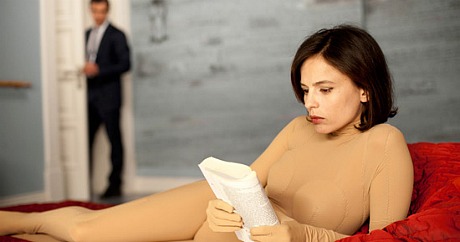
Elena Anaya, Antonio Banderas in The Skin I LIve In.

So…whatever, see it at a midnight screening with a hip gay crowd and prepare for doses of exceedingly dry humor and strange-itude in the general vein of David Cronenberg‘s Dead Ringers and Georges Franju‘s Eyes Without A Face. In a just-up tweet MSN’s James Rocchi has invoked Vertigo…yeah, that works.

For this is a highly perverse and, typical for Pedro, lusciously sensuous film about a mad plastic surgeon (Antonio Banderas) who goes to great lengths to…how to put this? A one-line synopsis I’ve found says it’s about a surgeon “who tries to save the life of his wife by creating a new skin.” Nope, wrong. It’s about Banderas, playing a brilliant Dr. Frankenstein-like sociopath with wealth and elegance to burn, recreating his dead wife and daughter with…well, let’s not say.

But the story is also about rape-payback and revenge and a selfish young hound getting a taste of his own medicine and having the tables turned. That’s vague enough, I think.

Let’s take a wild guess and suppose that straight, hamburger-eating, ESPN-watching guys are not going to beat down the doors to see this. But I like burgers and I had a enjoyable, better-than-okay time with it. It’s a first-class effort, beautifully shot by Jose Luis Alcaine (Volver, Bad Education) and assured and technically spot-on, etc. I’m a devout Pedro guy from way back, but I prefer his more soulful, deep-well stuff.


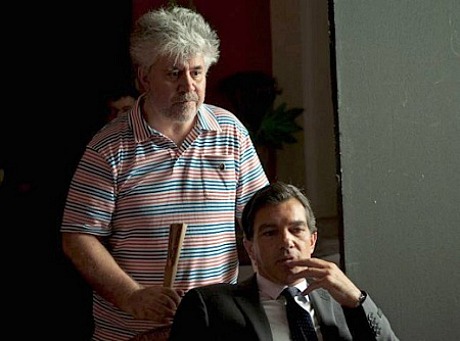
Pedro Almodovar, Antonio Banderas.

Almodovar also said during the press conference that he “was thinking about Fritz Lang” when he wrote the screenplay (which is based upon a book called “Tarantula” by

Thierry Jonquet). He also said he “considered” shooting it as a silent black-and-white film. That probably would have been too on-the-nose.

I had a slight issue about to what degree a person of a certain gender could become as thoroughly transformed as shown in the film, but it’s not worth picking at.

As Robert Ledgard, Banderas has delivered his most striking star-turn performance since “Che” in Evita (which I loved him in) and before that Philadelphia. In the second-lead originally intended for Penelope Cruz, Elena Anaya (Habla con Ella, Sex and Lucia) is fierce and focused as Vera, Banderas’s reconstructed guinea pig and object of desire. Costars Marisa Paredes and Jan Cornet also burn through.

Last Licks

One final full day left before packing it in and flying to Paris. Up at 6:30 am, Pedro Almodovar‘s The Skin That I Live In at 8:30 am, the Pedro press conference at 11 am, writing time, Hogn Sangsoo‘s The Day He Arrives at 2pm, more writing time, back home to pack and write, Nicholas Winding Refn‘s Drive at 7:30 pm and then final composing and clean-up. It’s 12:15 am right now.

Don't Ask


Taken three or four days ago in Salle Debussy.

Tattoo on Lars Von Trier’s right hand. Pic taken by Indiewire contributor Eugene Hernandez.

“Well, you know, Mr. Thompson, you’re pretty young. A fellow will remember a lot of things you wouldn’t think he’d remember. You take me. One day, back in 1896, I was crossing over to Jersey on the ferry, and as we pulled out, there was another ferry pulling in, and on it there was a girl waiting to get off. A white dress she had on. She was carrying a white parasol. I only saw her for one second. She didn’t see me at all, but I’ll bet a month hasn’t gone by since that I haven’t thought of that girl.”

Refn, Gosling, Drive

A couple of hours ago Drive director Nicholas Winding Refn described his film, which costars Ryan Gosling and Carey Mulligan, as a “kind of fantasy” thing that was partly inspired, he said, by the vibe of driving around and listening to great music on the car stereo. He also said that in one sense it’s “almost a John Hughes film.”

That scared the hell out of me. My initial impression had been that Drive is a lean ’70s flick in the vein of Michael Mann‘s Thief featuring a quiet hero in the mold of Steve McQueen, etc. (This was fortified by moderator Trevor Groth, who said he’s seen it, during the discussion.) So I asked Refn what he meant exactly by the dreaded term “John Hughes.”

He basically meant, he said, that Drive, which will have its first Cannes press screening tomorrow night, is a somewhat lighter thing during the first half and then turns into something darker in the second half when Gosling’s character, a stunt driver, “goes a little crazy.” Refn mentioned, I think, Pretty in Pink , but I couldn’t tolerate that notion. (Not Ringwald…no!) So I asked if Drive might perhaps be analogous to Jonathan Demme‘s Something Wild, which definitely does the light-goes-into-darkness thing, and he said yeah, that wasn’t a half-bad analogy.

Refn also said he doesn’t drive, doesn’t have a license, is “car-ophobic” and is terrified of going on Magic Mountain rides. And yet “I like speed,” he said. Go figure.

Really

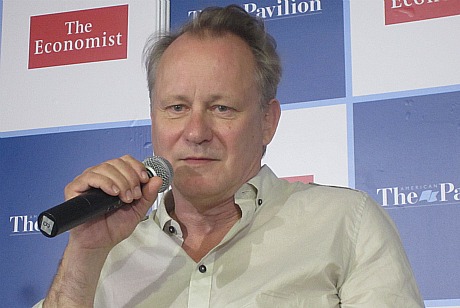
During an American Pavillion q & a this afternoon, I asked Melancholia costar Stellan Skarsgard if anything that indefatigable game-player Lars von Trier said during this morning’s press conference was sincere. Skarsgard said VonTrier was sincere when he said his next film would be a porno, although most likely not with Kirsten Dunst (as the director had playfully implied).


Melanchola costar Stellan Skarsgard at American Pavilion — Wednesday, 5.18, 4:15 pm.

Meanwhile, Sony Classics has announced its North American territory acquisition of Lars von Trier and Martin Scorsese‘s The Five Obstructions: Trier vs. Scorsese. The collaboration doc, modelled on a previous film Von Trier made with director Jorgan Leth, will be about Von Trier giving Scorsese a series of instructions — “cinematic challenges” — in the making of a short film of some kind.

Shut-Out

I tried to see Aki Kaurismaki‘s Le Havre, one of the biggest festival favorites so far and a possible Palme d’Or winner, at a noontime Salle de Soixentieme showing. I didn’t make it in so that’s that. I’ll see it when I see it.

Cheapass

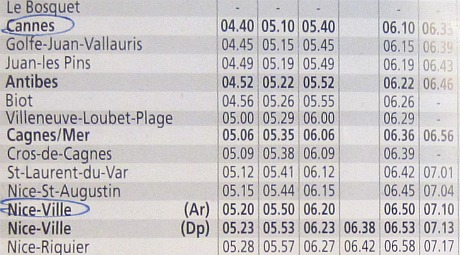
A taxi from Cannes to Nice airport costs a fortune — 70 or 80 euros, or over $100 bills. And there’s something in me that just seethes at this. So my plan on Friday morning is to get up at 4:30 am and catch a 5:40 am train that will get me into “Nice Ville” (i.e., the main “gare”) by 6:20 am. That gives me a comfortable 40 minutes to find a cab and get down to Nice airport by 7 am. My plane for Paris leaves at 8:05 am.

Shoot and Load

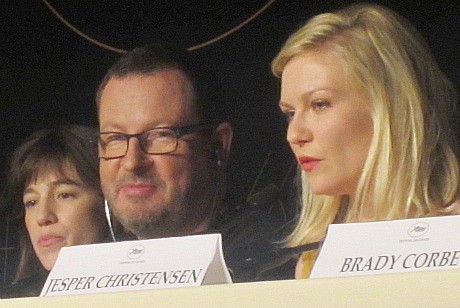
“For a long time I thought I was a Jew and I was happy to be a Jew,” Melancholia director Lars von Trier said this morning, “then I met (In A Better World director) Susanne Bier and I wasn’t so happy. But then I found out I was actually a Nazi. My family were German. And that also gave me some pleasure. What can I say? I understand Hitler…I sympathize with him a bit.”


(l. to r.) Charlotte Gainsbourgh, Lars Von Trier, Kirsten Dunst at this morning’s Melancholia press conference.

“I don’t mean I’m in favor of World War II and I’m not against Jews, not even Susanne Bier. In fact I’m very much in favor of them. All Jews. Well, Israeli is a pain the ass but…now how can I get out of this sentence? Ok. I’m a Nazi.”

Please, please don’t take this guy seriously. Okay, go ahead…what do I care? But he lives to say stuff like this. He’s an artist, a madman…unbalanced. And he loves getting this kind of attention.

Here’s a festival video link.

Update: Von Trier has apologized for his Nazi comments. “If I have hurt someone this morning by the words I said at the press conference, I sincerely apologize,” Von Trier said in a statement. “I am not antisemitic or racially prejudiced in any way, nor am I a Nazi.”

Absence of Leads

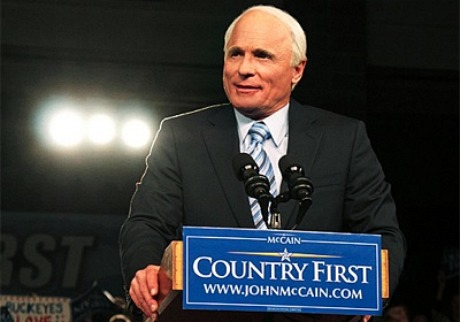
So Ed Harris is going to be a convincing John McCain in Jay Roach‘s Game Change, an adaptation of John Heileman and Mark Halperin‘s book which began filming last month. But am I to presume that the characters of Hillary Clinton or Barack Obama will not be appearing in the film? No actors have been announced as playing these two in press stories.

Is it okay if I say that no-Barack-or-Hillary strikes me as totally whacked? How do you do this film with actors playing McCain and Sarah Palin (i.e., Julianne Moore) and no one playing Obama and Clinton? I read the book and believe me, Obama and Clinton are definitely major characters so what am I missing?

Melancholia

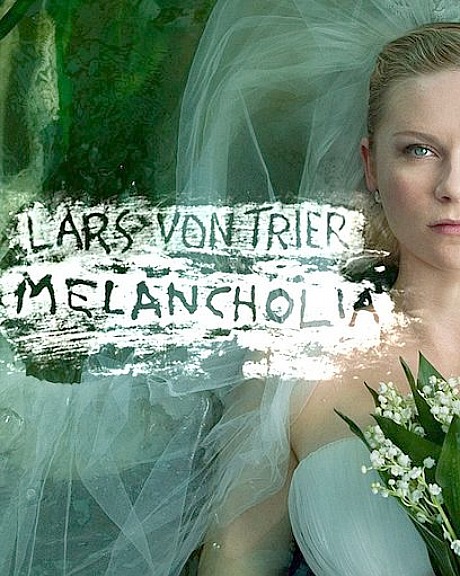
Lars von Trier‘s Melancholia is a morose, meditative in-and-outer that begins stunningly if not ecstatically and concludes…well, as you might expect a film about the end of the world to wrap itself up. Von Trier’s ensemble piece “isn’t about the end of the world but a state of mind,” he said during this morning’s press conference. My thinking exactly.

But Melancholia is a much more striking thing for where it starts and what it attempts than how it plays.

And yet I believe it’s the best…make that the gloomiest, most ambitious and craziest film Kirsten Dunst has ever starred in. Way bolder than Spotless Mind. It’s kind of La Notte-esque, now that I think about it. Dunst pretty much scowls all through Melancholia and does three nude scenes. What I really mean, I suppose, is that she’s never operated in such a dark, fleshy and grandiose realm.

I can understand Cannes critics going “wow!” over the film’s audacity or whatever (the moody-gloomy beauty, the melancholy current), but I can’t honestly see how they could call it a top contender for the Palme d’Or. It’s basically just a stylishly nutso, intriguing, semi-bombastic ensemble piece about despair in the face of eventual ruination. You know…the kind of thing that most HE readers have in their heads each and every day.

I felt elation only in the very beginning, and somewhat at the very end. But otherwise it mostly felt like a meditative slog. It’s not without its intrigues but lacking tension and a through-line and a story, really, of any kind. I don’t imagine this film will be embraced by pro-family Christian groups, or even the rightwing end-of-days crowd (although…naah, forget it).

I tried to ask Von Trier what the F-U-C-K tattoo on his right-hand fingers was about. A tribute to sensual joysex? The middle word in life? A nihilistic fuck-off statement? But press conference moderator Henri Behar didn’t pick me.

After the stunning, tableau-like, slow-motion opening, a brief impressionistic symphony, Melancholia gets down to basic business. Situation, circumstance, character, mood.

Justine (Dunst) is getting married to Michael (Alexander Skarsgard) and her control-freak sister Claire (Charlotte Gainsbourg) has orchestrated the wedding with husband Keifer Sutherland‘s money, and not the funds of Dunst’s father (John Hurt). Charlotte Rampling has a couple of scenes as Dunst’s blunt, cynical mom.

But right after the wedding Justine (allegedly based on Von Trier himself) slips into gloom-head nihilism and suddenly stops being attentive to Skarsgaard and starts meandering and moping around and fucking some guy (Brady Corbet) she barely knows near a golf course sandtrap.

Did I mention that the Earth is apparently on some kind of collision course with a planet called Melancholia, which has recently emerged from behind the sun? And that no one turns on a TV news station throughout the whole film, and that Gainsbourgh goes online only once?

The movie is never “boring” but only rarely gripping. It’s Von Trier, after all, but when all is said and done it’s basically a downhill swamp-trudge with tiny little pop-throughs from time to time.

There’s an overhead tracking shot of two horseback riders galloping down a trail during a foggy morning that’s heartstoppingly beautiful. That plus the beginning I will never, ever forget.

Melancholia is definitely better than Von Trier’s Antichrist — I’ll definitely give it that. Death dance, death art…when worlds collide. Von Trier had a mildly intriguing idea here but didn’t know what to do with it, or he perhaps didn’t care to try. All he does is riff about how tradition and togetherness are over and very few of us care. My sense is that Von Trier experimented and jazz-riffed his way through most of the filming.

All I know is that I feel the way Dunst’s Justine feels during most of the film, and I’m not dealing with the end of the world. Vaguely scared, unsettled…something’s coming.

Forget Von Trier’s Nazi remarks during the press conference. He’s turned into a very dry and clumsy kidder. Nothing is even half-sincere — absurdist put-on all the way.

“My next film…and Kirsten demanded it…will be a porn film,” Von Trier said at one point. “That’s how women are. Really hard-core. That’s what I’m writing now.”