Last night Variety‘s Jeff Sneiderreported that The Hangover Part II director Todd Phillips has cut Liam Neeson‘s cameo (i.e., the one that Mel Gibson was going to play until the cast revolted) because the scene had to be rewritten, and so he re-shot it with Nick Cassevetes because Neeson was in London shooting Clash of the Titans 2…another paycheck.
I’ve read the story three times and don’t understand what the big deal is. People who passed it along were saying”uh-oh,” “this one looks sticky” and so on. Maybe…but the only problem with this film (Warner Bros., 5.26), I’m told, is that it’s just a Bangkok version of the first one.
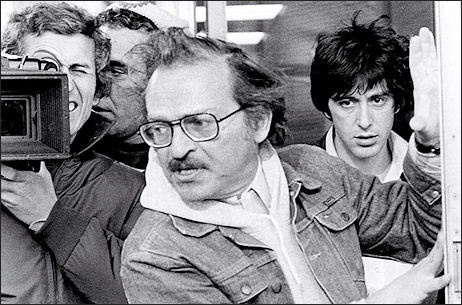
The great Sidney Lumet — a gifted and tenacious explorer of urban crime-and-punishment realms, and easily the most New York City-steeped director of the 20th and early 21st Century — died this morning in Manhattan at age 86. This is a tough one for me. All my adult life I’ve felt a special kinship with Lumet, who not only understood good gritty drama but especially (given my New Jersey, Connecticut and Manhattan background) what it is to grapple with and bathe in New York City moods, currents, aromas and atmospheres.
Sidney Lumet on set of Dog Day Afternoon with Al Pacino.
Armond White used to trash Lumet, but what a boxer he was! A fast shooter who portrayed the moralistic urban landscape like few others, and what a great finale to a long and storied career that two of Lumet’s best films — Find Me Guilty and Before the Devil Knows You’re Dead — were his last two, released in ’06 and ’07 when he was 82 and 83.
What can you say about a guy who directed 12 Angry Men (’57), The Fugitive Kind (’59), A View From The Bridge (’61), Long Day’s Journey Into Night (’62), The Pawnbroker (’63), Fail-Safe (’64 — eclipsed by Dr. Strangelove but certainly an above-average nuclear-war thriller), Last of the Mobile Hot-Shots (’70 — noteworthy for including the first unmistakable off-screen blowjob in motion picture history, and an inter-racial one at that), Serpico (’73 — a legendary Al Pacino performance in Lumet’s first seriously-steeped-in-New York’s-law-and-order-culture film), Dog Day Afternoon (’75), Network (’76), Just Tell me What You Want (’80 — a personal guilty pleasure), Prince of the City (’81), The Verdict (’82), The Morning After (’86), Q & A (’90 — a memorable scuzzy-grizzled Nick Nolte performance), Find Me Guilty and Before The Devil Knows You’re Dead.
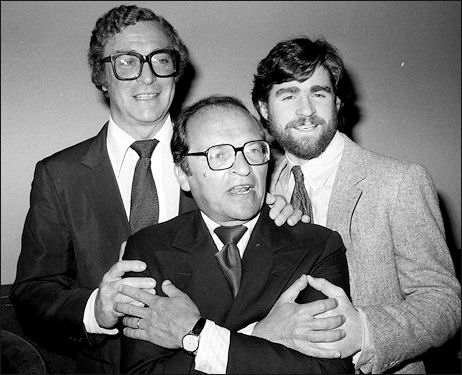
Michael Caine, Lumet, Treat Williams — sometime around ’81 or thereabouts.
The late ’50s and early ’60s were Lumet’s break-out years, and then he really roared into his prime in the ’70s and early ’80s — five classics in an eight-year period. He held on with distinction in the late ’80s and early ’90s, kind of went into a slumber mode for a decade or so and then flared back into action with his final two films.
To me Lumet’s masterpiece is Prince of the City (’81) — a nearly three-hour-long drama about the morality of finking out your friends in order to find your morality, and entirely about New York cops and mob guys and district attorneys and junkies, most of it set in the offices of this or that prosecutor with guys dressed in suits and shirtsleeves with cold takeout food and tepid coffee on the desk. For 30 years I’ve worshipped and fed off memories of Jerry Orbach ‘s performance as Gus Levy in that film.
Here’s a Lumet interview I did in Toronto four years ago, primarily discussing Devil but also Guilty.
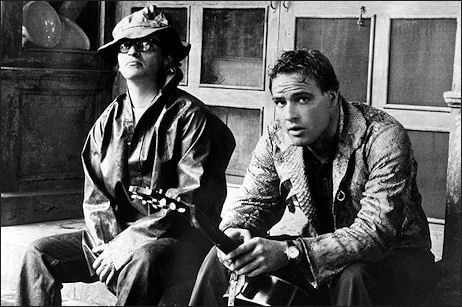
Lumet, Marlon Brando on the set of The Fugitive Kind (’60).
In their 4.7 N.Y. Times profile of IDPR‘s Kelly Bush, Michael Cieply and Brooks Barnes run an observation about Bush from Extra‘s Lisa Gregorisch: “A lot of publicists still see their job as blocking the press — when you call they either run for the hills or lie — and Kelly is smart enough, in the age of the internet, to know that never works.”
And thank God for that. Many publicists, in fact, are far more accessible and conversant and generally more pleasant these days than they used to be. Or so it seems. I am too, I suppose.
Back in the bad old pre-internet days of the early ’90s, when I was reporting and writing for Entertainment Weekly, and also during my mid to late ’90s reporting work for People and the L.A. Times Syndicate, 50% of my calls took several hours to be returned, and 80% of my conversations with publicists involved getting lied to or fielding half-truths that were meant to confuse or throw me off the track. Not to mention outright blocking, complaining calls to my bosses or assignment editors, etc.
It was awful. Each day was like going into combat. I felt at times as if I needed therapy to deal with it.
I’m sure that many publicists felt the same way about me and my inquiries, but I had a job to do and it was tough to keep things on a lah-lah basis. Some EW stories back then were about bringing up and writing about subjects or angles that publicists (especially personal publicists) believed would hurt or compromise their clients in some way, and it was no picnic. And sometimes the stiff-arming and stonewalling was nonsensical. And petty. I don’t want to think about it. A lot of unpleasant memories are rushing back into my head.
Why are things less strident and combative now? Because I’m not spending a lot of time making investigative calls and doing tough, shoe-leather entertainment reporting these days. HE is an opinion-and-attitude column with hindsight-and-perspective plus links-and-riffs-on-other-articles-and-reviews. I’ll chase stuff down from time to time but it’s not the same game.
2011 is over 25% gone, and so far there have been eight winners. Which, if any, will figure on ten-best lists nine months from now? Win Win, I’m thinking. What have I omitted?
HE’s best so far, in this order: Win Win, Hanna, Source Code, Cedar Rapids, In A Better World, Super, Applause and The Lincoln Lawyer.
Good, Okay, Approved: Rango, The Housemaid, Meet Monica Valour, Making The Boys (doc about Mart Crowley and The Boys in the Band), Insidious, The Last Lions.
Respectable But Doesn’t Get There: The Way Back, The Adjustment Bureau, Jane Eyre, The Dilemma, The Company Men, White Irish Drinkers.
Underbaked, Less is Less, Insufficient: Meek’s Cutoff, Certified Copy, Rubber, Ceremony, Hall Pass.
Worst (lowest-rated listed first): Your Highness, Sucker Punch, Paul, The Green Hornet, Battle: Los Angeles, Arthur, Miral, Cat Run.
Haven’t Seen ‘Em: Soul Surfer, Henry’s Crime, Blank City, Cold Weather.

Charles Martin Smith‘s Dolphin Tale (Warner Bros., 9.23) is a true-life saga of a wounded dolphin who’d lost his tail in a crab trap, and who was rescued and given a prosthetic replacement. I’m a softie for dolphin movies as long as they’re not Flipper-related. I saw The Cove three or four times, of course. I even accepted the sentimentality in Mike Nichols‘ The Day of the Dolphin. This one looks a little obvious.
Nathan Gamble plays the proverbial cute kid who bonds with the dolphin (who came to be called Winter) early on, and Ashley Judd plays his mom. Harry Connick Jr plays a vet who rescues Winter and brings her to the Clearwater Marine Aquarium. Morgan Freeman is a doctor who helps a prosthetic limb, etc. Presumably shot (and not just processed) in 3D.
You’re making an arduous journey across the arid eastern Oregon plains in 1845, and there’s reason to be worried about available water and therefore survival itself. Bruising, punishing, chilling…no picnic. And then an oblique sense of salvation when you come upon a half-dead, spread-out pine tree — an indicator of underground water and more greenery to come. And so you stop your wagons and walk over to savor its aroma and shade, and to generally take comfort.
And you say to yourself, “I don’t know what the hell movies are because they won’t be invented fer another 50 or 60 years, but if someone ever makes a movie about what we’ve just gone through, I sure as hell hope he or she decides to end it with somethin’ better than discovering a damn tree. I mean, I’m happy now, standing under it and smelling the pine needles and all, but we’ve been telling each other campfire stories all during our journey and we know a little somethin’ about what makes a good yarn, and I’m just being honest here — the sight of a tree is what it is, but it ain’t that profound. I ‘spect some folks who pay to see the movie might feel a bit cheated. I’m jes sayin’.”
Flash forward 165 years to Meek’s Cutoff, a critically respected but deathly dull movie about this journey by director Kelly Reichardt. Her film is spare, austere, quiet, observant and highly realistic in conveying the boredom and tedium of such a trip. It’s not uninteresting, but Reichardt isn’t much into crackerjack engagement by hook or crook. She’s trying to convey more by doing and showing less, but at the very end I said to myself, “That’s it?”
The three strongest characters are Meek (an all but unrecognizable Bruce Greenwood), a bearded, buckskinned, Buffalo Bill-like racist blowhard who doesn’t know all that much about guiding a small wagon train along the Oregon trail; Emily Tetherow (Michelle Williams), one of the three wives on the journey who distrusts and dislikes Meek for obvious reasons; and a bare-backed Native American (Rod Rondeaux) who is captured by Meek and then goaded into leading the wagons to water and green pastures, and who gradually turns out, as you might reasonably expect, to be a strong, decent and even compassionate fellow.
But Reichardt is one of those thoughtful, spiritual, let-well-enough-alone filmmakers who never seem interested in stories with any real bite or snap or strong flavor. She seems to believe in letting her audience sift through raw untreated story material and do the refining as they see fit. All I know is, Meek’s Cutoff trudges along in this fashion and is more than content to take its sweet-ass time because (and I’m not saying this in a snide or smart-ass way) there’s plenty to digest and consider if you’re inclined to think it through. Don’t get me wrong — supplying interesting rudimentary material by way of character and circumstance is one mark of a respectable filmmaker. But after a while you’re saying to yourself, “This is too slow and uneventful.” Because it is.
In a sense Meek’s Cutoff is about Reichardt-the-director looking for a special kind of water — the kind that pays off and satisfies and makes a journey feel like it was well worth taking — and never quite finding it, and staying with the search as the film ends. Walkin’ with hats and bonnets and flintlocks, big-horn oxen, lookin’ for water, runnin’ low on water, parakeet in a cage, establishin’ a relationship with that weird Indian feller, allowin’ a wagon to crash at the bottom of a hill (totalled) and then discoverin’ that pine tree already.
This?
I feel it’s a little dishonest and more than a little inconsiderate for critics to have given this film a glowing pass (as many have — Meek’s Cutoff has an 85% and 86% rating on Rotten Tomatoes and Metacritic, respectively) without plainly explaining, as I’ve tried to do, what it’s like to actually sit in a seat and watch it. The thumbs-up reviews I’ve read are primarily about what the critics got from it in their own heads, and not what the movie is actually putting out as you sit there. It’s realistic and atmospherically moody and dispenses solid-fibre material but you have to do the work, and Joe and Jane Popcorn are used to be being spoon-fed, for the most part. I think they’re going to be pissed and sighing with frustration.
Critics have an obligation, I feel, to at least acknowledge the Joe-and-Jane element. I think it’s a form of lying when you’re writing about a film to say, “Joe and Jane who? I don’t know who they are and I don’t want to know.”
The performances are pretty much flawless by the rules and temp that Reichardt establishes early on. Cheers for Williams, Rondeaux, Greenwood, Will Patton, Zoe Kazan, Paul Dano, Shirley Henderson, Neal Huff and Tommy Nelson.
Honestly? My favorite thing about Meek’s Cutoff is the fact that it was shot and projected at 1.33 to 1. The last commercially viewable film to be shot in this fashion was, I think, Gus Van Sant‘s Last Days. Update: MSN’s Glenn Kenny has reminded that Andrea Arnold‘s Fish Tank is the most recent feature to go all boxy.
Update: I was mistaken about Kelly Reichardt being from or a resident of Oregon. Haste makes mistakes. She was born and raised in Florida and she now resides in New York where she teaches at Bard College.
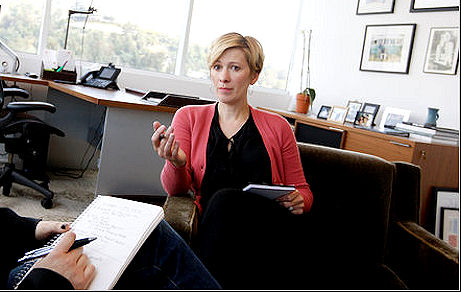
Dawn Hudson can thank the debacle of the James Franco-Anne Hathaway Oscar telecast for her new job as CEO of the Academy of Motion Picture Arts and Sciences. Otherwise the change-averse board of governors would have probably given the gig to status-quo functionary Ric Robertson, and the show would have probably continued its gradual slide into cultural irrelevance. Robertson has accepted what some are calling a humiliating second-in-command COO position under Hudson.
(l.) Dawn Hudson; (r.) Ric Robertson.
As one who feeds at the AMPAS/Oscar trough, I’m somewhat encouraged by Hudson’s appointment. Her years as exec director of FIND/Film Independent indicated a somewhat nervier, spritzier approach to running a film organization, certainly more so than outgoing AMPAS CEO Bruce Davis. Hudson isn’t a magician, but once she gets past the ritual of soothing Academy elders by demonstrating her allegiance to tradition, she may become a force for changing AMPAS into a somewhat less ossified oufit, and the Oscar telecast into a semi-vibrant, somewhat more connected event than it seems to be now. Maybe.
Who will get Hudson’s job at FIND? Senior director Sean McManus, festival director Rebecca Yeldham, etc.? I’m asking.
I can’t help but flinch and scowl when I hear/see Republican legislators with a Southern accent recite their rhetorical blah-blah on a news show. Do these guys exaggerate their yokel patter in order to project more of a country-ish, Tea Party-appealing persona? This plus their corporate-serving views…God.
The main barrier preventing a budget=cut agreement between the Obama administration and Republicans is reportedly over a “rider” that would completely defund Planned Parenthood — a culture-war sop to hinterland primitives because PP advises and assists in abortions.
Originally posted on 3.13, re-posted for current NY and LA openings: Super is partly a dark and bracing satire of superhero movies, partly a withering “eff you” to T-shirted ComicCon culture dweebs who live for superhero fantasies, and partly a violent, surreal-ish Troma comedy. However you want to slice it, it is not selling the same old bilge about a lonely neurotic dork finding transcendence and salvation by adopting a super alter-identity and kicking criminal ass and getting the girl of his dreams, etc.
The fact that it’s dopey-funny in a dry and anarchic way doesn’t change the fact that Super is, deep down, a rather harsh and unsparing portrait of marginally sociopathic comic-book readers-and-dreamers (as represented by Rainn Wilson and Ellen Page‘s characters) who are so full of rage and caught up in absolutist fantasy themes that they can’t really process reality, and who hand out severe bloody beatings in an oddly giddy but mean-spirited way.
James Gunn‘s movie, which also delivers sincere-anguished-weeping and praying-to-God scenes, is really quite the original thing. By my standards Super is way, way better than Kick-Ass because the latter was made with an underlying affection for superhero movies & mythology while Super mostly feels contempt for it. It’s the closet approximation I’ve ever seen of my own view of superhero films and fans of same. I now have another fantasy to resort to apart from my dream of strafing the ComicCon faithful in San Diego in an F-14 Tomcat.
It’s about a glum short-order cook (Wilson) who decides to become a vigilante superhero called The Crimson Bolt after his unstable former-addict wife (Liv Tyler) succumbs to the temptations of a of a local drug dealer (Kevin Bacon). Wilson soon after partners with a hyper, semi-delusional comic-store clerk (Page) who dress up in yellow and green outfit and calls herself Boltie.
It never occurs to Wilson and Page that the kind of justice and punishment they mete out to lawbreakers and selfish ne’er do wells is just as bad and dangerous and socially threatening as anything that riled them up in the first place. When Wilson gets into fights he clubs his adversaries with a wrench, crunching skulls and splattering blood and sending them to intensive-care wards, and Page’s delight and ecstasy when she delivers similar-type woundings is both hilarious and appalling. She’s really quite the loony firecracker in this film — it’s a wicked, super-spirited, no-holds-barred performance.
JoBlo’s Chris Bumbraywrote last September that Wilson and Page’s third-act assault on Bacon’s headquarters “is almost like the superhero equivalent of Taxi Driver” which was precisely my thinking as I watched it last night. In part because I never believed in Taxi Driver‘s post-shoot-out aftermath of Travis Bickle being called a hero in N.Y. Daily News accounts and receiving a thank-you-for-saving-our-daughter letter from Jodie Foster‘s parents and Cybil Shepherd looking at him admiringly and longingly as he drives her home, etc.
The divorcement from reality was total and absolute in Martin Scorsese‘s epilogue, just as the comprehensions of Wilson’s character in Super are saturated with visions of delusion. Okay, at the very end there’s a glimmer of self-recognition and acceptance of the way things really are, but mostly Wilson is DeNiro’s Bickle and vice versa. An excellent thing, that.
2011 looks like the year that Mixed Martial Arts goes mainstream. We’ve got four MMA movies awaiting release and/or in the pipeline, and that obviously spells a trend. And I’ve never watched a mixed-martial-arts bout in my life. Who does? ESPN mainliners, guys who drink Four malted beverage and watch Mexican wrestling, etc.?
Gavin O’Connor‘s Warrior, which allegedly screened through the roof for exhibitors last week in Las Vegas (and which I briefly mentioned earlier today), is one. Another is Michael Tucker‘s Fightville, which generated good buzz at last month’s South by Southwest (Cinematical‘s Eugene Novikovcalled it “an exhilarating sports documentary and a levelheaded, piercingly intelligent treatment of a touchy subject”). And there’s also Kevin James’ MMA movie for Sony, directed by Frank Coraci (The Wedding Singer, Click, The Waterboy) from a script by Allen Loeb. And of course, Steven Soderbergh‘s long-simmering (some would say endlessly simmering) Haywire.
I completely understand and sympathize with Javier Bardem‘s decision to accept a straight paycheck acting gig (i.e., portraying gunslinger Roland Deschain in a three-part TV mini based on Stephen King‘s The Dark Tower) that’s well beneath his usual aesthetic pay-grade. He’s doing it, almost certainly, to fortify the nest for the sake of his and Penelope Cruz’s recently arrived son Leo. All acting parents do this when a baby comes along — they go for the money and feel just fine about it. Just a fact of life. I’d do the same in his position.