I spoke today with The Princess of Montpensier director-cowriter Bertrand Tavernier at a luncheon thrown on his behalf (and also on behalf of Potiche costars Catherine Deneuve and Judith Godreche) at the Beverly Hills home of the French Consul General. It was my first talent-publicists-and-journalists mixer since arriving in LA a couple of weeks ago, and a pleasant one at that. Thanks to Fredel Pogodin for the invite.
Director Bertrand Tavernier at home of French Consul on Camden Drive in Beverly Hills — Wednesday, 3.9, 1:05 pm.
(l. to r.) Variety‘s Steven Gaydos, TheWrap‘s Sharon Waxman, director Bertrand Tavernier.
It was also good to chat with Princess costar Gaspard Ulliel, who’s only four and five years older, respectively, than my sons Jett and Dylan. I didn’t dare say anything to Deneuve as she can be withering (and because I haven’t seen Potiche). I also spoke with Variety‘s Steven Gaydos, TheWrap‘s Sharon Waxman and Hollywood Reporter‘s Merle Ginsberg.
After sharing the many things I enjoyed and admired about The Princess of Montpensier, Tavernier told me that his reps are starting to shop a “films of my life” documentary along the lines of Martin Scorsese‘s A Personal Journey Through American Movies and My Voyage to Italy. Tavernier is, of course, as much of a devoted and super-knowledgable buff as Scorsese, so a doc of this type, which he said would focus on his many influences within the realm of French cinema as well as beyond, would be absolutely priceless and essential to own.
I also enjoyed speaking with him about the realistic battle and sword-fighting scenes in The Princess of Montpensier, and his decision not to use CG or to indulge in hyper-cutting (in fact to keep cutting to a minimum) in order to allow the audience to actually comprehend the geography and choreography…amazing.
I’ve finally seen Bertrand Tavernier‘s The Princess of Montpensier (IFC Films, 4.15 in theatres, 4.20 on demand) after missing it at last year’s Cannes Film Festival. The initial response was not wildly enthusiastic, so I was rather surprised to find that this historical drama of intimacy, set in 16th Century France during the Catholic vs. Huguenot wars, is one of the most intriguing erotic trips I’ve taken in a long while.
Partly because the occasionally undressed lead, Melanie Thierry, performs in a way that feels rather prim and Grace Kelly-ish, an all-but-extinct vibe or romantic brand in films today. But mostly because the movie is mostly about unrequited desire and hardly at all about consummation. It’s probably not bawdy or obvious enough for most viewers, but I felt and believed this film without the slightest discomfort, and I never wanted to turn it off or multitask as I watched.
The story is basically about four or five guys who can think of little else but having Thierry, and who spend most of their screen time being told “if only,” “no,” “now now,” “yes but” and so on. I only know that the combination of Thierry, the feeling of sensual restraint or suppression, and the generally realistic and non-movieish atmosphere created by Tavernier and his team (including some excellent hand-to-hand combat and duelling scenes) feels right and believable and on-the-money.
It’s delightful when a film drops you into an exotic time-trip visitation without making this world seem arch or “performed” or overly prettified or set-decorated within an inch of its life. I’ve never thought of Tavernier as a director who excels or even cares about violent action and/or mercury-popping eroticism, but maybe I need to go back to watch some of his films.
I didn’t expect to say this, but I felt as stirred and satisfied and convinced by The Princess of Montpensier as I was by Andrzej Wajda‘s Danton (’83), a superb historical drama about the post-revolutionary “terror.”
To judge by this review of Red Riding Hood, the not-very well known bloggers B. Fatt & Lazy are coarse and sexually frustrated GenX animals — one of the many confirmations of the devolution of film criticism and the human species as a whole. But they know how to write fairly well, and they’re blunt and “funny.” A voice is telling me I shouldn’t flatter them further, but another voice is saying that films like Red Riding Hood (Warner Bros., 3.11) were made for guys like B. Fatt & Lazy to rip into.
This isn’t to say their pan is necessarily correct. It’s hard to accept that Red Riding Hood is compete merd with the generally respected Catherine Hardwicke (Thirteen, Twilight, Lords of Dogtown) having directed. I’m telling myself there has to be more to Red Riding Hood than what these guys have indicated.
Surreptitiously videotaped comments by senior NPR exec Ron Schiller that described Tea Party faithfuls in blunt but — let’s be honest — more-or-less accurate terms has led to his dismissal along with the resignation of NPR president and CEO Vivian Schiller (i.e., no relation). The male Schiller was recorded saying that Tea Party-ers are “weirdly evangelical…white, middle America, gun-toting….seriously racist, racist people.”
Gaffes are called gaffes not because they’re untrue, but because they’ve been spoken in the wrong mixed company and deemed impolitic or insensitive.
Tree of Life visual effects supervisor Dan Glass has spoken to Trevor Hogg of Little White Lies and said the following: “I can confirm that there are dinosaurs [in the film].” The guy who actually delivered the beasts was Mike Fink of Frantic Films, although Bryan Hirota of Prime Focus reportedly worked on the dinos for several months before that.
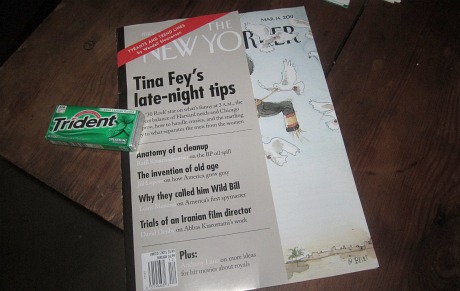
On the way back from this evening’s Battle: Los Angeles screening I stopped by the newstand on Robertson between Wilshire and Olympic. The latest New Yorker plus a pack of Trident, the guy said, would be $8 and change. Something snapped like a twig. “Eight dollars for a magazine and a pack of gum,” I said with a tone of resignation. He laughed. I’m not likely to submit again.
“Elektra Luxx is a cartoon — it’s shot in vivid candy colors — yet it’s not wholly cartoonish,” writesMovieline critic Stephanie Zacharek. “[Director Sebastian] Gutierrez isn’t out to make any serious pronouncements about the porn industry. But he’s not looking down on his subject, either. The picture is rambunctiously affectionate; Guiterrez may go for the broad joke, but never the cheap one.”
Two years ago I saw Guiterrez’s Women in Trouble, which, like Elektra Luxx, also toplined Carla Gugino. It wasn’t offensively bad, but it certainly wasn’t any kind of grade-A (or grade B) experience. The other thing to keep in mind is that there’s something about the porn industry (as a subject, vibe or attitude) that almost always stinks up the place. Except when the director is Pedro Almodovar, whom Guiterrez would like to be as good as.
All my life I’ve managed to avoid reading Charlotte Bronte‘s “Jane Eyre“, but I’m going to dash through it this weekend to see if the book, published in 1847, is as morose and chilly and constipated as all the various film adaptations have been. I’m 98% sure that it is, but I want to be able to say that I’ve absorbed it first-hand.
I saw Cary Fukunaga‘s Jane Eyre (Focus Features, 3.11) last night, and it’s full of authentic, high-toned period highs. All the performances (including those from costars Jamie Bell, Judi Dench and Sally Hawkins) seem perfectly aged and restrained in just the right way. And hail to all the other 19th Century downer elements. Everything is exquisitely in place, whipsmart and oh-so-carefully rendered.
But the fretfulness…my God! Jane Eyre is like an Oxford Film Festival mood pocket times ten. It’s like a tattered flag rippling in an early March wind on an English moor. Come to us, all ye educated women of a certain age seeking a Bronte fix! We will envelope you in bonnets and lace and corsets and repression and misery, and make you feel like you’re really and truly stuck in olde country-manor England, full of feeling but afraid to speak of it, much less act. We will saturate you with emotions so damp and muffled that you’ll plotz.
Jane Eyre is so convincing and persuasive in this regard that it made me depressed about my own life, and I’m feeling fine these days.
I wanted to leave about 45 minutes in, but I held fast. One reason was that I didn’t want Wall Street Journal critic Joe “JoMo” Morgenstern, who was sitting in the last row, to see me leaving lest he regard me as lacking in patience and literary couth. But I thought about it being over and being released and the coming joys of getting into the car and driving east to Amoeba Records. In fact, I’ve never been so in love with the Amoeba experience as I was last night at the Clarity screening room.
The best thing about Jane Eyre is Michael Fassbender‘s performance as Edward Rochester. The truth is that he’s been disappointing me in ways modest and small since Hunger, but here he shows his earnest, slightly mad Laurence Olivier chops. Every line he speaks is sharp and grave with a river churning beneath it, and I was especially pleased by that I understood each and every word. Why did this provide particular comfort? Because most of the time I couldn’t understand what Fassbender’s costar, Mia Wasikowska, who plays Jane Eyre, was saying at all.
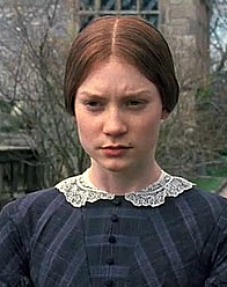
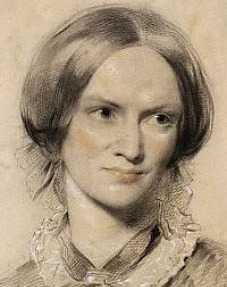
(l.) Mia Wasikowska as Jane Eyre; (r.) Charlotte Bronte.
I’m serious. Wasikowska’s eyes are haunted and piercing, and her Jane Eyre face has that silently-suffering quality that the story requires, but her British accent is so….it’s hard to describe but so precociously affected and her delivery is so breathy and trembling and tremulous that I got the gist of what she was saying only occasionally. Most of the time I couldn’t figure what her phrases and/or sentences were conveying at all. Okay, now and then, but it got to the point that I stopped trying to understand her thoughts and started grasping at words.
There’s something opaque and bland about Wasikowska’s face when she’s not turning on the current. I’ve never understood why so many filmmakers are so taken with her because of this. She looks glum and bothered all the time, and in this context her face (which has a sort of Eastern European quality, as suggested by her last name) doesn’t have a genetically English appearance. Jane Eyre is supposed to be plain-looking so that fits, but consider the above drawing of Charlotte Bronte — now that’s a face! That discerning half-scowl…magnificent! And she actually looks like a Brit.
I’ve always been afraid of what the Bronte sisters (Charlotte’s sister Emily wrote Wuthering Heights) might do to my mood if I sat down and actually “let them in,” to so speak.
Didn’t the original Cars (’06) become something of an unmentionable, not just in the general animated realm but also in Pixar circles? I look at this thing and I want to take gas.
Attention must be paid to the just-posted words of HitFix‘s Drew McWeeny: “The ugly truth is that the industry is chasing a fanboy audience that perhaps they need to stop chasing. I spent so many years at AICN complaining that no one was making films that catered to my interests, and now I find myself thinking that perhaps I don’t need to be catered to in quite so naked and craven a fashion.” Bravo! Especially coming from McWeeny, who, let’s not forget, wet himself over Sherlock Holmes.
“I would happily give up the non-stop barrage of superhero films and fanboy ‘favorites’ if it meant there was room for real innovation and a wider array of voices in studio filmmaking. There is a fine line between serving an audience and shamelessly pandering to them, and when the studios decide to go whole-hog and pander without hesitation, and the result is box-office failure after box-office failure, the message seems clear: chasing the fanboys isn’t working. They are unreliable, they are ungrateful, and they aren’t turning out for the ‘sure things’ that have been greenlit specifically for them.”