Ninth-Inning Diss

The King’s Speech “is basically a film about what positively smashing folks the royals are,” Joe Queenan wrote two days ago in The Wall Street Journal. “It’s a film that’s infatuated by those awfully swell people up at Balmoral who wear kilts and shoot foxes. Americans used to turn up their noses at this sort of stuff. But that was before Upstairs, Downstairs and Merchant & Ivory intoxicated the entire republic with the rustle of crinoline and the shimmer of lace.

The King’s Speech is not, after all, a film about a Welsh coal miner who overcomes a speech impediment. It is not a film about an Aussie doughboy trapped on the beach at Gallipoli who overcomes a speech impediment. It is a film about spiffing chaps and the spiffing folks who help them to be even more spiffing.”

Worst Title Sequences

Only one of the opening-credit sequences mentioned in Alice Rawsthorn‘s 2.21 N.Y. Times piece (“If There Were An Oscar For Film Titles”) stirred my interest: Neil Kellerhouse‘s for The Social Network. “[The] idea was for the titles to be totally unobtrusive…it was literally a case of how small can we make the type,” Kellerhouse explains. Which I liked enormously. It established the brisk, dry tone of the film in just the right way.

Sooner or later all discussions of main-title sequences end up mentioning (i.e., defaulting to) Saul Bass. There’s no getting around the guy. Lord knows I’ve written plenty about his ’50s and ’60s work. I can write about the main-title sequence of The Man With The Golden Arm all day along. So let’s give it a rest this time and consider…I don’t know, how about the absolute worst title sequences of all time?

The worst are always primarily interested in calling attention to their cleverness or cuteness or flashiness rather than conveying some mixture of mood and metaphor about the film itself.

One of the most irritating, I feel, is the pompous and obnoxious blue-laser-flash sequence that opens Richard Donner‘s Superman: The Movie (’78). The guy who designed it obviously fell in love with the idea of turning each and every major name connected to the film into a hissing fantabulous cosmic light show. It quickly becomes tiresome, and then irksome, and then rancid. Mainly because the sequence goes on forever. By the time the film is about to start, you’re almost ready to leave.

The absolute worst, however, didn’t use any titles it all. The film was Robert Moore‘s The Cheap Detective, a 1978 spoof of Humphrey Bogart-in-a-trench-coat films, and it opened with either star Peter Falk (or so I recall) speaking the titles directly into the camera lens with a sassy Sam Spade tone of voice. I was sitting there aghast, wondering if he was going to mention the gaffer and the best boy.

Another groaner is the cartoony credit sequence for Steven Spielberg‘s Catch Me If You Can. It was all about underlining how clever and entertaining the person who thought it up was. It was actually a kind of omen. It said “beware…a spirited movie that Spielberg had a grand time making but which you’ll never be able to quite believe is about to begin.”

Warm-up Phase

Years later, I’ve often found that my favorite parts of the best films are the earlyish portions. Late in the first act, say, before anyone has acted decisively (or tragically) and cast their lot. The good-to-go, pure-enjoyment cruising section.

[Filed from Delta flight #165, somewhere above New Mexico.]

Alamo Defenders Better Than Mexican Attackers

As I understand it (and please correct if I’m wrong), Guardian film editor Andrew Pulver isn’t predicting a Social Network Best Picture win — he’s simply saying it should win. “A superb piece of filmmaking in every respect,” they declare in one passage, “[and] probably the first important movie that could only have been made in this century. It brings a sharp eye and a critical intelligence to bear upon a remarkable phenomenon without appearing either dazzled by youth or querulously fogeyish.”

[Filed from Delta flight #165, somewhere above Arkansas.]

Great Refusal

Sasha Stone‘s Awards Daily Oscar prediction chart is up, and I must say again that it’s incredibly heartwarming to know that six pundits have joined me (or I them) in predicting a Social Network Best Picture win. It’s one thing to deny reality on your own, but there’s a special feeling of fraternity from being one of seven mule-ish diehards.

Favorite stubbornism: It is a far, far better thing to stand with these few than to join The King’s Speech crowd. 2nd favorite: “No…I cannot!,” said John Foster Dulles when he refused to shake the hand of Zhou Enlai.

[Filed from Delta flight #165, somewhere above Tennessee…I think.]

Give Hesher A Chance

15 months after debuting at the 2010 Sundance Fim Festival, Spencer Susser‘s Hesher will arrive on 4.15.11 via Newmarket Films. And the most arresting thing about the trailer is the revelation that Natalie Portman looks hotter in horn-rimmed glasses than without. The last time this happened was when Marilyn Monroe put on glasses in How To Marry A Millionaire…bingo.

I’m not saying Hesher is another low-budget drama with a slightly brownish-and-bleachy color scheme in the vein of Monogamy, but it does seen to lean in that direction.

Synopsis: “After the tragic loss of his mother, T.J. (Devin Brochu) and his pill popping father (Rainn Wilson) are forced to live with T.J.’s elderly grandmother (Piper Laurie). A young man with a troubled past named Hesher (Joseph Gordon-Levitt) assumes the role as both mentor and tormentor, leading T.J into troubles he could never have imagined. A young grocery clerk named Nicole (Natalie Portman) steps in to protect T.J., and becomes the object of T.J.’s fantasies, while Hesher moves into Grandma’s home. Although uninvited, he is somehow accepted.”

Susser and Hesher are obviously sound-alike names. You don’t suppose…?

[Filed from Delta flight #165, somewhere above Kentucky.]

Gatsby 3D

It’s not clear or proven to me whether Baz Luhrman‘s 3D version of The Great Gatsby, to begin shooting next August in the Sydney area, will ignore the Long Island setting of F. Scott Fitzgerald‘s classic novel, or attempt to simulate it. Either way, I find it oddly appealing that 3D will be used in service of a dialogue-driven, tragic-fancy-pants drama rather than the usual usual.

No Orphan Movies

It’s time to acknowledge a fundamental truth (and okay, perhaps a prejudice) in the wake of yesterday’s news about Paramount’s decision to release Martin Scorsese‘s Hugo Cabret on 11.23. The forthcoming 3D drama has been described as basically another orphan story in the tradition of Oliver Twist, Annie and the Harry Potter films, and I’m telling you right now that movies about orphans have never reached me, much less melted me down.
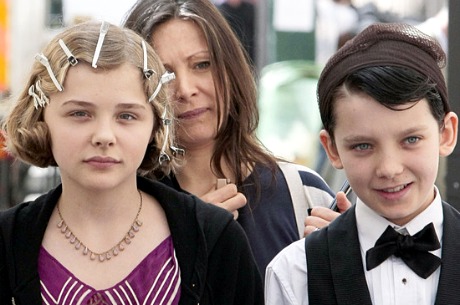

Hugo Cabret costars Chloe Moretz (l.) and Asa Butterfield (r.)

Growing up young and vulnerable without parental support is painful and wounding, but it also toughens and demands invention, adaptation and resourcefulness. I just don’t see it as being that much different than being raised by abusive or alcoholic parents, and it may not be as bad.

Bottom line: Each and every orphan film I can think of has left me cold or not especially moved because orphan movies (except for the Batman‘ pics) are inherently cloying and emotionally manipulative. You could call The Girl With The Dragon Tattoo an orphan film, and that didn’t put the hook in either.

On top of which is a standard Scorsese assessment: the more earnestly emotional the subject matter, the less successful the film. Scorsese is much, much better when he’s dealing in oblique or understated or, best of all, suppressed feeling. Over the last 38 years he’s made exactly two films that have really delivered in terms of upfront emotion — Alice Doesn’t Live Here Any More and The Last Temptation of Christ. He also runs into trouble when he does anything fanciful (like Kundun) or period (The Age of Innocence, The Aviator, Gangs of New York). Protest and stamp your feet all you want, but Scorsese’s home turf has always been (and always will be) contemporary northeastern urban crime movies and/or goombah relationship films. By this assessment his next effort, Silence, is going to be agony.

I’m not dumping on Hugo Cabret (the 3D aspect alone has my interest) but let’s keep expectations in check — that’s all I’m saying. Because (a) orphan movies are, boiled down, the cinematic equivalent of those children-with-big-eyes paintings and (b) Scorsese doesn’t really get “heartfelt.”

Eddie Omen?

Kirk Baxter and Angus Wall‘s editing of The Social Network is so clean, swift and seamless that you could almost overlook it. But of course, the American Cinema Editors didn’t. Last night they gave their big Eddie award to the TSN guys instead of to The King’s Speech‘s Tariq Anwar. Does this mean the Best Picture Oscar tide may be shifting? Doubt it. I think that the editors simply decided that they liked the cutting of The Social Network better than that of The King’s Speech. Nothing beyond that.

At 1:02 am this morning Deadline‘s Pete Hammond ran one of his “did we just feel a small earthquake tremor?” analysis pieces. On the heels of last weekend’s BAFTA editing award win, the Eddie win reps “a big psychological boost” for Team Network, he says. The use of the term “psychological boost” obviously implies a presumption on Hammond’s part that the TSN guys were in a state of psychological slumber and/or resignation prior to the Eddie Win. If Anwar had won last night would Hammond have called this a psychological boost for The King’s Speech?

Hammond then mentions that any film favored to win Best Director, Best Adapted Screenplay and Best Editing Oscars (which Network is almost certain to do) almost always indicates a Best Picture winner unless — this is me talking here — it’s an exceptionally good film that doesn’t deliver in lump-in-the-throat, comfort-blanket terms. (Sample sentiment: “We can’t give an Oscar to a movie about a brilliant but chilly computer dweeb who screws over his best friend.”) Traffic, for example, won Oscars for direction, adapted screenplay and editing 11 years ago but lost the Best Picture Oscar to Gladiator because Traffic didn’t provide huggy-bear assurances.

Oft stated, can’t hurt to repeat: the huggy-bear requirement was apparently set aside over the last four years when The Departed, No Country for Old Men, Slumdog Millionaire and The Hurt Locker won the Best Picture Oscar, but the recent King’s Speech surge indicates that it’s now back in force. Traffic, for example, won Oscars for direction, adapted screenplay and editing 11 years ago but lost the Best Picture Oscar to Gladiator.

On top of which, Hammond reminds, is the tendency of the Academy’s preferential voting system to “favor a consensus film like The King’s Speech,” making it “entirely possible” that “this weird split could be the scenario next Sunday at the Kodak.”

I Get The Willies

I went completely blank — no posts or tweets — yesterday. Mainly due to final packing for today’s 3 pm flight to Los Angeles plus the usual dark-gray-hole effect that accompanies any visit to my mother’s assisted-living-facility in Connecticut. (Don’t ask.) Plus the generally traumatic mindset that always kicks in prior to a cross-country move involving three suitcases. The whole HE operation is shifting back to Los Angeles (cats included) for four to six to eight months, depending on the breaks. Just in time for the last seven days of the 2010/2011 Oscar season. Escaping New York’s winter weather will be very nice, but you have to wonder about the wisdom of a big move in which the only real upside is meteorological.

Settled

Yesterday The Digital Bits’ Bill Hunt reported that Bluray singles of Barry Lyndon and Lolita will be on sale in France, Germany and Denmark in May. If they’re not region-locked, I’ll be buying both in Paris after the Cannes Film Festival.