

Tree of Life star Brad Pitt is quite thoughtful and considerate when it comes to signing autographs. The last time I saw him at the Cannes Film Festival was in ’07, when he was here with the Ocean’s 13 gang. Like today, he signed in the Salon de Presse Conference and then lingered in the lobby doing the same for those who couldn’t get into the q & a. Doesn’t hesitate; always signs.
Rapturous, Undisciplined Visual Poetry
I was standing in the right-rear section of the orchestra when The Tree of Life ended and didn’t even hear the booing, which reportedly came from the upper balcony. In any event I think it’s beastly to boo a film as hauntingly beautiful and immensely ambitious and spiritually directed as this one, and which is so dazzling and transporting during its first half-hour to 40 minutes.
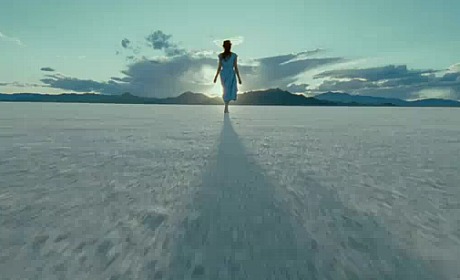
I understand the frustration, mind, because The Tree of Life does lose itself in its own impressionistic quicksand after the first half-hour. It begins to drown, sink, swallow itself. The center cannot hold. But it’s entirely worth seeing (and praising) for the portions that clearly and unmistakably deliver. I’m especially referring to what people will soon be calling the 2001/Douglas Trumbull section. Who in the big-budget realm is even trying to make pure art films like this except Malick?
But over time he’s been given, I feel, a bit too much freedom and time to do whatever he damn well pleases. There’s a part of me that would dearly love to see Malick suffer under a brutal Harry Cohn-like taskmaster producer because as unhappy as that would make him personally, he’d make tougher and more rigorous films.
Malick’s staunchly non-linear, 136-minute poem about beauty and Godliness suppressed and the unfortunate legacy of brutal paternal parenting in the 1950s is a sad and beautiful…wank? The ultimate refutation of narrative? An often captivating but rudderless impressionistic exercise?
Yes, I know I twittered the last passage only minutes after emerging from the theatre, but it came out well and on-target so there.
I understand why distributors and exhibitors were apoplectic about this thing last year. It’s not going to sell a lot of popcorn. Or tickets, for that matter. But fuck those guys. The Tree of Life is, of course, essential viewing if you care at all about movies that aspire to more than showing us Johnny Depp mugging and rolling his eyes and pocketing another paycheck.
You know what? I’m just going to re-run and in some instances re-write my tweets and possibly elaborate here and there:
Tweet #1: “Terrence Malick made The Tree of Life in this free-flowing, free-associative way because he could, because he doesn’t have Bert and Harold Schneider riding his ass in post, and because God told him to…like it or lump it.” That’s pretty much on the money. I adore hundred of things that Malick captured in The Thin Red Line and The New World, but there was more discipline in Days of Heaven because (I’ve read) of Bert and Harold, and Badlands was just as tight.
Tweet #2: “Terrence Malick needs a trainer, a tough collaborator, a friend with a stick. No such luck.This movie is the fault of his many enablers.”
Tweet #3: “The first half-hour of The Tree of Life is magnificent. But then it begins to dissipate because the center cannot hold. Airy fairy.
Tweet #4: “The Tree of Life should have been shorter. It’s the first ten minutes of The Thin Red Line — meditative, jungle-leafy, reptile in water — only set in 1950s suburban Texas” — the film was primarily shot in Smithville, about 40 miles southest of Austin — “rather than an island in the South Pacific.”
Tweet #5: “Shorter Tree of Life: Life sure could be symphonically, heart-stoppingly beautiful if it wasn’t for my hard-ass, totally frustrated, spirit-suffocating dad” — i.e., Brad Pitt’s character. Imagine The Tree of Life without those tree shots, those kick-the-can moments, Jessica Chastain‘s looks of disdain for Brad Pitt, etc.” I can’t. But there are an awful of those tree shots. Scores. This must be acknowledged because I think it’s overdone.
Tweet #5: “Don’t get me wrong — The Tree of Life is, at times, transcendent poetry. I’m glad I saw it, but I’m not sure if I’ll buy/get the Bluray.”
If nothing else The Tree of Life is one prolonged Emanuel Lubezski orgasm. Every shot is captivating, sublime, amazing, heavenly.
I love this passage from Justin Chang‘s Variety review: “[At] roughly 20 minutes in The Tree of Life undergoes arguably the most extreme temporal shift in the history of cinema. Comparisons to 2001: A Space Odyssey are perhaps intended, not least because Stanley Kubrick‘s special-effects creator Douglas Trumbull served as a visual consultant on Malick’s eye-candy evocation of the dawn of time (conceived by several visual-effects houses but designed with minimal reliance on CGI).
“We observe a flurry of awe-inspiring images at astronomical, biological, macro- and microscopic levels: a nebula expanding in outer space; cells multiplying in a frenzy; a school of shimmering jellyfish; darkness illuminated by a volcanic eruption; a bubbling primordial ooze.”
Pitt plays the villain, all right, and delicate, red-haired Jessica Chastain plays his tender, spirited, angel-like wife. Their taxed and tormented son Jack is played an adolescent by Hunter McCracken, and as an adult by Sean Penn (who’s barely in the film, and has maybe five or six lines).
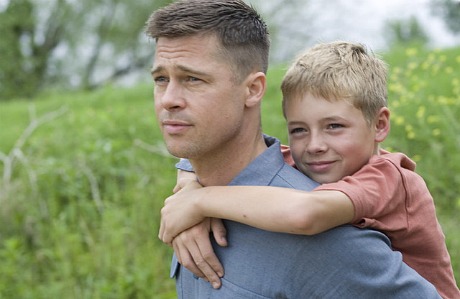
There’s a young blonde kid who plays McCracken’s younger brother, and who resembles Brad Pitt quite unmistakably. It’s almost like he’s Pitt’s actual son, which is all but unheard of in movies. There’s one rule that Hollywood casting agents seem to go by when casting families, and that’s to never, ever allow for the faintest resemblance between on-screen parents and children. On this point alone The Tree of Life deserves high praise.
"That's An Apology"?
Tip of the hat to Slashfilm‘s Peter Sciretta for posting this work-priint version of an alternate ending to Alexander Payne‘s Election, etc. Horrible!
Cards Up
If Terrence Malick could somehow swing it, I’m sure, The Tree of Life wouldn’t be about to screen in 70 minutes’ time. (It’s now 7:20 am.) However good or great or whatever it turns out to be, there’s a certain satisfaction in one of the most prolonged hiding-from-the-world acts in modern cinematic history about to come to an end. I briefly discussed it last night with a friend. Friend: “So how sucky is the Malick going to be, do you think?” Me: “It might not be what some want, but it can’t suck — it’s Malick.”
You Lose
Earlier today I tried to catch a 5:15 pm screening The Snows of Kilimanjaro at the Salle Bazin. This is what I saw when I arrived 15 minutes before showtime. I went to the end of the line and stood and waited and stood and waited. I knew I’d never get a seat but I toughed it out to the end. And then I said “eff it” and got on the train to Juan-les-Pains.
Silver Train
Late this afternoon I took a quick ride between Cannes and Juan-les-Pains, except the train decided not to stop at Juan-les-Pains and dropped me off at Antibes instead. So I impulsively asked Sasha Stone and her daughter Emma to join me there, and we had a pretty good time detoxing and sipping rose and roaming around the marina area and contemplating the Picasso museum exterior.
Antibes
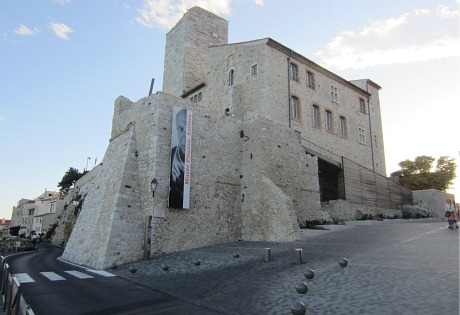
The Picasso museum in Antibes, which is about a half-hour east of Cannes by local roads.
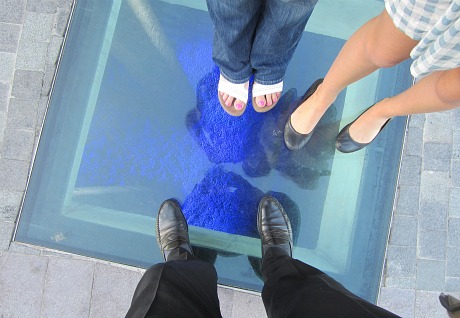
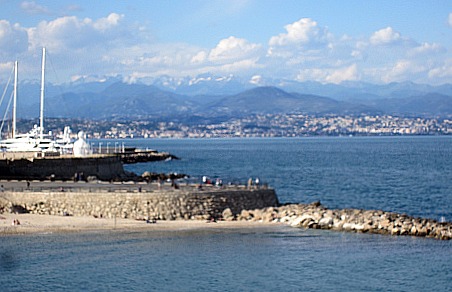
Looking east toward Nice — Sunday, 5.15, 7:20 pm.
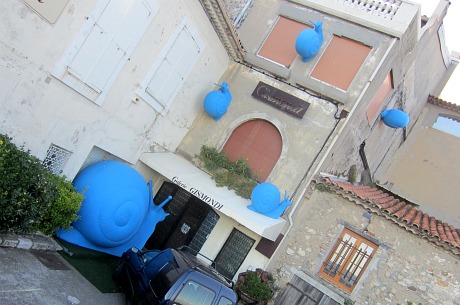
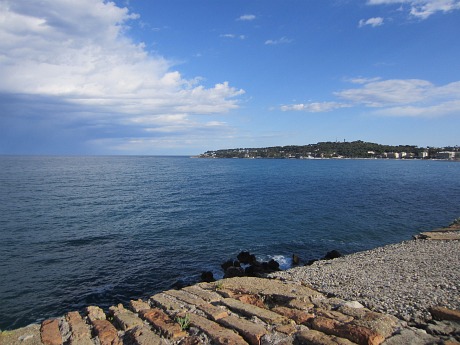
Reasons Why
Any and all theories about why Paul Feig and Judd Apatow‘s Bridesmaids exceeded expectations this weekend to earn an impressive $24.4 million are hereby requested. The expectations were between the low teens and $16 or $17 million. So what happened? Was Saturday Night Live‘s” Kristen Wiig the big selling point? The girlie poo-poo humor? Or what? And what were the gender and age breakdowns?
The film’s B-plus from Cinemascore is a result of it not being a start-to-finish laugh riot so it’ll probably drop at least 40% next weekend, but still…
"But Not Out Here…"
Here’s an excellent analysis of John Ford‘s The Man Who Shot Liberty Valance by N.Y. Times critic A.O. Scott. Spoiler whiners are hereby advised that Scott reveals the third-act secret in this 49 year-old film.
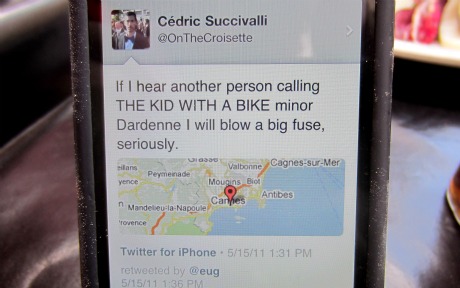
Shuffle
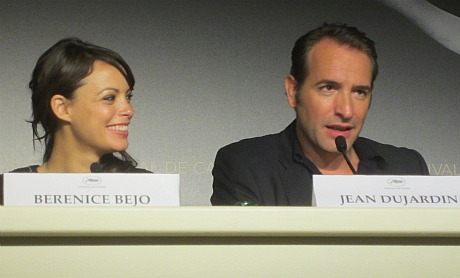
The Artist costars Berenice Bejo, Jean Dujardin at this morning’s Cannes press conference.
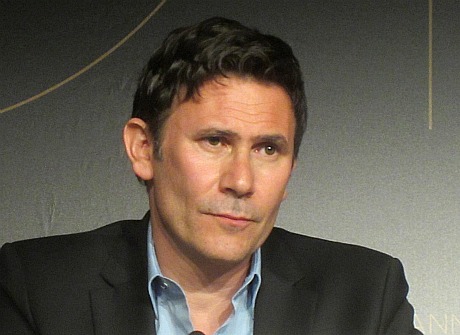
The Artist director Michel Hazanavicius — Sunday, 5.15, 11:25 am.
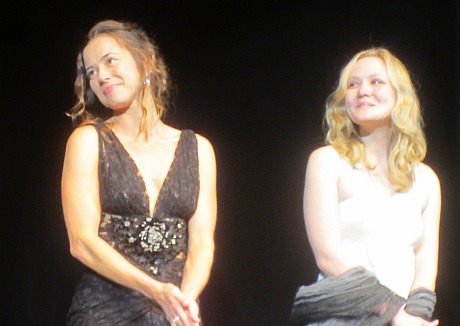
Return star Linda Cardellini (l.), costar Louisa Krause (I think) prior to last night’s showing of Liza Johnson’s film about a female soldier’s difficulty in adapting to home turf after serving in Iraq.
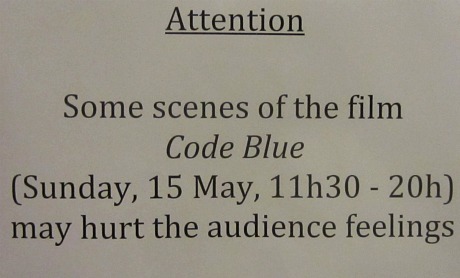
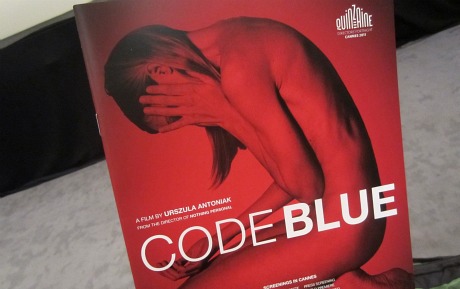
This is one of those unfortunate translations. The original French caveat was probably something about Code Blue being possibly traumatic for some.

Days of Wop Rock
Two days ago Deadline‘s Michael Fleming reported that Ryan Gosling will star in and direct a remake of Taylor Hackford‘s The Idolmaker (’80). Gosling will be playing Ray Sharkey‘s role, I presume, which was based on rock-music promoter and manager Bob Marcucci.
The first two-thirds of The Idolmaker are brilliant. It’s probably my favorite Hackford film, closely followed by Against All Odds. Marcucci discovered and managed Frankie Avalon and Fabian, among others.