Why Of It

The vast majority of reports about the Beatles arrival on iTunes, which was announced this morning, have offered no explanations about what’s been holding this deal up for so many years. However, an article posted last night by the Wall Street Journal‘s Ethan Smith (with additional reporting from Nick Wingfield and Dana Cimilluca) provides a through-sounding history.
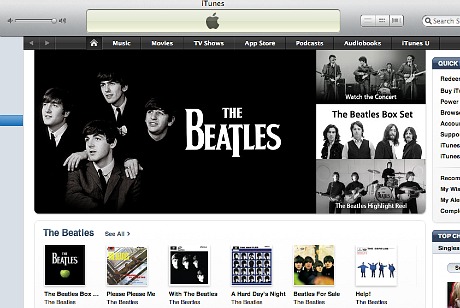
Pop-out #1: “People who have done business with [the Beatles] and its corporate entity, Apple Corps Ltd., describe a very slow-moving process in which the two surviving members, and the heirs of the other two, can take a long time to reach consensus.”

Pop-out #2: “The Beatles deal with iTunes was delayed in part by ongoing trademark litigation, the most recent round of which was resolved in 2007. The Beatles and iTunes have traded lawsuits since 1978, when the Beatles alleged that the computer maker, incorporated as Apple Computer in 1977, infringed on the band’s trademark in the name and logo of Apple Corps. The lawsuit was settled in 1981 for an undisclosed sum, plus an agreement that the Cupertino, Calif., computer maker wouldn’t compete in the music business.”

Pop-out #3: “The Beatles’ record label, EMI Group Ltd., has been under financial strain following an ill-timed leveraged buyout by Terra Firma Capital Partners LP in 2007. If the iTunes tie-up generates significant cash advances or sales, it could delay breaches in the company’s loan covenants. Terra Firma borrowed ¬£2.74 billion (US $4.4 billion) from Citigroup Inc. to finance the deal, but has fallen into breach of those covenants, forcing it to add millions more to its equity position last year.

Pop-out #4: “Even as recorded-music sales have plummeted, the Beatles have remained one of the most reliable franchises in the business. In 2009, 39 years after breaking up, they sold the third-highest number of albums of any act in the U.S., according to Nielsen SoundScan, with 3.3 million copies sold.”
Avoid "The" Whenever Possible

I didn’t read this 11.13 Drew McWeeny/Darren Aronofsky conversation piece until last night. Aronofsky told McWeeny that his Wolverine flick will be a “one-off” and shouldn’t be regarded as a sequel or prequel or related in any way to the X-Men franchise or Gavin Hood or anything. Aronofsky also told DW it’ll be called The Wolverine.

Right away I recoiled. I don’t like seeing “The” in any title, especially one citing the name of a superhero. I recognize that one of Heath Ledger‘s signature lines in The Dark Knight is “kill the Batman,” but a superhero is not an article like a table or a refrigerator or a car. A superhero is a myth, a force field, an icon, a tower. And most of them own their names for eternity. I’m obviously aware of The Shadow and The Green Hornet, but the use of the word “the” is generally superfluous and bothersome.

The fact that villains are agitating anti-socials allows them on some level to be called, fittingly, the Joker, the Riddler and so on. But imagine paying to see a film called The Superman or The Batman. It’s not right, not cool…stupid-sounding. So please — jettison The Wolverine.

Japan-phobia

I have two minor issues with the Drew McWeeny/Darren Aronofsky/Hitfix riff that was posted last weekend. Okay, one minor one and another that I could almost call major in a fundamental/cultural sense.


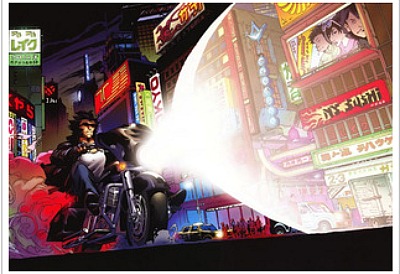
Adam Kubert illustration from 11.13 Hitfix article about a discussion between Drew McWeeny and Darren Aronofsky. Kubert “is just one of the many artists who have sent Wolverine to Japan over the years,” it says, “and now Darren Aronofsky is set to do the same.”

An illustration caption in the McWeeny article suggests that The Wolverine, which will be dp’ed by Matthew Libatique (Black Swan, The Fountain, Cowboys and Aliens), will be locationed in Japan. That scares me a bit. Go to Japan and your movie becomes a flamboyant acrobatic action-flash samurai-yakuza cartoon. I’ve loved Ichi the Killer and High and Low and dozens of Japanese-shot thrillers and action films over the decades, but visiting American filmmakers have this tendency to objectify and sanctify Japanese culture in a big-budgety, broad-stroke ways.

I’m sure there are U.S.-shot, Japan-based action thrillers that I’ve really enjoyed besides Ridley Scott‘s Black Rain and Sydney Pollack ‘s The Yakuza, but they’re not coming to mind. I know that quiet and meditation and small-scale simplicity don’t seem to factor in very much. Don’t even mention Kill Bill‘s Japanese section, which I found more or less ridiculous.

On top of which I’ve been developing this idea for years about Japan being a profoundly depressing place. Gaspar Noe‘s Enter the Void may have finally convinced me of this. Japan seems like one big Los Angeles strip mall these days. A strip mall with nicely landscaped gardens. I’m totally fine with the idea of never visiting there. I’ve never wanted to, really. Too crowded, too commercial, too expensive, and too sprawling. Plus they kill dolphins and eat them.

I also have a problem with McWeeny calling Libatique “Matty.” That feels like forced familiarity. I’m obviously not one to talk with my having adopted Bennett Miller‘s “Philly” in references to Phillip Seymour Hoffman, but Matty is somehow different. To me it’s in the same realm as Danny and Frankie.

Just so we’re straight: Mattie is bad, Danny is bad, and Frankie is bad…but Philly is somehow okay.

Yep, Yep

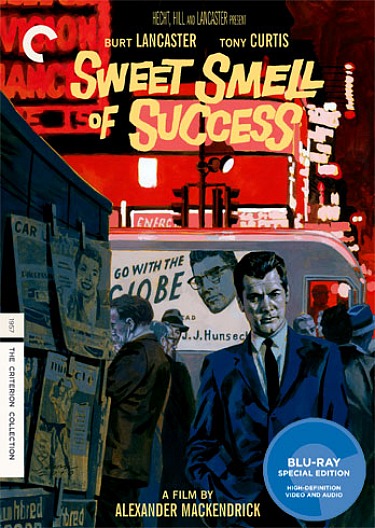
I’m probably more surprised than most by Criterion’s decision to issue a colorized 3-D surround-sound Bluray of Alexander Mackendrick‘s Sweet Smell of Success next February. Seriously, I do hope and trust, in fact, that Criterion will make this Bluray look like an actual 1957 black-and-white celluloid film. I can’t wait to see how the sad-eyed Barbara Nichols will look extra-silvery and glimmery.

Balls of Gelatin

Yesterday N.Y. Times columnist Paul Krugman explained in a roundabout way why a strong leftist-activist needs to run against President Obama in the 2012 Democratic primaries. Obama needs to “find it within himself to use his power, to actually take a stand,” Krugman writes, “[but] the signs aren’t good.”

Orange Mechanique

“Orange symbology is so burned into general public consciousness that it almost diminishes the natural attractiveness of orange in nature — the fruit, the occasional flower, the oriole, sunsets. Notice that nature is tasteful enough to use orange very sparingly. Nature knows what Frank Sinatra and Olly Moss didn’t recognize — that orange used with any kind of force or emphasis feels a bit oppressive.

“It’s a safety color when you’re hunting or working construction or standing on a busy traffic road in the evening, but it’s also a kind of control color — a symbol used to enforce rules and segregate prisoners and make people stay within boundaries. Orange doesn’t say “life can occasionally be beautiful or transporting.” It says ‘do this,’ ‘watch out,’ ‘don’t go there,’ ‘slow down,’ etc.” — from “Orange, Part 2,” posted on 8.5.10.

"No Exaggeration"

I’ll soon have a chance to sit down with Paprika Steen, the Danish actress best known for Susanne Bier‘s Open Hearts and Thomas Vinterberg‘s The Celebration. She’s said to be staggering as an alcoholic actress in Martin Pieter Zandvliet‘s Applause (WWMP, 12.3). I wouldn’t know myself. I’m not seeing the film until Thursday.

“Ms. Steen doesn’t just surpass herself in Applause — she gives one of the best screen performances of the year,” wrote Karen Durbin in the N.Y. Times on 10.29.

“[She] plays Thea, a famous theater actress fresh from a lengthy stint in alcohol rehab who is eager to regain at least partial custody of her two young sons. Applause intercuts the tense drama of her troubled present with pungent flashbacks to Thea triumphant as the drunken Martha in Who’s Afraid of Virginia Woolf? We see that she was not only great but, once offstage, viciously abusive to her young dresser.

“Playing an alcoholic has been known to bring out the scenery chomper in the best of actors. Ms. Steen never puts a foot wrong, even though she’s playing two alcoholics, wild Martha with the meat-cleaver mouth and the more alienated, calculating Thea.

“There are no melodramatics in the latter portrayal, just a silent, simmering rage at everyone but her children, a tormented sense of being forever on the outside looking in, and a self-destructiveness so willful that when her ex-husband lets her take the boys on an outing near a lake, it’s impossible not to think she’s going to drown them.

“To say that Ms. Steen commands this film is no exaggeration. She’s in every scene, with Thea’s drink-ravaged face often shot in unforgiving close-up. There is even a single eerie, fleeting moment when we can’t tell if she’s Martha or Thea: Ms. Steen is that good.

“Thea’s story is harrowing. Yet for all the pain she depicts, Ms. Steen is delving so deep and with such unerring precision into the human psyche, not even for a moment do we want to look away.”

Wise Up

A young guy I know broke up with his girlfriend last night. He was looking for an actual boyfriend-girlfriend thing, and she turned out to be a bit too aloof and casual-minded. I offered a little solace by quoting the following line, which is from a well-respected late ’70s film: “Jesus…you know, I knew you were crazy when we started going out. You always think you’re gonna be the one that makes ’em act different, but…”

Skirting

I was under this vague impression that if somebody “friends” you on Facebook they’re stating a willingness to converse a tiny bit. In a sort of tappity-tap-tap way, I mean. You send them a note and they write back, etc. But apparently not. I sent a friend request to an ex-girlfriend a while back and she accepted — cool. But that was it. I’ve followed up a couple of times, and Ingmar Bergman‘s The Silence has nothing on her. Same deal with a marketing exec for a major distributor. She accepted, I wrote back…zip. Facebook is nothing. It’s contact without contact. It’s about nominal acknowledgement, if that.

Blame Ford?

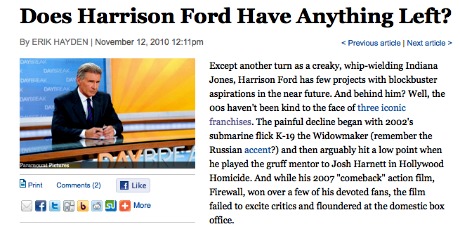
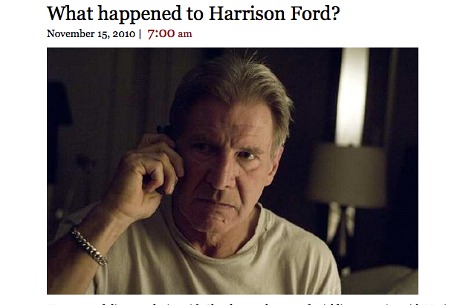
Is it fair to ask if Harrison Ford is over in the wake of Morning Glory‘s box-office shortfall? Fair or not, they’re doing it. The LA TimesStephen Zeitchik hammered the poor guy this morning for his “marginality” and “obscurity.” Which more or less echoed what Atlantic Wire‘s Eric Hayden wrote last Friday.

Ford is too mopey, too weathered, too glum and over the hill, they’re basically saying.

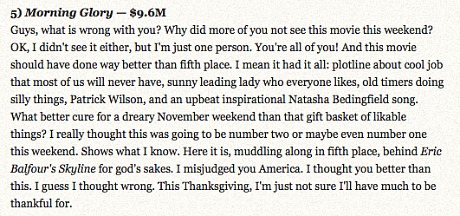
I for one felt that Ford’s snarly, misanthropic, pissed-off news anchor in Morning Glory was not only his best role but his best performance in years, but what do I know? A movie buff I know saw Morning Glory last night and feels that Ford is “perfect.” But Joe and Jane Popcorn didn’t share this enthusiasm, apparently, to go by last weekend’s $9.6 million haul.

Ford’s role in Jon Favreau‘s Cowboys & Aliens is a real quickie so that’s not much to hang onto. Judging by the comic, I deduced last April that “the only guy whom Ford could possibly play is a 60ish U.S. Cavalry Colonel who refers to Native Americans as ‘filthy savages’ and is soon after wasted by the aliens. A cameo, in short — two or three minutes and hasta la vista.”