Measuring Stick

Late last night an HE reader named Billy wrote that Due Date “played okay” at last night’s “packed New York premiere. Not gut splitting. Okay.” That was also how it felt during yesterday afternoon’s Manhattan press screening, but this, to me, is a secondary consideration. I responded this morning as follows:
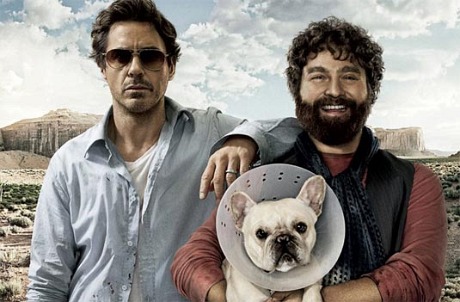
You’re measuring Due Date, in other words, by the standard of “how big and rollicking is the laughter?” And by that standard, you’re not wrong. The big haw-haws don’t come every other minute, but there’s a lot of “no-laugh funny” stuff in it, and to me that’s an excellent thing. The best comedies get you with humor that’s concurrently broad and unmissable and interior and smirk-worthy.

I’m measuring Due Date by the standard of novelty and relative bravery. It’s dealing comic cards from a fairly dark and calloused place. It’s genuinely funny in a way that is obviously not original in terms of the basic template (i.e., strange bedfellows on a road trip, Planes, Trains & Automobiles) but is, I feel, significantly different from other mainstream comedies by way of being meaner. This is not a comedy that believes in man-hugging. At best it believes that others can be tolerated if you work on your attitude and turn the other cheek.

Downey is playing a chilly, highly intelligent dick — a snide, superior-minded, hostile-attitude type who knows how to be a mensch but doesn’t care to let that side of himself out because…well, fuck ’em. And he really commits to that without winking at the audience, and he uncovers aspects and vulnerabilities within this guy that are definitely darker and more intriguing than the kind of thing you usually get in a big-studio comedy like this.

Honestly? Downey’s character is a little bit like me during my darker, more defensive moments in the early to mid ’90s when I was recently divorced and struggling in a highly competitive Hollywood freelance realm and routinely getting blown off and lied to and told “no” and “sorry, pal” and “eff you” and dealing with all kinds of political pressure from film-industry bigwigs as well as my own editors and dealing with a vodka-and-lemonade problem on top of all that. I had moments of defensiveness and hostility, no question, and I’m very, very happy not to be succumbing to that current these days. Hollywood Elsewhere is a great gig and a great forum — I’m stressed but very happy these days — but I remember, I remember…

In short, it ain’t the “hah-hah” in Due Date but the “oh, wow…really? A mainstream comedy is going there? Brave.” It works because Downey is obviously counterbalanced by Galifianakis, and because Galifianakis is showing a bit more subtlety and a few more colors than he has in previous films, certain more so than in The Hangover.

Incidentally: Here’s a negative review by Marshall Fine, who’s also judging Due Date by asking “how funny is it?” I say again, quoting the legendary Michael O’Donoghue, that simply “making people laugh is the lowest form of humor.”
Scowling and Deranged

Todd PhillipsDue Date, which opens Friday, will delight anyone with the ability to savor a nervy comedy that isn’t afraid to play it “mean.” A fellow critic used this term following a screening earlier today, and I said, “Yes, exactly — and its willingness to boldly go in that direction is what makes it such a stand-out.

“I can honestly say that no comedy has taken me into such hilariously hostile and misanthropic realms,” I added, “and that’s why I was charmed and delighted and never once looked at my watch.”

Due Date is obviously a boilerplate road-trip comedy in the vein of Planes, Trains and Automobiles, but its embrace of dark-streak humor — particularly in the case of Robert Downey‘s character, a snarlier and more misanthropic version of Steve Martin‘s PTA adman — is what makes it, for me, close to brilliant. It’s not the material that’s original — it’s the dark style of delivery and its refusal to attempt to charm or placate those looking for a sense of harmony and okay-ness.

Yes, Due Date lets a little bit of light shine in toward the end, but for the most part it flips the bird at those looking for a traditional dumb-ass, good-time comedy. And I’m almost in love with it for that. Call it a highly engaged state of “like.”

It’s also one of those comedies that will play slightly better if you’re ripped, or at least if you’re familiar (i.e., experienced) with the principals of high-end stoner humor. It’s basically a pot-inhaling GenX version of Planes, Trains & Automobiles but with a gnarlier, skankier and more hostile sense of humor. There’s a scene between Downey and a little kid that’s an instant classic — I’ll tell you that much right now.

Downey, God love him, is so butt-plugged and fearlessly unlikable in this thing that I’ve almost forgiven him for Sherlock Holmes. (Almost, I say.) At one point his character describes himself as “a pig” and an asshole, and it’s not that he doesn’t let the audience “in” so they can sense and perhaps understand why he’s this way — he does — but he does so without resorting to the usual actorish tricks. He just sucks it in and lives in his character’s skin. It’s a borderline amazing performance — seriously.

The film also contains the funniest and most likable Galifianakis performance yet — his man-child routine has been finessed and improved upon in ways I’m finding difficult to describe except to say he’s much more tolerable here than he was in Phillips’ The Hangover. (He has a scene in which an unexpected emotional flow pours out of him — a moment that surprises and touches.) And cheers to Jamie Foxx for delivering an amusing cameo, and particularly for his character’s facility with coffee-preparation.

I recognize that my endorsing a comedy can almost be interpreted as a kiss of death. I loathe many if not most of the comedies that mainstream audiences go for. I’m guessing that women won’t like Due Date very much — the humor is very guy-ish — but maybe that won’t happen. I hope it succeeds financially. I want the same for all comedies that make you gasp and laugh simultaneously. I know that while The Hangover may be funnier to a broader spectrum of people, Due Date is a much ballsier and more interesting film.

"We're Not Faking It"

I think it’s malicious to exploit people when they’re down or to portray them as eccentric or out-to-lunch, especially when they seem to lack the horse sense that would tell anyone to just shut the hell up and not make things worse, so I’m not posting this to make fun of poor Randy Quaid and his wife Evi. The ABC News video interview strongly suggests that they’re not dealing from a full deck. I don’t know (and I don’t want to know) what’s actually actually going on here, but I’ve enjoyed and respected Quaid’s work over the years, and I’d just like to see him get back to it. Over and out.

Again

I remember that I posted this video after the jump on the Michael Moore piece that I ran Saturday morning. It was only two days ago so yeah, I do recall doing this. Here’s to those reactionaries who’ll be voting for the corporation-kowtowing crazies on Tuesday.

"My First Asian"

This is what Vince Vaughn does better than anyone else in the world. He’s a marvel at hyper guy-talk humor, but since The Wedding Crashers he hasn’t done it enough, certainly not at this particular level. Notice how much leaner he was five years ago compared to his appearance in the trailers for The Dilemma.

Oscar Poker #6

Oscar Poker #6 contains a little bit of box-office with Phil Contrino, a discussion of why certain Best Picture winners have prevailed, a fairly detailed explanation of what Morning Glory is and why it works as well as it does, and reflections about the passing of George Hickenlooper and the fate the upcoming Casino Jack — his last film. (The recording abruptly stops at the end, but that’ll be fixed.) The podcast is also sitting in its usual iTunes berth.

A Times Mystery

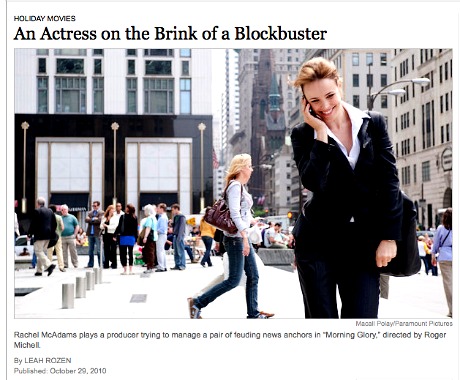
Yesterday’s N.Y. Times included a profile of Morning Glory star Rachel McAdams by ex-People critic Leah Rozen. The headline says “An Actress On The Brink of a Blockbuster.” Right away you’re thinking, “Wait…the Times is suggesting that Morning Glory will be a blockbuster?” Because Rozen’s story doesn’t even hint at that possibility. Not even in a roundabout game-of-chance sense.

Rozen reports that McAdams is a sincerely admired, greatly talented and versatile actress. And that Morning Glory is “a comedy,” even though it’s more of a spirited, occasionally amusing fast-lane survival story. The “hah-hah, that’s really funny” moments happen, but not all that frequently. Which is fine. It doesn’t need to be a “comedy.” I was surprised and pleased after seeing it last Thursday morning. It’s a first-rate, highly intelligent mainstream confection.

Rozen explains that Morning Glory is about “a hotshot television producer who must rein in bickering anchors, played by Diane Keaton and Harrison Ford, while trying to increase ratings on a struggling morning news show.” This isn’t quite right either. It’s not so much that Keaton and Ford are “bickering”, but that McAdams and Ford are at loggerheads. McAdams has arm-twisted Ford, a Dan Rather-ish TV newsman, into co-hosting her morning show, and he’s repelled by the show’s cotton-candy countenance and won’t play ball and make with the amiable banter despite the fact that McAdams’ job and the continuance of the show hang in the balance.

Rozen also reports that McAdams is admired by director Roger Michell and by her costars Harrison Ford and Jeff Goldblum, and by critics like the Chicago Tribune‘s Michael Phillips. But the article doesn’t contain the slightest hint of approval or a qualitative assessment, even, for Morning Glory itself. So what blockbuster, exactly, is McAdams on the brink of?

“What McAdams is still missing is the breakout hit that will do for her what Pretty Woman did for Julia Roberts in 1990,” Rozen writes. Okay, then why run with a headline that says McAdams is, in fact, on the brink of this kind of success? What does the Times know that we don’t?

At the end of the piece Woody Allen, who’s directed McAdams in the forthcoming Midnight in Paris, says that “she’s going to make a fortune in this business, because there aren’t a lot of girls out there with that much sex appeal and beauty who can also be comic.” So McAdams is destined to be very wealthy — fine. But that’s not quite the same thing as being “on the brink of a blockbuster.”

McAdams is currently shooting (or is just about to shoot) Terrence Malick‘s super-secretive new film, which is being shot near Bartlesville, Oklahoma, with costar Ben Affleck. But Malick doesn’t make (and never will make) blockbusters so that’s obviously not the allusion either.

If anyone can figure this out, please get back to me.

Transformer

I never put on Halloween costumes, but these husky contacts are so cool I might buy a pair next year just for the fun of it. They were purchased at Abracadabra on West 21st Street for $99 and change. And they have all kinds of weird-looking ones, I’m told. Cat eyes, serpent eyes, Terminator eyes, etc.

Values Again

Every year I trot out the old saw about values and lessons being the main determining factor in the choosing of Best Picture winners by Academy voters. People recognize strong stories, first-rate artsy elements and high-level craft, but more often than not the tipping factor is a film “saying” something that the Academy recognizes as fundamentally true and close-to-home — a movie that reflects their lives and values in a way that feels agreeable.

Ordinary People beat Raging Bull because the values espoused by the former (suppressing trauma is bad, letting it out is good, wicked-witch moms are bad) touched people more deeply than the ones in Raging Bull. What values did Martin Scorsese‘s film espouse? Art-film values. Great goombah acting values. Black-and-white cinematography values. The only value that resulted in a big Oscar was Robert De Niro‘s commitment to realistic performing values — i.e. putting on 50 or 60 pounds to play fat Jake LaMotta. But there were no values in the film at all. What, it’s a bad thing to beat up your brother in front of his wife and kids?

American Beauty won the Best Picture Oscar because it said something that everyone (particularly workaholic careerists) believes to be true, which is that we spend so much time and energy running around in circles that we fail to appreciate the simple beauty of things.

Casablanca won because it said the right things about nobility and selflessness just as the U.S. was about to enter World War II. And because it was very well made and performed and had obvious romantic appeal, etc.

Gone With The Wind won in part because it presented the Civil War trials of Scarlett O’Hara as a metaphor for what the U.S. had gone through during the Great Depression, and said that if you don’t have gumption life will run you over and trample you down.

I’m not saying each and every Best Picture winner has won because of the values factor, but it does seem to explain the triumph of Dances With Wolves over Goodfellas (respecting and understanding other cultures and creeds is a spiritually nourishing thing vs. life in the Queens mob in the ’60s and ’70s was volatile and tacky and bloody). And Crash‘s victory over Brokeback Mountain (a values rebellion due to the over-70 Tony Curtis contingent being unable to stomach the idea of the iconic American cowboy figure being messed with). And Kramer vs. Kramer beating Apocalypse Now (learning to be a good dad vs. “the horror” in a psychedelic Vietnam).

So what values are espoused by this year’s Best Picture contenders?

The Social Network doesn’t espouse as much as observe and frame a particular social world that’s evolved over the last six or seven years. It says that (a) geniuses aren’t very good with the social graces and that they also have trouble with loyalty if it gets in the way of a better business plan, and (b) what this particular genius wanted all along was a Rosebud-y girl who dumped him.

The King’s Speech says the nobody is so high and mighty that they can’t be helped by a good tutor who talks plain and straight and can cut through the pretense and the bullshit.

127 Hours says that arrogance and thoughtlessness invites tragedy, and that survival is a duty that must be obeyed, even if it means a huge sacrifice. The glories of life are worth what whatever it takes to simply stay alive.

Black Swan says that the performing life is tough and that self-doubt can metastasize like a cancer if you don’t face it.

What does Inception say? The Kids Are All Right? Another Year? The Way Back? Blue Valentine?