Bird Still Flies

It’s been nearly 50 years since Marilyn Monroe was found dead in her bedroom in August 1962. I’ve personally visited that home on Brentwood’s Fifth Helena Drive seven or eight times (I took my mother there once), but there’s something bizarre about her brand continuing to generate books and movies and magazine articles (like Sam Kashner‘s in the current Vanity Fair), and making money for people still hungry for a piece. Memorials a decade or 20 years later, okay, but to be turning heads almost half a century later?
The sad metaphor of Monroe’s life — that of a “poet on a street corner trying to recite to a crowd pulling at her clothes,” as Arthur Miller once described her — has never stopped resonating among people of suppressed hurt who feel ignored, under-valued or marginalized. I get that. We all do.

Elton John and Bernie Taupin‘s “Candle in the Wind” was written twelve years after her death, and then the following year — 1975 — came Norman Mailer‘s ‘Marilyn‘, and even then the feeling was “okay, we’ve stirred her ghost and put her on the stage again and again…now let her be.” And yet the band is still parading around some 35 years later.

Maureen Dowd‘s current N.Y. Times column compares the attitude of Marilyn’s day, when intellectual uplift and spiritual growth was something everyone wanted and in fact needed in order to feel whole, to the tea-bagger Palin notion that people of intellect deserve our suspicion and mistrust and that political leaders need that good old Walmart touch.

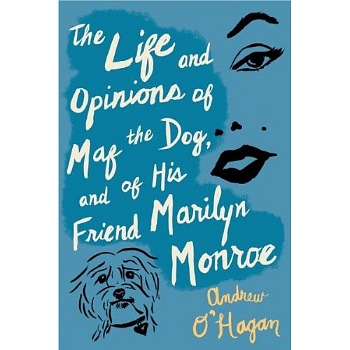
But it also anecdotally reminds that there’s “a hit novel in Britain narrated by the Maltese terrier Frank Sinatra gave Monroe, which she named ‘Maf‘, for Mafia, and three movies in the works about her. Three? Naomi Watts is reportedly planning to star in a biopic based on the novel, ‘Blonde,’ by Joyce Carol Oates; Michelle Williams is shooting My Week With Marilyn, and another movie being planned is based on an account by Lionel Grandison, a former deputy Los Angeles coroner who claims he was forced to change the star’s death certificate to read suicide instead of murder.”

I’m not at all persuaded that both the Watts and Williams movies, which are being made in order to cash in the 50th anniversary of Monroe’s death, are destined to attract huge interest.
No More Happy

If nothing else, Jeff Deutchman‘s 11.4.08 (10.20) — a doc about what various everyday people were doing, seeing, saying and feeling on the day Barack Obama was elected President — proves that timing really counts. I’m sorry to be a killjoy, but the idea of watching a film in October 2010 that celebrates the hope and highs of 11.4.08 feels like some kind of sick joke.

How can anyone watch this film without thinking that that good old “yes, we did it!” vibe is absolutely dead and gone? That feeling was over three or four months after the January ’09 inauguaration. I’m disoriented and angry and pissed off, and if Jeff Deutchman is still fluttering around on a November ’08 nostalgia high then he needs to find the right medication and comes down to earth and deal with the here-and-now.

How are things not awful now? Obama has done well in a limited, modified, lily-livered Jimmy Carter-like way, but he’s disappointed even the faithful. The crazy-ass looney-tunes righties are going to beat the shit out of Democrats in several House races (though perhaps fewer than we were presuming a few weeks ago). Obama has the same corrupt guys who not only rubber-stamped but profited by the system that led to the ’08 economic collapse running his economic policies. He’s spending billions of dollars every week in Afghanistan.

Are we idiots? The hope days are over, for heaven’s sake. Who wants to celebrate how great everything felt two years ago when snarling, salivating wolves are prowling around and biting everyone on the leg, and the hunter with the gun is going “is there some way these wolves can be persuaded to act rationally and constructively?”

Pelted

I was a fairly literal-minded kid, which is why the first time I ever heard Bob Dylan‘s line about how “sometimes the President of the U.S. must have to stand naked,” I thought of Lyndon B. Johnson standing buck naked in a rainstorm on the south lawn of the White House. Not a pleasant image. I thought of this about 30 minutes ago when I came upon the following Johnson quote: “Being president is like being a jackass in a hailstorm. There’s nothing to do but to stand there and take it.”

We Are Devo

The chances of IFC Films releasing James Gunn‘s Super sometime later this year are, I realize, remote or off the table. (It’s…what, a late winter or spring release?) The chances of the full-length feature sustaining the humor in this violent teaser clip are also not high. I really laughed at this. And then he seriously hurts the guy and it was like…what? Oh, I see. Doofus asshole. Fine.The movie-line analogy, of course, is that scene in Woody Allen‘s Annie Hall in which Allen squared off against that irritating academic guy talking about Federico Fellini and Marshall McLuhan.

I get the point of Super. (I think.) It’s a roundabout commentary on the ridiculous notion of superheroes as well as dark situation comedy about a lonely, deeply angry schlub who lacks the moves and the control and the soul to be a true-blue hero. But the difference between the above scene and the one in Annie Hall is what people mean they talk about social and political devolution. Both scenes are about the protagonist feeling great surges of hostility, and they both involve fantasy solutions. But they’re very different birds.

Rileys Interrupted

I saw about 40 minutes’ worth of Jake Scott‘s Welcome to the Rileys (Samuel Goldwyn, 10.29 — NY, LA, Boston) at Sundance 2010. It seemed slowish and doleful but at the same time straight and unpretentious. Pudgy James Gandolfini is excellent in his usual unforced way, and Kristen Stewart matches him move for move. I don’t want to get overheated about the portion that I saw, but it seemed like a decent effort.

I’d love to see the rest of it. For whatever reason the Manhattan p.r. agency repping it chose not to invite me to any of their screenings, or to the recent junket. Thanks.

Mystifying Town Love

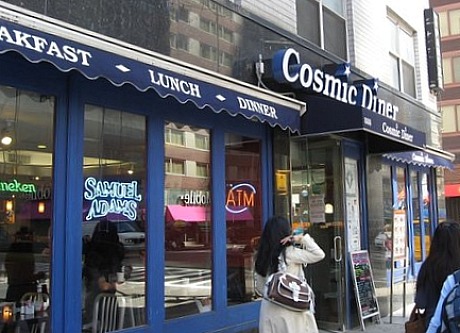
Two or three days ago I was sitting at the counter of the Cosmic Diner (Eighth Ave. at 52nd Street) with my computer, and this overweight guy who looked and sounded like a reasonably bright New York City employee sat down two stools away and started telling the counter guy that his friend really loves The Town, and that he’ll definitely be seeing it soon. I flinched ever so slightly, glanced over and said nothing. I was witnessing word-of-mouth in action. This is how it happens. I felt like Margaret Mead.

Counter guy: “Really good, huh?” Fat guy: “What he said, yeah. One of the best he’s seen this year. And the guy…the director, whatsisname.” Counter guy: “Uhhm, yeah.” Fat guy: “Tobey…?” Counter guy: Ben Affleck?” Fat guy: “Affleck, yeah. He’s good.”

Affleck is a good director — the new Sydney Pollack! — but I kept biting my tongue and telling myself “don’t fucking say anything…just shut up. Just let ’em have their moment and shut the fuck up. If you tell them what you think — that it’s got decent action and is reasonably handled in most respects but it doesn’t begin to compete with other Boston crime flicks like The Departed, Mystic River, Affleck’s own Gone Baby Gone or The Friends of Eddie Coyle — they’ll look at you funny and weird because you’ll sound like a know-it-all.”

But after a couple of minutes I couldn’t help it.

Me: “I saw it.” Fat guy: “Yeah?” Me: “Your friend’s not wrong. It’s a good film. Good bank-robbing, good car chases. But I don’t believe in Affleck’s nice-guy bank robber. I think that’s a bullshit Hollywood conceit. And I don’t believe that Rebecca Hall‘s character…you know her?…I don’t believe that an ambitious woman, a Donna Karan-wearing bank officer, would accept an amiable, blue-collar Charlestown schlub as a boyfriend, particularly after he confesses that he’s a bank robber. If she herself was a Charlestown native, maybe. But otherwise, no way.”

What I really wanted to say was “what is it about this film that makes it so good in so many people’s eyes? It verges on bizarre. I mean, if I talk to a serious sports writer about the Yankees, I’m going to listen to what he says and give it a certain weight. I know what The Town is and I know it’s not as good as everyone is saying. It’s fine, it’s okay but calm the fuck down, will ya? It’s high-end functionalism, which is a hoity-toity term for high-end hack work. It’s basically a whaddaya whaddaya okay fine whatever. Affleck cuts his character way too much of a break. He’s basically a dirty guy who doesn’t deserve to escape. But the dictates of a big-studio crime film say otherwise.

Continuing Boston Follies

A month ago I reported about a “dark and murky-looking” screening of The Social Network for Boston-area critics at the notorious AMC Boston Common plex. This resulted in a Sony rep calling it “a projectionist error” and a pledge to set “a new screening as soon as possible for those who attended.” Naturally, nothing has changed. The Boston tipster who told me about the 9.20 TSN incident says that recent press screenings of Hereafter, Fair Game and 127 Hours have also been degraded at the same theatre by cruddy AMC (i.e., “All Movies Compromised”) technology.

Hereafter was screened for Boston press on Monday evening — screen #18 at the AMC Boston Common plex — from the very same Sony 4K projector that caused the problems during that 9.20 screening of The Social Network,” he writes. “The 3-D lens was still in place and, once again, it appeared as though we were watching a bootleg copy instead of a real movie. Simply atrocious.

“Likewise, the same projector/house combination afflicted the Never Let Me Go afternoon press screening on 9.13.

“It gets worse. Both Fair Game (which screened on the afternoon of 10.12) and 127 Hours (screened on the morning of 10.6) were projected from a Christie 2K in theatre #8 at the theater. Yes, the Christie is regarded as a superior projector. However, the Christie used in this room is one of the very first digital projectors the AMC plex installed, and the image it currently outputs is broken.

“Reds and greens constantly separate, vertical streaks (complete with mottling toward the center) appear through the image and, in the case of 127 Hours, there was visible red/green artifacting cropping up (colored blocks within those vertical lines).

“Now, given that 127 Hours director Danny Boyle and dp Anthony Dod Mantle were using their standard variety of digital cameras, I wasn’t entirely sure that some of the imagery wasn’t intended to appear distressed (especially the consumer-grade — circa 2003 — handycam footage shot by James Franco‘s character). However, a subsequent screening at a different Boston theater — the Regal Fenway 13, with Boyle on hand for a post-movie q & a session — featuring supremely clear imagery erased these doubts.

The source adds that “we lucked out, as the Fenway theater has also had its share of technical problems.”

“With Fair Game the periodically-appearing subtitles, which should have been white, had a bizarre series of — yes — red and green diagonal hatch marks running through them, in addition to the same red/green separation issues mentioned above. In one late-inning scene Sean Penn is dressed in a brown pin-striped suit jacket, except the pin stripes broke up into a moire pattern, the likes of which you haven’t seen since people appeared in pin-stripes on old CRT televisions.

“If you bought a new TV and witnessed these kinds of abnormalities on screen, you’d return the TV and demand either a replacement or a refund. And yet, consumers regularly view movies under these conditions, accepting the terrible image as the way it should be. What’s wrong with this picture?”

Wells to Boston tipster: What’s wrong is that AMC management has apparently decided that it’s just too costly to project films correctly. The exhibition business is not booming. They’d like to upgrade their standards but they just don’t want to pay for it.

Why do people sit meekly through poorly-projected theatre showings but turn around and demand complete satisfaction from their TVs? Primarily because the size of the investment in their home entertainment systems is much higher than the price of two movie tickets, and because problems with their TV will obviously plague their viewings on a day-to-day basis whereas they’ll accept single-incident screwings (even if they’re endlessly repeated) at crap plexes like the AMC Boston Common 19. People are basically sheep when it comes to bad theatrical projection — they’ll sit through anything. And theatre owners know this.

"Whatever You'd Like…"

Every time some sexually provocative scene from a well-known ’60s or ’70s film comes up, people always say “they’d never get away with that scene in a mainstream film today.” Or “they would never even try that…it’s a different climate today.” Can anyone imagine a major actress of today delivering Julie Christie‘s legendary punch line (it comes at 1:05) in a mainstream comedy with a big-name actor on the…uhm, receiving end? I’m asking.

Bite Your Tongue

In his 10.18 Showeast-response-to-upcoming-movies piece, TheWrap‘s Steve Pond quoted an exhibitor who’d seen Tony Scott‘s Unstoppable (20th Century Fox, 11.12) and said it’s “exactly what you see in the trailer — a totally routine action film.”

Who said that? Who the fuck said that? Who’s the slimy little communist shit, twinkle-toed cocksucker down here who just signed his own death warrant? Some exhibitor with a drink in his hand? I’ve only seen the trailer, but I know that’s a stupid and lazy thing to say.

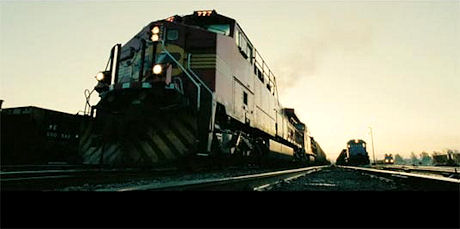
Scott is constitutionally incapable of making routine action films. With the exception of Domino and maybe one other, he always hits ground-rule doubles that wind up being triples because the runner always goes for the extra base. And when he’s got good material (like, for example, when he made Crimson Tide or Man on Fire) he always hits long triples. Within the white-knuckle, smart-ass action realm Scott is as good as it gets, so don’t tell me he’s made something “totally routine.” A runaway train slamming into buses and cars with Denzel Washington and Chris Pine and the usual ace photography and cutting and rat-a-tat-tat supporting cast that you always get with any Scott film?

Last year at this time I suggested with a straight face that Scott’s The Taking of Pelham 123 should be considered as a Best Picture nominee, not because it’s a “serious” emotional film about something important or close to our communal heart, but because it delivers a certain type of thing with exceptional flair and skill. Here’s a portion of what I wrote:

“The idea in nominating ten films is to promote and celebrate a movie or two that guys like Scott Foundas and Dennis Lim don’t approve of, right? That Average Joes paid to see and actually enjoyed?

The Taking of Pelham 123 “is precisely the kind of shrewd, sharp-angled, deftly layered urban thriller that high-end Hollywood filmmakers like Scott are better at making than anyone else in the world. And I’m convinced after watching [it] that it’s a damn near perfect film for what it is. The sucker never lags or falls into clicheville, it has a crafty plot with well-massaged characterization, it’s always psychologically complex or at least diverting, it delivers first-rate performances and just rocks out up and down.

“And so somewhere over the Atlantic I began asking myself why a film as well-made and fully engaging as this one can’t be nominated for Best Picture? Because it’s a summer movie and summer movies don’t win awards? Of course they don’t, and of course this one can’t. The suggestion is to pop Pelham into the ranks of Best Picture contenders in order to round out the pack and toss a bone to the lowbrows and guilty-pleasure fixaters like myself.”

Death, Betrayal, "Balance"

“It’s always a pleasant surprise to discover a film you know nothing about and find that it transports you in ways you never expected,” writes Marshall Fine. “So it is with Nora’s Will, a Mexican import that opened in limited release last Friday (10/15/10) before going wider. Written and directed by Mariana Chenillo, it is a film that never telegraphs its surprises — and offers both low-key and broader comedy, even as it finds its way to the heart.”


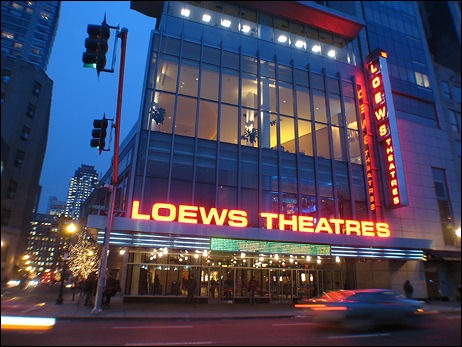
Snapped this morning — Tuesday, 10.19, 8:40 am.