Balls Felt Like Concrete

N.Y. Times critic A.O. Scott has delivered one of his perfect little sonnet pieces on James Foley and David Mamet‘s Glengarry Glen Ross (1992). Except he doesn’t mention Foley. No one who talks about this film ever does. Because GGR is a show about one thing and one thing only — Mamet’s “hard-boiled, lyrical mysticism,” as Scott puts it.

Except it’s not, as Scott infers, a commentary on the “the current economic crisis [that] had its origins in the real-estate bubble and bond market frenzy of the last decade.” Nor is it an essential expression of the Clinton-changeover ethos of 1992, when the film was released. Glengarry Glen Ross is based on Mamet’s real-estate job in the late ’60s but it became what it became because it understood and reflected the emerging greed and malice of the Ronald Reagan era — when the seed of everything that stinks today was sewn, in the view of Paul Krugman — and that is when the play’s vitality was greatest, when it gleamed and instructed like a demon orator.

I saw Gregory Mosher’s original New York production just before opening night — some time in mid-March of 1984 — with N.Y. Times theatre critic Frank Rich sitting a few aisles away, and with a truly electric snapping-turtle cast — Joe Mantegna, Mike Nussbaum, Robert Prosky, Lane Smith, James Tolkan, Jack Wallace and J. T. Walsh. And I am telling you that night was it — the Glengarry Glen Ross apogee.

Foley’s film improved upon Mamet’s stage play by way of Alec Baldwin‘s live-reptile speech to the salesmen (“Third prize is you’re fired”) and Kevin Spacey‘s performance as the office manager (i.e., Walsh’s part), but was otherwise only so-so. In my head I’ve always blamed this on the influence of producer Jerry Tokofsky, whom I’ve always heard was a bit of a cowardly lowballing weasel, but I wasn’t there so what do I really know? Nothing.

The movie took too long to get funded and so, as noted, it came out too late — it missed the cultural synchronicity. And Foley smothered it in standard-issue noir atmosphere — darkness, neon, constant rainstorms — and in so doing blew off the unfettered, straight-from-the-shoulder, granite-like clarity of the play. And Jack Lemmon overdid the jittery desperation of the sweaty downswirling salesman known as Shelley “the machine” Levene. (For my money Robert Prosky did him better on-stage — anxious and vulnerable but also snarly, pugnacious, testy.)

Worst of all the film doesn’t have Joe Mantegna as Ricky Roma — a role that Mantegna owned like Humphrey Bogart owned Duke Mantee in The Petrified Forest and Jason Robards owned Murray Burns in A Thousand Clowns. Al Pacino does very well with the part — his handling of the big existential pitch speech that closes Act One is effectively phrased — and we all understand that movie stars like Pacino routinely take parts away from guys like Mantegna for the most sensible of reasons, but it was still wrong.

To my knowledge Mantegna’s Roma was never captured on film or tape (even audio tape), and for this history does not look kindly, especially upon Jerry Tokofsky.
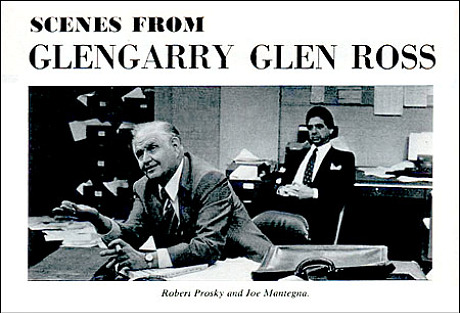

Robert Prosky, Joe Mantegna in Gregory Mosher’s original 1984 stage play of Glengarry Glen Ross
Get Low Schmooze

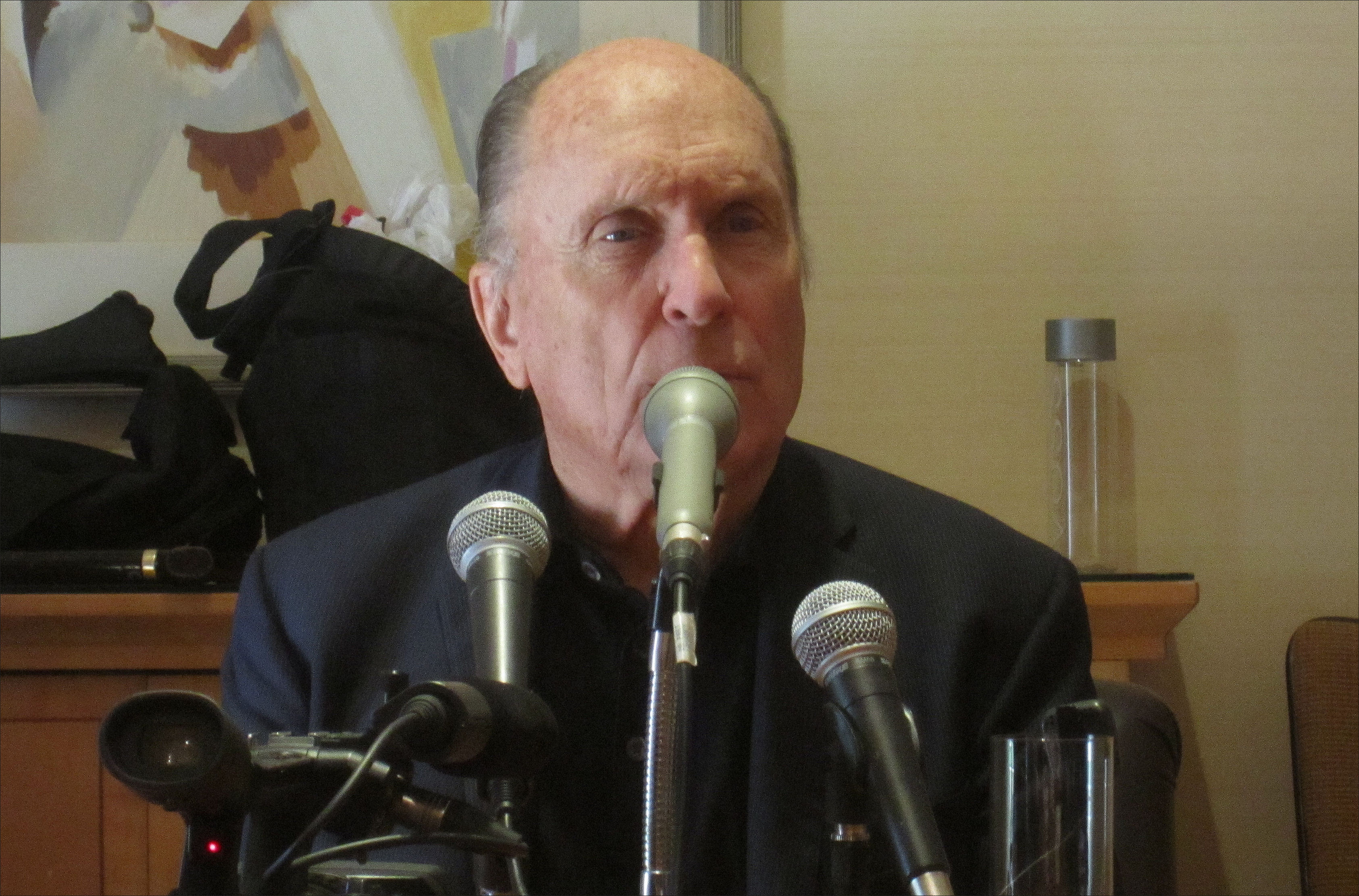
Get Low star and executive producer Robert Duvall said during today’s junket that Crazy Heart director Scott Cooper recently met with Brad Pitt about directing The Hatfields and the McCoys for Warner Bros….if and when Pitt decides to clear a place in his schedule. An excellent script about the legendary family feud of the 1800s has been written by Eric Roth, Duvall said. Pitt’s Plan B would produce with Pitt playing “the main guy,” Duvall said. Duvall would costar, and T-Bone Burnett would do the music.


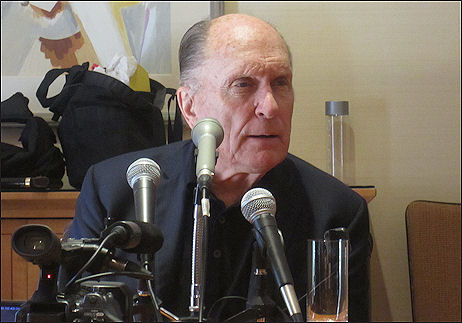
Get Low star/executive producer Robert Duvall during this afternoon’s Four Seasons press junket — Tuesday, 4.27, 3:10 pm.

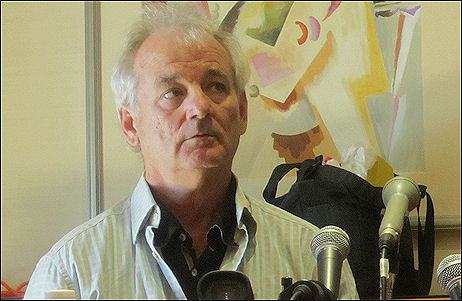
Get Low costar Bill Murray — Tuesday, 4.27, 2:45 pm. I love it when Murray takes a disliking to journalist who ask vapid questions, as he did today in the case of a certain questioner. Go, Bill!

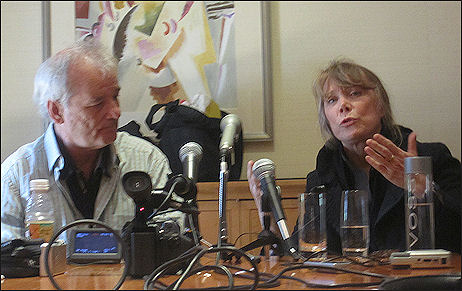
Murray, costar Sissy Spacek

Irish Tavern

The Cinetic/Film Buff team today hosted a few journalists for lunch at the Half King (23rd St. and 10th Avenue) to discuss various new ventures. Big Kahuna John Sloss and aggressive lieutenant Matt Dentler discussed the basics, which is basically that FilmBuff, the digital distribution label run by Cinetic Rights Management, will release Pelada, a doc about soccer that debuted last month at South by Southwest, in June. And that Collapse, which has been among the top-ten iTunes sellers, will be released on DVD on 6.15.

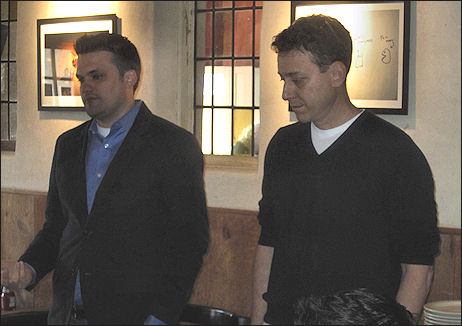
Cinetic/FilmBuff guys Matt Dentler, John Sloss at today’s press luncheon.
Sloss also mentioned that Alex Gibney‘s Eliot Spitzer doc, easily the hottest film of the Tribeca Film Festival so far, will most likely be at the Toronto Film Festival.

I had to be at a 2 pm Get Low junket at the Four Seasons so I couldn’t stay long, but the Half King has an amazing macaroni and cheese and broccoli dish, and the Shepherd’s Pie is pretty great also.

Forget Mulligan/Fincher/Tattoo

Update: Producer Scott Rudin, producer of David Fincher‘s forthcoming The Girl With the Dragon Tattoo pic, says the report about Carey Mulligan playing Lisbeth Salander, punk heroine of Stieg Larsson‘s bestselling trilogy, is “absolutely not true.”

Previous posting: I’ve been waiting for Nikki Finke or the trades to run a confirmation of John Harlow‘s 4.25 Times Online report that Carey Mulligan is set to play Lisbeth Salander, punk heroine of the bestselling trilogy that began with “The Girl With the Dragon Tattoo,” in an alleged feature to be directed by David Fincher and produced by Scott Rudin.”

Except the report hasn’t been confirmed by anyone, or not to my knowledge. I’ve asked a certain party in a position to know so we’ll see.

Mulligan has “won the approval of Fincher as well as the the family of the late Stieg Larsson, the Swedish author who created Salander,” Harlow reported. “The choice follows weeks of casting rumors, with producers sifting through nearly 5,000 potential candidates,” blah, blah.

I was okay with Neils Arden Opley‘s film version of the first novel, but I wasn’t what you’d call a huge fan. The movie was all plot, plot, plot, plot and more plot. Fincher and Rudin, I would imagine, would make something more formidable.

Man Stumbles

Iron Man 2 isn’t as much fun as its predecessor, but by the time the smoke clears, it’ll do,” writes Variety‘s Brian Lowry. Wait — didn’t Edmond O’Brien say that to Robert Ryan at the end of The Wild Bunch? “It ain’t like it used to be but…it’ll do.” Life tends to degrade or disappoint rather than improve. But you have to laugh about it.

“Much like The Dark Knight, this Paramount release brings an enormous stash of goodwill to the party, thanks to a well-crafted origin tale whose popularity fueled anticipation for a follow-up. Yet while the first go-round for this lesser-known Marvel hero benefited from its freshness and visual flair, the beats here are more familiar, the pacing more uneven. Given the demand, though, that will hardly matter, and this armored adventure promises to be a money-making machine that clicks on all cylinders.”

An HE commenter named “t.w.” says the following: “Iron Man 2 is a bit of a mess. Too much squeezed in. Definitely not as enjoyable as the first. I found Downey fairly irritating in this, and Don Cheadle (who replaces Terrence Howard) looked like he would rather be anywhere else. The movie it reminded me of most is Spiderman 3. It will make a fortune at the box office as the masses will eat it up, etc., but it’s a major disappointment to add to this year’s already long list of failures. At least it isn’t in 3D.”

Remains Of The Day

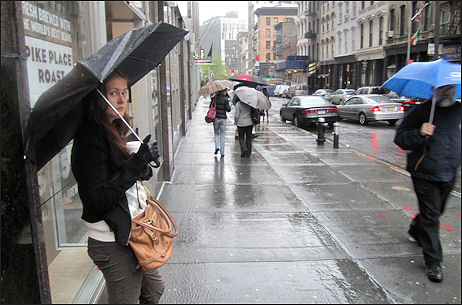
I hate it when I’m framing a shot on a Manhattan street and people who are walking along and about to enter into the frame stop and wait for me to snap the shot. They’re being polite, of course, but in a tediously mundane and American middle-class way, which is to say a form of politeness that says “we don’t get it.” Know this and know it well — people who stop and wait for you to take a shot don’t get it.

If you’re in the shot then you’re in the shot, and if you’re not then you’re not in the shot. If I see somebody about to take a photo on a New York street I walk right the fuck in front of them every time. If I wind up in somebody’s Flickr album then so be it. And I don’t then I don’t. Everyone is in everyone’s else’s photo album, and the chances are it’ll be a better shot if someone happens to wander into the frame. It almost always is.

Most people don’t understand this. A photo taken in a crowded city full of life and energy is always better if something untidy happens. Your shot of Aunt Mabel standing in front of a horse-drawn buggy in Central Park is always improved if a derelict happens to stumble into the shot, or if Glenn Kenny is strolling along the footpath and happens to be captured as he walks by. Or if a cop on horseback is clopping along and becomes part of the shot. Or if a dog wanders into the frame.

Plain old shots of Aunt Mabel standing and smiling in front of a horse are bad pictures because aside from the “say cheese!” aspect they’re about suppressing life in order to create a regulated and somewhat banal thing. In this sense I feel that they represent a kind of middle-class cancer of the soul. Life is not tidy or “posed,” and it wouldn’t hurt if this idea got around a bit more, especially among people from Iowa. Aunt Mabel can still smile if life intrudes into the shot and you can still make sure she’s in focus, but life is not a showroom for Nordstrom bedroom settings.

We’re all “in the movie.” Nothing matters. There is no “privacy.” Security cameras and satellite cameras tape everyone all the time for no reason other than rote surveillance. If a fellow human being captures your puss in a photo it’s at least being done with a personal motive of some kind. Live with it, groove with it, be here now.

New Maneuvers A'Comin'

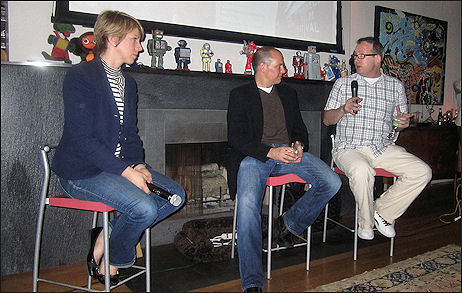
I’ve just spent the last 140 minutes or so hanging at an elite gathering of new-media people at a fifth-floor loft on Warren Street, listening to The Wrap‘s Sharon Waxman, indie producer Ted Hope and B-Side/Slated CEO Chris Hyams talk about brilliant new ways of using social media to get the word out about shorts, sites, films, whatever. It was fast-moving and a little spritzy from time to time, but I’m glad I attended. It pushed things along in my head.


(l. to .r.) New Media discussion moderator Sharon Waxman, B-Side/Slated CEO Chris Hyams, indie producer Ted Hope at tonight’s event, which was called “The Power of Crowds and Independent Film: Marshaling the Wisdom of Social Media.”

The sponsor was Flickweets, the new iPhone application that’s attached to mrqe.com (which is pronounced “marquee.”)

The Light That Failed

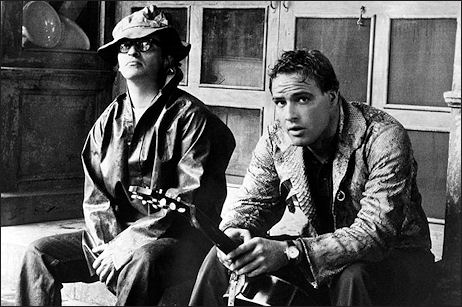
In recognition of tomorrow’s (4.27) DVD release of Sidney Lumet and Tennessee WilliamsThe Fugitive Kind, or more precisely the Criterion Collection’s rendering, an appreciation by David Thomson currently sits on the Criterion site.


Sidney Lumet, Marlon Brando on the set of The Fugitive Kind.

“Movies are not just the sum of the stories that can be told about their shooting,” Thomson says toward the end. “The Fugitive Kind was unlike other films, and it was something Lumet had never tried before: a portrait of small-town meanness in which the outward action was to be fired by internal demons.

“In that sense, it was not too far from the wasteland of Psycho, which was filmed at the same time. Is Psycho a crime story from local papers (like In Cold Blood) or is it a movie that stirs at dysfunction in America? In the same spirit, The Fugitive Kind is true to the stark paranoia in Williams, minus the lush color and starry glory that marked the films of Cat on a Hot Tin Roof and Sweet Bird of Youth. Those hit movies look so much less now than Streetcar, Baby Doll and The Fugitive Kind.

“This is a mood picture, where, if you pay close attention, you can feel the lights come up and fade away to match the eloquence of the speeches. You can see the decor giving an emotional or spiritual force to the text. And you begin to hear Marlon Brando‘s shy lyricism rising in the long speeches — this Orpheus in a snakeskin jacket sings. Joanne Woodward gives one of the least guarded performances of her odd career. And Anna Magnani looks like a great sensualist terrified of getting her last chance.

“There’s no question that Magnani could do too much, but Lumet restrains her here and urges his cameraman to trust her tragic face and wounded voice. It was not often in this era that an actress shared the screen with Brando — so many were erased by his light. Lumet began by using markedly different lenses on the two leads, but as the film progressed, he let Magnani have more and more long-lens close-ups to match Brando’s. And so we feel their relationship growing in the most natural way.

“No one went to see the movie in 1960. It got no nominations at Oscar time. It lost a fortune. But it may be one of the most intriguing Tennessee Williams pictures, in that we are asked to weigh and consider the faults of its provincial society. It is about time we yielded our trust in box office, the Academy, and journalistic critics as measures of quality. We have to see the pictures for ourselves. In which case, it’s natural enough to notice that The Fugitive Kind is only two films before Lumet’s Long Day’s Journey into Night, another study of the light fading in a small town.”

Horse Farts

Someone who may be Russell Crowe is on Twitter and strongly disputing Gawker’s excerpt from Nicole LaPorte‘s upcoming DreamWorks book, “The Men Who Would Be King: An Almost Epic Tale of Moguls, Movies, and a Company Called DreamWorks” (Houghton-Mifflin, 5.4). The possible Crowe is saying, in fact, that “mentions of me are eg’s of distance from the truth [and a] waste of paper written by a lying horse’s ass.”

Hood Precedents

New tracking shows Ridley Scott‘s Robin Hood, which opens in 18 days, averaging a 38 definite interest — 43 from under-25 males, 42 over-25 males, 28 under-25 females and 38 over-25 females. It’s also averaging a 7 first choice — a figure that clearly needs to increase over the next two weeks.

I’m not looking to pour rain on anyone’s parade and I’m very much looking forward to Robin Hood, but Universal needs to buckle down and get on the stick, and fast. Iron Man 2 is opening only a week before Scott’s film and its average definite-interest and first-choice figures are 67 and 32, respectively. Not fair to compare an adult-angled historical pageant drama with a kid-friendly superhero comic-book movie? Fair enough, but Robin Hood still cost a bundle and needs to earn serious coin.

So what’s the Robin Hood problem, in a nutshell? There are two factors, a friend suggested this morning.

One is Russell Crowe being seen as a bully and a sorehead these days, or at the least not being popular enough to put arses in seats if the film looks a wee bit iffy. The other is a perception that Robin Hood is another Kingdom of Gladiator Forest with arrows and spears being propelled by men with beards who need baths.

The latter concern, in other words, is that Robin Hood is Scott’s third historical action-and-romance flick to do the same approximate things in a two-out-of-three equation — i.e., star Crowe (Gladiator and Robin Hood), deal with the Crusades (Kingdom of Heaven, Robin Hood), show large ancient armies in conflict in wooded areas with flying projectiles (Gladiator, Kingdom of Heaven, Robin Hood), depict a rebellious hero at odds with cynical tyrants (Gladiator, Robin Hood, Kingdom of Heaven), and cast an intriguing actress in her 30s as a romantic lure or foil of some sort (Cate Blanchett, Eva Green Connie Neilsen).

I don’t agree with this view. Every film is it own beacon, idea, construct, vision. And I sure as shit don’t see Crowe’s presence as anything but a guarantee of true grit and conviction. But as soon as I heard it put this way I had to admit my friend had a point.