Boating For 14 Minutes

My early-morning plan was to file a couple of short stories (which I did) and then dash over to the Holiday Cinemas for a 9:30 am screening of Amir Bar Lev‘s The Tillman Story (which I wrote about last week). But then a friend called from the Eccles saying he had an extra ticket to Philip Seymour Hoffman‘s Jack Goes Boating. For whatever reason I told him I’d be right over. I paid a cab driver six bucks for a ride that lasted 55 seconds.


Eccles crowd just prior to showing of Philip Seymour Hoffman’s Jack Goes Boating — Sunday, 1.24, 9:25 am.

When I sat down I told my journalist pal I was a wee bit leery based on an age-old fear of first-time directing efforts by prominent actors, and especially those from the indie realm. (Obviously there have been welcome exceptions to the rule.) He mentioned that Jack Goes Boating hadn’t been slated for a press screening, and my heart sunk — I hadn’t noted that. Then the film began, and less than ten minutes later I was grumbling to myself. Four or five minutes later I got up and left.

Not because it was terribly made or horribly off its game — the opening established an amiable, easy-going tone with dabs of low-key humor — but because I really, really didn’t want to hang with Hoffman’s Jack, an oafish Manhattan limousine driver. Jack is pudgy — okay, fat — and rumpled and conversationally slow as molasses. He wears a dim and drowsy expression, and seems borderline stupid and to some degree emotionally shut down. “I don’t like this guy — he’s too doltish,” I muttered to myself. And the humor, as I heard it, conveyed a kind of low-energy flatness, reflecting the perceptions of people with somewhat diminished capacities.

And then came a scene between Hoffman and Amy Ryan, portraying a plain girl named Connie whom Jack is interested in, and costars John Ortiz and Daphne Rubin-Vega. It ends with Hoffman telling Ortiz that Ryan wants to go boating sometime, and Hoffman explaining that this might not work because he can’t swim. And then Ortiz mentions that he could teach Hoffman to swim at an indoor pool he’s been to.

That was it — I wasn’t going to watch Hoffman in bathing trunks. He’s been getting more and more corpulent lately, and it just makes me feel badly for the guy. I want him to be Capote-sized for the rest of his life. I’m sorry. I’m really not trying to be an asshole. It’s quite possible that Jack Goes Boating will be called a decent-enough film by critics and festivalgoers I respect. I just didn’t want to be in that world so I left.

I ran outside with the hope of catching The Tillman Story, which had only begun a few minutes earlier. A shuttle bus stopped but it wasn’t headed for the Holiday Cinemas. I stuck out my thumb and caught a ride. I ran into the theatre lobby about 20 minutes after the film had started, and was told by volunteers there was no room at the Tillman inn — every seat was taken. Defeat, despair. I walked over to the Yarrow and started to write some stories. And that’s where I am right now.

Usual Frenzy


Get Low director-writer Aaron Schneider and two unidentified people of presumed quality and accomplishment

A Prophet director-writer Jacques Audiard, Sundance volunteer Nicole Staton — Saturday, 1.23, 10:15 pm.

Indie publicists Linda Brown, Elizabeth Glenn — Yarrow Hotel lobby, 1,24, 9:55 am.

Ditto

Four Lions

Early last evening I saw Chris Morris‘s Four Lions — an unsettling, at times off-putting, at other times genuinely amazing black political comedy about London-based Jihadists — Islamic radicalism meets the Four Stooges/Keystone Cops. It’s sometimes shocking and sometimes heh-heh funny, and occasionally hilarious.

Morris uses a verbal helter-skelter quality reminiscent of In The Loop, and yet the subject is appalling — a team of doofuses who dream of bombing and slaughtering in order to enter heaven and taste the fruit of virgins. It’s amazing and kind of pleasing that a comedy of this sort has been made, but I don’t want to think about the reactions in Manhattan once it opens.

At times it felt flat and frustrating (I couldn’t understand half of it due to the scruffy British accents) and at other times I felt I was watching something akin to Dr. Strangelove — ghastly subject matter leavened with wicked humor. An agent I spoke to after the screening said, “I don’t know if the American public is ready for this film.” He’s probably right, but Four Lions is an absolute original — I’ve never seen anything like it, nor have I have ever felt so torn in my reactions. I’d love to see it again, but with subtitles.

Bullock

Heartfelt speech. So Bullock — all but ignored by critics groups — is now the front-runner for the Best Actress Oscar? Apparently. I wasn’t focusing last night when this happened — I was having my first relaxation moment since last weekend. Somebody (Pete Hammond, Tom O’Neil) needs to canvas Academy members and explain why she overtook Streep. Is it strategically possible for Carey Mulligan to take the Oscar due to the Bullock and Street votes cancelling each other out?

You Try It

Every Sundance festival you have to re-learn the same lesson — you can’t see three or four films per day plus file about them with any clarity much less eloquence if you’re also going to attend a late-evening party or freebie lunch or dinner and/or socialize and…well, not exactly chase skirt but do the dance of that. It really doesn’t work, and the tension between the usual filing requirements (which I have no trouble handling when I’m home) and the transporting ether of constant smiles and attention (particularly from devastating blondes, the company of whom I never keep in New York or Los Angeles) can really drive you nuts.

The films and the reviews are paramount, of course, but the Sundance aura can feel like a truly perfect weekend in high school with your parents away. The lah-lah must be resisted, of course. I will not allow my ship to crash on the rocks. You have to be hard and strong and face once again who you are and the degree of commitment required to do the damn job…yikes. This gig is hard enough without the siren call.

“C’mon, Wells — we’re not paying you to party and sleep,” a reader wrote last night. “Write some reviews.” Well, I’m trying to do that right now as I sit in the Yarrow Hotel lobby, dealing with the arctic blasts of air that surge in every time the automatic glass door opens. It’s 10:40 am and I’m realizing now that I’m going to have to blow off Smash His Camera, Leon Gast‘s doc about legendary paparazzo Ron Gallela, which press-screens at 11 am. I’m going to try and catch Mark Ruffalo;s Sympathy for Delicious at 12 noon, followed by Animal Kingdom at 2:30, Welcome to the Rileys at 5:30, The Runaways at the Eccles at 6:30 and 3 Backyards at 8 pm.

Boy Pops Through

A little while ago I emerged from Taika Waititi‘s Boy, which is now, I’ve decided, the other strong-recommend film I’ve seen so far at Sundance 2010 (on top of Get Low). The third apparent winner, to go by the buzz, is Catfish. The problem is that I have a hard ticket to Four Lions, which will begin at the Egyptian at 5:30 pm. It’s now 4:40 pm so I have no time to write anything.


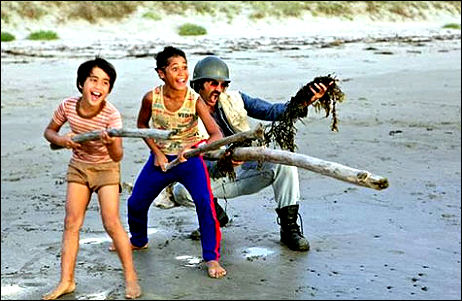
Te Aho Aho Eketone-Whitu (Rocky), James Rolleston (Boy), and director-actor Taika Waititi (Alamein) in Boy

I have time to say one thing. Waititi has a little bit of Wes Anderson in him. The movie is as freshly felt and stylistically alive as Bottle Rocket and Rushmore did in the mid to late ’90s.

Here’s a link to Julian Sancton‘s review of A Boy on vanityfair.com. I agree with pretty much every word. I’ll be sitting down after Four Lions and tapping out impressions of both films.

Downish, Trapped

I regret to say that John WellsCompany Men, a drama of layoffs and despondency affecting three Boston-area white-collar guys (Ben Affleck, Tommy Lee Jones, Chris Cooper), plays like an intelligent funeral in a nicely furnished minimum-security prison.

It’s an honest and competently assembled attempt to capture the Great Recession lamentations of the moment, but the story just kind of plods along. It feels lifeless and confined — stuck with itself with no escape plan. It’s kind of proud, in fact, of being a story about well-dressed prisoners and their wives and children. Each dawn I die.

Wells was obviously convinced that just telling these three stories in a plain, no-frills, reality-reflecting way would suffice. Over and over Company Men says that losing one’s job can be devastating on several levels, that unemployment requires lifestyle cutbacks, that older men need sometimes need the jolt of an affair to feel alive, that job-seekers frequently fall into denial and despair, and that this country’s inability to compete in the honest making of things amounts to a huge spiritual deficit.

Yeah — agreed, agreed. But I kind of knew or suspected all of this. And yet the movie confines itself in an upper middle-class ghetto that feels — I’m going to steal a line from Camille Paglia — so lacking in “the lurid pagan truth about life.”

There’s no madness, no sexual intrigue to speak of, no wily characters, no humor, no violence, no fist fights, and no Sopranos-style aplomb in portraying the grim or ironic undercurrent of things among suburbanites with power and money, etc.

Company Men is obviously occupying a portion of the same turf as Up In The Air minus the Clooney-and-Farmiga charm, the emotional resonance, the air miles, the sharp dialogue and the smartly angled characters.

Kevin Costner has a smallish role in Company Men as the house-renovating brother of Affleck’s wife, played by Rosemary DeWitt. He doesn’t have very many lines, but I wish the story had been mostly about him because he’s easily the most appealing personality on the boat. The second most engaging performance is given by Craig T. Nelson as the blunt-spoken CEO of the company whose cost-trimming decisions cause all the grief.

I’m genuinely sorry to have said most of this. A team of smart, sophisticated and well-intentioned people made Company Men , but it’s an absolute stiff in terms of real-world theatrical potential. I could see watching Company Men on HBO on a Sunday evening and going “yeah, not half bad,” but I wouldn’t dream of recommending it as a movie to go out and pay $12 bucks to see plus parking and popcorn.

Slippery Catfish

Okay, okay — I should have gone to see Henry Joost and Ariel Schulman‘s Catfish late yesterday morning. An MCN link calls it “Sundance’s sensation of the hour” and Marshall Fine says it’s “a film whose emotional journey is wholly unexpected and which takes the viewer on a ride he can never anticipate. It’s as visually low-tech as a movie can be, but these filmmakers prove that, with the right story, the images are in service to something much, much larger.”

Time and again at film festivals I’ve shown a remarkable genius for accidentally missing, sidestepping or deliberately not catching the proverbial “hot film.” I had just come out of Get Low yesterday morning and the notion of trudging it over to the Library for the 11:30 am Catfish screening was considered and discarded. Not enough time, didn’t have a hard ticket, hated (and still hate) the title, averse to docs about cyber relationships, etc. I’ll be able to see Catfish today at a 4:30 pm press showing, but I have a ticket to the highly anticipated terrorist comedy Four Lions at the Egyptian at 5:30 pm.

In The Company of Men


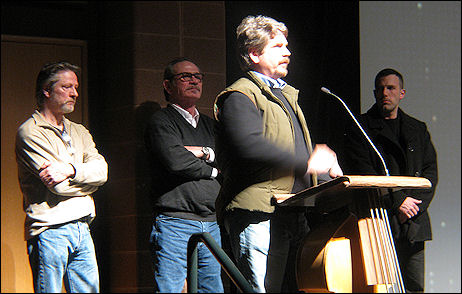
Following this evening’s Eccles screening of Company Men — (l. to r.) Chris Cooper, Tommy Lee Jones, director-writer John Wells, Ben Affleck. 1.22.10, 11:35 pm.

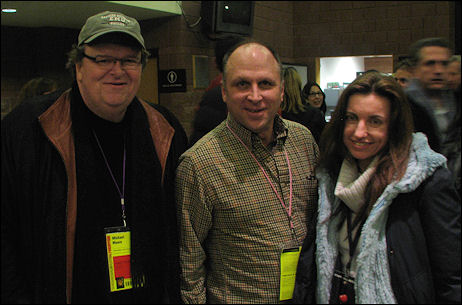
Prior to Company Men screening in Eccles lobby — Michael Moore, Apparition co-chief Bob Berney, an Apparition exec/ally whose name I should know. (Sorry.)

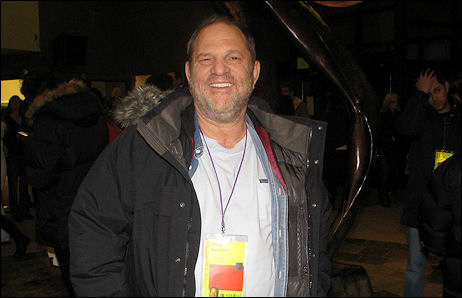
The indefatigable Harvey Weinstein — Eccles lobby, 1.22.10, 9:15 pm.

Hurt Disser

The problem with The Hurt Locker, in the view of Newsweek‘s Seth Colter Walls, is that it has no political inquisitiveness and is therefore way too opaque.

“Artists were put on earth to…give us insight and catharsis, not merely riff on the free-floating tensions that already dominate the mass consciousness,” he says. “The conventional wisdom is that Iraq War films have foundered at the box office because we have no appetite for them, but it might be that our appetite for them has been slight because they offer precious little nutrition. Nearly all of them are telling us pretty familiar war-is-hell narratives, even if those narratives are skillfully rendered in a technical sense.

The Hurt Locker gives us not only no context but no hint that the context is missing, since it mines the adrenaline of combat without mussing itself in the viscera of anything as dangerous as ideology. It’s a rip-roaring piece of suspense cinema, but decidedly no more than that.”

The Voidoid

I was on the Gaspar Noe boat after seeing Irreversible, but after seeing Enter The Void — a visually over-indulged and thoroughly sleazy after-death fantasy film — I’m totally off it until further notice. I’ll always admire Noe for being the go-for-broke provocateur — intensely opposed to typical shooting and cutting modes, pushing the boundaries as it were — but provocation in and of itself can get very old, especially when there’s next to no story being told and the characters are spiritually empty, pill-popping nowhere heads.

Noe has used, in these two films, an audacious, swirlygig crazy-bold shooting style. The camera rises and rotates and floats along and around, watching characters dealing or doing drugs and having sex (lots of that) from above, and flying over roofs and passing through walls and diving into gross toilets and bullet holes and squishy vaginas. But this camera language, if you will, is wildly undisciplined and grows tedious very quickly. Yes, it plays the visual panache card like few others films or filmmakers have ever dared or dreamed. But it’s essentially masturbatory.

I am going to take my time seeing the next Gaspar Noe film — that’s a promise. He’s no longer a must-see filmmaker.

Enter The Void is basically about the spirit wanderings of Oscar (Nathaniel Brown), a youngish kid who get shot to death inside a grimy toilet stall in a Tokyo club called The Void. His reason for lingering on earth is a pledge made to his sister Linda (Paz de la Huerta), a stripper/faux-prostitute whom he’s been living with in Tokyo, that they would never part, “no matter what.” So he floats and hovers over the people and places he knew in life.

But it all adds up to zip except for the initial intrigue of taking a ride with Noe’s camera, although that intrigue, as stated, goes out the window after 20 or 30 minutes. And then it becomes its own hell. For 156 minutes. People who take ecstasy and snort coke are deathly boring.