Beautiful Feeling

Hours after my first viewing of Avatar on 12.10 I wrote it was “ardently left, pro-indigenous native, anti-corporate, anti-rightie, anti-imperialist, anti-troop-surge-in-Afghanistan,” etc. Then I said on 12.24 that one of the great pleasures of this film is the way it makes right-wingers furious and miserable. So I’m very sorry that I missed this 12.25 rant by Telegraph‘s conservative commentator Nile Gardiner, because it says all the right things.

Avatar is “a distinctly political work of art, with a strong anti-American and anti-Western message,” he stated. “It can be read on several levels — a critique of the Iraq War, an assault on the U.S.-led War on Terror, a slick morality tale about the ‘evils’ of Western imperialism, a futuristic take on the conquest of America and the treatment of native Americans — the list goes on.

It’s also “a highly manipulative film,” he wrote. “When I saw the movie last night in a packed theatre, I was disturbed by the cheering from the audience towards the end when the humans — U.S. soldiers fighting on behalf of an American corporation — were being wiped out by the Na’vi. Washington is one of the most liberal cities in America and you come to expect almost anything here – but still the roars of approval which greeted the on-screen killing of U.S. military personnel were a shock to the system, especially at a time when the United States is engaged in a major war in Afghanistan.

Avatar is more than just a cinematic thrill-ride. It is an intensely political vehicle with a distinct agenda. In fact I would describe it as one of the most left-wing films in the history of modern American cinema, and perhaps the most commercially successful political movie of our time. While the vast majority of cinemagoers will simply see it as popcorn entertainment, Avatar is at its heart a cynical and deeply unpatriotic propaganda piece, aimed squarely against American global power and the projection of US economic and military might across the world.”

Yes!
If…

If by some curious twist of fate James Cameron takes the Best Director Oscar instead of Kathryn Bigelow (as indicated by Pete Hammond, Ed Douglas, Scott Feinberg, Dave Karger, Kevin Lewin, Michael Musto and Sam Rubin predicting that Cameron will take the Best Director Golden Globe), Cameron will be obliged to say the following to the Academy:

“Thank you all from the bottom of my heart and from everyone on Team Avatar, but I have to say you made a mistake. Kathryn Bigelow deserves this Oscar more than I do because she had less to work with than I did, and she still made a great war film. Not just kick-ass but emotional and granular and profound — for the ages. This was her year — everyone knew that — and you guys blew her off to pay tribute to the fact that Avatar made over a billion dollars. Well, thanks sincerely, guys. I love you for this — and please, please don’t take offense at this because I really am grateful as hell — but I have to say ‘thanks very much but no thanks.’ Kathryn? C’mon up here. This Oscar belongs to you.”

Scherfig & Criminality

Five or six days ago An Education director Lone Scherfig told Notes on a Season‘s Pete Hammond that she “wants to break into action by doing a gangster movie” and is actually predicting it may happen. “Exploring the criminal mind is truly interesting and something I haven’t done,” she said. “I’m interested in someone more violent and more flawed.”

Earlier in the chat Scherfig spoke admiringly of Hurt Locker helmer Kathryn Bigelow “for breaking into territory most in the film industry think is reserved exclusively for men by doing a gritty action war film…I think she’s admirable and it means a lot to me that she does that because it’s important that it’s not so much about gender as it is about storytelling.”

Avatar’s First Billion

Avatar crossed the worldwide billion-dollar mark this weekend. It was reported last night that the projected North American cume after 17 days in release will be $350.5 million, and that the worldwide haul will be $1.05 billion by this evening. Boxoffice.com’s Phil Contrino says Fox’s int’l figure is $1.022 billion.

I’m guessing that Sherlock Holmes$140.5 million cume is 65% its own attraction and 35% Avatar coattails (i.e., people seeing it because they couldn’t get into Avatar).

Liberal Wisdom

On page 129 of Peter Biskind‘s “Star: How Warren Beatty Seduced America,”Bulworth screenwriter Jeremy Pikser (who also worked on Reds) explains the basis of Beatty’s lefty political philosophy.

I not only feel that Beatty’s is a wise way of regarding the world, but that it counter-illuminates the core of conservative thinking — i.e., we’re taking care of ourselves, and the hell with those who haven’t the smarts, chutzpah or connections to put money on their own kitchen tables. In essence, screw the have-nots.

“Warren’s fundamental belief about politics is that the world is a safer and better place for everybody if nobody get shit on too badly,” says Pikser. “He doesn’t want anybody in the world to be so poor, miserable and so pissed that they want to kill rich people. Because that’s bad for him. [He readily admits that this is the point of view of] a rich, selfish, self-interested individual. He realizes that his life is an embarassment of riches, so envy is not a good thing for him.”

Boiled down to basics, the troubles we’re having with Middle Eastern Islamics are at least partly if not essentially due to (a) conservative politicians’ screw-the-have-nots attitude and/or (b) these same people aligning themselves with others in the world who feel the same way. The world would be a far less volatile place if Beatty’s philosophy was this country’s governmental rule of thumb.

Bingham vs. Cancer?

As a reader of Walter Kirn‘s “Up In The Air“, Matthew Morettini suspects that Jason Reitman shot Up In the Air with an undercurrent of fatality in mind — i.e., George Clooney‘s Ryan Bingham suspecting his days may be numbered.

Those who haven’t seen the film should know that spoilers follow.

“Kirn’s 2001 novel is told in the first-person from Bingham’s point-of-view,” Morettini begins. “By the time we reach the third act, after a series of strange and confusing episodes, it becomes clear that Bingham is an unreliable narrator. It is only in the last few pages that we learn he has been suffering from seizures, black-outs for hours on end, and has an upcoming appointment at the Mayo clinic for treatment of this unnamed affliction.

“In short the book has a twist ending that makes you go back and rethink everything you read. I think director-cowriter Reitman had the same ending in mind when he made the movie only to pull his punches in post.

“The first clue to Reitman’s intention is the ‘Would you like the cancer?/Would you like the can, sir?’ joke during Bingham’s maiden flight. When I saw this scene, I immediately knew the meaning of the signal since I’d read the book. My presumption was that unlike Kirn in the novel, Reitman was going to be a bit more clever about planting clues about Bingham’s health throughout the story.

“As it stands in the film now, without the twist, the ‘cancer/can, sir’ joke is an odd bit that doesn’t really make sense. It’s merely a joke that seems to have been written to demonstrate Bingham is preoccupied with thoughts of cancer and death.

“There are other hints of mortality. If you go back and watch the movie again in your mind, almost everything else Bingham does makes more sense if we suspects he may be dying.

“As in the novel, Bingham is obsessed with frequent flier miles. (One million in the book, ten million in the film) “I would be number seven,” he explains. “More people have gone to the moon.” If we look at his quest through a mortal lens, we see that instead of just being a guy trying to score points, Bingham is someone racing the clock, trying to achieve something that would give his life a kind of meaning before he meets his early end.


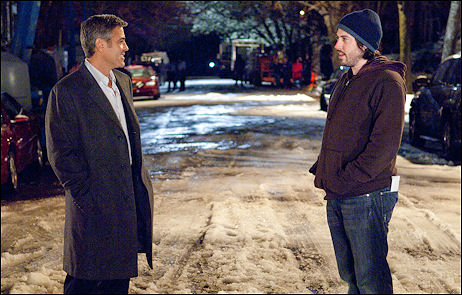
George Clooney, Jason Reitman

“Bingham’s rash decision to throw away his whole life/relationship philosophy as he tries to connect with Alex in Chicago is something a sick guy with emotional avoidance issues might just do.

“Ditto his reaching out to reconnect with his family in northern Wisconsin, however awkwardly, and his trip down memory lane when he and Alex break into his old high school. Not to mention his ‘we all die alone’ declaration whenever he discusses relationships with Natalie.

“My gut tells me that Reitman watched his movie from start to finish and decided the ending was dark enough without piling a cancer diagnosis upon his main character.

“I’m not arguing that movie needed the twist; it works brilliantly without it. But the threads of this lost ending are woven through the film, and I do think it was there at the start. I think the whole story was started down that path and I think Clooney played the character as a goner, and that Reitman had second thoughts in post.

Sidenote: Morettini says that when Bingham tells his boss (Jason Bateman) that he doesn’t remember a bridge-jump suicide threat of one of the women Natalie laid off, “it didn’t read to me that he was protecting Natalie…it seemed to me he that he just forgot about the incident altogether.” That’s obviously not true. Bingham had forgotten nothing. He was protecting Natalie. And himself, of course.

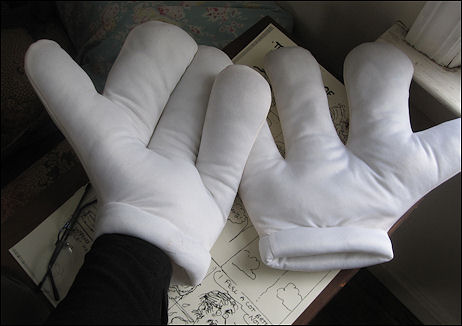
Disney Hands

Shared by Mickey and Minnie Mouse, Goofy, Donald Duck, etc. I found these in the Elizabeth Taylor-Nicky Hilton cottage late this afternoon.


Saturday, 1.2.10, 3:10 pm.

Best January Hate-On

Where do they find directors like Mark Steven Johnson, whose latest effort, a vapid chick flick called When In Rome, opens in late January? One look at the trailer tells you everything. Look at his hack moves, hack TV-series lighting aesthetic, hack preferences for extra-broad comedic reactions, etc. Why are young chick flicks always so vapid and inexpertly made? Is it because producers fear that young women wouldn’t see them if they were of a higher calibre?

Closer

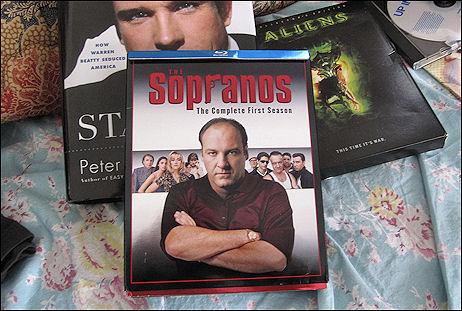
I’m not going to try to out-describe a riff by DVD Beaver’s Gary Tooze on the Sopranos Complete First Season Bluray that I got for Christmas. I can’t help being impressed by “it’s like watching an Ektachrome slide show in perfect continuous motion” — that’s a very good line. So is “the resolution is so good that we are aware of no pixels, just substance.”

Beyond the obvious Blu-ray factor, the reason for the exceptional clarity is that The Sopranos “was very directly filmed, without massive quantities of post-production filtering and manipulation,” he notes. “We are just that much closer to the source here than many of today’s movies. The Sopranos has more in common with a motion picture feature than a television series, so it makes sense that it should look like film, despite that it’s undergone transition and compression with a digital interface presented through a digital medium. Grain is very tight, but image resolution is tighter; impression is voyeuristic, which, I am certain is the intention.”

White Night


Saturday, 1.2.10, 9:25 am — view from the historic Elizabeth Taylor-Nicky Hilton cottage (local legend says they stayed here in ’50 or ’51 for two or three weeks during their brief and stormy marriage) in Wilton, Connecticut.