Time To Show Brothers

Last night Envelope/Notes on a Season columnist Pete Hammond wrote with some enthusiasm about a Sunday DGA screening of Jim Sheridan‘s Brothers (Lionsgate, 12.4), the remake of Susanne Bier‘s 2004 film with Jake Gyllenhaal, Tobey Maguire and Natalie Portman costarring.


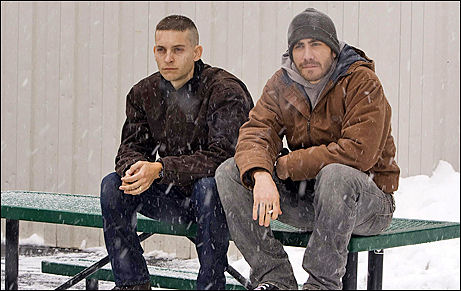
Tobey Maguire, Jake Gyllenhaal in Jim Sheridan’s Brothers.

Hammond asked “why no bloggers are buzzing about Brothers even with its Dec. 4 opening less than a month away”? Well, I’ve been writing about this film for over two years now, beginning with a start-of-filming announcement and into a 10.1.08 report that MGM had bumped Brothers out of a once-planned 12.4.08 release.

But to answer Hammond, no one’s blogging about Brothers because Lionsgate has been lagging on press screenings invites, or at least none as far as this inbox is concerned. I’m told there’s some kind of “special screening” in Manhattan slated for 11.22, and an L.A. premiere screening set for 12.1. Sheridan is currently in Toronto preparing to shoot Dream House, a psychological thriller with Daniel Craig starring. He flies to Ireland tomorrow and returns to this side of the pond a week or so later.

Sheridan’s remake follows Bier’s basic story. Maguire and Gyllenhaal are the brothers separated by character and philosophy (as well as four inches of height). Maguire is the older, “responsible,” married brother who goes off to Afghanistan and gets into a situation that results in a MIA report sent home. Portman plays Maguire’s wife. Gyllenhaal is the younger fuck-up brother who begins to fill his brother’s familial duties when Maguire disappears during a skirmish and is presumed dead.

Lionsgate is obviously much more interested in promoting Precious than Brothers at this stage, and who can blame them? But conspicuously not screening a film that will be released nearly three weeks hence seems like a weird way to play it. Being a huge fan of Bier’s original work, I refuse to believe that a film with this story and a cast of this calibre wouldn’t deliver in a significant and applaudable way.

“This powerful and timely story of a decorated Marine, presumed dead in Afghanistan, who comes home to great conflict within his family and within his own head, is a poignant and explosive look at the toll that combat exacts from veterans’ lives,” Hammond writes. “It feels especially pertinent now in the wake of the Ft. Hood tragedy and shows that war doesn’t really end for some vets once they return.

“Sheridan received a tremendous ovation Sunday afternoon when he was introduced for a q & a after a very well-received Directors Guild of America screening. The free-wheeling director engaged in a refreshingly honest and thoughtful conversation about the film’s bumpy journey to being remade.

“Sheridan pointed out that he doesn’t normally like the idea of remakes, but this one seemed irresistible, if full of minefields. In the end he believes it is quite faithful to the spirit of the Danish original and said Relativity Media, which financed the film, even did research screenings on Bier’s movie to get a take from an American audience for help in shaping the redo.

“[Sheridan] also mentioned there were some reshoots as he tried to get a grip on what the movie should be.

“The film was finished by November 2008 but Relativity agreed to hold it for a year to get just the right release date. Sheridan says selling any film with a war theme is tricky and fall is a better time for this particular subject matter. With Summit’s widely acclaimed Iraq war flick, The Hurt Locker opening last summer, it was probably a wise move.”


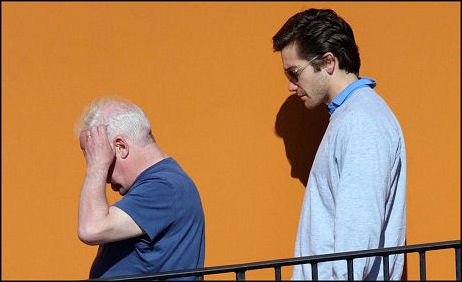
Jim Sheridan, Jake Gyllenhaal.

Hereafter

I’m very interested in snagging a PDF of Peter Morgan‘s Hereafter, if anyone has access. This is the now-shooting Clint Eastwood film, of course — a reportedly supernatural piece about three characters “touched by death in different ways,” etc.

Hereafter costars Matt Damon, Cecile de France, Marthe Keller (Marathon Man, Bobby Deerfield, Black Sunday — U.S. theatrical career seemingly killed by Fedora and The Formula), Mylene Jampanoi and Thierry Neuvic.

I’m forming an idea that whatever Invictus may or may not be, Hereafter may settle in and really touch home. It would be seen, of course, as a contemplation of realms beyond by a director obviously edging a bit closer to the take-off point as the years fall away, etc. We’re all going there sooner or later so what does it matter how soon or far off? Quality, not quantity.

Eastwood began shooting Hereafter last month in Paris, and then went to London. Filming in San Francisco and Hawaii is next. Eastwood, Kathleen Kennedy and Robert Lorenz are producing. Steven Spielberg, Frank Marshall, Tim Moore and Morgan are exec producing. Warner Bros. will open Hereafter in December 2010.

Apocalypse Gaga

I’ve forgotten if there’s a review embargo in effect for Roland Emmerich‘s 2012, but let’s assume there is and state unequivocally that this is not a review. But I do need to say that this mother-of-all-disaster-movies — this stunner, this train wreck, this howler that is Deep Impact, The Poseidon Adventure (Hackman/Winters/Lynley/Buttons version), Titanic, Airport and Hot Shots times infinity multiplied by five hits of blotter acid with CG that will make you plotz in your gourd — is absolutely, categorically and certifiably insane and must be seen because of this fearless wackazoid quality.

That’s all I’m going to say except hats off to John Cusack, the mother of all genius paycheck whores. This movie, believe it or not, is a Cusack score and not a fumble. Let’s raise a glass to Emmerich-level insanity and the nerve it took to make a film like this. As the medic said at the end of David Lean‘s The Bridge on the River Kwai, “Madness! Madness!”

Slamdunks & Slummers

I just filled out my projected Top Ten Best Picture list for the Envelope Buzzmeter chart Most seem to be following an equation that includes six or seven Best Picture contenders with serious chops (Up In The Air, Invictus, An Education, A Serious Man, etc.) along with three or four slummers, which is to say films that exude a certain crowd-pleasing popcorn aroma (Avatar, District 9, Inglourious Basterds, Up).

I’m going right now with Up In The Air, The Hurt Locker, Invictus, An Education, Nine, A Serious Man, Precious, A Single Man, Avatar and Inglourious Basterds — eight real contenders and two slummers. What really matters, of course, is whether a potential Best Picture nominee has a Best Director nomination to fortify it. This is what people will be seriously weighing when push comes to shove.

Right now my Best Director projections are based only on films I’ve seen, to wit: Jason Reitman (Up In The Air), Kathryn Bigelow (The Hurt Locker), Lone Scherfig (An Education), Joel and Ethan Coen (A Serious Man) and Tom Ford (A Single Man).

I’ve seen Precious, Up and Inglourious Basterds, of course, but it still shakes down as a temporary no-go for Lee Daniels, Peter Jackson, Pete Docter, Quentin Tarantino and James Cameron…for now. If and when it appears that Invictus has the right stuff then maybe Clint Eastwood will step in and bump Ford…maybe. Or the Coen brothers…I haven’t decided yet.

Calculator’s Broken

Michael Cieply‘s financial assessment piece in today’s N.Y. Times about potential revenues from James Cameron‘s Avatar states the following:

(a) “Published reports have put the production budget at more than $230 million“;

(b) “[But] when global marketing expenses are added, Avatar may cost its various backers $500 million“;

(c) “Fox’s biggest investment in Avatar may be on the marketing side, where the company is planning to spend about $150 million around the world”;

(d) Rupert Murdoch‘s News Corporation “is carrying a much smaller share of Avatar’s production cost, as a pair of private equity partners — Dune Entertainment and Ingenious Media — pick up 60 percent of the budget”;

(e) “If domestic ticket sales reach $250 million — a level broken in the last year by five films, including Star Trek and The Hangover — Fox and its allies would appear to be headed into the black.”

I’m lost — totally lost. MCN’s David Poland posted a pretty good slice-and-dice reaction piece last night. Says what I was thinking and then some.

Imagine That

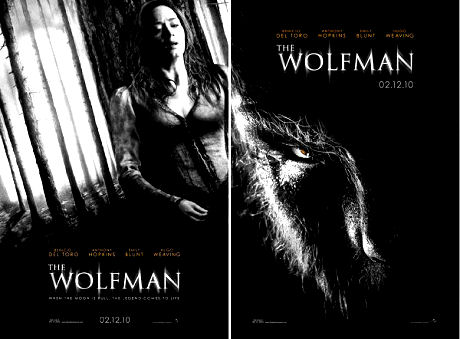
It’s almost fascinating that Universal marketing has decided to try a suggestive/arty mode for its recently revealed one-sheet campaign for Joe Johnston‘s The Wolfman (2.12.10). If Val Lewton were making werewolf movies today and designing his own posters, these are the kind of material he’d probably turn out.

All Fall Down

There’s a paywall up on the Newsday site, but Lewis Beale has written a piece about apocalyptic movies called “2012 and The Road lead doom boom on screen.” And the only thing wrong with it is that — huh? — Beale and his editors chose to ignore the real-life gloom-and-doom doc that film cognoscenti are all over right now — i.e., Chris Smith‘s Collapse.

Beale says he hasn’t seen Collapse and that it was never mentioned in conversations with his editors, but if it had been the dialogue would have probably sounded something like this:

Beale: “Uhh, there’s this other thing, this doc called Collapse that…uhhm, pretty much explains how we’re all fucked and the whole system is doomed to stop functioning due to oil shortages.”

Editor: “Is this one of those wake-up, love-the-earth movies? Don’t they show enough of those on PBS and the Nature Channel?”

Beale: “No, it’s not one of those. It’s an intellectual, cold-facts horror film…kind of a thinking man’s 2012.”

Editor: “Well, we don’t want to get into that. Too real. We’re selling newspapers to mom and pop and Uncle Freddy. People who just want to eat popcorn and watch movies that…whatever, make ’em laugh and show stuff getting blown up.”

Here’s Beale’s piece, in any event:

The Road opens with the sound of explosions and the vision of a fire that obliterates the sky. Is it a nuclear holocaust? Planet-wide environmental disaster? Rogue comet?

“The thing about the post-apocalyptic wasteland in the film, which opens Nov. 25th, is that whatever turned Earth into a pestilential wasteland is never really specified. So as a father and son (played by Viggo Mortensen and newcomer Kodi Smit-McPhee) make their way across a bombed-out landscape, trying to avoid cannibals, thieves and other sub-human life forms, The Road mirrors the concerns of the Pulitzer Prize-winning Cormac McCarthy novel on which it is based: what is important isn’t why things happened, but what happens afterward. And how the bond between a father and son can triumph over adversity.

“An extreme environment like the one in the movie ‘is a projection of our worst fears,’ says The Road director John Hillcoat. ‘In a way, as individuals we face that day when we have to leave this world, and it’s a projection of that fear on a global scale. It also brings out the best and worst in humans. How do you hang onto humanity?’

The Road is not the only film to ask this question. In fact, apocalyptic fantasies seem to be all the rage these days. The animated feature 9, released last summer, is about a group of automatons dealing with an Earth in which humans have died off. 2012, opening Friday, is a cosmic disaster flick based on Mayan prophecy which alleges the world will end on Dec. 21, 2012. And The Book of Eli, opening in January, stars Denzel Washington as a hero who carries a book that could save a post-apocalyptic society.

“This fascination with total destruction is because ‘we’re all prophets of doom,’ says James Berger, author of After The End: Representations of Post-Apocalypse. ‘In part, it has to do with our relation to our mortality,’ he adds. ‘There is also this total critique of the world as it is, the corruption of society is so tremendous, it can’t be reformed. There is the perverse pleasure of seeing it go down. It’s done, it’s cooked, stick a fork in it.’

“These films are about ‘our lack of control over our own destiny — our fear that larger forces are at work that we know nothing about or that we have no say in,’ adds critic Marshall Fine of HollywoodandFine.com. ‘It’s the issue of control — that we want it and, for whatever reason, suddenly find out we don’t have it.’

“Not that this is anything new. The concept of the apocalypse has been with us since Biblical times — the Book of Revelations, anyone? — but really picked up speed beginning in the late 19th century, when writers like H.G. Wells began to explore the negative consequences of the industrial revolution. Then World War I, with its mass slaughter, only made these fears more palpable.

“‘The advent of new military technologies [during the conflict] made war brutal and grotesque in new and overwhelming ways,’ says Berger. ‘It was hugely destabilizing.’

“But then came the nuclear age, and the idea of total global destruction became a reality. Add in environmental, biological and terrorism-related concerns, and you get the perfect cocktail of paranoid, or maybe not so paranoid, fears.

“‘You don’t have to be a scientist to know that if we don’t change our ways, the end of the world is here,’ says Harald Kloser, co-writer and producer of 2012. ‘The end of the world is not a fiction if we don’t change real soon. And the question is, have we passed the point of no return.’

“Hollywood, never afraid to plug into the zeitgeist, picked up on the End Times mentality pretty quickly. The 1936 film Things To Come, written by Wells, pictures a pre-nuclear world destroyed by a catastrophic war. Pictures like Panic In Year Zero (1962) and On the Beach (1959) dealt with the aftermath of nuclear terror. Silent Running (1971) and The Omega Man (1971 — remade in 2007 as I Am Legend) channeled environmental and biological fears. And The Road Warrior (1981), probably the best of the end-of-the-world films, dealt with nuclear war, political paralysis and a post-apocalyptic fight over resources (in this case, oil) that seemed all too real.

“‘There’s always something that’s scaring people, which can be used as an overlay on movies with a disaster or threat at their center,’ says Fine. “Communism, nuclear war, terrorism, global warming — there are plenty of things that have or will make us worry about the world coming to an end that movies can exploit to make a buck.’

“If anything, The Road takes this genre and gives it a new twist, since it is so intimate and character driven.

“In fact, Hillcoat says two non-apocalyptic movies served as a sort of template for the film: the 1948 Italian film Bicycle Thieves, about a desperate father searching for the stolen bike that is his source of income, because ‘[the father and son lead characters] are starving and trying to survive, and the father’s morals start to slide’; and the 1940 feature The Grapes of Wrath, in which farmers are driven from Oklahoma by drought, since it involves ‘a complete sort of breakdown, and the people are on the road, and there are apocalyptic overtones.’

“No matter what the source material they refer to, however, it seems apocalyptic films are not going away. And that’s because the fears they plug into will always be with us — especially in a post-9/11 world.”

“There is an undercurrent of the possibility of an apocalypse happening that makes these movies go deep emotionally,” says Kloser. “That’s why people are drawn to destruction. It connects them with their deepest inner fear.”

Good Vibe

I’m proud and pleased to announce that I’ve been officially welcomed into the fold of the Broadcast Film Critics Association. This’ll be great as far as time screening invites and receiving screeners are concerned, and of course it’s a nice thrill to be honored with a membership in the first place.

Ansen Calling LAFF Shots

Longtime Newsweek film critic David Ansen has joined Film Independent as artistic director of the organization’s 2010 Los Angeles Film Festival, it was announced an hour or so ago. Senior programmer Doug Jones has also been promoted to associate director of programming. The festival will run from 6.17 through 6.27. I did a quick phoner with Ansen around 2:45 pm today; will post something later tonight or tomorrow morning.


Newsweek critic and just-announced LAFF artistic director David Ansen.

The Pinch

Last weekend Time‘s Erin Davies delivered a fairly thorough (read: depressing) summary of the hard economic times plaguing the independent film industry, including a blind quote from an “industry executive” that “very few people think Focus Features is going to survive.” All the bummer statistics are presented, and all of it explaining why ads are a little harder to come by, and/or require a lot more in the way of begging and cajoling.

Ultimate GWTW Upgrade

“There are moments” when Warner Home Video’s new Gone With The Wind Bluray “simply looks ‘better’ than the previous DVDs,” says DVD Beaver’s Gary Tooze, “and then there are times when it makes you gasp. Most notable may be the colors — flesh tones are warm at times but lose that yellow-orangey look of the SD transfers. Detail advances to as high a degree as we are likely to see for this 70-year old classic.”

The GWTW Bluray streets on 11.17. I haven’t received a copy myself but then again I’m at a new Brooklyn address.

“Whites are whiter (no longer creamy), blacks are pitch and the dual-layered, 44 Gig transfer of this almost four-hour film shares the disc with only the Rudy Behlmer commentary and some extensive foreign language dubs and subtitle options.

Gone With the Wind‘s enormity is half the experience and it’s big here — very BIG. Contrast and lighting visuals have some jaw-dropping moments and I can’t imagine it looking any better for your home theater enjoyment. There is less grain that I would have thought but I don’t feel there was an over-abundance of digital manipulation, and it is smooth in motion.”

Tooze doesn’t mention that his screen-grab comparisons indicate that the Bluray offers slightly more picture information on the sides than the previous standard DVD issue of this 1939 mega-classic. Look closely and you’ll see extra info on both the left and right sides of the Bluray captures.

It can’t be overstated that while Gone With The Wind is nominally about the agonies caused by the Civil War in the 1860s and the deprivations of Reconstruction from 1865 through the late 1870s, it is at heart a portrait of the sufferings Americans went through during the Great Depression of the 1930s. Which links to today, in a sense, in that most Americans are grappling with the bite of the Great Recession, despite recent cheering by the elite Wall Street crowd that the hard times are pretty much over. For them, maybe.