All Fall Down

There’s a paywall up on the Newsday site, but Lewis Beale has written a piece about apocalyptic movies called “2012 and The Road lead doom boom on screen.” And the only thing wrong with it is that — huh? — Beale and his editors chose to ignore the real-life gloom-and-doom doc that film cognoscenti are all over right now — i.e., Chris Smith‘s Collapse.

Beale says he hasn’t seen Collapse and that it was never mentioned in conversations with his editors, but if it had been the dialogue would have probably sounded something like this:

Beale: “Uhh, there’s this other thing, this doc called Collapse that…uhhm, pretty much explains how we’re all fucked and the whole system is doomed to stop functioning due to oil shortages.”

Editor: “Is this one of those wake-up, love-the-earth movies? Don’t they show enough of those on PBS and the Nature Channel?”

Beale: “No, it’s not one of those. It’s an intellectual, cold-facts horror film…kind of a thinking man’s 2012.”

Editor: “Well, we don’t want to get into that. Too real. We’re selling newspapers to mom and pop and Uncle Freddy. People who just want to eat popcorn and watch movies that…whatever, make ’em laugh and show stuff getting blown up.”

Here’s Beale’s piece, in any event:

The Road opens with the sound of explosions and the vision of a fire that obliterates the sky. Is it a nuclear holocaust? Planet-wide environmental disaster? Rogue comet?

“The thing about the post-apocalyptic wasteland in the film, which opens Nov. 25th, is that whatever turned Earth into a pestilential wasteland is never really specified. So as a father and son (played by Viggo Mortensen and newcomer Kodi Smit-McPhee) make their way across a bombed-out landscape, trying to avoid cannibals, thieves and other sub-human life forms, The Road mirrors the concerns of the Pulitzer Prize-winning Cormac McCarthy novel on which it is based: what is important isn’t why things happened, but what happens afterward. And how the bond between a father and son can triumph over adversity.

“An extreme environment like the one in the movie ‘is a projection of our worst fears,’ says The Road director John Hillcoat. ‘In a way, as individuals we face that day when we have to leave this world, and it’s a projection of that fear on a global scale. It also brings out the best and worst in humans. How do you hang onto humanity?’

The Road is not the only film to ask this question. In fact, apocalyptic fantasies seem to be all the rage these days. The animated feature 9, released last summer, is about a group of automatons dealing with an Earth in which humans have died off. 2012, opening Friday, is a cosmic disaster flick based on Mayan prophecy which alleges the world will end on Dec. 21, 2012. And The Book of Eli, opening in January, stars Denzel Washington as a hero who carries a book that could save a post-apocalyptic society.

“This fascination with total destruction is because ‘we’re all prophets of doom,’ says James Berger, author of After The End: Representations of Post-Apocalypse. ‘In part, it has to do with our relation to our mortality,’ he adds. ‘There is also this total critique of the world as it is, the corruption of society is so tremendous, it can’t be reformed. There is the perverse pleasure of seeing it go down. It’s done, it’s cooked, stick a fork in it.’

“These films are about ‘our lack of control over our own destiny — our fear that larger forces are at work that we know nothing about or that we have no say in,’ adds critic Marshall Fine of HollywoodandFine.com. ‘It’s the issue of control — that we want it and, for whatever reason, suddenly find out we don’t have it.’

“Not that this is anything new. The concept of the apocalypse has been with us since Biblical times — the Book of Revelations, anyone? — but really picked up speed beginning in the late 19th century, when writers like H.G. Wells began to explore the negative consequences of the industrial revolution. Then World War I, with its mass slaughter, only made these fears more palpable.

“‘The advent of new military technologies [during the conflict] made war brutal and grotesque in new and overwhelming ways,’ says Berger. ‘It was hugely destabilizing.’

“But then came the nuclear age, and the idea of total global destruction became a reality. Add in environmental, biological and terrorism-related concerns, and you get the perfect cocktail of paranoid, or maybe not so paranoid, fears.

“‘You don’t have to be a scientist to know that if we don’t change our ways, the end of the world is here,’ says Harald Kloser, co-writer and producer of 2012. ‘The end of the world is not a fiction if we don’t change real soon. And the question is, have we passed the point of no return.’

“Hollywood, never afraid to plug into the zeitgeist, picked up on the End Times mentality pretty quickly. The 1936 film Things To Come, written by Wells, pictures a pre-nuclear world destroyed by a catastrophic war. Pictures like Panic In Year Zero (1962) and On the Beach (1959) dealt with the aftermath of nuclear terror. Silent Running (1971) and The Omega Man (1971 — remade in 2007 as I Am Legend) channeled environmental and biological fears. And The Road Warrior (1981), probably the best of the end-of-the-world films, dealt with nuclear war, political paralysis and a post-apocalyptic fight over resources (in this case, oil) that seemed all too real.

“‘There’s always something that’s scaring people, which can be used as an overlay on movies with a disaster or threat at their center,’ says Fine. “Communism, nuclear war, terrorism, global warming — there are plenty of things that have or will make us worry about the world coming to an end that movies can exploit to make a buck.’

“If anything, The Road takes this genre and gives it a new twist, since it is so intimate and character driven.

“In fact, Hillcoat says two non-apocalyptic movies served as a sort of template for the film: the 1948 Italian film Bicycle Thieves, about a desperate father searching for the stolen bike that is his source of income, because ‘[the father and son lead characters] are starving and trying to survive, and the father’s morals start to slide’; and the 1940 feature The Grapes of Wrath, in which farmers are driven from Oklahoma by drought, since it involves ‘a complete sort of breakdown, and the people are on the road, and there are apocalyptic overtones.’

“No matter what the source material they refer to, however, it seems apocalyptic films are not going away. And that’s because the fears they plug into will always be with us — especially in a post-9/11 world.”

“There is an undercurrent of the possibility of an apocalypse happening that makes these movies go deep emotionally,” says Kloser. “That’s why people are drawn to destruction. It connects them with their deepest inner fear.”
Good Vibe

I’m proud and pleased to announce that I’ve been officially welcomed into the fold of the Broadcast Film Critics Association. This’ll be great as far as time screening invites and receiving screeners are concerned, and of course it’s a nice thrill to be honored with a membership in the first place.

Ansen Calling LAFF Shots

Longtime Newsweek film critic David Ansen has joined Film Independent as artistic director of the organization’s 2010 Los Angeles Film Festival, it was announced an hour or so ago. Senior programmer Doug Jones has also been promoted to associate director of programming. The festival will run from 6.17 through 6.27. I did a quick phoner with Ansen around 2:45 pm today; will post something later tonight or tomorrow morning.


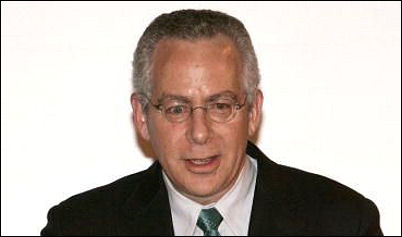
Newsweek critic and just-announced LAFF artistic director David Ansen.

The Pinch

Last weekend Time‘s Erin Davies delivered a fairly thorough (read: depressing) summary of the hard economic times plaguing the independent film industry, including a blind quote from an “industry executive” that “very few people think Focus Features is going to survive.” All the bummer statistics are presented, and all of it explaining why ads are a little harder to come by, and/or require a lot more in the way of begging and cajoling.

Ultimate GWTW Upgrade

“There are moments” when Warner Home Video’s new Gone With The Wind Bluray “simply looks ‘better’ than the previous DVDs,” says DVD Beaver’s Gary Tooze, “and then there are times when it makes you gasp. Most notable may be the colors — flesh tones are warm at times but lose that yellow-orangey look of the SD transfers. Detail advances to as high a degree as we are likely to see for this 70-year old classic.”

The GWTW Bluray streets on 11.17. I haven’t received a copy myself but then again I’m at a new Brooklyn address.

“Whites are whiter (no longer creamy), blacks are pitch and the dual-layered, 44 Gig transfer of this almost four-hour film shares the disc with only the Rudy Behlmer commentary and some extensive foreign language dubs and subtitle options.

Gone With the Wind‘s enormity is half the experience and it’s big here — very BIG. Contrast and lighting visuals have some jaw-dropping moments and I can’t imagine it looking any better for your home theater enjoyment. There is less grain that I would have thought but I don’t feel there was an over-abundance of digital manipulation, and it is smooth in motion.”

Tooze doesn’t mention that his screen-grab comparisons indicate that the Bluray offers slightly more picture information on the sides than the previous standard DVD issue of this 1939 mega-classic. Look closely and you’ll see extra info on both the left and right sides of the Bluray captures.

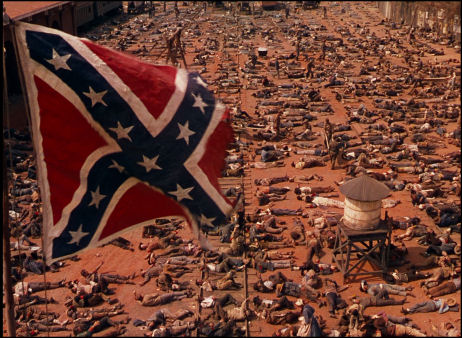
It can’t be overstated that while Gone With The Wind is nominally about the agonies caused by the Civil War in the 1860s and the deprivations of Reconstruction from 1865 through the late 1870s, it is at heart a portrait of the sufferings Americans went through during the Great Depression of the 1930s. Which links to today, in a sense, in that most Americans are grappling with the bite of the Great Recession, despite recent cheering by the elite Wall Street crowd that the hard times are pretty much over. For them, maybe.

Messenger Guys

I saw Oren Moverman‘s The Messenger last July. I went with the menu, respected the chops and intent, found Samantha Morton‘s performance as a bereaved Iraq War widow especially moving. (So far the film has a 100% Rotten Tomatoes rating.) Last night I attended the after-party at 1Oak following the Manhattan premiere. The Oscilloscope release opens this Friday.


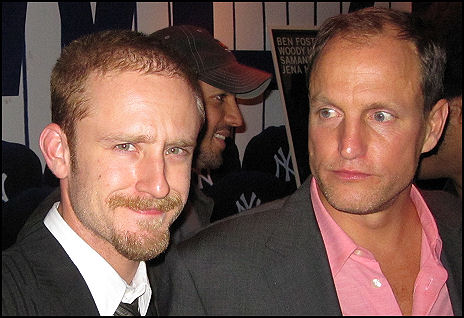
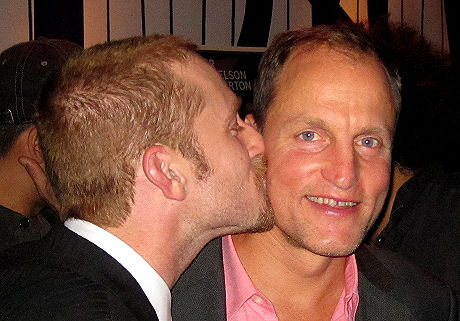
The Messenger costars Ben Foster, Woody Harrelson at 1Oak — Sunday, 11.8, 10:10 pm.

I spoke to Woody Harrelson briefly about that Sunset Strip oxygen bar he owned/ran about eight or nine years ago. We could have gotten into loads of other topics but the loudness of the party and the three or four people hovering nearby, waiting for the slightest opening (i.e., a perceived lull in the conversation) as a opportunity to dive in and say hi to Woody…but that’s human nature, and what these parties are like every time.

I was a bit hesitant about speaking with Foster because his Messenger performance is, for me, a slight hiccup. There’s something inwardly clenched and raging in Foster that won’t let up. Even when he’s smiling and being gentle as he’s looking at Samantha Morton, you half-think he’s got plastic explosive strapped to his chest and he’s about to pull the string. He’s a serious actor trying to be real and plain, and I understand that he’s trying to suppress the wired-nutbag thing in The Messenger. But it comes out anyway.

The upside, of course, is that he’s got this quality as a kind of signature, which every actor needs. So it’s better, really, to be “Ben Foster” in this sense than to be one of hundreds or thousands of likable edgeless actors just looking for work. He’s definitely a brand and a personality. I have this inkling that he’d be great in a comedy.

The Messenger “joins the group of strong Iraq-war movies that, like rejected suitors, stand hat in hand, waiting for an audience to notice their virtues,” writes New Yorker critic David Denby. “My canon includes In the Valley of Elah, The Hurt Locker and the commercially conceived but affecting Stop-Loss. Box-office wisdom holds that it’s too early to make movies about this conflict, but how can it ever be too early to make a good movie?”

Reds

In an acknowledgement of the 20-year anniversary of the fall of the Berlin Wall, which heralded the end of the extended and aggravated U.S.-Soviet Union tensions generally referred to as the Cold War, L.A. Times critic Betsy Sharkey has listed her favorite films which reflected that era and mindset. But she misdescribes one seminal 1950s-era monster movie, and overlooks the bulls-eye capturing of American fears of Communist invasion and subversion in the finale of another ’50s monster flick.

In other words, Sharkey calls Don Siegel‘s Invasion of the Body Snatchers (1956) a fear-of-aliens movie when the common interpretation is that the film is a metaphor about encroaching 1950s conformity — about the horror of submitting to the bland uniformity of Eisenhower-era values and attitudes.

And no review of Cold War movies is complete without acknowledging how concisely and comprehensively the last ten or twelve seconds of Howard Hawks‘ and Christian Nyby‘s The Thing From Another World (1951) says it all. “Watch the skies…keep looking, keep watching the skies” is a kind of rough haiku that sums up what all middle-class Americans were vaguely thinking or reacting to on a subconscious level during the height of early ’50s paranoia about “them.”

(Apologies for the ghastly visual quality of the clip.)

A Great Story?

To me it’s just more of the same improbable, nobody-could-ever-survive-this-in-real-life action-movie horseshit. I stopped even half-believing what I was seeing before the guy was up the tree. Jean-Luc Godard would spit on it.

Hide The Women

I was puzzled after reading Mark Olsen‘s 11.8 “Indie Focus” column this morning. The focus was Sebastian Guitterrez‘s Women in Trouble, an apparently sexy, allegedly Pedro Almodovar-esque indie anthology that will open in New York and Los Angeles on 11.13. It costars Carla Gugino, Adrianne Palicki, Marley Shelton, Simon Baker, Elizabeth Berkley and Josh Brolin.L.A. Times columnist and screening series host Pete Hammond, who knows everyone and sees everything) telling me they’d never heard of Women in Trouble, much less received an invite themselves.

I eventually learned that the film is being repped by Mike Rau of 42West. There have been one or two select screenings in Los Angeles, apparently. (I’m not sure about NYC showings.) The responses, I’m told, have been moderate to cool. A guy I spoke to who’s seen it says “it’s not bad…there’s nothing horribly wrong with it, but it’s not great either.”

Screen Media is a kind of “for hire” vanity distributor, I gather. You pay them, they put it out there, handle the ads and whatnot.

I’m a Gugino fan (especially after seeing her in Desire Under The Elms) and really wouldn’t mind seeing this. Any movie with girls running around in underwear gets at least half a pass from this quarter. Okay, not really but underwear is…you know, a pleasant thing.

Here’s a South by Southwest review by Variety‘s Joe Leydon. Here’s the Wikipedia page. Here’s a promotional/fictional blog by Gugino’s “Elektra Luxx” character.

No Penalty

A long while ago I accepted the notion of Samantha Morton, 33, being the Daniel Day Lewis of younger actresses. She’s a very high-calibre, high-throttle type who can’t help but drill deeply and maybe go a little mad (or madder) with each new performance. Which is what makes her good. But I did mutter “uh-oh” when she first came on-screen in The Messenger. In fact, anyone who’s seen it and claims he/she didn’t say “uh-oh” is probably lying.


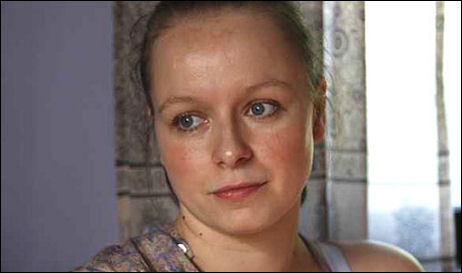
Samantha Morton in The Messenger

The truth is that Morton has been…well, physically changing as the years go by, and I’m now starting to think of her, very respectfully, as more of a Phillip Seymour Hoffman type than a DDL, if you get the drift. Is there any way to mention this issue without sounding like a weight Nazi?

I love that Morton hasn’t done a Kate Bosworth or Kate Hudson to herself, and that she seems more or less indifferent to the psychology that Bosworth/Hudson seem to have responded to. I’m not harping on this issue. I’m just saying Morton is looking a little different these days….that’s all. She’s moving in a certain direction.

Numbers

This weekend Lionsgate’s Precious averaged $100,000 per location in 18 locations — an indie-level record. An Oprah Winfrey-propelled mix of upscale black-and-white audiences (plus middle-scale and downscale black crowds) resulted in a $1.8 million Friday-to-Sunday gross.

The Robert Zemeckis/Jim Carrey/3D A Christmas Carol only managed $31 million from 3,683 locations for a $8,417 average. Not bad but a bit of a shortfall, given the broad family-market potential. I suspect it was because parents decided that the mo-cap Scrooge character looked too scary for toddlers.

Sony’s This Is It was down 40% from last weekend — a relatively decent hold — for a second-place showing of $14 million from 3,481 screens. It has now $57.9 million in the domestic tll and more than $100 million from overseas bookings

Overture’s The Men Who Stare at Goats came in third with $13.3 million earned in 2,443 situations for a $5,444 average.

As expected, Richard Kelly‘s The Box didn’t do too well. The James Marsden-Cameron Diaz horror pic took in about $7.9 million from 2,635 theaters for an average of $2998.