Public Option Cave-in?

President Obama’s reported decision to bail on pushing public option health insurance — a government-subsidized alternative to private health care that would obviously push prices down — is, for me, a heartbreaker. I confess to knowing zip about whether insurance co-ops, which the Obama administration is now floating as an alternative, would have as strong and decisive an effect on keeping costs down…but I strongly doubt that they would.

I do know that there’s no honor in compromising in order to save face. By my sights the public-option tent-fold is a wimp move. A bad day for the Obama brand. The greedy insurance-company bastards are having their way.

N.Y. Times columnist Paul Krugman, whom I trust, says in an 8.16 column that Obamacare (as it was understood before the public-option capitulation) is basically “a plan to Swissify America, using regulation and subsidies to ensure universal coverage.”

But “if we were starting from scratch we probably wouldn’t have chosen this route,” he adds. “‘True ‘socialized medicine’ would undoubtedly cost less, and a straightforward extension of Medicare-type coverage to all Americans would probably be cheaper than a Swiss-style system. That’s why I and others believe that a true public option competing with private insurers is extremely important: otherwise, rising costs could all too easily undermine the whole effort.”

Howard Dean said this morning on talk shows that “you can’t really do health reform without” a public-option program. He called a direct government role “the entirety of health care reform. It isn’t the entirety of insurance reform…we shouldn’t spend $60 billion a year subsidizing the insurance industry.”

Vicko

Did I believe disgraced football player Michael Vick‘s pre-scripted apology on 60 Minutes last night for running a sadistic dog-fight operation that landed him in jail and all but destroyed his career? Nobody did. The guy can’t act. Plus he never talked about his deep-down attitudes and feelings about dogs and how he could see them not as super-loyal friends to love and care for but as snarling gladiators good at killing and being killed. On top of which 60 Minutes interviewer James Brown was too scared to touch on the real cultural “why.”

Dog-fight culture is an ugly thing that stems, I believe, from a predatory, inner-city, watch-your-back vibe that its fans initially encountered in their growing-up neighborhoods. But Vick and Brown never even glanced at, much less alluded to, this. Because that would take them into the machismo thing that has obviously influenced African-American and Hispanic guys of a certain economic strata and their seeming preference (based on years of my own first-hand observation) for fearsome attack dogs. Too close to the bone so they dodged it entirely.

Vick revealed his true self with three lines. The first came when he began one his unconvincing run-on apologies with “whatever the reasons I did this.” (translation: “I probably know why but I sure as shit ain’t gettin’ into it on nationwide TV”). The second came when he said “I don’t know how many times I gotta say [I’m sorry].” (translation: “I’m gettin’ a little sick of apologizin’ over and over for this shit”). The third was his admission that “the first day I walked into that prison and he slammed that door…I knew the magnitude [and] the poor judgment that I allowed to happen to those animals” (translation: “Damn…gettin’ caught and being punished sucks!”)

“It’s wrong, man, ” Vick said. “I don’t know how many times I gotta say it. I feel tremendous hurt about what happened. I deserve to lose the $135 million [contract]. I feel disgusted because of what I allowed to happen to those animals. The first day I walked into that prison and he slammed that door…I knew the magnitude and the poor judgment that I allowed to happen to those animals…I cried over what I did, being away from my family, letting so many people down, letting myself down….being in a prison bed, in a prison bunk…that wasn’t my life, that wasn’t the way things were supposed to be…[and all] because of the so-called culture I thought was right and cool…I thought it was fun and exciting at the time.”

Talking My Language

I was grouching and grumbling about Quentin Tarantino‘s choices for the best films of the last 16 years (i.e., since ’93). Lost in Translation, for example. Then he explained why The Matrix no longer holds the second-place slot on his list due to the what-happened? effect of Reloaded and Revolutions. And I began to smile like I haven’t smiled in several days.

“Bliss of Evil”

Whoever cut this Werner Herzog interview about Bad Lieutenant: Port of Call New Orleans has as much editing expertise as yours truly, which is to say next to none. Movie City Indie‘s Ray Pride posted it this morning. Sorry for the Vimeo. If John Cusack and other occasionally mercenary actors do a straight paycheck movie now and then, so can Werner Herzog.

BAD LIEUTENANT: PORT OF CALL NEW ORLEANS – Werner Herzog Interview from Millennium Films on Vimeo.

Work Ethic

Metropolitan Museum of Art central stairway — Sunday, 8.16, 5:20 pm
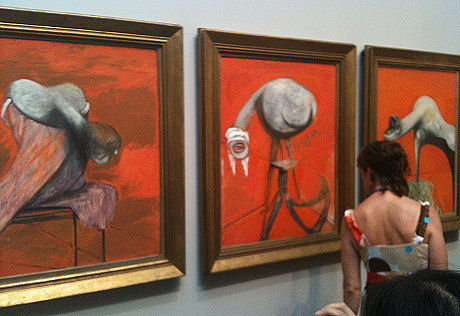
Final day of Met’s Francis Bacon exhibit — 8.16, 3:10 pm

8.16, 4:25 pm
8.16, 6:20 pm
8.16, 6:40 pm

Snake

Where is the transcendent theme or “lift” element in George Hickenlooper‘s Casino Jack, a drama about oily wheeler-dealer Jack Abramoff (Kevin Spacey)? What I mean is that a film about a scumbag has to do more than say “what a scumbag!” I could answer my own question since I have a copy of Norman Snider’s script, but I’ve been too much of a lazy-ass to read it.

Some light has been shed by George Rush & Joanna Molloy, who’ve read the script. But all they’re saying is that “some of its real-life characters” — George Bush, Karl Rove, Tom DeLay, former U.S. Congressman Bob Ney — “have cause for concern.” In other words, scumbag plural.

What I want and expect from this film — especially with the sardonic Spacey in the lead — is perverse black comedy.

Curse and Blessing

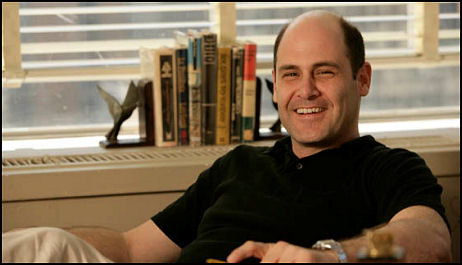
“I’m of the persuasion that budget constraints are very, very good for creativity,” Mad Men auteur Matthew Weiner tells Vanity Fair‘s Bruce Handy. “I think people having unlimited amounts of money makes you really lazy. And I will be quoted on that, believe it or not.”

Mad Men‘s creative honcho Matthew Weiner

I’ve been saying this for years. The more money spent on a film, the more needlessly grandiose and overbearing it tends to be. Obviously not always. That Gone With the Wind shot of the dead and dying in Atlanta surely cost a load of dough, but it was worth every penny. Ditto the mothership arrival in Close Encounters, the chariot race sequence in Ben-Hur, and hundreds of others in this vein. Big money has been creatively well spent in the past, and will be again.

But having less of the stuff to throw around does tend to inspire better films. Case in point: Martin Scorsese‘s The Last Temptation of Christ (a classic made on the cheap) vs. Marty’s Gangs of New York (problems galore despite — or because of? — a massive budget). If I was a studio chief I’d have a framed motto on the wall behind my desk saying “Do it for less or take a hike.”

The problem with Weiner’s less-is-more approach is that it doesn’t necessarily work in a dollars-and-sense way outside of the cable TV realm. Because the Eloi don’t respond to creativity per se. They want dumb-ass CG, high-concept spectacle, monsters and robots, stuff blown up, pants pulled down, guys vomiting in Vegas, etc. They really don’t seem interested in responding to much else. So you can’t make profitable Eloi movies with less money — you need more. And there’s the leak in the boat.

Tumbling Tides

In this morning’s Mad Men vs. Woodstock piece, N.Y. Times columnist Frank Rich quotes Vanity Fair‘s Bruce Handy: “As in Hitchcock, the Mad Men characters are unaware of shocks that the audience knows all too well lie ahead, whether they be the Kennedy assassination and women’s lib or long sideburns and the lasting influence of Doyle Dane Bernbach’s witty, self-deprecating ‘lemon’ ad for Volkswagen.”

“What we don’t know,” Rich comments, “is how the characters will be rocked by these changes. But we’re reasonably certain it won’t be pretty. That’s where the drama is, and it’s tense.

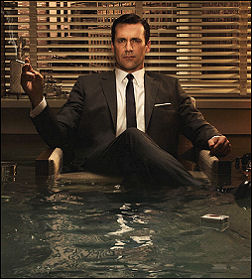
“In the world of television, Mad Men is notorious for drawing great press and modest audiences. This could be the season when the viewers catch up, in part because the show is catching up to the level of anxiety we feel in 2009. In the first two seasons, the series was promoted with the slogan ‘Where the Truth Lies.’ This year, it’s ‘The World’s Gone Mad.’ The ad hyping the season premiere depicts the impeccably dressed Don Draper, the agency executive played by Jon Hamm, sitting in his office calmly smoking a Lucky Strike as floodwater rises to his waist.

“To be underwater — well, many Americans know what that’s like right now. But we are also at that 1963-like pivot point of our history, with a new young president unlike any we’ve seen before, and with the promise of a new frontier whose boundaries are a mystery. Something is happening here, as Bob Dylan framed this mood the last time around, but you don’t know what it is. We feel Don Draper’s disorientation as his once rock-solid ’50s America starts to be swept away. We recognize his fear that the world could go mad.”

Tree-Tasting Time

I don’t know much about Terrence Malick‘s The Tree of Life. Okay, I know a couple things. I know that I’ve faintly disliked the title from the get-go because it sounds too pat and cliched. I know the film is coming out in the late fall through Apparition, the new distribution company. And that it’s about an anxious and disturbed middle-aged guy named Jack (Sean Penn) trying to get past a long-simmering resentment of his father (Brad Pitt). And that one way or another Malick’s narrative takes a detour into a dinosaur realm of some kind.


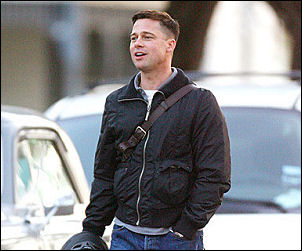
My understanding is that Brad Pitt plays Sean Penn’s dad in Terrence Malick’s Tree of Life.

I was talking about the dino aspect with a journalist friend a couple of weeks ago, and we were both shaking our heads and acknowledging what a bizarre mind-fuck it sounds like. On paper at least. And it’s not like I’m blowing the dino thing out of proportion because there’s some kind of Tree of Life-related IMAX dinosaur movie due in early 2010 that will augment or expand on some theme that’s expressed within the parameters of the Penn-Pitt story. Right? I’m just trying to sound like I have a clue.

All I know is that it’s one hell of a transition to go from a story of angry, frustrated people in the 1950s as well as the present and then to somehow disengage the spacecraft and travel into another realm entirely (like Keir Dullea did in 2001: A Space Odyssey when he soared through Jupiter space), and somehow float into a world that is pre-historical and pre-human, and have this time-trip somehow add to our understanding and feeling for the sad/angry/bitter people in the Pitt-Penn realm.

And I just think it’s time for a little taste. A little marketing hors d’eouvre. Some kind of meet-and-see immersion. You can’t just open a movie like this and go, “Okay, guys…. Penn, Pitt, angst, dinosaurs! Line forms to the right.” You have to set things up and prepare people, get them in the mood, warm up the sauce pan, put out a trailer or a short reel…something.

I mean, if someone like me is scratching his head and going “what the fuck…?” over the unusualness of a ’50s domestic drama mixed with footage of prehistoric beasts, imagine what Joe Popcorn is going to think or say. Don’t even talk about the Eloi. Tree of Life is going to be out in.,..what, three and a half months? Four? Time for a little hubba-hubba.

“Starving and Desperate”?

There are only four leap-out portions in David Segal‘s 8.15 N.Y. Times piece about the convulsive goings-on at the Weinstein Co. (“Weinsteins Struggle to Regain Their Golden Touch”).

The first is a vague hint that Segal may have seen Nine or Nowhere Boy or Youth in Revolt…maybe. But that’s all she wrote because he cops out and doesn’t identify which of the six completed Weinstein Co. films he was shown, which strikes me as a very candy-assed, needlessly covert way to go. Not even hints, for Chrissake.

Harvey and Bob Weinstein “were downright generous with me when it came to screening their coming movies,” he writes. “In fact, they shared as much of their slate as was ready — six movies in all, as well as ads, DVDs and rough cuts of unfinished products.”

Think of it…a major August 2009 piece about the Weinsteins and not even a slight intimation about whether or not Nine has that schwing? No backstage gossip of any kind? No discussion about how it might play for Joe and Sheila Popcorn in Jacksonville? No acknowledgement or argument that this ambitious Rob Marshall Oscar-bait musical is or isn’t the big make-or-breaker?

The second is Harvey telling Segal that “the ship’s riding on the slate” and that “if by February, when we release Hoodwinked 2” — he playfully thumps a hand on the table, dramatizing the sound of failure — “I’ll be driving you, or making cheap hamburgers, or selling trailers or refrigerators or something. If the slate works, we’re right back to plan.” Any time a big-wheel talks about flipping burgers…well, draw your own conclusions.

The third stand-out is a little tingle-hint about Youth in Revolt, which will show at the Toronto Film Festival. Segal begins by talking about how he “got a hint of [Bob Weinstein‘s] attention to detail at a recent test screening of Youth in Revolt, a teenage comedy in the vein of Juno. The director, Miguel Arteta, said that for weeks he and Bob had lengthy back-and-forths over seemingly minor decisions, like this one: Does the last scene of the film need a voice-over?

“Bob said yes. Mr. Arteta said no. Bob’s version screened on this particular night in an East Village theater in New York, and afterward, a focus group of 20 audience members were peppered with questions. Among them: How many of you liked the voice-over in the last scene? Every hand but one went up.

“Unbeknownst to the attendees, Mr. Arteta sat two rows away, and after that vote, he turned to Bob, who sat at the rear of the theater, offering him a grateful, smiling shrug that said, ‘You were right.'”

What does this tell us? It tells me that Youth in Revolt may have issues. Any film that needs a line or two of narration….well, you know what they say. It’s not just Segal’s article telling me this. It’s also Michael Cera, the most inert and unassertive one-trick-pony in the film business right now, being the star.

The fourth stand-out is a quote from longtime Weinstein Co. lover/supporter (and my former boss) Kevin Smith. “They had impeccable taste when they were hungry,” Smith tells Segal. “The problem is that they’re not really hungry anymore. They’re starving and desperate.” Yikes.

That said, I’m very keen on seeing the Weinstein slate and can’t wait, especially, to see The Road and Nowhere Boy and, yes, Nine.

Russkis

One of the below images is the word APPARITION converted to Russian cyrillic letters; the other is the new logo of Bob Berney and Bill Pohlad‘s Apparition, a just-announced distribution company that will bring out The Young Victoria and Terrence Malick‘s The Tree of Life. Which is the Russian version and which is the logo? And what’s the reason for the Russian/KGB/Alexander Nevsky ‘tude in the first place?