Candid Deep Blue

Steven Soderbergh, clearly in a dispirited post-Moneyball mood, has told the Guardian‘s Henry Barnes that he’s feeling marginalized and roughed up and may be looking at a diminished future. “In terms of my career, I can see the end of it,” he says. “I’ve had that sensation for a few years now. And so I’ve got a list of stuff that I want to do — that I hope I can do — and once that’s all finished I may just disappear.
“I’m looking at the landscape and I’m thinking, ‘Hmmm, I don’t know. A few more years maybe. And then the stuff that I’m interested in is only going to be of interest to me.”

I buy this and I don’t buy this. The triple whammy of Che‘s box-office wipeout, the admired but under-patronized The Girlfriend Experience and the total collapse of the Moneyball project were jarring upsets, for sure. But Soderbergh is too much of a filmmaking nut to just ride off into the sunset like Alan Ladd‘s Shane or fade away like Gen. Douglas MacArthur. He was just in the one of those moods when Barnes called him. We all go there from time to time.

“It would all sound depressing if Soderbergh didn’t pepper his speech with fits of incredulous laughter,” Barnes writes. “Perhaps the last few years – capped by his recent run-in with Sony over his revised script for Moneyball, a baseball movie starring Brad Pitt, that saw him elbowed off the project – have left him punch-drunk.”

“‘Everybody got scarred by Che a little bit,’ Soderbergh says. ‘I don’t know how to describe it. It took a long time to shake off. It was just such an intense four or five months that it really…’

“There is a long pause. He speaks slowly and evenly.

“You know, for a year after we finished shooting I would still wake up in the morning thinking, ‘Thank God I’m not shooting that film.’

“Does he wish he hadn’t done it?

“‘Yeah.’

“Really?

“‘Yeah. Literally I’d wake up and think, ‘At least I’m not doing that today.'”
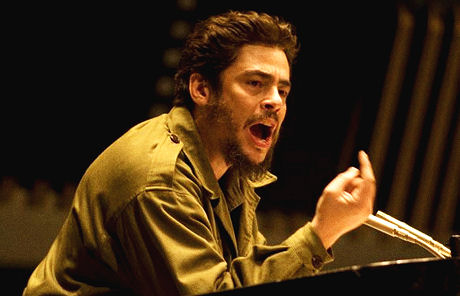
“Soderbergh knew Che (recently released on DVD in the UK, coming from Criterion sometime in the vague fall) would be difficult from the start. The project was brought to him by its eventual star, Benicio del Toro, and producer Laura Bickford, during the shooting of Traffic — the drug war docudrama that won Soderbergh the best director Oscar in 2001.

“Che was essentially Del Toro’s baby and Soderbergh, who was interested in the man but nowhere near as smitten as the actor, approached the movie cautiously, heading into the production with what he describes now as a ‘pretty significant sense of dread’.

“Lack of funding fuelled his fear. And the money wasn’t there partly because of Soderbergh himself. In the characteristically noble pursuit of authenticity he decided to film Che in Spanish, a decision that effectively blitzed any hope of finding significant investment within the US.

“‘It’s a film that, to some extent, needs the support of people who write about films,” he argues. “If you’d had all these guys running around talking in accented English you’d [have had] your head taken off.’

“Eventually European investors were tapped for $58 million (35 million quid) — a paltry figure considering the project’s ambition. As a result Soderbergh was forced to shoot extremely quickly to stay on budget. The two parts were filmed over 76 days, four days fewer than for his glitzy Vegas action comedy Ocean’s Eleven, an $85 million capitalist fat-cat of a movie in comparison with Che.

“‘It’s hard to watch it and not to wish we’d had more time,’ he says of Che. ‘But I can’t tell you that if we’d had more time it would be better — it would just be different. There was an energy and intensity that came out of working that quickly.’
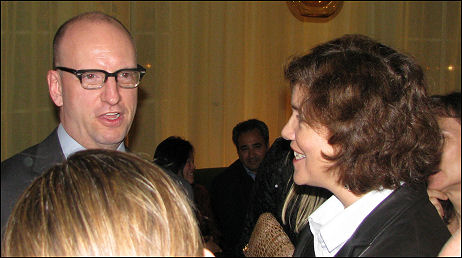

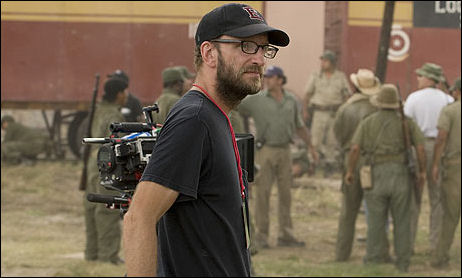
Steven Soderbergh, columnist Anne Thompson at an elite after-party following Che screening at Mann’s Chinese, taken sometime last fall.

“Indeed, Che is easily Soderbergh’s best film since Traffic. But it was a terrible failure at the box office, grossing under $2 million worldwide. Soderbergh blames piracy (‘We got crushed in South America…we came out in Spain in September of last year and it was everywhere within a matter of days…it killed it.”) but it probably didn’t help that his film is a foreign-language marathon with an admittedly distant and impersonal lead.

“Che seems, in retrospect, like a glorious, sad aberration: a niche-audience epic it would be impossible to commission in these straitened times. Today, the willingness of the studios to take such a punt has all but evaporated – a fact that Soderbergh is more alive to than most.”

Loop Premiere

An interesting group attended last night’s In The Loop premiere at the IFC Center. Hangover star Zach Galifianakis was there (and giving me what felt like a bit of a dirty look as the theatre emptied out). Three or four Sopranos guys (Paulie Walnuts, Artie Bucco, Big Pussy, Furio) came at the invitation of Loop costar James Gandolfini. Famke Janseen (Nip/Tuck, Taken, “Jean Grey” in X-Men) was there; ditto Tom Arnold. Several great-looking women with legs to die for were waltzing around the after-party. Plus the usual assortment of journalists (myself and Jett among them).


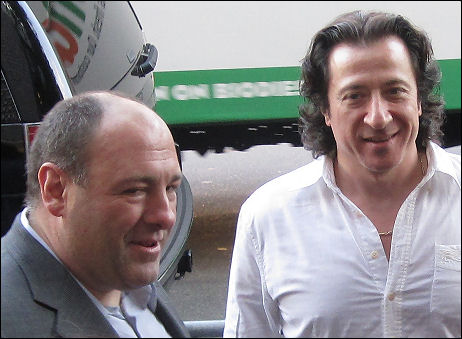
James Gandolfini, Federico Castelluccio (a.k.a., “Furio” on The Sopranos) prior to last night’s In The Loop premiere screening at IFC Center on lower Sixth Avenue.

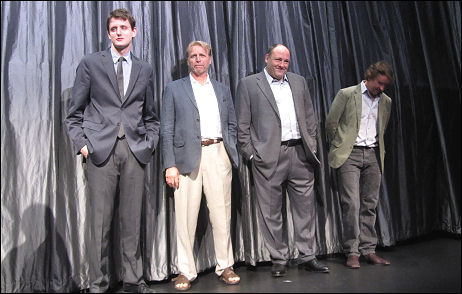
(l. to r.) In The Loop costars Zach Woods, David Rasche, James Gandolfini and Steve Coogan (apologies for the blur) prior to last night’s Loop screening. I have a concern with any older guy who wears sandals but there’s no point in harping.

Lenny Bruce Moment

The gradual left-to-right degradation of the cellar wall opposite the bathrooms in the basement level of the IFC Center (i.e., the way it goes from a faux natural jagged-brick texture to a smoothed-over Mexican restaurant look) reminds me of a bit Lenny Bruce delivered toward the end of John Magnuson‘s Lenny Bruce Performance Film (’65). “This is a real classy wall…looks good, good, decent…and here’s where the brother-in-law took over. ‘People don’t know quality, they’ll settle for shit, let’s give ’em shit.'”


Basement wall opposite bathrooms at Manhattan’s IFC Center — Monday, 7.13, 7:25 pm

Darfur Aliens

The only thing that concerns me about Neill Blomkamp‘s District 9 (Sony, 8.14), which is about insect-like aliens being imprisoned and ghettoized and treated worse than Darfur refugees, is Blomkamp’s visual effects background. This tells me the film will mainly please fanboys and leave people like me wanting more. But maybe not.

I’m also concerned with the dreaded Peter Jackson having produced and the Jackson-allied screenwriter Phillipa Boyens having a co-producer credit. This means that the over-emphatic Jackson stamp — grandiose and hammering visuals without a corresponding passion for believable characters and narrative tension and thespian restraint — could be a prevalent trait in District 9. The fact that the 29 year-old Blomkamp is perhaps a little wet behind the ears in terms of directing prowess certainly leaves the door open for Jackson to have exerted a strong influence.

I’m also a little concerned about aliens looking like those giant cockroaches who knock on doors in those Orkin commercials (“Did you order a pizza?”).

How Sicko Got Blunted

This is three or four days old, but anyone who saw/liked/was aroused by Michael Moore‘s Sicko absolutely needs to watch this scalding Bill Moyers Journal interview with Wendell Potter, former vp corporate communications for CIGNA and current health-care activist with the Center for Media and Democracy. Part #1 is below; here‘s part #2.

Bill Moyers: So what did you think when you saw that film?

Wendell Potter: I thought that he hit the nail on the head with his movie. But the industry, from the moment that the industry learned that Michael Moore was taking on the health care industry, it was really concerned.

Moyers: What were they afraid of?

Potter: They were afraid that people would believe Michael Moore.

Moyers: We obtained a copy of the game plan that was adopted by the industry’s trade association, AHIP. And it spells out the industry strategies in gold letters. It says, “Highlight horror stories of government-run systems.” What was that about?

Potter: The industry has always tried to make Americans think that government-run systems are the worst thing that could possibly happen to them, that if you even consider that, you’re heading down on the slippery slope towards socialism. So they have used scare tactics for years and years and years, to keep that from happening. If there were a broader program like our Medicare program, it could potentially reduce the profits of these big companies. So that is their biggest concern.

Moyers: And there was a political strategy. “Position Sicko as a threat to Democrats’ larger agenda.” What does that mean?

Potter: That means that part of the effort to discredit this film was to use lobbyists and their own staff to go onto Capitol Hill and say, “Look, you don’t want to believe this movie. You don’t want to talk about it. You don’t want to endorse it. And if you do, we can make things tough for you.”

Moyers: How?

Potter: By running ads, commercials in your home district when you’re running for reelection, not contributing to your campaigns again, or contributing to your competitor.

Moyers: This is fascinating. You know, “Build awareness among centrist Democratic policy organizations…”

Potter: Right.

Moyers: “…including the Democratic Leadership Council.”

Potter: Absolutely.

Moyers: Then it says, “Message to Democratic insiders. Embracing Moore is one-way ticket back to minority party status.”

Potter: Yeah.

Moyers: Now, that’s exactly what they did, didn’t they? They…

Potter: Absolutely.

Moyers: …radicalized Moore, so that his message was discredited because the messenger was seen to be radical.

Potter: Absolutely. In memos that would go back within the industry — he was never, by the way, mentioned by name in any memos, because we didn’t want to inadvertently write something that would wind up in his hands. So the memos would usually — the subject line would be — the emails would be, “Hollywood.” And as we would do the media training, we would always have someone refer to him as Hollywood entertainer or Hollywood moviemaker Michael Moore.

Moyers: Why?

Potter: Well, just to — Hollywood, I think people think that’s entertainment, that’s movie-making. That’s not a real documentary. They don’t want you to think that it was a documentary that had some truth. They would want you to see this as just some fantasy that a Hollywood filmmaker had come up with. That’s part of the strategy.

Moyers: So you would actually hear politicians mouth the talking points that had been circulated by the industry to discredit Michael Moore.

Potter: Absolutely.

Moyers: You’d hear ordinary people talking that. And politicians as well, right?

Potter: Absolutely.

Moyers: So your plan worked.

Potter: It worked beautifully.

Moyers: The film was blunted, right?

Potter: The film was blunted.

Flakey Zooey

I love the lead sentence in Stu Van Airsdale‘s 7.13 Movieline piece about Zooey Deschanel, to wit: “[She] has long been something of an emo-dork wet dream for more than just her striking features, lilting voice and commanding screen presence.” Feeling no kinship with emo types or dorks, I’ve never felt the slightest anything for Deschanel. She’s just…whatever. I can roll or not roll with her, but in no way does she push the buzzer.

That said (and as I said on 6.20), 500 Days of Summer “may be, in fact, be the most honest and agreeable blend of romantic headiness and sinking despair since Jerry Maguire.”

Gimme Da Schlesinger

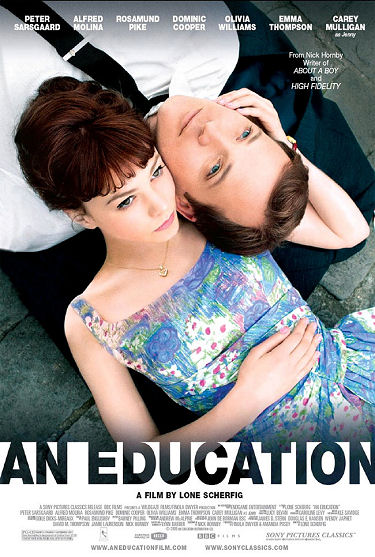
The official Sony Classics one-sheet for Lone Scherfig‘s An Education debuted today on Movie City News. What does it “say”? Period, obviously. A certain poise, a touch of class. But not necessarily an older guy-younger lassy relationship. (Peter Sarsgaard has been Photoshopped to look 26 or so, and Carey Mulligan could be 22 or 23.) What it doesn’t say — and what it should say, I feel — is “a mid ’60s John Schlesinger film.” In sum, it feels a shade too cautious. But what do I know?

Colors


A few feet away from entrance to Cooper Union hotel — 7.13, 8:55 am

Taken at yesterday’s afternoon brunch at a friend’s place in Tribeca — 7.12, 2:25 pm. The colors, the trees, the smiles, woman with the camera, etc. — nice shot.

San Diego Blockage

I’ve only just decided to hit San Diego Comic-Con next week due to an opportunity that was recently presented to me (by Brazilian journalist and HE pally Pablo Villaca) to participate in a forthcoming InFilm tour/seminar. So yesterday I wrote ComicCon’s press guy Christopher Jansen, and seconds later I got a form letter saying that press registration Comic-Con 2009 is closed, and that there will be no onsite registration. It also said “due to the high volume of emails it may take several days before I can get back to you.”

So this is a direct appeal to anyone at Comic-Con who reads and respects and values HE to please ask Jansen to cut me a break.

Locker, Army Guys

HE reader Ray Ciscon has passed along an article on a US Army-related website in which The Hurt Locker is discussed. Some commenters voice relatively minor realism and credibility issues with the portrayal of U.S. soldiers (particularly Sgt. James) in the film. A persistent theme throughout the article is that a good percentage enjoyed it and would in fact recommend it to others.

Boosting Johnson-Lennon

In a just-posted discussion with Ain’t It Cool’s Mr. Beaks, Kick-Ass director Matthew Vaughn has shared an observation about Aaron Johnson‘s performance as John Lennon in Nowhere Boy, which Vaughn has seen.

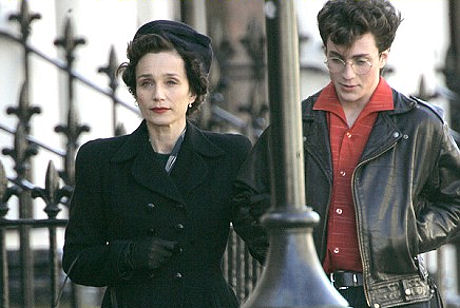
Kristin Scott Thomas as Aunt Mimi and Aaron Johnson as John Lennon in Nowhere Boy.

Vaughn: I nearly postponed the movie for a year because I couldn’t find Dave Lizewski [the lead character in Kick-Ass]. I just couldn’t find Kick-Ass. It was a Friday morning, and I said to the guys, ‘We’re going back to London tonight, and we’re postponing the movie until we figure out who’s playing Dave.’ Then Johnson came in, who, mark my words, is going to be a huge movie star.

“I just saw Nowhere Boy, where he plays John Lennon, and it is a ten-out-of-ten performance. The whole film is fantastic, but he is phenomenal in it. I actually feel like a juvenile moron for what I did to that kid compared to what he does in that film.

Beaks: “What sort of qualities does he bring to the character?

Vaughn: “He has that charisma where you believe every word he says. He can also stand in front of the camera and say nothing, but you still want to watch him. He’s fun. The actor I think he’ll become is Robert Downey, Jr. He’s very similar to him.”

Nowhere Boy is slated for a 2010 release. Beaks remarks that “if Johnson is as good as Vaughn says, I wonder if the Weinstein Co. will consider moving this film into 2009 for a run at Best Actor (especially if Nine turns out to be troublesome).”

Return of Loop Maestro

“I’m trying to think of another American comedy that has this kind of vigor and springy step,” I said this morning during a breakfast interview with In The Loop director Armando Iannucci. “The overwhelming majority of American comedies are geared for guys like Turtle on Entourage, and they don’t have a fraction of the mental alertness, that special Preston Sturges-like quality, that In The Loop has.”


I forgot to snap a photo this morning of In The Loop director Armando Iannucci, but this is where we sat for breakfast at the Cooper Union hotel.

I also remarked that “if I was a major comedian — if I were a Jim Carrey or a Steve Martin — I would consider it vital to somehow work with you somewhere down the line. Sooner or later. There are just not that many people who know how to do this sort of thing, or even care to do this sort of thing well. The lines are just snap-snap-snap. Like Sullivan’s Travel or The Lady Eve.”

Seven months after enjoying an uproarious debut at the ’09 Sundance Film Festival, In The Loop — easily one of the sharpest and funniest potty-mouth comedies about governmental inanity and media mis-speak ever made — is finally about to open. IFC is doing one of their simultaneous indie-level theatrical and IFC On Demand preems on 7.24.

I posted my first Iannucci interview (including an mp3) on 1.13, when George Bush was still president. And now I’ve done another one.

With an invitational Manhattan screening-and-after-party of In The Loop set for this evening, I sat down this morning with Iannucci at the Cooper Square hotel.

In The Loop director-writer Armando Iannucci, costar James Gandolfini.

In The Loop costars Peter Capaldi, James Gandolfini, Tom Hollander, David Rashe, Gina McKee, Chris Addison, Anna Chulmsky and Mimi Kennedy. It’s basically about how the media can sometimes focus on a gaffe by an official or spokesperson and make it sound (via sheer repetition and obsession) to represent firm government policy concerning this or that major issue.

In The Loop‘s major issue is a potential military conflict involving U.S. and British troops — think Iraq in late ’02 and early ’03. The humor is about how various second- and third-tier government types in London and Washington try to dodge, maneuver and counter-spin their way around an essentially meaningless statement by a British cabinet minister that war is “unforeseeable.” Meaningless and yet strangely meaningful once the media gets hold of it. And the source of endless misery for many people.

“One of the most robust pleasures of In The Loop,” I said this morning, “is the wonderfully creative and liberal use of absolutely disgusting profanity. It’s really some of the funniest uses of it. Was every word of it pretty much scripted?”

“More or less, yeah,” Iannucci replied. “You do improvisation, but that’s just to loosen it up and make it feel more natural. But with Malcolm’s…with Malcolm’s swearing, it has to be so precisely done. He does it syllable for syllable, precisely as on the page.

“I’ve tried to describe that sense of absolute certainty that comes when you’re watching a comedy that is absolutely working,” I continued. “To get that feeling one of two things seem to have happened. One is that al the actors have gone to some kind of comedy boot camp and had it drilled into them that there’s a certain attitude that energy that they all need to absorb and radiate, because they’re all of a piece.”

I love how Iannucci, who is Scottish-British, says “Pentagen” rather than “Penta-gone.