


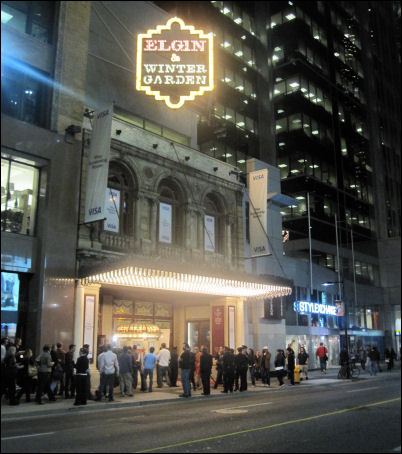
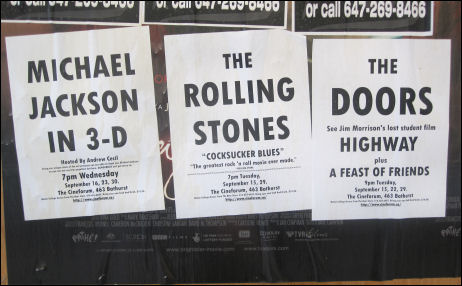

Tim Blake Nelson‘s Leaves of Grass, a rowdy pot-dealing dramedy about twin brothers (both played by Ed Norton) with radically different attitudes and lifestyles — wasn’t what I wanted to see this morning. Actually I’d never want to see a film like this. Most of it is set in some Oklahoma backwater, and I realize how this may sound but it has too much of a greasy, fast-food, good-old-boy attitude for someone like myself. Every so often Nelson’s screenplay avoids the broad-brush approach, but too often it stomps and grins and goes “yeehaw!”
I just don’t give a damn about mangy bearded pot dealers dressed in flannel shirts and parkas and work boots with all kinds of ugly facial hair, and all the crap in their lives to boot. In the same sense that I’m automatically down with the stylish and rarified vibe of Tom Ford‘s A Single Man, which is set in Los Angeles and concerned with people of taste. I understand that a certain aridity can be suggested by such milieus. I’m not suggesting that a film has to be about tasteful and toney people to be good or interesting. I’m merely saying that grotesque Middle American natives are a huge turn-off for me, and that I can’t seem to stifle this feeling. I’m just being honest.
Two scenes early on told me Leaves of Grass wasn’t working. The first involves Norton’s bright college-professor brother being propositioned in his office by an adoring female student. My heart sank as she pulled her top off and leapt up on Norton’s desk — stuff like that is straight out of the Bob Clark Porky’s handbook. I was further disengaged when the same brother, named Bill, is beaten up by enemies of his pot-dealing brother, named Brady, in a mistaken-identity situation. The violence feels way too excessive and sadistic and out-of-the-blue (especially for an Act One occurence), and the guys doing the beating have Deliverance accents and look like scurvy dogs.
I didn’t come to the Toronto Film Festival to watch crude, low-rent fisticuffs that feel as if they were thrown in for some haphazard punch-up effect. I hated this kind of material when it turned up in Burt Reynolds shitkicker movies of the ’70s, and I won’t sit for it now. Life is short, and I don’t care if this sounds like I’m giving Nelson a fair shake or not. It’s not the shitkicker milieu per se — I’ve always loved Lamont Johnson‘s Last American Hero. But I didn’t like the chops I was seeing and I was shifting around in my seat and starting to feel pissy about being there, and that was the way it was.
So how much will it cost to get Variety after the paywall goes up in early 2010? I’ll go for $20 bucks monthly and $150 annually — no more. And it seems strange that the Hollywood Reporter is apparently planning to dump its print version before the end of the year, which means, of course, it’ll lose out on a good amount of Oscar ad pages.


Nikki Finke reported earlier today that the online-only switch-over date date considered was 10.167.09, but now that’s been pushed back. I’m not all that sure I need or want to pay for the online Reporter, to be perfectly frank.
I never wrote anything about Patrick Swayze‘s passing. I should have and I’m sorry — he was way too young and caught a bad break — but the guy just never appealed to me all that much. Not in a deep down sense, I mean. I never loved or bonded with him. I wasn’t even that taken with him in Point Break. So in the midst of all the Toronto hubbub I kind of allowed myself to put off sitting down and paying the poor guy some form of appropriate respect. I’m playing catch-up here. Anyway, I’m sorry. Rest well and sail on.
I went right over to my favorite Starbucks work station (at Bay and Cumberland) right after seeing Chris Smith‘s Collapse, which jolted and melted me down like no documentary has in a long, long while. And as I started to work on a reaction piece, I discovered that Hollywood Elsewhere had gone down. Yes, again. A similar-type wipeout happened last April, and there’s just no alternative at this stage but to sign up with another server, which I’m in the process of doing. HE is back up again, but that’s all she wrote for the Houston-based Orbit/The Planet.
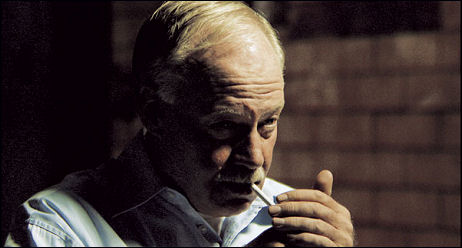
Back to Collapse…
Shot over a two-day period last March, Collapse is basically a Spalding Gray-like soliloquy piece in which Michael Ruppert, a former LA police officer turned independent reporter, author and truth teller, explains in a blunt spoken, highly detailed and extremely persuasive way that our economic and energy-using infrastructure is on the verge of worldwide collapse.
There’s too much debt, too much greed, not enough oil and it’s all going to start falling apart — in fits and starts, bit by bit and then more and more, and then eventually…well, look out. A vast and terrible turnover that will devastate and destruct is just around the corner. Ten years, twenty years…forget it. I listened and listened to what Ruppert said, and “a hard rain’s gonna fall” ain’t the half of it. A survivable scenario, but a very different and much tougher world awaits.
Before I saw Collapse I would have readily agreed with the view that things are very, very bad in terms of the world’s economic and energy scenarios. After seeing Collapse I’m 95% convinced that we’re on the brink of Armageddon — that we’re truly and royally fucked. Get hold of as many organic vegetable seeds as you can and start growing your own food. Hey, Viggo…nice shopping cart!
The 5% of me that isn’t fully convinced has concerns about Ruppert’s personality and temperament, which seem a little bit wiggy at times. He’s been called a 9/11 Truther and, according to a CBC News summary, “claims to have met one of JFK’s shooters.” He seems stable and knowledgable enough and is obviously quite bright, but he chain smokes, is having trouble paying his rent, and is clearly emotionally distraught over the data he’s gathered and the information he’s sharing. Collapse gets into his head and soul the way Erroll Morris‘s The Fog of War burrowed into Robert McNamara.
The reason I’m only 5% concerned with Ruppert is because he fits the paradigm of other crazy prophets who’ve been right. He’s the aged soothsayer who went up to Julius Caesar and said “beware the Ides of March.” He’s Elijah, the man in rags who warned Ishmael in John Huston‘s Moby Dick that “there will come a day when ye shall smell land but there will be no land, and on that day Ahab will go to his grave…but within the hour he will rise and beckon.” He’s I.F. Stone, whose newsletter called it right on so many issues in the ’60s and ’70s.
Isn’t it in the nature of most whole-equation alarmists to be alone and uninvested in establishment currencies and memberships with a tendency to shout from streetcorners, publish nickel-and-dime newsletters or expound in low-budget documentaries such as Collapse?
There’s another reason why I believe Ruppert and why his manner doesn’t bother me all that greatly. The reason is that everything he says in Collapse seems or sounds, to the best of my admittedly limited knowledge, to be absolutely dead-on.
There were three basic kinds of group mentalities aboard the Titanic, Ruppert remarks, once the crew understood the extent of the iceberg damage. The first was the reaction of sheep — “We don’t know what to do, we’re scared, we’re cold, and all we want to do is huddle together.” The second was “yes, this is serious, we get it — and what can we do to build lifeboats?” And the third was “you’re crazy, this ship can’t sink, the people who are saying this are pathetic alarmists, and we’re just going to sit at the bar and enjoy the pleasures of decades-old bourbon.”
The thought that kept hitting me as I watched Collapse was everyone needs to see and really listen to it without drifting into the usual denial patterns. President Barack Obama really needs to see this thing. Even though his ability to do anything about the collapse is limited, to say the least. Ruppert says he’s basicaly a prisoner of the organizations that surround and fortify the power structure that supports his Presidency. Obama doesn’t have the power (and perhaps not even the will, much less solve) to really address the coming calamity. It’s really in our hands.
So what will it be? Huddle, bourbon or lifeboat-building?
I’ve got Tim Blake Nelson‘s Leaves of Grass at 8:30 am (i.e., twelve minutes from now), Bruce Beresford‘s Mao’s Last Dancer at 9 am if Nelson’s film doesn’t work out, Chris Smith‘s Collapse ( a said-to-be-gripping doc about forces and premonitions stirred by the economic meltdown of the last twelve months) at 10:15, Damjan Kazole‘s Slovenian Girl at 12 noon, and then we’ll see where improvisation takes us the rest of the day and into the evening.
One of the cats who live in the home-of-a-friend where I’ve been staying for the last seven or eight days took a dump on my bed and pissed in an area close to my pillow. That’s the cat’s way of saying (a) “I’m not sure that I like the fact that you’re staying here” and (b) “Perhaps you might consider moving out sooner rather than later?” I’m back to NYC tomorrow morning so he/she will be happy.
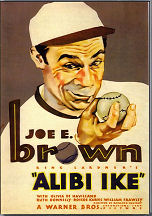
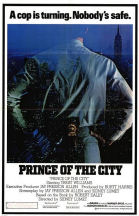
Steven Soderbergh‘s The Informant! — an entertaining enough LQTM dramedy with a jaunty Marvin Hamlisch score and a knockout lead performance by Matt Damon — is, in my mind, a Midwestern gene-splicing of Joe E. Brown‘s Alibi Ike (1935) and Sidney Lumet‘s Prince of the City (1982). Soderbergh’s film is basically about pathological lying, and Ike was a Chicago Cubs baseball movie about a guy who couldn’t help telling one whopper after another. Mix that in with the Prince of the City ethos (i.e., nothing can be hidden) and there it is.
Henry Gibson‘s finest acting moment in his entire career is viewable at the 1:43 mark in this Long Goodbye trailer. He died Monday at age 73.
My favorite Long Goodbye dialogue:
Marty Augustine (Mark Rydell): “When I was in junior high school I was terrified of gym class. Because I never had any pubic hair until I was 15 years old.”
Philip Marlowe (Elliott Gould): “Oh, yeah? You musta looked like one of the three little pigs.”
I caught and very much liked Tom Ford‘s A Single Man this morning. It’s basically about passing through grief and despair and coming out alive on the other side. We’re speaking of a very lulling and haunting thing to settle into. I can’t rouse myself into full-on review mode, but the thoroughly readable feelings in the features of star Colin Firth — longing, grief, numbness, curiosity, contentment — keep the film aloft.
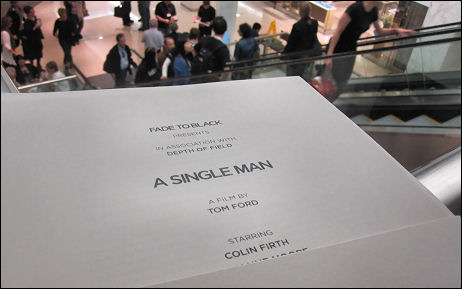
Along with the immaculate visual values, of course. A Single Man reminded me at times of Michelangelo Antonioni‘s Red Desert and La Notte. The conservative gayish vibe will mean box-office issues with hinterland heteros, I suppose (i.e., support hose), but it’s so exquisitely composed and refined and well-written, etc. A huge hit with urban gay audiences, but film lovers of all persuasions owe it to themselves.
The redband trailer for I Hope They Serve Beer In Hell (opens 9.25), directed by Bob Gosse and written by Tucker Max and Nils Parker, based on Max’s book.
“It does not bespeak great wisdom to call the film The Bad Lieutenant, and I only agreed to make the film after William (Billy) Finkelstein, the screenwriter, who had seen a film of the same name from the early nineties, had given me a solemn oath that this was not a remake at all. But the film industry has its own rationale, which in this case was the speculation of some sort of franchise.
“I have no problem with this. Nevertheless, the pedantic branch of academia, the so called ‘film studies,’ in its attempt to do damage to cinema, will be ecstatic to find a small reference to that earlier film here and there, though it will fail to do the same damage that academia — in the name of literary theory — has done to poetry, which it has pushed to the brink of extinction.
“Cinema, so far, is more robust. I call upon the theoreticians of cinema to go after this one. Go for it, losers.” — an excerpt of Werner Herzog‘s statement in the Bad Lieutenant press notes, as passed along by The Wrap‘s Eric Kohn.