Coyle On The Shelf

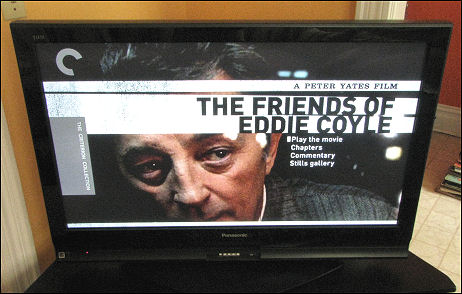
I picked up the Criterion DVD of The Friends of Eddie Coyle yesterday. There’s a little booklet inside that contains a reprint of a superb Rolling Stone set-visit piece by Grover Lewis (a great journalist who died in ’95 of lung cancer) called “The Last Celluloid Desperado.” It also contains an eloquent essay by Kent Jones , the recently resigned Film Society of Lincoln Center director/programmer, called “They Were Expendable.”

In a discussion of Coyle costars Robert Mitchum, Peter Boyle, Richard Jordan Alex Rocco and Stephen Keats, Jones writes that “these actors, then in their prime, now signify a lost era. Many are dead — Mitchum in ’97, Boyle after a brilliant and successful career, the Harvard-educated Jordan far too early from a brain tumor, Keats by suicide before he turned 50. All of them worked hard on their craft and put flesh and muscle on an entire era’s worth of movies. With the notable exception of Boyle, few ever found roles as good as the ones they played in The Friends of Eddie Coyle.”

Here’s the closing paragraph in Jones’ essay:

And here’s a portion of the commentary by director Peter Yates that gives credit to former Paramount executive (and current Variety guy) Peter Bart for turning Yates on to the George V.Higgins‘ book and suggesting that a film be made of it.

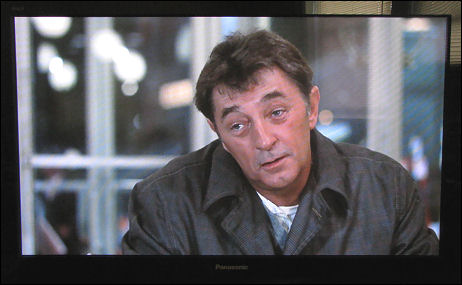
And here’s some noisy dialogue that I’ve always loved, spoken by Keats.

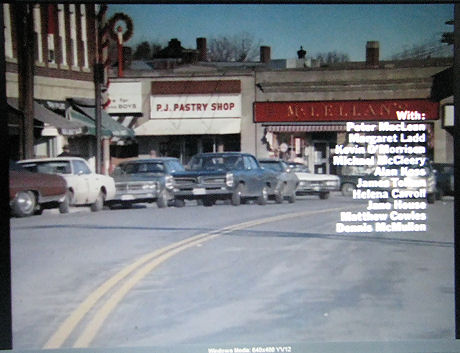
The aspect ratio of Criterion’s Coyle is, of course, 1.85 to 1 or 16 x 9. It looks fine but was shot, of course, in Academy full frame (1.33 or 1.37 to 1) version. I have a full-frame version of Coyle sitting on my backup hard drive, and I have to say that I prefer this shape to the Criterion crop. I always prefer taller, boxier frames. The full-frame version of Dr. Strangelove , for example, is a more purely Kubrickian version than the 1.85 crop version.


Early scene from the 16 x9 Criterion Coyle

The boxier full-frame version of Coyle that’s sitting on my backup hard drive.

Odd Affinity

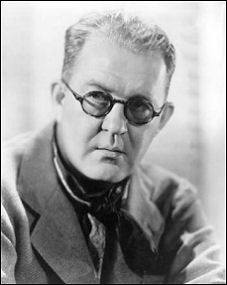
At some point in Douglas Brinkley‘s “Bob Dylan’s America,” a Rolling Stone cover story keyed to Dylan’s new album “Together Through Life,” is a passage about director John Ford. And I have to be honest and say that it bothers me somewhat.


cover of current Rolling Stone; director John Ford.

“At heart Dylan is an old-fashioned moralist like Shane, who believes in the basic lessons taught by McGuffey’s Readers and the power of a six-shooter. A cowboy-movie aficionado, Dylan considers director John Ford a great American artist. ‘I like his old films,’ Dylan says. ‘He was a man’s man, and he thought that way. He never had his guard down. Put courage and bravery, redemption and a peculiar mix of agony and ecstasy on the screen in a brilliant dramatic manner. [And] his movies were easy to understand.

“I like that period of time in American films. I think America has produced the greatest films ever. No other country has come close. The great movies that came out of America in the studio system, which a lot of people say is the slavery system, were heroic and visionary, and inspired people in a way that no other country has ever done. If film is the ultimate art form, then you’ll need to look no further than those films. Art has the ability to transform people’s lives, and they did just that.'”

Yes, of course — the director of The Grapes of Wrath, The Informer, How Green Was My Valley, She Wore a Yellow Ribbon, The Horse Soldiers, Drums Along the Mohawk and The Man Who Shot Liberty Valance was a superb visual composer and one of Hollywood’s most economical story-tellers bar none. His films were always layered and ripe with sub-currents that never flowed in one simple direction. His films always seemed fairly obvious and sentimental…at first. Then you’d watch them again and reconsider, and they always seemed to be about a lot more.

Except being a man’s man only goes so far. And I’m disturbed by Dylan being either oblivious to or deliberately overlooking the John Ford downside. The occasional staginess and jacked-up sentiment in just about every one of his films. The Irish clannishness, the tributes to boozy male camaraderie, the relentless balladeering over the opening credits of 90% of his films, the old-school chauvinism, the covert racism, the thinly sketched women, the “gallery of supporting players bristling with tedious eccentricity” (as critic David Thomson put it in his Biographical Dictionary of Film), and so on.

How could the guy who wrote “the ghost of electricity howls in the bones of her face” not at least acknowledge the conflict between the majestic Ford and the whorish Irish sentimentalist? It’s depressing to consider a man who “once held mountains in the palm of [his] hand” being content to rely upon a distillation of a classic frontier ethos as the bedrock of his philosophy. I realize Dylan is a big Barack Obama fan, but it bothers me to think of him as a bit of a cultural conservative. Because Shane isn’t about old-fashioned morality, dammit. It’s nominally about a heroic, stand-up figure in buckskin, yes, but it’s really about a man grappling with — resisting — his basic nature only to finally give in to it at the end.

Perfect Casting

A guy who tends to hear reliable things read this morning’s Lone Ranger item and said that “per studio desire, the leading candidate for The Lone Ranger is Matthew McConaughey. The initial choice was Christian Bale, but there’s worry about his spearheading too many franchises so they’re waiting to see how McG’s Terminator film does. He’s carrying a certain prick status at the moment due to his still reverberating rant.”

Doyle Von Trier

I’m fine with the design of these T-shirts by Matthew Morettini, but it’s not the design as much as the style of the T-shirt (i.e., European short sleeves, none of that blowsy Hanes shit) and of course the density of the fibre. My favorite movie-related T-shirt is the Von Trier one that I bought at L.A.’s Cinefile last fall.


CU of one of Morretini’s T-shirts; Cinefile Von Trier shirt, which is my favorite right now, partly because of the high thread-count and partly for the lettering. What I’d like right now is a Michelangelo Antonioni T-shirt. Or a Don Siegel one.

Cliffhanger Tyranny

Has anyone ever commented on the absolute Hollywood mandate regarding cliffhanger scenes in action films? The mandate basically states that (a) whatever tight situation the hero may be in, he/she will never get out of it until the last fraction of a second; and (b) the cutting of this sequence will never give the slightest indication that any escape, remedy or solution is possible. Until it happens out of the blue, of course.


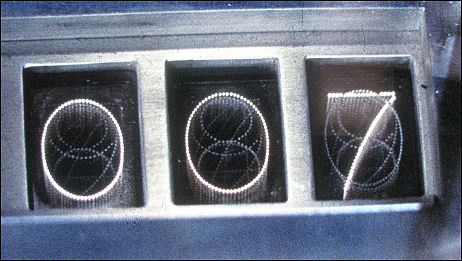
Insert shot of timer just after an atomic device has been defused in Goldfinger.

This mandate is absolutely stifling in terms of excitement and suspense because we always know it will be enforced in each and every thriller or actioner. Tight situations will never be defused with five or seven or twelve seconds to go. The result, obviously, is that the resolution of cliffhangers have become 100% predictable. And nobody ever complains about this. Except me right now.

Think of Sean Connery trying to defuse that atomic device inside Fort Knox in the final minutes of Goldlfinger. By the terms of today’s cliffhanger mandate it was almost revolutionary in that the bomb was disarmed with seven seconds to go before explosion. This would never happen today.

Nevermore

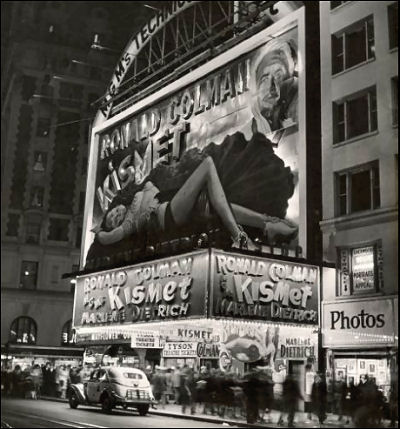
Along with the almost-complete disappearance of palace-sized movie theatres with balconies over the last 30 years is the abandonment of super-sized, building-mounted promotional art. We still have the huge billboard posters along L.A.’s Sunset Strip and along 42nd Street between Eighth Avenue and Times Square, but it’s really a shame that today’s moviegoers will never know the visceral thrill of standing before flamboyantly large movie promotions attached to big marquees (or building walls above marquees) that were common in Times Square until the mid ’60s. They had a real Collossus of Rhodes-type aura. What’s life without a little grandeur?


Wall art for the 1943 Kismet atop the Astor in Times Square.

Fine Old Roddenberry Seed

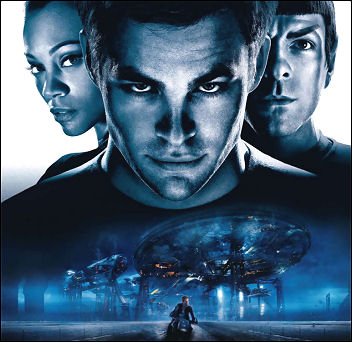
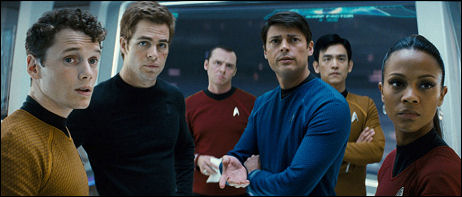
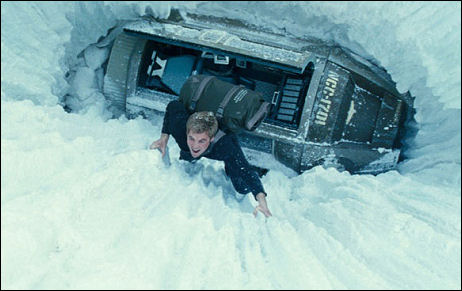
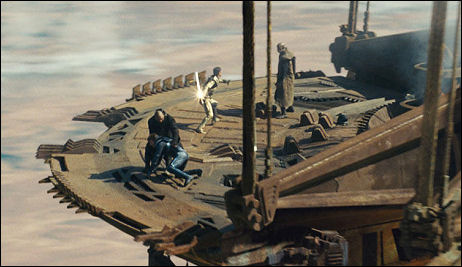
JJ AbramsStar Trek (Paramount, 5.8) is a lot of things, and all to the commercial good. I wasn’t moved to the depths of my soul, but it’s not supposed to make you want to hug your children or find God or cry. It’s supposed to engage and arouse in a half-spiritual, half-popcorn sense, and provide a sense of familial warmth. And avoid being too labored or ponderous. It’s supposed to just zip along and keep the ball in the air while fortifying that good old positivist Trek attitude. And that it does.

I went to last night’s all-media expecting to smile now and then and shrug my shoulders and say “whatever.” I’ve never been a big Trekkie type. But I came out feeling surprised and moderately pleased. I expected to be somewhat irritated by it, and this didn’t happen. I was nodding to the Paramount publicist after it was over. “Not bad, not bad at all,” I told her.

Star Trek is an efficiently made, intellectually game and tightly constructed movie-movie that’s closer to the spirit and intellectual vistas of the original mid ’60s Gene Roddenberry TV series than any of the feature film versions.

If you’re a serious Trek-hound this should be heartening news. The original show was about facing issues, exotic realms, positivism, intellectual engagement, echoes of social concerns and various matters of heart and spirit. Abrams’ Star Trek is largely an origin story so there’s no time or inclination to get into trippy-ass material, but I could easily imagine this new crew — Chris Pine‘s James Kirk, Zachary Quinto‘s Spock, Karl Urban‘s “Bones” McCoy, Zoe Zaldana‘s Uhura, Simon Pegg‘s Scotty, John Cho‘s Sulu and Anton Yelchin‘s Chekhov — grappling with some intellectually propelled, philosophically profound plots and themes in future outings.

With economy, scope and moxie, I mean, which is certainly what Abrams delivers here.

In fact — and I don’t want to say this in the wrong way — Abrams’ Star Trek is a bit like a super-expensive, hyper-cranked, widescreen pilot for a new Trek series that just happens to be playing in theatres. I’m just saying it is what it is. Abrams would be the last guy, I imagine, to say it’s in the realm of 2001: A Space Odyssey, and that’s cool by me. I imagine it’ll be cool with everyone. Star Trek doesn’t have a high-falutin’ sense of itself, but it doesn’t go the lowball route either.

Pine is certainly a younger, cockier and more brazen incarnation of Cpt. Kirk, but at the end of the day he shows balls and conviction and steadiness under fire — the essential qualities of any leader. I was a little put off at first by his surfer-dude, motorcycle-mechanic, Luke Skywalker by way of a Southern Californian stud-lifeguard mentality, but at least he’s his own guy. There’s very little Shatner or Jeffrey Hunter in him.

Quinto is a superb Spock — focused, steely, unflappable. (And with a spiritual/ romantic/sexual component this time!) And Urban — my third favorite character — is a sharply drawn, aggressive, compassionate fellow to have on your team. He’s no stooge.

I felt after seeing early footage last December that Yelchin could’ve toned down the Russian accent but I got used to it after a while. Pegg’s Scotty is amusing in a sort of loudmouth-Brit way. The attractive Zaldana does a fine job of inhabiting a secondary character who happens to look great in underwear.

My all-time favorite Trek film is still Galaxy Quest, which made me feel the current in a way that none of the William Shatner-Leonard Nimoy movies did. (I don’t care if it was a spoof — it got what the whole Trek culture is about.) But Abrams’ version runs a close second.

Star Trek pissed me off only three or four times, and trust me, that’s almost a kind of compliment. It can’t be be easy to assemble a nifty sci-fi adventure flick and make it all hum like a single organism, and this has certainly been done by director Abrams and screenwriters Roberto Orci and Alex Kurtzman.

I’ll list my three or four complaints in a subsequent piece. There’s plenty of time. I can’t sit here and write this thing indefinitely.

All right, I have time for one beef. I didn’t much care for Eric Bana‘s Cpt. Nero, who seems to have been told to scowl or at least look really pissed off in each and every scene. Villains don’t see themselves as villains when they look in the bathroom mirror. They see themselves as guys doing what they have to do in order to protect their own and/or exact vengeance from their enemies. They see themselves, in other words, as good guys forced to respond to special circumstances.

My misfortune was sitting next to a guy who laughed and went “whoo-hoo!” at almost everything that happened. I glared at him three or four times and then gave up. He thought it was hilarious when Pine bumped his head on the ceiling of a galactic transport. And I hated the spazzy sound of his laughter — “Hee-hee-hee-hee-hee!” I despise people who over-react to films, who show any level of disproportionate enthusiasm. I should have just moved. The guy had a 1959 flat-top haircut with whitewalls on the side. That was a tip-off right there.

Flirting With Farce

Dark HorizonsGarth Franklin is reporting that British director Mike Newell, 69 years old and looking to stay in the groove, has decided to hold his nose and take a paycheck for directing Jerry Bruckehimer‘s The Lone Ranger, which will star Johnny Depp as Tonto. No one’s signed for the title role, but this project has sounded like a feature-length SNL skit since it was first reported about by Collider‘s Steve Weintrab on 5.24.07. It certainly seems to represent a career low for Newell.

Newell has never been Neil Jordan or Mike Leigh, but in the ’80s and ’90s he showed an occasional facility for dramas and comedies with provocative social themes — Dance With a Stranger (’85), Pushing Tin (’99), Donnie Brasco (’97), An Awfully Big Adventure (’95), Four Weddings and a Funeral (’94), Into the West (’92). He seemed to drift into a glossier, helium-filled realm in the 21st Century with Mona Lisa Smile (’03) and Harry Potter and the Goblet of Fire (’05), and then came the disappointing Love in the Time of Cholera (’07).

The fact that the screenplay is by Terry Rossio and Ted Elliot, a pair of opportunistic Bruckheimer-stable whores who’ve written the scripts for the Pirates of the Caribbean films, The Mask of Zorro and Roland Emmerich’s Godzilla tells you everything you need to know about where The Lone Ranger will be coming from.

Depp’s willingness to play Tonto has indicated from the start that the film is going to be a jape of some kind. How could his performance not be satiric-ironic-moronic?

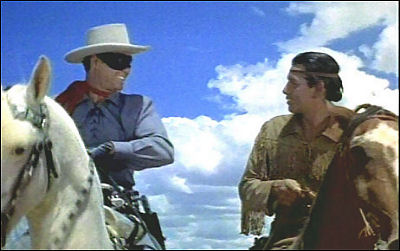
I wrote a year or so ago that The Lone Ranger “is an obvious non-starter for the simple fact that westerns haven’t mattered for decades. Open Range showed that one could make a good solid western that stood on its own two feet, but the genre lost its cultural vitality back in the ’60s. Boomers have a sentimental thing for the classic TV series with Clayton Moore and Jay Silverheels (‘What you mean, we?’), but GenXers and GenYers, I would think, are completely uninvested. It just boils down to being a title that has a certain marketability because it sounds vaguely familiar in the dead-head sense of that term.

The other thing I wrote is that if Bruckheimer is really and truly married to the idea of reviving a 1950s-era western, he should remake Shane. Now that I’d pay to see in a New York minute.

H1N1 + Box-Office

My ex has two tickets to see Impressionism, the critically-derided Jeremy Irons/Joan Allen play, tonight. And she just told me an hour ago that a friend is thinking about not going over fears of exposure to the H1N1 virus. We’re obviously talking about a timid person going overboard with caution and perhaps a little hysteria, but she’s probably a blade of grass signfiying the feelings of millions of over-40 types out there.

Younger people won’t be deterred from going to Wolverine this weekend, but my ex has persuaded me that a certain percentage of older viewers and particularly older women (10% to 15%?) might decide against going this weekend. This could marginally cut into the business for Ghosts of Girlfriends Past, the romantic comedy that will be depending on the support of over-30 females. I’d be lying if I said this wouldn’t provide a measure of satisfaction as it would reflect to some degree on the drawing power of Matthew “Satan Incarnate” McConaughey.

Tribeca Jury Winners

Founders Award for Best Narrative Feature: About Elly, directed and written by Asghar Farhadi; Best Documentary Feature: Racing Dreams directed by Marshall Curry; Special Jury Mention: Defamation, directed by Yoav Shamir; Best New Narrative Filmmaker: North, directed by Rune Denstad Langlo, written by Erlend Loe; Best New Documentary Filmmaker: Ian Olds, director of Fixer: The Taking of Ajmal Naqshbandi; Best Actor in a Narrative Feature Film: Ciaran Hinds in The Eclipse; Best Actress in a Narrative Feature Film: Zoe Kazan in The Exploding Girl, directed and written by Bradley Rust Gray.

If You’re Stuck…

A friend has written with a last-minute offer of a shared apartment in Cannes during the festival. It’s a two-bedroom place, open from May 10th to 24th, in Pointe Croisette, on the east side of the Croisette — about a 15-minute walk along the beach to the Palais. He’s asking $1750 (or half of what he’s paying) for a room with a king-sized bed that can be split into 2 singles. And he can send pics. I’m the go-between.

Kudos to Chuck

When all was said and done and the NRA aside, Charlton Heston was always a talented, confident and resourceful actor. He always brought it home; knew how to sell it. The non-verbal conviction be brought to this scene from The Big Country — those looks of intense resentment and lingering loyalty for his boss, played by the blustery Charles Bickford — are what make it work. They’re the emotional bedrock.