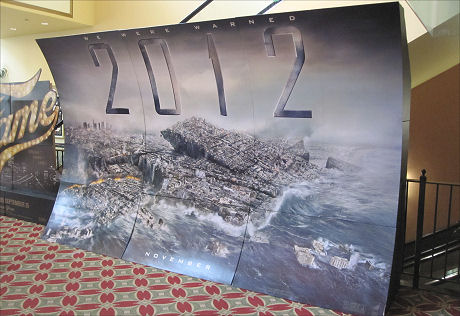
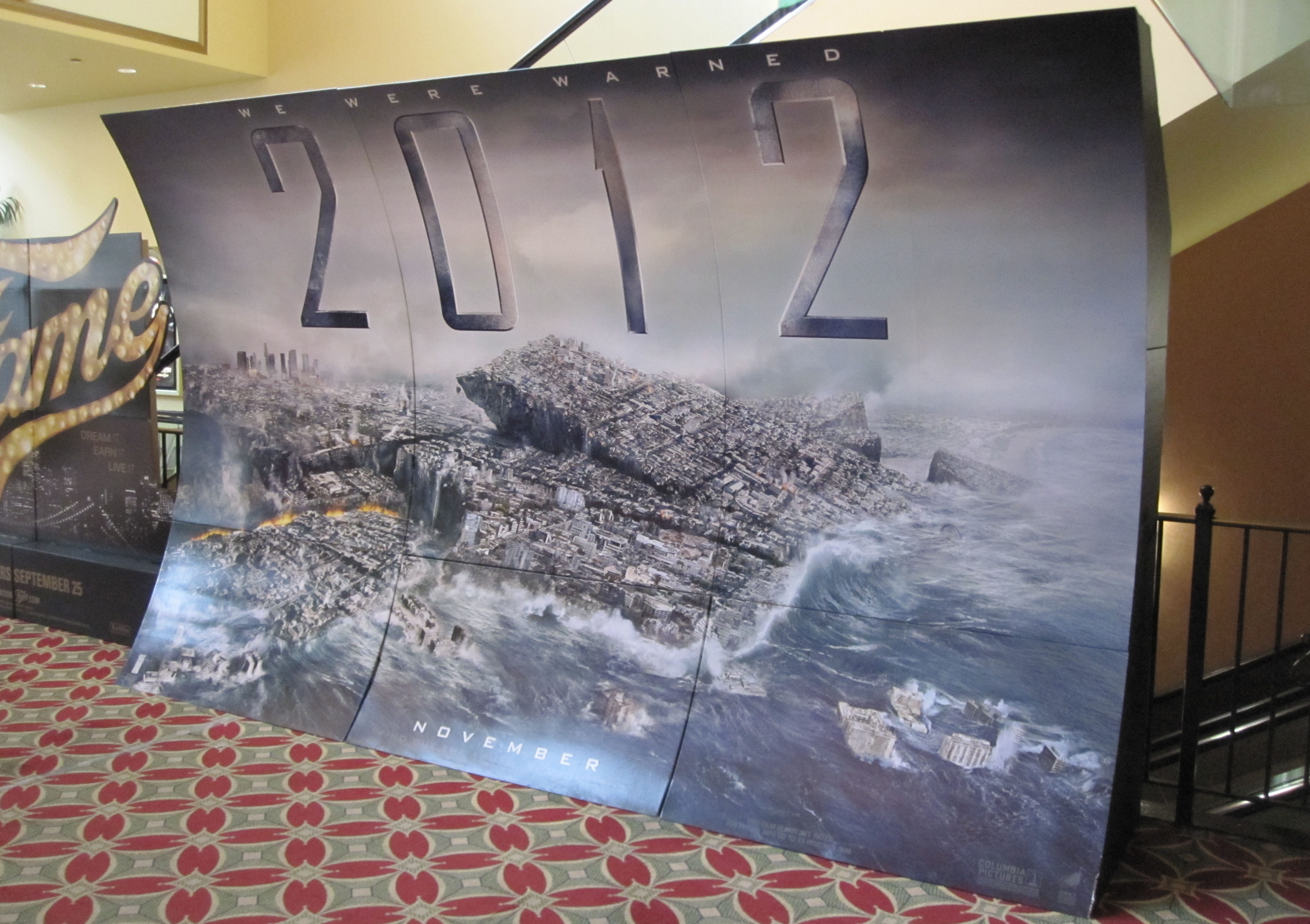
2012 standee in 2nd floor lobby at AMC 34th Street — Thursday, 7.2.09, 9:05 pm. A depiction of Los Angeles getting walloped by what looks like a combination massive earthquake (with huge rectangular chunks of the city uprooted like a buckled sidewalk) and ocean flooding in the style of When Worlds Collide.
A lot of man-boobs in this thing, which is always cause for concern if you share my psychology. Otherwise Couples Retreat (Universal, 10.9) feels like a possible return to Wedding Crashers-level humor for Vince Vaughn. The downside is that it also feels a bit like the Hawaiian resort section of Forgetting Sarah Marshall, partly, I suppose, because Kristen Bell costars. Other topliners: Jon Favreau, Malin Akerman, Ken Jeong, Jason Bateman, Jean Reno, Kristin Davis, John Michael Higgins.
Like everyone else and fool that I am, I thought it might be nice to go somewhere for a night or two over the July 4th weekend. I first thought about Long Beach Island, but every motel owner I spoke to insisted on a three-night minimum. I finally found a nice-looking place called the Drifting Sands that was willing to rent for just Friday night — great. Except they wanted $325.00 for a simple beach-facing room with a TV and a king-sized bed and a cot. That turned me off. If there was a big drought these guys would charge $20 for a gallon of water.
So I forgot about LBI and found a nice little inn in Walton, NY, where my father used to have a cabin on the river (which he bought from Mork & Mindy‘s Pam Dawber). The Walton Inn only charged $75 bills. A little less than a two-hour drive. Leaving tomorrow morning. Stay just one night, I’m thinking, and maybe stop by the Bethel Arts Center, which I didn’t visit during my previous visit to the original Woodstock festival site, on the way back. And then back in Manhattan in time for the fireworks over the Hudson on Saturday night.
This rehearsal video, released a couple of hours ago, obviously shows that MJ was active and energetic 48 hours before the wrong dosage of the wrong drug sent him on his way. It also suggests there was something vaguely Heather Ledger/Jokerish about his facial appearance. I’m looking for a pure embed code without all that CNN copy stuck to the bottom — ugly.
I’ve never seen Erick Zonca‘s Julia, a dysfunctional melodrama with what’s said to be a tour-de-force performance from Tilda Swinton, in part because I was invited to exactly one screening — a lah-lah thing at the Tribeca Grand on 4.30 — that I couldn’t attend. It opened on May 8th in NY and LA and now it’s gone from sight. Except Roger Ebertreviewed it yesterday.
I just called to see if there’s a screener I can look at over the weekend, got a voice mail
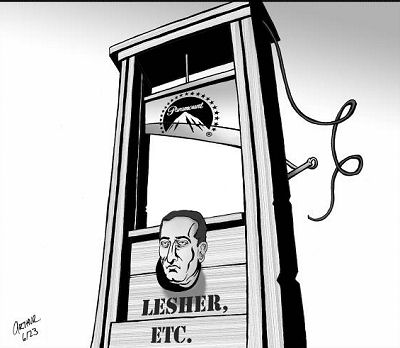
The news about the firing of former Paramount Film Group chief John Lesher broke on the afternoon of Friday, 6.19. Four days later Arthur-the-Deadline Hollywood Daily-cartoonist completed a cartoon that depicted Lesher’s fate. Nine days later or 13 days after the whacking — yesterday, in other words — the cartoon appeared on DHD. Worse, it used a future-tense caption — “There Will Be Blood.” Obviously if it had run a day or two before the Lesher firing….whatever. But it’s decently done.
“I wanted the audience in the period, in 1933, standing right next to John Dillinger. I wanted them to feel like they’re right there, like it’s really happening. I’m mainly interested in extreme conflict, in men who find themselves in extreme circumstances and really threatened to the point of annihilation. [At the end of the film] Dillinger is alone, the last man standing. How is he supposed to think about what he’ll do next? How is he to think about how his life has happened? That to me is what the film is…about character and ferocity and determination.” — Public Enemies director Michael Mann speaking during a video interview with some guy from the Guardian. Either Jason Solomons or Laurence Topham.
It’s fairly obvious where Joe Stillman‘s Planet 51 (Sony, 11.20) is coming from. Aimed at not-very-hip suburban families. A fish-out-of-water reverse-alien sitcom. Done in classic Pixar style. The voice actors are Dwayne Johnson (as Capt. Chuck Baker), Seann William Scott, Jessica Biel, Justin Long, Gary Oldman and John Cleese.
The snivelling contempt that World War II-generation news writers felt for rock music icons like Jimi Hendrix (“It’s not known if he saved his money…”) back in the late ’60s and early ’70s is fairly apparent in this clip. What a wee man Frank Reynolds seems to have been. (Thanks to HE reader Travis Crabtree.)
There are several indications on the tube that tens of millions of lower-middle-class Americans — that plague-culture of coarse, under-educated, fast-food-eating, mall-meandering, Transformers-loving fat asses — are experiencing some kind of profound emotional catharsis over the death of Michael Jackson.
The tipoff for me came last weekend when the folks who live upstairs, the fabled “Hispanic party elephants” who’ve earned their rep and then some by playing loud Latino dance music at all hours and then dancing to it like pachyderm storm troopers, began playing Thriller over and over. That’s when I knew that Jackson Death Mania had spread over-under-sideways-down
Why is Jackson’s legend and memory so big with so many? It’s not just because they loved Jackson’s sugar-pop music but, I suspect (and correct me if I’m wrong) because he lived in a manner that they themselves would love to savor — a kind of whimsically perverted, high-denial, candy-cane existence in which all malignancies are ignored or suppressed in order to satisfy each and every fantasy-dream whim, without compromise or hesitation.
This is why we’re truly doomed — why the country will never do what’s necessary to face much less avert whatever greenhouse-gas, ice-cap-melting apocalypse is coming our way. A nation that worships a monster like Michael Jackson is a nation of undisciplined “I want!”-ers and high-lifestyle drunkards. I don’t want to sound harsh but they’re the kind of manifestations that God wanted to get rid of when he got in touch with Noah. I can hear Morgan Freeman saying to Steve Carell right now, “Things are rancid out there — look at Jermaine Jackson on MSNBC! Look at Joe Jackson! — so I need you to build me a huge ark.”
Jackson lived an absurdly lavish, grossly indulgent lifestyle marked by constant escapes from everything and anything that didn’t feed or support his neurosis — plastic surgeries, all manner of prescription drugs, self-loathing behavior, twisted and predatory sexuality, absurdly reckless spending, and across-the-board Peter Pan values. He was the ultimate fantasy-tripping Frankenstein beast, and now there’s a nation of people out there who are reacting to his death as an excuse to celebrate not just his music but all aspects of the disease.
This tearful, feel-his-pain piece by MCN’s Kim Voynar is nothing short of disgusting. “I never found jokes about Jackson’s life funny while he was alive, and I find them even less funny in the wake of his death. This was a man who’d been used, abused and manipulated from the time he was just a little boy, chewed up and spit out for most of his adult life by the tabloid press, and it baffles me that anyone could find humor in the tragedy of his life and death.” Oh, by all means — let’s all cherish the memory of a ridiculously wealthy man who used the excuse of an abusive childhood to justify the most malignant famous-person behavior in history.
Assemble the ghosts of Abraham Lincoln, John Reed, Isadora Duncan, F. Scott Fitzgerald, Thomas Alva Edison, James Dean, Bix Biederbeck, Cary Grant, Chet Baker, Michelangelo Antonioni, Edgar Allan Poe, Jimi Hendrix, Lillian Hellman, Federico Fellini, Leland Hayward, Jack Paar, Che Guevara, Django Rinehart, Tallulah Bankhead, Andrew Wyeth, Buddy Holly, Ernest Hemingway, Amelia Earhart, Louise Bryant and Eugene O’Neil, and sit them down before a high-def LCD screen and show them how the news channels are all spraying shorts over the Jackson frenzy, and they’d all be weeping on their knees in a matter of minutes.
The public funeral for Jackson at LA’s Staples Center on Tuesday July 7th is going to be a huge Diane Arbus event, like nothing ever seen or imagined. A Multitude of Grotesques. If I could afford it I would fly the hell out of the country that day, just for the statement value.
In short, a social convulsion of this sort is embarassing and sickening. I don’t live in Michael Jackson nation — millions don’t — but there are so many other millions who are sipping the Kool-Aid right now that it seems as if the whole country has gone nuts. Because the media is paying so much attention to this middle- and lower-middle class movement, because they know that’s where the sales and ratings and page views are.
The thrust of this Kim Masters/Daily Beasthit piece (“The Knives Are Out for Michael Mann“) is that if and when Public Enemiestanks with Mr. and Mrs. Joe Schmoe and their kids over the July 4th holiday then it’s curtains for Mann in terms of getting any kind of heavy funding for his next film.
Haven’t I already figured this out? Mr. and Mrs. Joe Schmoe and their kids will not be all that happy with Public Enemies — let’s face it. It’s not a mojo burger, pickles and potato chip type of film and it never will be.
I heard today from an older North Carolina couple. Not very sixpacky in their taste and attitudes (the husand is former Manhattan-based entertainment reporter Lewis Beale), but they went to the film today and here’s what they thought. “The Beales saw it today, and loved it,” Lewis wrote. “We agree that it’s an art film, which is why it’s really problematic at the b.o. But languid, elegaic and beautifully shot. Depp and Cotillard are great. Stirring social-political subtext (lone entrepreneur up against big business and big government). A major work.”
Masters also reports that Johnny Depp decided not to talk to Mann at some time during filming — big deal.
“I think the idea of going to conservative Republicans, who are essentially representing the insurance companies and the drug companies, and watering down this bill substantially, rather than demanding we get 60 votes to stop the filibuster….I think that is a very wrong political strategy.” — Sen. Bernie Sanders (I-Vermont), quoted in 7.1 Huffington Post story about health care strategy.